

Back translation, also called reverse translation or backward translation, is the process of translating a document back into its original language using an independent translator who has not seen the source text. The result is compared against the original to surface meaning shifts, omissions, or terminology drift introduced during the forward translation. For high-stakes work – clinical trial documentation, validated survey instruments, informed-consent forms, and regulatory submissions – back translation is a recommended quality gate. For creative marketing copy or low-risk UI strings, it usually adds cost without proportional benefit.
WHO guidance and Brislin’s foundational 1970 methodology both treat back translation as a core procedure for demonstrating cross-language equivalence. Veridata Insights handles the full execution chain: forward translation, blind back-translation, reconciliation, and documentation for academic or regulatory use.
Key Takeaways
Back translation is a necessary but not sufficient QA step: it confirms surface equivalence, not construct equivalence, and must be paired with expert review and cognitive debriefing for validated instruments.
| Point | Details |
|---|---|
| When to use it | Apply back translation to clinical documents, validated instruments, consent forms, and regulatory submissions; skip it for creative or low-risk content. |
| Blinding is non-negotiable | The back-translator must never see the original source text; confirm this in writing and use a separate vendor. |
| Document everything | Log every discrepancy, every reconciliation decision, and every sign-off; this record is your audit trail for publication or regulatory review. |
| Pair with other methods | Combine back translation with expert committee review and cognitive debriefing to check conceptual equivalence, not just surface accuracy. |
| Veridata Insights | Veridata Insights manages the full back-translation and validation workflow, including bilingual recruitment, reconciliation documentation, and regulatory-ready reporting. |
Table of Contents
- What is back translation and where did it come from?
- How do you run a back-translation process step by step?
- When should you use back translation, and when should you skip it?
- What does back translation catch, and what does it miss?
- How does back translation compare to other validation methods?
- What does a practical SOP and reporting checklist look like?
- What does the research literature say about back translation’s limits?
- What are the most common back-translation mistakes and how do you fix them?
- What is the right role for back translation in your QA strategy?
- Veridata Insights handles the full back-translation workflow for you
- Sources
What is back translation and where did it come from?
Back translation entered the research lexicon through Richard W. Brislin’s 1970 paper, which proposed it as a method for demonstrating functional equivalence across languages in cross-cultural research. The core logic is simple: if a translation captures the original meaning faithfully, translating it back should produce something close to the source. Divergence signals a problem.
You’ll see the method called reverse translation, backward translation, or simply back-translation depending on the publication. These terms refer to the same procedure.
One distinction matters practically. Literal back-translation reproduces the surface wording of the intermediate text as closely as possible, which is useful for spotting exact-word drift. Conceptual equivalence, by contrast, asks whether the underlying idea survives the round trip intact. A sentence can back-translate cleanly at the word level while still carrying a culturally loaded meaning the target audience will interpret differently. Brislin’s framework addresses both, and that dual focus is what makes his criteria still relevant more than five decades later.
How do you run a back-translation process step by step?
The five-step workflow used across regulated industries follows a consistent pattern. Here it is with roles attached.
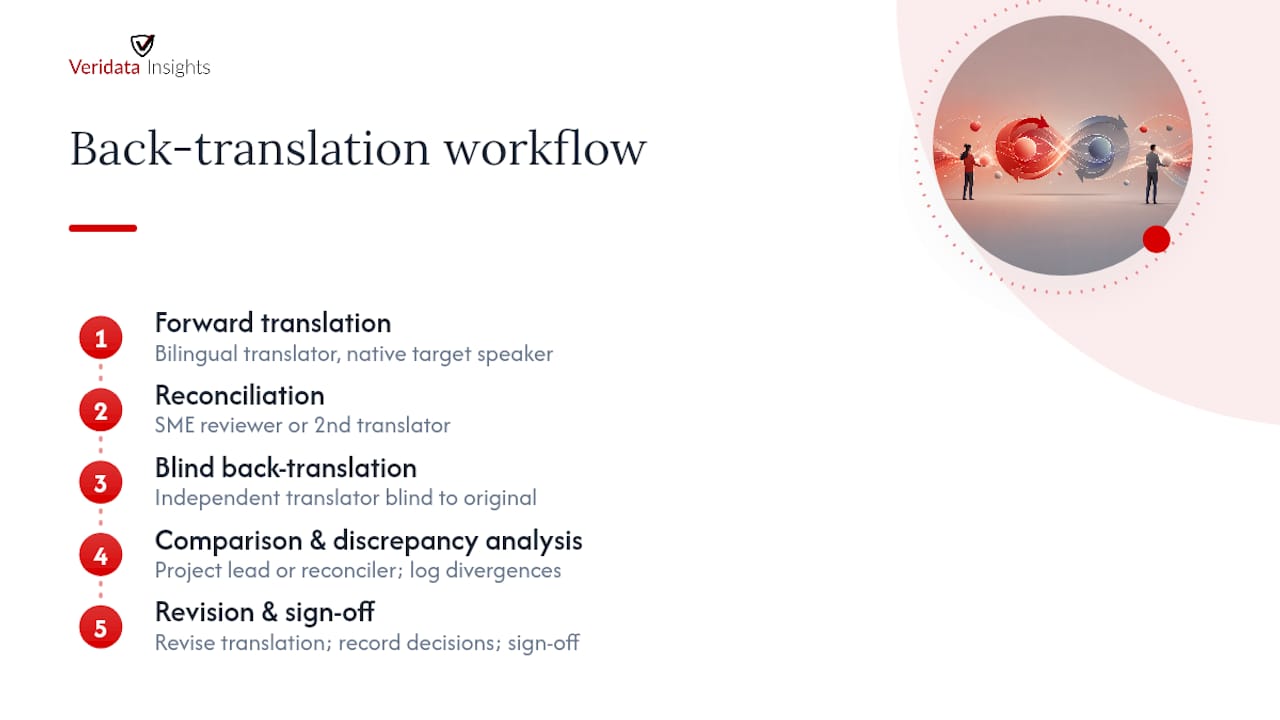
Step 1: Forward translation. A bilingual translator fluent in the target language produces the initial translated document. This person should be a native speaker of the target language and familiar with the subject matter.
Step 2: Reconciliation of the forward translation. A subject-matter reviewer or a second bilingual translator reviews the forward translation for accuracy, terminology consistency, and cultural appropriateness. Any issues are resolved before moving forward.
Step 3: Blind back-translation. A second, independent translator, who has NOT seen the original source document, translates the reconciled forward translation back into the source language. Keeping this translator blind to the original is the single most important procedural control in the entire process.
Step 4: Comparison and discrepancy analysis. The project lead or a reconciler places the original source text and the back-translated text side by side. Every divergence is logged with a severity rating: minor wording variation, substantive meaning shift, or factual error.
Step 5: Revision and sign-off. The forward translation is revised to address confirmed discrepancies. A documentation owner records the reconciliation decisions, and all parties sign off. For regulated projects, this sign-off becomes part of the audit trail.
Roles and responsibilities
- Forward translator: native speaker of the target language, subject-matter familiarity required
- Back-translator: native speaker of the source language, must not have access to the original
- Reconciler: bilingual reviewer who adjudicates discrepancies between source and back-translated text
- Subject-matter reviewer: domain expert (e.g., clinician, psychometrician) who validates conceptual accuracy
- Documentation owner: responsible for maintaining version logs, reconciliation notes, and sign-off records
A short worked example
Consider a survey item about emotional distress. The source English reads: “I feel overwhelmed by small problems.”
After forward translation into Spanish, the reconciled text reads: “Me siento abrumado por problemas pequeños.”
The blind back-translation returns: “I feel crushed by minor difficulties.”
The discrepancy: “overwhelmed” became “crushed,” and “small problems” became “minor difficulties.” Neither shift is catastrophic, but “crushed” carries a more severe emotional weight than “overwhelmed.” In a validated scale measuring anxiety severity, that drift matters. The reconciler flags it, the forward translator revises to a closer equivalent, and the cycle repeats until the back-translation aligns.
Pro Tip: When briefing your back-translator, give explicit instructions: translate naturally into the source language as if writing for a native reader, not word-for-word. A back-translator who tries to mirror the intermediate text’s syntax will produce an artificially clean result that masks real conceptual gaps. Separate the back-translator from the forward translator by using a different vendor or department whenever possible.
When should you use back translation, and when should you skip it?
Back translation earns its cost in specific contexts. Clinical trial documentation guidance and WHO protocols both identify informed-consent forms, patient-reported outcome instruments, and safety communications as the clearest cases for mandatory back-translation.
Core use cases
- Clinical trial documents: informed-consent forms, protocol summaries, adverse-event reporting forms
- Validated survey instruments: psychometric scales, quality-of-life measures, diagnostic screeners
- Regulatory submissions: labeling, instructions for use, safety data sheets
- High-stakes safety text: warnings, dosing instructions, contraindication language
- Academic cross-cultural research: any instrument being adapted for use in a new language population
When it’s usually not the right tool
Creative marketing copy depends on cultural resonance, not literal equivalence. A back-translation check on a tagline will almost always show divergence, because good localization should depart from the source. Similarly, high-volume continuous localization of UI strings, app notifications, or low-risk product descriptions rarely justifies the time and cost. The industry consensus is clear: back translation is a targeted tool for high-stakes content, not a universal QA step.
Quick decision checklist
Ask these four questions before committing to back translation:
- Is the document used in a regulated or clinical context? If yes, back translation is likely required.
- Will the translated text be used to make decisions that affect participant safety or data validity? If yes, proceed.
- Is the content a validated instrument that must maintain psychometric equivalence across languages? If yes, back translation is standard practice.
- Is the content creative, high-volume, or low-risk? If yes, consider LQA or expert review instead.
What does back translation catch, and what does it miss?
Back translation is good at specific things and genuinely blind to others. Understanding both sides prevents the most common mistake: treating a clean back-translation as proof that the translation is ready to use.
What it reliably catches
- Terminology drift: a clinical term translated to a colloquial equivalent that changes precision
- Omissions: a phrase or clause dropped entirely during forward translation
- Factual changes: a number, unit, or proper noun altered in the intermediate text
- Structural inversions: a conditional statement reversed in meaning (“you should” becoming “you must not”)
What it commonly misses
- Naturalness and fluency: a translation can back-translate perfectly and still read awkwardly to native speakers
- Cultural fit: idiomatic expressions that are technically accurate but socially inappropriate for the audience
- Tone and register: a formal source rendered in casual target-language phrasing won’t show up as a discrepancy
- In-context meaning: a word that is correct in isolation but wrong in the sentence’s pragmatic context
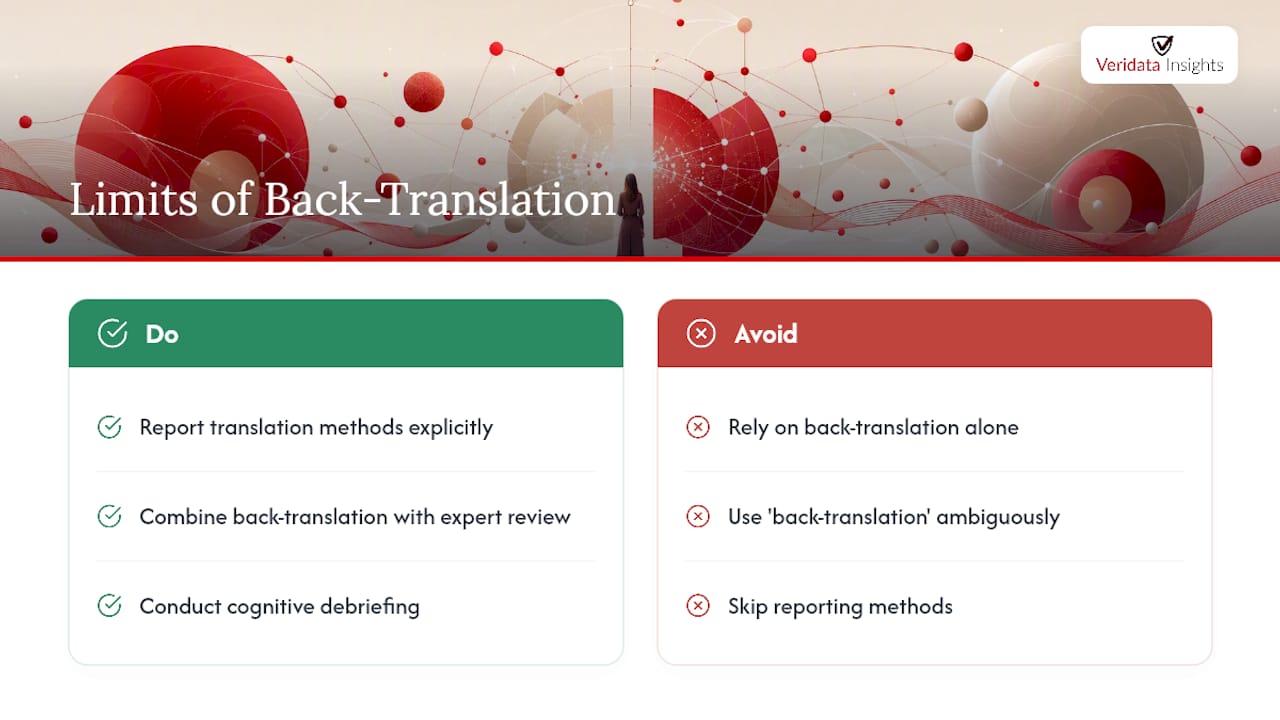
A back-translation that looks clean is not the same as a translation that works. The method checks surface equivalence. It does not check whether the translated text will be understood, trusted, or acted upon correctly by the people who read it. That check requires cognitive debriefing.
A short illustration: a pain-rating scale item translated from English to Mandarin back-translates as “I experience discomfort in my body.” The original was “I have physical pain.” The back-translation looks acceptable, but “discomfort” is systematically milder than “pain,” and the scale’s scoring norms were built on the stronger term. The back-translation passed; the conceptual equivalence did not.
There is also a risk of false confidence from back-translator error. If the back-translator makes a mistake that happens to produce something close to the original, a real problem in the forward translation goes undetected. This is why back translation is a necessary but not sufficient QA step.
How does back translation compare to other validation methods?
Back translation is one tool in a larger hybrid validation framework. Each method has a distinct job.
Method-by-method overview
- Expert committee review: A panel of bilingual subject-matter experts evaluates the forward translation for conceptual equivalence, cultural appropriateness, and terminology. Excels at catching nuance back translation misses. Slower and more expensive than automated checks, but widely accepted in academic and regulatory contexts.
- Cognitive debriefing: Target-language participants read the translated instrument and explain their understanding of each item in their own words. The only method that directly tests whether real respondents interpret items as intended. Recommended for any validated scale being adapted cross-culturally.
- Linguistic Quality Assessment (LQA): A trained bilingual reviewer scores the translation against a defined error typology (accuracy, fluency, terminology, style). Scalable, structured, and produces quantifiable results. Metrics like Errors Per Thousand (EPT) and Time to Edit (TTE) make quality trends trackable over time.
- Automated checks: Machine-based tools flag terminology inconsistencies, missing segments, formatting errors, and number mismatches at speed. High scalability, low cost per word, but blind to meaning and cultural fit.
Comparison across practical dimensions
| Validation method | Detects conceptual drift | Checks naturalness | Scalability | Regulatory acceptance |
|---|---|---|---|---|
| Back translation | Partial | No | Low | High |
| Expert committee review | Yes | Partial | Low | High |
| Cognitive debriefing | Yes | Yes | Low | High |
| LQA (human) | Partial | Yes | Medium | Medium |
| Automated checks | No | No | High | Low (standalone) |
Recommended method combinations
For clinical or regulated research (informed consent, patient-reported outcomes): back translation + expert committee review + cognitive debriefing. This combination satisfies WHO guidance and most IRB/ethics board expectations.
For academic survey instruments: back translation + expert panel review, with cognitive debriefing on a small pilot sample (typically 5–10 participants per language group is a common starting point in the literature, though specific sample sizes vary by instrument complexity).
For high-volume commercial content: LQA + automated checks, with back translation reserved for safety-critical strings only.
What does a practical SOP and reporting checklist look like?
A reproducible standard operating procedure keeps every team member aligned and gives you the documentation trail you need for publication or regulatory review. Here is a ready-to-adopt framework.
SOP checklist
- Define project scope: identify which documents require back translation, the source and target languages, and the regulatory or publication standard that applies.
- Select translators: forward translator must be a native speaker of the target language with domain expertise; back-translator must be a native speaker of the source language with no access to the original.
- Issue blinding instructions in writing: confirm in the back-translator’s brief that the original source document is not provided and must not be sought.
- Complete forward translation and reconciliation: document all changes made during reconciliation with rationale.
- Conduct blind back-translation: log the back-translator’s credentials and confirm blinding in writing.
- Run discrepancy analysis: log every divergence with severity rating (minor, substantive, critical).
- Revise forward translation: address all substantive and critical discrepancies; document the resolution for each.
- Obtain sign-offs: forward translator, back-translator, reconciler, and subject-matter reviewer each sign the final reconciliation log.
- Archive all versions: retain source, forward translation (all drafts), back-translation, reconciliation log, and sign-off records.
- Conduct cognitive debriefing (for instruments): recruit target-language participants to verify comprehension of the final translated instrument.
Template fields for Methods section reporting
When writing up back-translation in a paper, protocol, or regulatory submission, include:
- Names and qualifications of forward translator(s) and back-translator(s)
- Whether the back-translator was blind to the original source text
- Language of the back-translator’s native fluency
- Number of reconciliation rounds conducted
- A brief description of the reconciliation process and who adjudicated discrepancies
- A sample of reconciliation decisions (at least two or three representative examples)
- Whether cognitive debriefing was conducted and, if so, the sample size and selection criteria
Pro Tip: For cognitive debriefing, recruit participants who match the study’s target population in language proficiency, education level, and cultural background. A convenience sample of bilingual graduate students will not catch the comprehension gaps that matter for a community health survey. Aim for participants who represent the actual respondent profile, and probe each item with open-ended “what does this mean to you?” questions rather than yes/no comprehension checks.
Coordinating translators, reviewers, and documentation owners across a project is itself a workflow challenge. Cross-team collaboration practices that define handoff points and version-control rules reduce errors significantly in multilingual projects.
What does the research literature say about back translation’s limits?
The academic record on back translation is more cautious than its widespread use might suggest.
Brislin’s 1970 framework remains the methodological anchor, but subsequent reviews have documented a persistent gap between how the method is described in textbooks and how it is actually applied in published research. A review of translation practices in Journal of Applied Psychology articles found that back translation is the dominant procedure for translating scales, yet it is frequently underreported and often used without complementary procedures like expert-panel review or cognitive debriefing. The authors recommend explicit reporting standards and combined methods to evaluate conceptual equivalence, not just surface accuracy.
Back translation alone cannot confirm that a translated instrument measures the same construct in the target culture. It confirms that the translation is a plausible rendering of the source text. Construct equivalence requires cognitive debriefing and expert review on top of that foundation.
A concrete failure mode from the literature: a quality-of-life instrument translated for use in a Southeast Asian population back-translated cleanly on all items. Post-publication cognitive debriefing revealed that two items about “independence” were interpreted as referring to political independence rather than personal autonomy. The back-translation had passed; the conceptual equivalence had not. The corrective procedure was a full expert-panel review followed by cognitive debriefing with 10 community participants, resulting in revised phrasing for both items.
The term “back-translation” also carries a different meaning in machine-translation (MT) research. In MT pipelines, back-translation at scale refers to generating synthetic parallel training data by translating monolingual target-language text back into the source language. This is a data-augmentation technique, not a QA check. Practitioners working across both domains should be explicit about which use they mean, since the two applications have almost nothing in common operationally.
What are the most common back-translation mistakes and how do you fix them?
Most back-translation failures trace back to a small set of procedural shortcuts. Here are the ones we see most often, paired with direct fixes.
- Pitfall: Showing the original to the back-translator. This contaminates the check entirely. The back-translator will unconsciously align with the source, masking real divergence. Fix: Use a separate vendor or department for back-translation, and confirm blinding in writing before the work begins. Practical guidance on vendor separation consistently identifies this as the highest-impact control.
- Pitfall: Using the same translator for forward and back-translation. Even with good intentions, a single translator will reproduce their own choices. Fix: Enforce a two-vendor or two-person rule as a project standard, not a case-by-case decision.
- Pitfall: Treating a clean back-translation as final approval. A back-translation that looks close to the original does not mean the translation is culturally appropriate or comprehensible to real respondents. Fix: Pair back translation with at least one additional method (expert review or cognitive debriefing) for any validated instrument.
- Pitfall: Skipping the reconciliation log. Without a documented record of what was changed and why, you cannot defend your translation decisions in a regulatory review or peer-review process. Fix: Use a structured reconciliation template from the start of the project, not after the fact.
- Pitfall: Back-translating everything when resources are limited. Applying back translation uniformly across a large document set dilutes attention and budget. Fix: Prioritize by risk. Back-translate all safety-critical text, consent language, and primary outcome items first. Secondary items and demographic questions can be handled with LQA or expert review.
QA gate: pass/fail criteria for a back-translated deliverable
A deliverable passes the back-translation gate when:
- No critical discrepancies (factual errors, meaning reversals, omissions of safety language) remain unresolved
- All substantive discrepancies have documented reconciliation decisions
- The back-translator’s blinding is confirmed in writing
- Sign-offs from the reconciler and subject-matter reviewer are on file
A deliverable fails when any critical discrepancy is unresolved, blinding cannot be confirmed, or the reconciliation log is missing.
What is the right role for back translation in your QA strategy?
Back translation belongs in your QA strategy as a targeted, documented procedure for high-stakes content, not as a universal default. Position it as the first verification layer for regulated and research-grade documents, then layer expert committee review and cognitive debriefing on top for instruments that must demonstrate construct equivalence.
The minimum standards for any back-translation process worth reporting:
- Blind back-translation by an independent translator who has not seen the original
- Third-party reconciliation with a documented log of every discrepancy and its resolution
- Documented sign-off from a subject-matter reviewer
- Cognitive debriefing for any validated instrument, conducted with participants who match the target population
- A complete archive of all translation versions and reconciliation records
Survey data quality depends on translation quality at every step. A validated instrument that loses conceptual equivalence in translation produces data that cannot be compared across language groups, regardless of how well the rest of the study is designed.
Veridata Insights handles the full back-translation workflow for you
Executing a rigorous back-translation process takes more than two translators and a spreadsheet. It takes coordinated recruitment, documented blinding, structured reconciliation, and reporting that holds up under academic or regulatory scrutiny. That is exactly what Veridata Insights delivers.
We support multi-language translation and localization projects end to end: forward translation, blind back-translation with vendor separation, expert committee review, bilingual cognitive debriefing recruitment, and full documentation packages for IRB submissions, regulatory filings, or journal Methods sections. Our pharmaceutical and clinical research clients rely on us for exactly this kind of traceable, audit-ready process.
No project minimums. Available 7 days a week, 365 days a year. Whether you need a single informed-consent form validated or a full multilingual instrument battery, we scope to fit your project. Contact Veridata Insights to discuss your translation validation needs and get a process that stands up to scrutiny.
Sources
The sources below are organized by what they are most useful for.
- Back-translation practices in organizational research: Avoiding loss in translation – PubMed
- Back-Translation for Cross-Cultural Research – Richard W. Brislin, 1970
- Understanding Back-Translation at Scale
- What is back translation? How the reverse translation method prevents mistranslations
- Translation Validation Methods: Quality Assurance & Verification Processes – Translated
Recommended
- Case Study: Translations & Localizations For A Multi-Language Project – Veridata Insights
- Translating Research into Client-Friendly Presentations and Recommendations – Veridata Insights
- Translating Market Data into Strategic Recommendations – Veridata Insights
- Step-by-step research recruitment guide for professionals