

TL;DR:
- Effective research participant recruitment requires precise profiling and targeted outreach to ensure data quality and reliable findings. Overcoming common challenges involves personalized messaging, appropriate incentives, and continuous process refinement based on performance metrics. Building flexible, iterative strategies and collaborating closely with stakeholders enhances recruitment success for diverse audiences.
Finding the right participants for a research study sounds straightforward. It rarely is. Whether you’re running focus groups for a healthcare brand, conducting B2B interviews with senior decision-makers, or fielding a large-scale quantitative survey, the quality of your recruitment directly shapes the quality of your findings. Bad participants mean bad data, and bad data means bad decisions. This guide walks you through every stage of the recruitment process, from defining your audience to verifying your outcomes, so your next study starts strong and finishes stronger.
Table of Contents
- Understanding research recruitment requirements
- Step-by-step recruitment process
- Troubleshooting recruitment and overcoming challenges
- Verifying recruitment success and optimizing for future studies
- What most recruitment guides miss: Real-world lessons from experience
- Connect with experts for your next research recruitment
- Frequently asked questions
Key Takeaways
| Point | Details |
|---|---|
| Clear recruitment plan | Defining requirements and objectives leads to stronger participant pools for research. |
| Structured outreach steps | Following an organized multi-step process boosts recruitment efficiency and success rates. |
| Troubleshoot recruitment problems | Addressing common pitfalls ensures your studies are not derailed by unresponsive or unsuitable participants. |
| Continuous process improvement | Tracking, reviewing, and optimizing your methods make future recruitment easier and more reliable. |
| Expert guidance matters | Leveraging specialist support and proven strategies increases your ability to recruit participants in challenging sectors. |
Understanding research recruitment requirements
Before you reach out to a single potential participant, you need a clear picture of what you actually need. This sounds obvious, but common pitfalls in research recruitment stem from unclear requirements and improper targeting. Many studies go sideways not because of poor fieldwork, but because the groundwork was never solid to begin with.
Start with your participant profile. Who exactly needs to be in this study? Define demographic characteristics, behavioral patterns, professional roles, purchasing behaviors, or clinical conditions, depending on your methodology. The more specific your profile, the more targeted and efficient your outreach becomes.
Then, decide on your approach. Qualitative and quantitative studies have very different recruitment needs, and mixing up your strategy for each is a costly mistake.
| Factor | Qualitative research | Quantitative research |
|---|---|---|
| Sample size | Small (8 to 40 participants) | Large (100 to 1,000+) |
| Participant depth | High engagement, detailed screening | Broader criteria, wider net |
| Recruitment method | Referrals, panels, direct outreach | Online panels, surveys, databases |
| Screening rigor | Intensive, multi-stage | Faster, automated |
| Timeline | Longer per recruit | Faster at scale |
Once you know your approach, build your toolkit. Here’s what you’ll need before outreach begins:
- A detailed screener questionnaire to qualify participants
- An incentive structure that fits your audience (cash, gift cards, charitable donations for healthcare audiences)
- Consent forms and privacy notices that meet applicable regulations (HIPAA for healthcare, GDPR-adjacent considerations for international projects)
- A recruitment platform or panel vendor
- A scheduling tool for interviews or focus groups
- A CRM or tracker to manage participant status
For teams working on consulting recruitment requirements, the participant profile must also account for business context, seniority, industry vertical, and company size. B2B recruitment adds layers of complexity that consumer studies don’t face, which is why B2B recruitment best practices deserve their own strategic approach.
Compliance is non-negotiable. Consent must be informed and documented. For healthcare studies, IRB (Institutional Review Board) approval may be required before any outreach begins. Overlooking this creates legal exposure and erodes participant trust. Address company recruitment challenges proactively by baking compliance into your setup phase, not your follow-up phase.
Step-by-step recruitment process
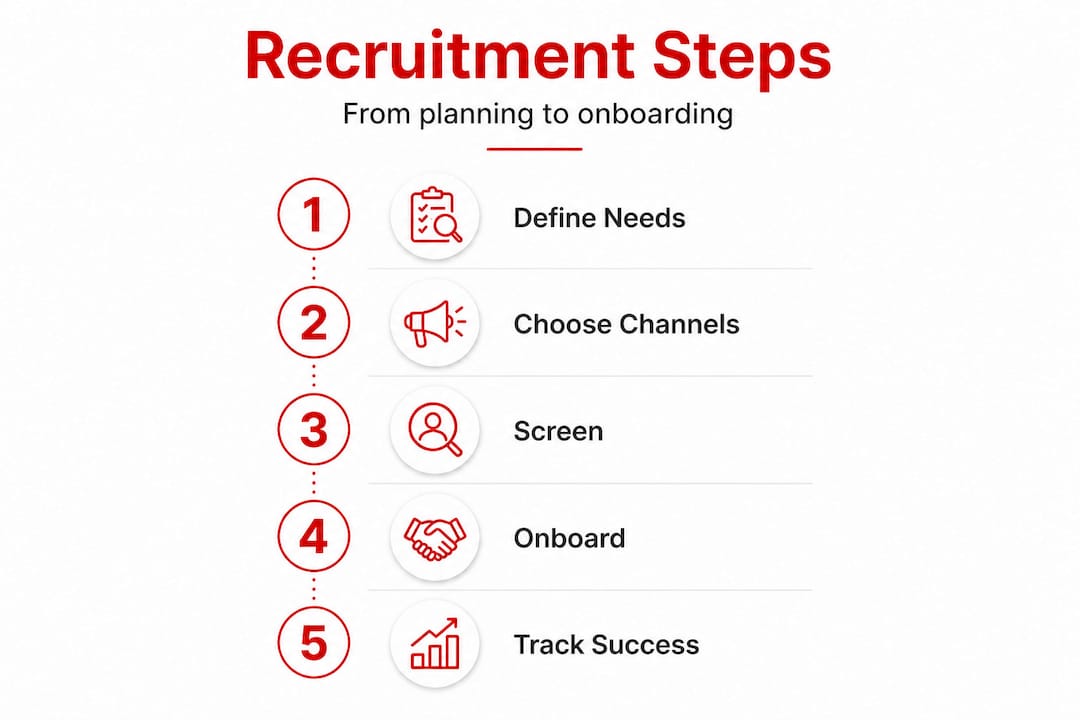
With your prerequisites in place, follow these proven steps for successful recruitment. Skipping steps or reordering them is one of the fastest ways to inflate costs and reduce data quality.
Step 1: Target audience identification
Map your participant profile to accessible recruitment channels. For healthcare professionals, this might mean medical associations, hospital networks, or specialty panels. For B2B audiences, LinkedIn and industry-specific communities are strong starting points. For consumer populations, online panels and social media targeting offer scalability. Be realistic about reach. Niche audiences take more time and more budget.
Step 2: Outreach method selection
Choose your channels based on your audience, not just convenience. Effective recruitment strategies involve clear communication and structured workflows that match how your target audience actually communicates. Cold email works differently than in-app surveys or recruiter calls. Test a small sample before scaling your outreach to validate the channel.
Step 3: Screening and eligibility assessment
Your screener is your quality filter. Design it to identify qualified participants without telegraphing the “right” answers. Use branching logic to keep it short for those who don’t qualify, while gathering enough detail from those who do. Screening for B2B studies should confirm job title, company size, decision-making authority, and relevant experience. For healthcare, confirm licensure, specialty, and patient-facing status where relevant.

Step 4: Participant onboarding
Once someone passes your screener, the work isn’t done. Confirm their participation with a formal invitation that includes study details, scheduling information, incentive terms, and consent documentation. Structured sample recruitment is crucial for reliable research outcomes, and onboarding is where that structure pays off. Participants who feel informed and respected show up, stay engaged, and provide better data.
Here’s a quick reference for channel effectiveness across audience types:
| Audience type | Top outreach channel | Average response rate | Incentive type |
|---|---|---|---|
| Healthcare professionals | Specialty panels, associations | 5 to 15% | Honorarium or CME credit |
| B2B decision-makers | LinkedIn, recruiter calls | 8 to 20% | Gift cards, cash |
| General consumers | Online panels, social ads | 15 to 35% | Gift cards, sweepstakes |
| Hard-to-reach/niche | Referral networks, communities | 3 to 10% | Premium incentives |
The step-by-step recruiting methods that work in talent acquisition share surprising overlap with research recruitment: clarity, structure, and a great candidate (participant) experience drive results.
Pro Tip: Automate your scheduling and reminder workflows using tools like Calendly or similar platforms. Studies show that participants who receive automated reminders 24 hours and 1 hour before a session have significantly lower no-show rates. This one change alone can recover 10 to 20% of your confirmed participants who would otherwise drop off.
Troubleshooting recruitment and overcoming challenges
Following the recruitment steps is critical, but knowing how to handle setbacks and common pitfalls is just as important. Even the best-planned studies hit walls. The difference between a project that delivers and one that derails is how quickly and effectively you adapt.
Here are the most common obstacles research teams face:
- Unresponsive participants: Outreach goes unanswered, especially for hard-to-reach groups like senior executives or specialist physicians.
- Low screener completion rates: Participants start the screener and abandon it mid-way, leaving gaps in your qualified pool.
- Participant dropout after qualification: Confirmed participants cancel or ghost before the actual study session.
- Data quality issues: Participants who pass the screener but give low-effort, inconsistent, or dishonest responses during the study.
- Compliance risks: Missing consent documentation, inadequate privacy disclosures, or recruiting from prohibited populations.
“Recruiting niche audiences is the number one pain point for research teams.”
This is something we hear constantly, and it reflects a real structural challenge. Niche audiences have less tolerance for poorly targeted, generic outreach. They receive many requests and respond to very few. Hard-to-reach audiences require specialized outreach and incentives that reflect the genuine value of their time and expertise.
Practical solutions:
- Tailor every outreach message. Generic invitations get ignored. Personalize your subject lines, reference the participant’s field of expertise, and be upfront about time commitment and compensation.
- Right-size your incentives. A $20 gift card won’t motivate a surgeon to give you 45 minutes of their time. Match incentives to the real market value of your audience’s participation.
- Use referral networks. Existing participants who had a positive experience can be your most effective recruiters. A formal referral program with an incentive for successful introductions can significantly expand your qualified pool.
- Maintain an active backup pool. Always recruit more than you need. For qualitative studies, recruit 25 to 30% over your target to account for dropouts.
- Address ethical recruitment practices from day one. Transparency about the study purpose, the use of data, and participant rights builds the kind of trust that keeps people engaged through completion.
Understanding challenges in talent hiring across industries reinforces a useful parallel: the organizations that struggle most with recruitment are often the ones that treat it as an afterthought rather than a core capability.
Pro Tip: Screen for eligibility early and make it easy to opt out. Counterintuitive? Maybe. But participants who don’t quite qualify and feel respected enough to be referred elsewhere become brand advocates. And participants who self-select out early save you the cost and frustration of late-stage dropouts.
Verifying recruitment success and optimizing for future studies
After addressing challenges, the next step is making sure your process actually delivers and continues to improve. Verification isn’t just a post-study checkbox. It’s how you build a recruitment capability that gets stronger with every project.
Start by measuring the right things:
- Response rate: What percentage of your outreach converted to completed screeners?
- Qualification rate: Of those who completed the screener, how many met your eligibility criteria?
- Show rate: What percentage of confirmed participants attended or completed the study?
- Completion quality: Were responses thoughtful, consistent, and on-topic, or did you see signs of disengagement or low effort?
- Demographic representation: Did your final participant group accurately reflect your target population in terms of diversity, geography, seniority, or clinical specialty?
Tracking these metrics across projects gives you a performance baseline. If your show rate drops below 70%, something in your onboarding process needs attention. If your qualification rate is below 20%, your screener or outreach targeting needs refinement. Participant recruitment best practices are only valuable when measured against real outcomes.
| Metric | Healthy benchmark | Warning threshold | Action needed |
|---|---|---|---|
| Screener completion rate | Above 60% | Below 40% | Shorten screener, improve intro |
| Qualification rate | 20 to 40% | Below 15% | Review targeting criteria |
| Show rate | Above 75% | Below 60% | Improve reminders, confirm incentives |
| Completion quality score | Above 80% | Below 65% | Add attention checks, review screener |
Document every lesson. After each study, hold a short debrief with your team. What worked? What cost you time and budget? Which outreach channel over-performed? Which audience segment was harder to engage than expected? These notes compound over time into a serious competitive advantage.
Research and consulting collaboration enhances recruitment results, because when your research team and consulting stakeholders align early on participant criteria and study goals, scope creep and mid-project revisions drop significantly. Bring stakeholders into the planning phase, not just the reporting phase.
The workflow optimization guide concept applies here too. Recruitment is a workflow. Treating it as a repeatable, measurable process rather than a one-time scramble is what separates research teams that consistently deliver from those that constantly firefight.
What most recruitment guides miss: Real-world lessons from experience
Here’s the honest truth: most recruitment guides focus on process. Follow these steps, use these tools, hit these benchmarks. And yes, that structure matters. But what the textbook version leaves out is that great recruitment is iterative, not linear.
We’ve seen studies where the initial outreach strategy was textbook-perfect, and response rates were still flat. Why? Because the messaging was correct but not resonant. It checked the right boxes but didn’t speak to what actually motivated that audience. The fix wasn’t a new tool or a bigger budget. It was going back to participants who had responded and asking what made them engage. That feedback loop changed everything.
“The best recruitment results often come from iterative refinements, not one-off efforts.”
Rigid processes break under real-world conditions. Participants cancel. IRBs take longer than expected. A panel vendor’s specialty segment turns out to be smaller than advertised. The research teams and professionals who navigate these moments well are the ones who built flexibility into their plans from the start. They didn’t just plan for success. They planned for the unexpected.
Another thing guides rarely say: your real-world recruitment strategies need to account for how participants feel during the process, not just whether they qualify. A technically eligible participant who felt confused by your screener, unsure about confidentiality, or undervalued by the incentive is a participant who drops out or gives you low-quality responses. Participant experience is recruitment quality.
Pro Tip: Always pilot your outreach before scaling. Send your screener and outreach message to 10 to 15 people before launching to your full audience. This catches confusing questions, broken links, technical issues, and tone mismatches before they cost you qualified participants at scale.
The best recruitment programs we’ve built weren’t the most complicated ones. They were the most adaptive ones. Know your target, communicate clearly, listen to early signals, and refine as you go. That’s the real step-by-step.
Connect with experts for your next research recruitment
You’ve got the framework. Now let’s put it to work. At Veridata Insights, we specialize in recruiting participants across healthcare, B2B, and hard-to-reach markets, the audiences that most firms struggle to access. We bring proven strategies, the right tools, and genuine flexibility to every project, with no minimums and availability 7 days a week, 365 days a year. Whether you need a full-service recruitment solution or just support for a specific phase of your study, we’re ready to step in where you need us most. Contact Veridata Insights and let’s talk about your next recruitment challenge. We’d love to help you get it right.

Frequently asked questions
What is the first step in research participant recruitment?
Start by clearly defining your target participant profile and study objectives, because unclear requirements are the leading cause of recruitment failure. Everything from your screener design to your outreach channel follows from that foundational clarity.
How do you recruit hard-to-reach audiences for studies?
Use tailored outreach methods and offer incentives that genuinely reflect the value of the participant’s time, since specialized outreach and incentives are what separate successful niche recruitment from expensive dead ends. Referral networks and community-based recruitment also significantly expand access to these groups.
What are common challenges when recruiting for quantitative research?
Low response rates, unqualified participants, and data quality issues are the most frequent problems, and overcoming them requires clear communication and structured workflows that keep the recruitment process tight from screening through completion.
How can you verify recruitment success after the study?
Track response rates, qualification rates, show rates, and completion quality, then document lessons learned to improve future studies. Collaboration between research and consulting teams plays a key role in aligning on success metrics before the study even launches.
Recommended
- How to Recruit Hard-to-Reach Audiences for Market Research – Veridata Insights
- What is respondent recruitment? The complete guide
- How to Recruit Participants for Market Research: Best Practices – Veridata Insights
- Participant Recruitment Strategies for Market Research Success
- Build a Winning AI-Driven Market Research Workflow