


TL;DR:
- Participant recruitment quality directly impacts research validity and actionable insights.
- Different methodologies align with qualitative depth or quantitative representation goals.
- Strategic, inclusive recruitment planning and continuous monitoring ensure representative samples and research success.
Participant Recruitment Strategies for Market Research Success
Most people assume participant recruitment is simply about filling seats. Post a screener, collect responses, move on. But that mindset is exactly what leads to skewed data, wasted budgets, and insights nobody can act on. Recruitment is not a checkbox. It is the foundation your entire study is built on. Get it wrong, and even the most beautifully designed questionnaire cannot save you. This guide walks you through what participant recruitment actually means, which methodologies work for which goals, how to build representative samples, and how to solve the real-world challenges that trip up even experienced researchers.
Table of Contents
- Understanding participant recruitment
- Key methodologies in participant recruitment
- Building inclusive and representative samples
- Practical challenges and solutions in participant recruitment
- A fresh perspective: Why participant recruitment is more strategic than most realize
- Ready to optimize your participant recruitment?
- Frequently asked questions
Key Takeaways
| Point | Details |
|---|---|
| Recruitment shapes research outcomes | The right participant recruitment strategy directly impacts the quality and relevance of research findings. |
| Strategy must match study goal | Tailor your approach for qualitative depth or quantitative representation depending on your research objectives. |
| Inclusivity requires planning | Diverse, representative samples arise from explicit protocol-level recruitment targets and ongoing monitoring. |
| Practical solutions exist | Evidence-based frameworks help overcome common recruitment challenges such as sample bias and engagement. |
Understanding participant recruitment
Let’s start with a clear definition. Participant recruitment is the structured process of identifying, screening, and engaging individuals who fit the specific criteria of a research study. It is not casting a wide net and hoping for the best. Every decision, from how you source candidates to what screening questions you ask, shapes the quality of your final data.
Why does this matter so much? Because research quality lives or dies based on who participates. If your sample does not match your target population, your findings will not reflect reality. That means misleading conclusions, misguided product decisions, and strategy built on shaky ground.
Here is where many projects stumble: researchers treat recruitment as logistics rather than methodology. The truth is, recruitment decisions are methodological decisions. Who you include, and why, is as scientifically significant as the questions you ask.
This becomes especially clear when you compare qualitative vs quantitative approaches. These two research types have fundamentally different goals, and that drives completely different recruitment logic. A key distinction is that qualitative studies prioritize depth, often using non-random, purposive or iterative approaches like theoretical sampling, while quantitative studies prioritize statistical representation and generalization.
Here is a breakdown of the most common sampling approaches:
- Purposive sampling: You deliberately select participants who have the specific characteristics your study needs. Common in qualitative research.
- Convenience sampling: Recruiting whoever is most accessible. Fast, but prone to bias if not carefully managed.
- Theoretical sampling: Used in grounded theory research, where recruitment is guided by emerging findings rather than a fixed plan.
- Snowball sampling: Existing participants refer others. Powerful for reaching tight-knit or hidden communities.
- Random sampling: Every member of a population has an equal chance of being selected. Core to most quantitative work.
Pro Tip: Define your recruitment goals before you finalize your methodology. Who you are looking for should inform how you look for them, not the other way around. If you start with a screening tool before clarifying your population, you are building the roof before the walls.
Setting these goals early saves you from costly mid-project corrections. It also forces your team to align on what a “qualified participant” actually looks like, which is a conversation worth having before a single invite goes out.
Key methodologies in participant recruitment
Now that we know what participant recruitment is, let’s look at the core methodologies that shape recruitment outcomes. The method you choose should follow directly from your research objective. This is not a one-size-fits-all situation.
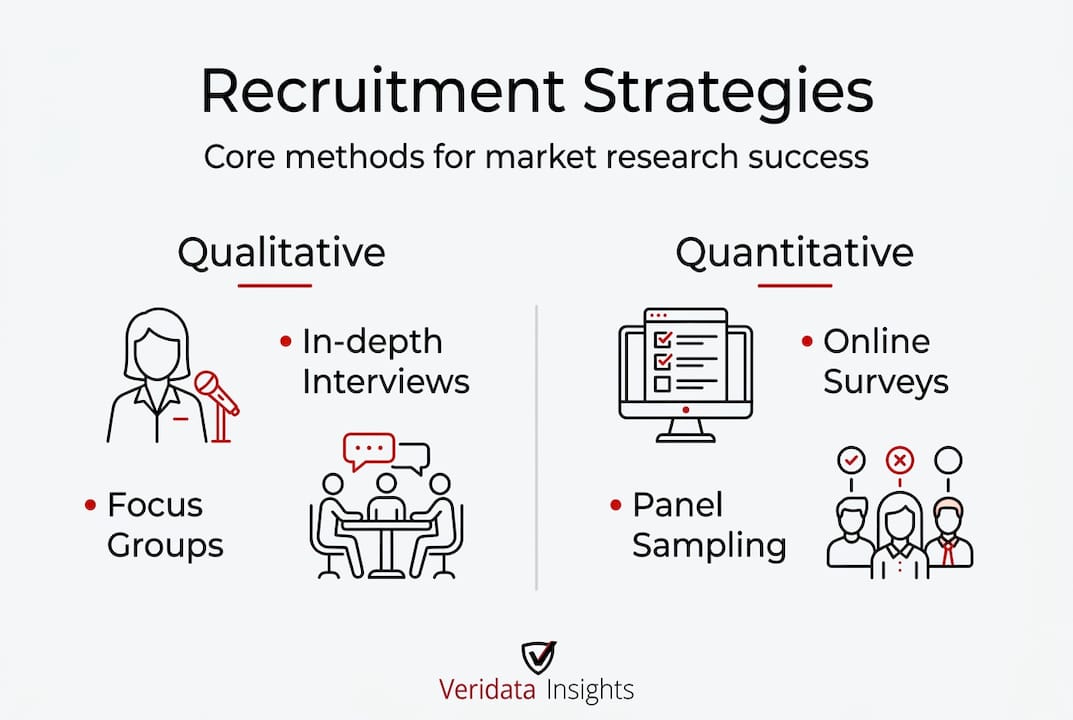
Qualitative recruitment focuses on depth over volume. You are not looking for a large number of responses. You are looking for the right voices. Qualitative sampling relies on information richness and data saturation rather than statistical formulas. Data saturation means you keep recruiting until new participants stop introducing new themes or perspectives. At that point, additional interviews add noise, not signal.
Quantitative recruitment works differently. Here, the goal is a sample large enough, and structured enough, to support statistical analysis. You need representation across demographic and behavioral segments so your findings can be generalized to a broader population. The sample size is calculated, not estimated.
The confusion between these two logics is one of the most common errors in choosing the right research approach. Some teams apply quantitative volume thinking to qualitative studies and end up with 200 interviews that all say the same thing. Others run quantitative surveys with a convenience sample and then try to draw population-level conclusions. Neither approach works.
Let’s make this concrete. Here is a comparison of recruitment types and their matching goals:
| Recruitment method | Best for | Key benefit | Main risk |
|---|---|---|---|
| Purposive sampling | Qualitative studies | High relevance, specific expertise | Limited generalizability |
| Random sampling | Quantitative studies | Statistical validity | Requires large, accessible population |
| Snowball sampling | Hard-to-reach groups | Network-based trust | Potential in-group bias |
| Convenience sampling | Exploratory research | Speed and low cost | High selection bias |
| Theoretical sampling | Grounded theory studies | Iterative, responsive design | Time-intensive |
Think of it this way: recruitment strategy is to research what casting is to a film. A brilliant script still fails with the wrong actors. Understanding the difference between recruitment and talent acquisition is useful context here, because both fields are learning that targeted, strategic selection consistently outperforms volume-based approaches.
Here are the primary methods used in research recruitment today:
- Purposive sampling: Targeted selection based on predetermined criteria
- Convenience sampling: Recruiting from the most available populations
- Snowball sampling: Participant-driven referral networks
- Random sampling: Probabilistic selection for quantitative validity
- Theoretical sampling: Emergent, iterative participant selection
Understanding effective sampling methods is the key to matching your recruitment logic to your research objective. Getting this right upfront will save you from rerunning fieldwork or patching a flawed dataset after the fact.
Building inclusive and representative samples
With a foundation in methodologies, let’s look at how to ensure your samples are truly representative and inclusive. This is where strategic recruitment gets real. It requires protocol-level decisions, not just intentions.

Sample inclusivity means your participant pool reflects the diversity of the population you are studying. Representativeness means the proportions in your sample match the proportions in your target population. These two goals are related but distinct, and you need both.
Inclusive and representative recruitment requires protocol-level design choices such as setting mandatory inclusion targets and building representation goals into recruitment operations. That means documenting exactly what demographic or experiential composition you are aiming for, then actively tracking progress toward those targets throughout fieldwork.
This is not just good practice for health research. It applies equally to brand studies, B2B surveys, consumer insight panels, and usability testing. If your sample skews toward one demographic simply because those participants are easier to reach, your data has a built-in blind spot.
Here is an example of how inclusion targets can work in practice:
| Demographic segment | Target representation | Achieved at midpoint | Final achieved |
|---|---|---|---|
| Ages 18 to 34 | 30% | 28% | 31% |
| Ages 35 to 54 | 40% | 41% | 40% |
| Ages 55 and older | 30% | 22% | 29% |
| Women | 50% | 48% | 51% |
| Rural residents | 20% | 14% | 19% |
Tracking against targets in real time allows your team to course-correct before fieldwork closes. That midpoint check on rural residents above is a red flag you can act on, not a gap you discover in the final report.
“Who is missing from your sample is just as important as who is in it.”
Here are the practical steps to operationalize inclusive recruitment:
- Define your target population precisely. Age, geography, behavior, occupation, or experience. Be specific.
- Set documented representation targets for each key segment before recruitment begins.
- Build quotas into your screening process so recruitment stops for over-represented groups and continues for under-represented ones.
- Monitor progress weekly during active fieldwork, not just at the end.
- Adjust recruitment channels if certain segments are consistently underperforming.
- Report on final composition alongside your findings so stakeholders understand what the data represents.
Pro Tip: The most common inclusivity failure is not malicious. It is accidental. Teams recruit through channels that are already biased toward certain populations, like online panels that skew younger, or professional networks that skew toward urban and educated respondents. Audit your recruitment channels the same way you audit your screener. Our recruitment experts across B2B, healthcare, and B2C sectors know which channels serve which audiences, and that knowledge matters.
Evidence-based approaches to hiring and retention are reshaping workforce decisions across industries. The same evidence-first mindset applies here: let your data on participant composition guide recruitment decisions, not assumptions about who is easy to find.
Working with market research recruitment agencies that specialize in targeted panel building can significantly close the gap between your representation goals and your final achieved sample.
Practical challenges and solutions in participant recruitment
With inclusive design approaches in mind, it is important to tackle the practical challenges of participant recruitment head-on. Because theory is one thing. Fieldwork is another.
Three challenges come up more than any others: recruitment speed, engagement quality, and sample bias. Let’s break down each one and what you can actually do about it.
Recruitment speed is almost always underestimated. Teams build a project timeline and then discover that recruiting qualified participants, especially for niche audiences, takes significantly longer than expected. The fix is building recruitment lead time into your project plan from day one, not as an afterthought once design is complete.
Engagement quality means participants who are genuinely invested in the research, not just completing it for an incentive. Disengaged respondents produce straight-line answers in surveys, minimal depth in interviews, and data that looks complete but is functionally useless. You can improve engagement by crafting screeners that set expectations clearly and by offering incentives that are appropriate but not so high they attract professional survey-takers.
Sample bias is the silent killer of research validity. It happens when your final sample systematically differs from your target population in ways that affect your findings. Purposive, convenience, snowball, and theoretical sampling each carry their own bias risks, and the smart researcher accounts for them by diversifying recruitment channels and monitoring sample composition continuously.
Here are actionable strategies to strengthen your recruitment process:
- Start recruitment planning before methodology is finalized. Know your audience before you design your approach.
- Use multiple recruitment channels to reduce channel-specific bias and expand reach.
- Pilot your screener with a small group before full launch to catch confusing or leading questions.
- Set realistic timelines that account for screening drop-off rates. Expect to screen significantly more people than you need.
- Build in soft quotas that allow you to monitor demographic balance without rigid cutoffs that stall fieldwork.
- Work with specialists for hard-to-reach audiences, because general panels simply do not have the penetration you need.
Pro Tip: Avoiding sample bias starts with honesty about your recruitment channel. If you are recruiting from a single online platform, your sample reflects that platform’s user base, not the general population. Diversify early and compare demographic profiles across channels to spot imbalances before they become a problem.
For a closer look at recruiting hard-to-reach audiences, the strategies differ meaningfully from standard consumer recruitment. B2B decision-makers, healthcare professionals, and niche consumer segments require tailored outreach, appropriate incentive structures, and often longer lead times.
You can also review participant recruitment best practices and a real-world research recruitment case study for a business consulting firm to see how these principles translate into actual project execution.
A fresh perspective: Why participant recruitment is more strategic than most realize
Here is something that most research guides will not tell you: the biggest threat to your research is not a poorly worded question or a flawed analysis model. It is the assumption that recruitment is an administrative function rather than a strategic one.
We have seen smart teams produce textbook study designs that fall apart because recruitment was treated as a last-mile logistics problem. The questions were great. The analysis was sharp. But the participants did not actually represent the population the client cared about. The insights were real, just irrelevant.
True strategic recruitment means asking hard questions at the start of every project. Who exactly are we trying to understand? What makes someone genuinely qualified? Are our channels reaching people who are representative, or just reachable?
Early planning, inclusive design, and continuous monitoring of sampling methods for project success are not optional refinements. They are the difference between data you can act on and data that collects dust. Participant recruitment deserves a seat at the strategy table, not just a line in the project plan.
Ready to optimize your participant recruitment?
If this guide has made one thing clear, it is that participant recruitment rewards strategic thinking. The methodology, the inclusivity targets, the channel selection, and the ongoing monitoring all work together to determine whether your research delivers insights you can genuinely trust.
At Veridata Insights, we do this every day, across B2B, B2C, healthcare, and hard-to-reach audiences, with no project minimums and full-service support seven days a week. Whether you need help designing a screener, sourcing a niche panel, or managing end-to-end recruitment for a complex study, we are ready to help.
Connect with Veridata Insights and let’s build a recruitment strategy that gives your next project the solid foundation it deserves.
Frequently asked questions
What is participant recruitment in market research?
Participant recruitment is the process of identifying and engaging suitable individuals for a research study, tailored to the study’s objectives and methodology. Matching recruitment logic to the study goal matters because qualitative studies prioritize depth, while quantitative studies prioritize statistical representation.
Why does recruitment strategy differ between qualitative and quantitative studies?
Qualitative studies seek information richness and nuanced data, while quantitative studies require statistical representation across a defined population, which drives entirely different recruitment logic. Qualitative sampling relies on information richness and data saturation rather than the statistical formulas that guide quantitative work.
How can I ensure my research sample is inclusive and representative?
Set protocol-level inclusion targets, embed representation goals into your recruitment operations, and monitor achievement of those targets throughout fieldwork. Inclusive recruitment requires mandatory inclusion targets and representation goals built directly into the recruitment design, not added as an afterthought.
What are common participant recruitment challenges?
Frequent obstacles include sample bias, low engagement rates, unrealistic timelines, and difficulties accessing hard-to-reach audiences, each of which requires a targeted solution. Using purposive, snowball, and theoretical sampling thoughtfully, alongside diverse recruitment channels, helps address these challenges systematically.
Recommended
- How to Recruit Participants for Market Research: Best Practices – Veridata Insights
- The Best Market Research Agencies for Participant Recruitment – Veridata Insights
- How to Recruit Hard-to-Reach Audiences for Market Research – Veridata Insights
- Best Ways to Engage Market Research Respondents – Veridata Insights