

TL;DR:
- Respondent recruitment involves identifying and screening the right participants to ensure data validity.
- Effective recruitment requires precise criteria, targeted sourcing channels, and ongoing quality control.
- Skilled recruiters adapt flexibly and prioritize relationship-building to optimize participant engagement and data quality.
Plenty of research projects start with a solid methodology and smart questions, then quietly fall apart before the first interview is scheduled. The culprit? Poor respondent recruitment. Most people assume that finding participants is the easy part, a quick email blast or a post in an online forum. In reality, getting the right people into your study is one of the most demanding and high-stakes steps in the entire research process. This guide breaks down what respondent recruitment actually means, why it shapes every insight you collect, and what strategies and tools give you the best shot at reliable, actionable data.
Table of Contents
- Understanding respondent recruitment
- The respondent recruitment process: step by step
- Key channels and tools for sourcing research respondents
- Quality control: ensuring reliable and valid research data
- Why respondent recruitment is more art than science
- Ready to elevate your respondent recruitment?
- Frequently asked questions
Key Takeaways
| Point | Details |
|---|---|
| Critical research step | Respondent recruitment directly impacts the validity and usefulness of market research findings. |
| Follow a structured process | A clear multi-step process leads to better participant quality and fewer research problems. |
| Choose channels wisely | Matching your recruitment channels to your study type improves speed and data integrity. |
| Monitor for quality | Rigorous screening and quality checks prevent unreliable data and wasted resources. |
| Experience matters | Expert judgment and adaptability often make the difference in successful respondent recruitment. |
Understanding respondent recruitment
Let’s get the definition right first. Respondent recruitment is the process of identifying, screening, and engaging individuals who meet specific criteria to participate in a research study. It applies to both qualitative work, like in-depth interviews and focus groups, and quantitative studies, like surveys and large-scale data collection. It is not just “finding people.” It is finding the right people and confirming they are genuinely qualified to provide meaningful input.
Where does it fit in the research workflow? Think of recruitment as the bridge between your research design and your data collection phase. You can have the most thoughtful discussion guide in the world, but if the people sitting across from you do not match your target profile, your findings will miss the mark. Effective recruitment determines research validity, and that connection between sample quality and research outcomes is not theoretical. It shows up in your results, your recommendations, and ultimately in the decisions your clients or stakeholders make based on your work.
Here is where many teams go wrong. They confuse respondent recruitment with general sampling. Sampling is the statistical decision about which population segments to include. Recruitment is the hands-on work of locating, screening, and confirming actual human beings who represent those segments. Conflating the two leads to vague criteria and rushed outreach that undermines everything downstream.
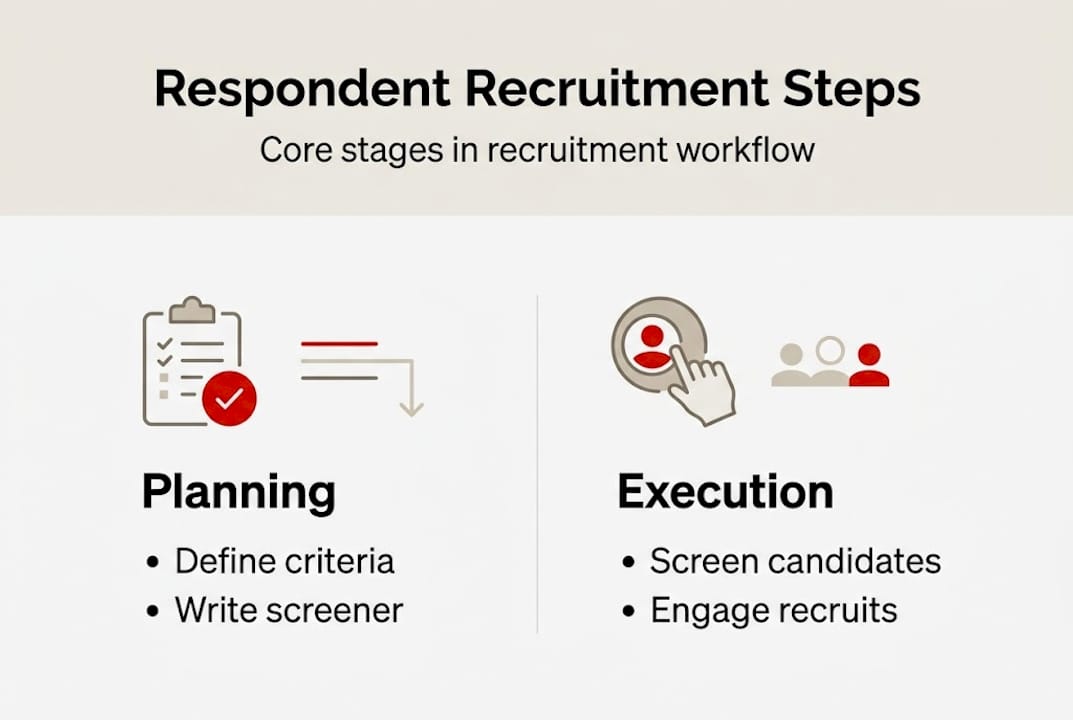
The key stages of respondent recruitment include:
- Identifying the target population: Defining exactly who qualifies based on demographics, behaviors, attitudes, or professional characteristics.
- Screening: Using qualifying questions to confirm that candidates actually meet your criteria before they enter the study.
- Outreach: Reaching potential participants through appropriate channels, whether that is panels, databases, or direct contact.
- Engagement: Building enough trust and interest that qualified participants actually show up and stay engaged.
- Follow-up: Confirming attendance, managing drop-off, and keeping the pipeline full.
“The quality of your recruitment is the quality of your research. You can optimize everything else, but weak respondents produce weak data.”
Every stage matters. Skip or rush any one of them and you introduce noise into your data that no analysis technique can fully fix.
The respondent recruitment process: step by step
Knowing what respondent recruitment is and knowing how to execute it are two different things. Let’s walk through the process in a way you can actually apply.
- Define your criteria precisely. Before you write a single recruiting screener, nail down exactly who you need. Age range, job title, purchase behavior, health condition, geographic location, whatever is relevant. Vague criteria are the single most common reason recruitment fails.
- Source your participant pool. Identify where your target respondents actually spend their time. Online panels, professional associations, agency databases, social communities, or client-provided lists are all options. The channel depends on your audience.
- Screen rigorously. Your screener is not a formality. It is a filter. Use layered questions that reveal whether a candidate truly qualifies. Avoid leading questions that telegraph the “right” answer. A structured process increases recruitment success rates and keeps your data cleaner from the start.
- Schedule and engage. Once screened, move quickly. Slow communication loses candidates. Send confirmation details, reminders, and any preparation materials promptly. Make participation feel easy and worthwhile.
- Follow up consistently. No-shows happen. Build a buffer into your recruit by over-recruiting slightly, and have a follow-up plan ready. Stay in contact without being overwhelming.
Common errors at this stage include writing screeners that are too short, failing to validate respondent claims, and treating scheduling as an afterthought. Each of these mistakes quietly inflates your cost and deflates your data quality. Familiarizing yourself with market research pitfalls before you start is time well spent.
Pro Tip: Write your recruitment criteria document before you write your screener. If you cannot summarize who you need in one paragraph, your criteria are not clear enough yet.
Key channels and tools for sourcing research respondents
Not all sourcing channels are created equal, and different recruitment channels serve different study needs. Picking the wrong one wastes time and budget. Here is a quick comparison to guide your decision:
| Channel | Cost | Speed | Quality Control | Best for |
|---|---|---|---|---|
| Online panels | Low to medium | Fast | Moderate | Quantitative, large-scale |
| Recruitment agencies | Medium to high | Medium | High | Qualitative, niche audiences |
| Direct outreach | Low | Slow | Variable | B2B, specialized professionals |
| Online communities | Low | Medium | Low to moderate | Early-stage exploration |
| Internal/client databases | Low | Fast | High | Known customer groups |
Each channel has a distinct trade-off. Panels give you volume and speed, but professional respondents who participate in study after study can skew your findings. Agencies cost more but bring expertise, especially when you need B2B and B2C recruitment experts who understand how to reach hard-to-access populations like healthcare professionals, C-suite executives, or niche consumer segments.
When evaluating recruitment tools and platforms, look for these must-have features:
- Robust screening capabilities: The platform should allow multi-stage qualifier logic, not just simple checkboxes.
- Participant verification: Can the tool validate claimed attributes like job title, industry, or diagnosis?
- Communication automation: Reminders, confirmations, and follow-ups should be automatable to save your team time.
- Audit trails: You need to document who was screened, when, and why they qualified or were disqualified.
- Integration with scheduling tools: Friction in scheduling leads to no-shows. Smooth calendar integration matters.
The right mix depends on your study type, timeline, and budget. Most seasoned research teams use a combination rather than relying on a single source. Diversifying your sourcing reduces risk and keeps your pipeline healthier if one channel runs dry mid-project.
Quality control: ensuring reliable and valid research data
Finding participants is one challenge. Finding good participants is another. Quality control at recruitment prevents errors in results, and this is where many teams underinvest their effort.

A quality respondent is not just someone who technically meets your screener criteria. They are engaged, honest about their experiences, and genuinely representative of the segment you are studying. Here is how to build quality into each stage:
| Recruitment Stage | Reliability Check | Purpose |
|---|---|---|
| Screening | Layered qualifying questions | Filter out unqualified candidates |
| Pre-study | Identity and credential verification | Confirm claimed attributes |
| During study | Attention checks and consistency probes | Catch disengaged or dishonest respondents |
| Post-study | Data audit and outlier review | Identify suspicious patterns |
One of the most underappreciated threats to data quality is the “professional respondent,” someone who participates in study after study and has learned to game screeners. They know what researchers want to hear, and they say it, which means their responses are rehearsed rather than genuine. Checking panel freshness and cross-referencing participant IDs across studies helps catch them.
Bias is another serious concern. Recruitment bias happens when your sourcing strategy systematically favors certain types of respondents over others. For example, recruiting only through LinkedIn skews toward professionals who are active on that platform, which may not represent your full target population. Applying B2B research best practices helps you recognize and correct for these patterns before they contaminate your findings.
Pro Tip: Document your incentivization strategy upfront. Incentives that are too high attract people motivated by the reward rather than the study. Incentives that are too low lead to high drop-off. Match the incentive to the time, expertise, and effort you are asking for.
Why respondent recruitment is more art than science
Here is something the checklists do not tell you: the best recruiters we know treat their work the same way a skilled interviewer treats a conversation. They read people. They adapt on the fly. And sometimes they throw the rulebook out because the situation demands it.
Protocols matter. Screening tools matter. But experienced recruiters also know when a technically qualified candidate is not going to be a good study participant, and when someone slightly outside the criteria will deliver far more value than a box-checker who meets every line item. That judgment does not come from software. It comes from experience.
Real-world recruitment throws curveballs constantly. A key segment dries up mid-project. A corporate gatekeeper blocks access to decision-makers. A screener that tested fine in one region produces odd results in another. Adapting quickly and creatively is what separates average recruitment from excellent recruitment.
We also see teams over-rely on automation and lose sight of the relationship element. Participants who feel respected and genuinely informed show up, stay engaged, and give better data. That relationship-building piece, whether it is a warm outreach email or a personal confirmation call, cannot be automated away. Great B2B survey design tips remind us that the participant experience begins long before the first question is asked. Treat recruitment as the first impression of your study, because it is.
Ready to elevate your respondent recruitment?
If this guide has shown you anything, it is that respondent recruitment is not a background task. It is the foundation your entire research project stands on. At Veridata Insights, we specialize in exactly this. Whether you need connect with our team for B2B, B2C, healthcare, or hard-to-reach audience recruitment, we bring the expertise, tools, and relationships to get you the right participants fast. No project minimums. Seven days a week. We handle as much or as little of the process as you need, from screener design to full recruitment management, so your data is solid before collection even begins.
Frequently asked questions
What is respondent recruitment in qualitative research?
Respondent recruitment in qualitative research means identifying, screening, and engaging individuals whose lived experiences align directly with the study’s aim. Respondent recruitment includes all actions necessary to bring genuinely suitable participants into a research study.
Which tools are best for respondent recruitment?
Panel providers, specialized recruitment agencies, and dedicated recruitment platforms are the most effective options for balancing speed and quality. Different recruitment channels serve different study types, so the right tool depends on your audience and methodology.
How do you ensure quality in respondent recruitment?
Rigorous screening with layered qualifying questions and pre-study identity verification are the most reliable ways to protect data quality. Quality control at recruitment is far less costly than trying to correct for poor respondent quality after data collection.
What is the difference between respondent recruitment and sampling?
Sampling is the strategic decision about which population segments to include in a study. Respondent recruitment is the hands-on process of locating and confirming participation from actual individuals within those segments. Respondent recruitment is distinct from sampling in that it operationalizes who actually sits down and participates.
When should you outsource respondent recruitment?
Outsource when your target audience is niche, your timeline is tight, or you need guaranteed quality control across a large sample. Agencies often provide significant recruitment advantages for hard-to-reach segments that internal teams struggle to access efficiently.
Recommended
- In-Depth Interview Recruiting: Why Veridata Insights Leads the Way in Quality Respondent Engagement – Veridata Insights
- The Best Market Research Agencies for Participant Recruitment – Veridata Insights
- Recruit the right ad audiences: 80% quality standard
- Best Ways to Engage Market Research Respondents – Veridata Insights