

TL;DR:
- Sample recruitment is critical for obtaining representative participants and meaningful research data.
- Poor recruitment can lead to biased results, blind spots, and invalid insights.
- Effective strategies involve clear targeting, diverse channels, and ongoing sample validation.
Recruiting research participants sounds simple until you try it. You post a screener, wait for responses, and suddenly realize you’ve attracted the wrong audience, or barely anyone at all. Even seasoned market research professionals know this sting. Getting a truly representative sample is one of the most technically demanding parts of any study, yet it’s often treated like an afterthought. This article walks you through what sample recruitment actually means, why it carries so much weight for your research outcomes, and how to apply the right methods, whether you’re running quantitative surveys, qualitative interviews, or focus groups with hard-to-reach populations.
Table of Contents
- What is sample recruitment?
- Why sample recruitment is essential for quality insights
- Methods and techniques for effective sample recruitment
- Common pitfalls and how to avoid them in sample recruitment
- Our perspective: Rethinking sample recruitment for today’s changing audiences
- Get expert support for your sample recruitment challenges
- Frequently asked questions
Key Takeaways
| Point | Details |
|---|---|
| Foundation of research quality | Sample recruitment powers genuine, actionable market research insights. |
| Choose methods strategically | Effective recruitment combines clear criteria with a mix of targeted channels. |
| Avoid common pitfalls | Careful screening and engagement strategies protect against bias and poor data. |
| Adapt to changing audiences | Evolving recruitment approaches are vital as populations and technologies shift. |
What is sample recruitment?
Sample recruitment is the starting point for any credible research project. Before you can analyze data, before you can write a report, before you can present findings to stakeholders, you need the right people in the room. Without that, everything else falls apart.
So what exactly is it? As we define it at Veridata Insights, sample recruitment involves identifying, sourcing, and enlisting participants who match the criteria for a research study. It’s not just “finding people.” It’s finding the right people, in the right numbers, through the right channels.
Sample recruitment is relevant across virtually every research format:
- Quantitative surveys: You need a statistically meaningful group that reflects your target population.
- Qualitative interviews: You need participants who can speak authentically to a specific experience or behavior.
- Focus groups: You need diversity of opinion while still staying within a defined audience segment.
- Ethnographic studies: You need individuals willing to open their homes, workflows, or routines to observation.
- Longitudinal panels: You need committed participants who will return for multiple waves of data collection.
Each of these requires a distinct recruitment approach. The criteria you set, the channels you use, the screening process you apply, all of it shapes who ends up in your study.
“Sample recruitment involves identifying, sourcing, and enlisting participants who match the criteria for a research study. The process directly determines whether your data will be meaningful or misleading.”
This is why working with experienced market research recruitment agencies matters. Agencies that specialize in recruitment understand screener design, quota management, and the nuances of reaching specific demographics. They don’t just fill seats. They protect the integrity of your study from the ground up.
Foundationally, sample recruitment bridges your research objective and your raw data. Get it right and your findings carry weight. Get it wrong and no amount of sophisticated analysis will save you.
Why sample recruitment is essential for quality insights
Now that we’ve clarified the definition, it’s crucial to understand why sample recruitment is more than just a checkbox. It is, arguably, the single biggest driver of whether your research produces insight or noise.
The reliability of your findings is determined directly by the quality of your participant sample. That’s not an opinion. That’s methodology. And it has real consequences for business decisions.
When recruitment goes wrong, the errors tend to fall into predictable categories:
| Recruitment Error | What It Causes | Business Impact |
|---|---|---|
| Sample bias | Results skew toward a non-representative group | Misinformed product or messaging decisions |
| Undercoverage | Key segments missing from the data | Blind spots in strategy |
| Over-representation | One group dominates the findings | False confidence in a narrow perspective |
| Poor screening | Wrong participants complete the study | Invalid data that misleads analysis |
Think about what happens when a B2B firm surveys only senior leadership about software adoption, ignoring the end users who actually interact with the tool daily. The insights they collect will look clean and confident. But the decisions they make based on those insights? They’ll miss the mark.

The stakes are especially high for industries like healthcare, financial services, and technology, where research informs product design, compliance strategies, and customer experience at scale. Poor sample recruitment for consulting firms can result in deliverables that clients question, eroding trust and credibility.
Here’s a number worth noting: studies show that sampling errors are among the top contributors to research replication failures. When samples aren’t carefully constructed, findings rarely hold up across contexts. That’s a serious problem if your research is informing a product launch, a market entry, or a major investment.
Sample recruitment done well means your data has a foundation. It means your research tells you something true.
Methods and techniques for effective sample recruitment
Understanding its importance, let’s break down how market research professionals recruit effective samples. Recruitment techniques vary depending on research goals, audience, and resources. There’s no single formula, but there is a process.
Step-by-step process for recruiting a representative sample:
- Define your target audience with precision. Specify demographics, psychographics, behaviors, and any professional or clinical criteria.
- Design your screener to filter in qualified participants and filter out anyone who doesn’t fit.
- Select your recruitment channels based on where your audience actually spends time.
- Set realistic quotas to balance representation across key subgroups.
- Launch and monitor actively. Track completion rates, quota fills, and dropout points.
- Validate your sample before fieldwork closes. Spot-check responses for consistency and authenticity.
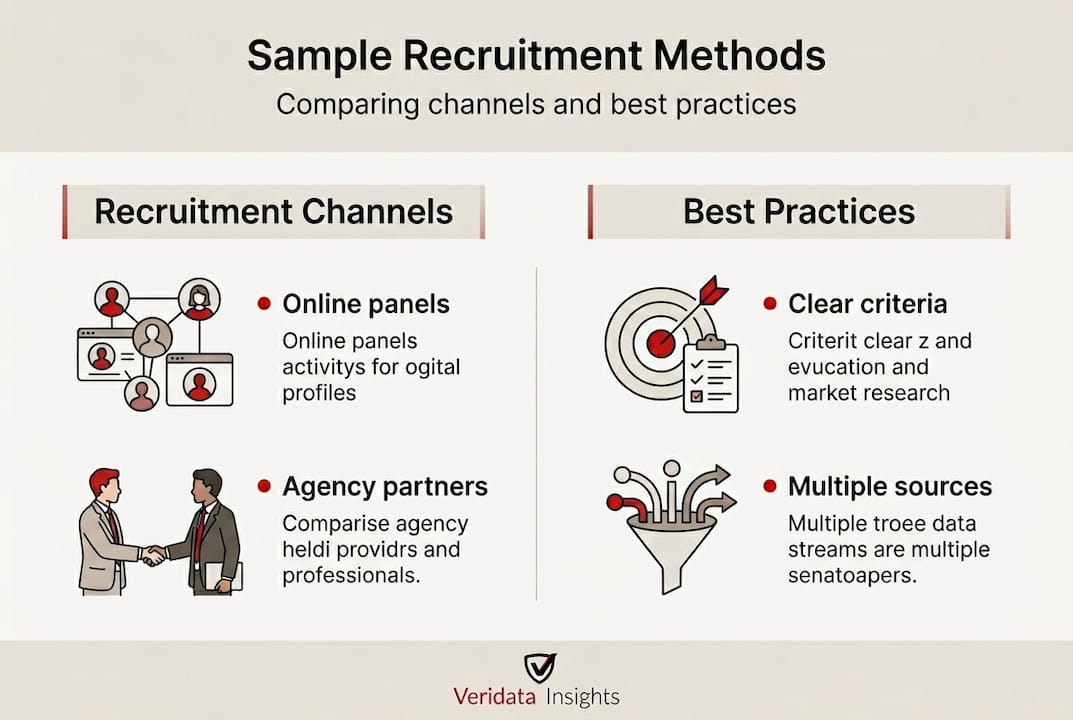
Your choice of recruitment channel matters enormously. Here’s how some common options compare:
| Channel | Pros | Cons |
|---|---|---|
| Online panels | Fast, scalable, cost-effective | Risk of professional respondents, panel fatigue |
| Social media | Broad reach, good for niche groups | Difficult to verify eligibility |
| Email lists | High trust, targeted | Requires access to the list |
| Phone recruitment | Ideal for B2B and senior audiences | Time-intensive, higher cost |
| Referral or snowball | Great for hard-to-reach groups | Can introduce social bias |
| Partner databases | Pre-screened, relevant | Dependent on partner quality |
Following recruitment best practices means combining channels strategically rather than relying on just one source. For example, recruiting niche audiences like content creators or specialized professionals often requires a mix of social outreach, referral programs, and targeted advertising.
Pro Tip: For hard-to-reach groups, incentives matter, but relevance matters more. A modest, well-targeted incentive paired with a clear value exchange (“your input shapes this product”) consistently outperforms high-dollar generic offers.
Common pitfalls and how to avoid them in sample recruitment
Having reviewed effective methods, it’s equally important to recognize and sidestep common mistakes. As we’ve seen firsthand, even experienced professionals encounter pitfalls like over-representation or failing to screen thoroughly.
Here are the most common problems and what to do about each:
- Insufficient screening: A screener that’s too short or too vague lets unqualified participants slip through. Fix it by testing your screener internally before launch and including attention checks.
- Sample bias: Recruiting primarily through one channel skews your results toward whoever uses that channel. Diversify your sources intentionally.
- Poor engagement: Participants who are disengaged give low-quality answers. Improve engaging research respondents by making screeners clear, respectful of time, and relevant to the participant’s context.
- Low participation rates: Invitations that feel cold or generic get ignored. Personalization, clear purpose, and easy opt-in steps dramatically lift response rates.
- Over-recruiting without management: Recruiting too many participants without quota controls leads to imbalanced samples that skew findings.
Failing to address these issues early rarely gets easier mid-study. By the time you notice the problem, you may have already collected hundreds of unusable responses. The simplified market research process begins with strong recruitment infrastructure, not with the survey itself.
Pro Tip: Use automated screening logic in your survey platform to instantly disqualify participants who don’t meet criteria. This protects data quality without relying on manual review, especially helpful at scale or when timelines are tight.
Our perspective: Rethinking sample recruitment for today’s changing audiences
Here’s something we’ve learned from years of running complex recruitment projects: the biggest mistake isn’t a bad screener or the wrong channel. It’s treating sample recruitment like a solved problem.
Audience behavior is changing fast. Privacy concerns are reshaping who responds to what and through which platforms. Third-party cookie deprecation is limiting digital targeting. People are more selective, more skeptical, and more protective of their time than ever before.
Conventional recruitment playbooks were built for a different era. If you’re still running the same approach you used five years ago, you’re likely missing key segments of your audience without realizing it. Effective sampling strategies must evolve with participant expectations, not just research budgets.
What we’ve found works today is leading with trust. Transparent communication about how data will be used, who’s behind the study, and what participants will experience dramatically improves recruitment outcomes. It’s less about casting a wide net and more about making a genuine, specific ask to the right person. That shift in mindset changes everything.
Get expert support for your sample recruitment challenges
If you’re ready to strengthen your sample recruitment strategy or need a partner for complex research, we’re here to help. At Veridata Insights, we specialize in recruiting for B2B, B2C, healthcare, and hard-to-reach audiences, with no project minimums and support available seven days a week. Whether you need a full-service research solution or just recruitment support for a study already in progress, we adapt to your needs. Getting recruitment right isn’t optional; it’s the foundation of research you can actually act on. Contact Veridata Insights today to talk through your project and find out how we can build the sample your research deserves.
Frequently asked questions
What is the difference between sample recruitment and sampling?
Sample recruitment is the process of finding and enlisting participants, while sampling is the broader method of selecting which group represents your target population. Both matter, but recruitment involves the active, operational work of getting qualified people into your study.
How do you ensure your sample is representative?
You ensure representativeness by defining recruitment criteria clearly, using diverse channels, and regularly screening candidate participants. Recruitment techniques vary by audience, so matching your approach to your specific target group is essential.
What are common mistakes to avoid during sample recruitment?
Common mistakes include failing to define criteria, under-screening participants, and using only one recruitment source. Experienced professionals encounter over-representation and weak screeners more often than you’d expect, even on mature research programs.
Why does sample recruitment impact research outcomes so heavily?
If your participant pool isn’t thoughtfully recruited, research findings may be biased or invalid, leading to poor business decisions. The quality of your sample is directly tied to the reliability and usefulness of everything your research produces.
Recommended
- The Best Market Research Agencies for Participant Recruitment – Veridata Insights
- How to Recruit Participants for Market Research: Best Practices – Veridata Insights
- How to Recruit Hard-to-Reach Audiences for Market Research – Veridata Insights
- Unlock project success with effective sampling methods
- Boost Candidate Engagement 50% in UK Security Recruitment|SJB