


More than 70% of new products fail without proper market research, yet 95% of businesses see positive ROI when they use it. These numbers reveal a stark reality: market research isn’t optional for businesses aiming to grow. It’s the difference between launching products that resonate with customers and wasting resources on ideas that miss the mark. This guide breaks down what market research is, why it matters for your bottom line, and how to apply it strategically to reduce risk and boost sales.
Table of Contents
- Key takeaways
- Understanding market research fundamentals
- Primary market research methods and when to use them
- Using market research data to drive informed strategy
- Choosing the right market research partner for your business
- Discover expert market research services
- Frequently asked questions
Key Takeaways
| Point | Details |
|---|---|
| High ROI from research | Businesses that use market research report positive ROI while many new products fail without it. |
| Reduce product risk | Proper market research helps minimize the chance of launching a product that misses market needs. |
| Qualitative and quantitative methods | Qualitative methods such as focus groups and in depth interviews uncover why customers behave, while quantitative surveys and analytics show what and how many. |
| Insights enable strategic decisions | Insights from research help guide resource allocation and shape offerings to meet genuine demand. |
| Customized surveys boost data quality | Tailored surveys and engagement with expert agencies improve the relevance and reliability of market insights. |
Understanding market research fundamentals
Market research is the systematic collection and analysis of data about your markets, customers, and competitors. It transforms guesswork into informed strategy by revealing what your target audience actually wants, how much they’ll pay, and where your competitors fall short. Without this foundation, you’re essentially flying blind in a competitive landscape where precision matters.
The core objectives of market research include understanding customer needs and preferences, measuring market size and growth potential, testing product concepts before launch, and identifying competitive advantages. These objectives aren’t theoretical exercises. They directly impact your ability to allocate resources wisely and avoid costly mistakes that drain budgets without delivering results.
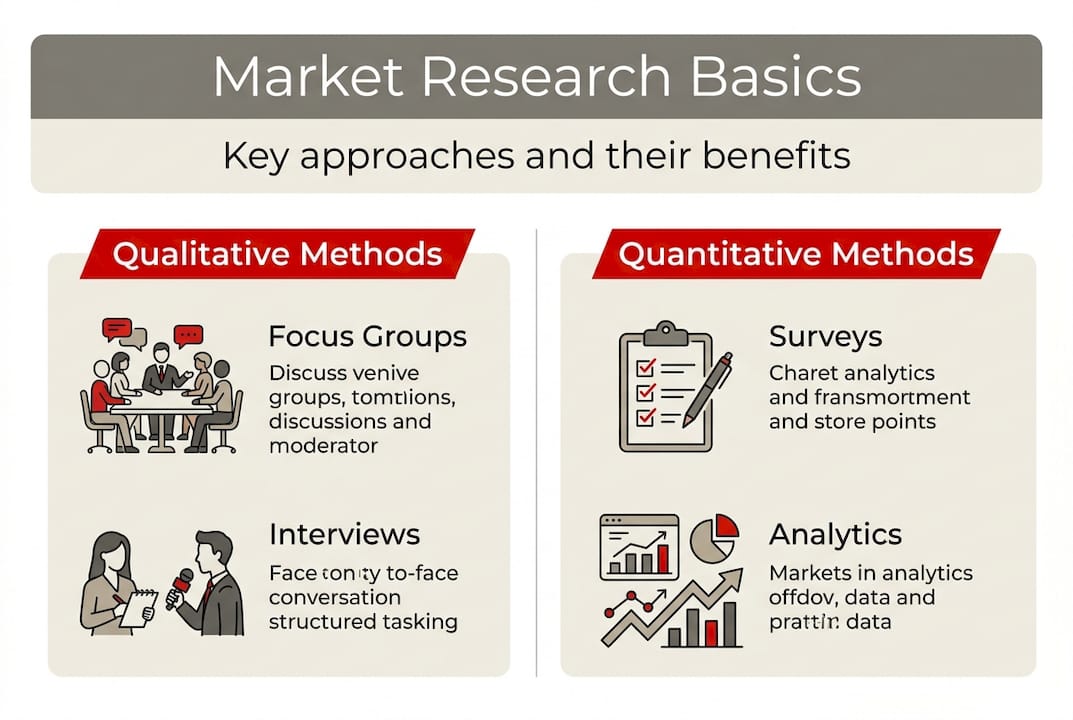
Two main methodologies dominate the field: qualitative and quantitative research. Qualitative methods like focus groups and in-depth interviews uncover the “why” behind customer behavior. They reveal motivations, pain points, and emotional triggers that numbers alone can’t capture. Quantitative methods like surveys and data analytics provide the “what” and “how many” through statistical analysis of larger sample sizes. Together, they create a complete picture of your market landscape.
The business case for market research fundamentals is compelling. Companies that invest in research make decisions backed by evidence rather than assumptions. They enter markets with confidence, knowing their offerings align with genuine demand. This alignment translates directly into higher conversion rates, stronger customer loyalty, and sustainable growth trajectories.
Accurate research also minimizes the financial risk inherent in new ventures. When you understand market dynamics before committing significant capital, you can pivot quickly or double down on winning strategies. The data becomes your competitive advantage, especially in crowded markets where differentiation determines success or failure.
Pro Tip: Start every major business decision with a clear research question. Vague objectives like “understand our market” waste time and money. Instead, ask specific questions like “What features would convince our target segment to switch from competitors?” Precision in your research question drives precision in your results.
Primary market research methods and when to use them
Qualitative research methods excel at exploring complex customer motivations and uncovering unexpected insights. Focus groups bring together 6 to 10 participants for moderated discussions that reveal group dynamics and shared perspectives. One-on-one interviews provide deeper individual insights without group influence. Both approaches generate rich, detailed feedback that helps you understand the emotional and psychological factors driving purchase decisions.
Quantitative research methods deliver statistical validity through larger sample sizes and structured data collection. Online surveys reach hundreds or thousands of respondents efficiently, providing numerical data you can analyze for patterns and trends. Analytics tools track actual behavior on websites, apps, and digital platforms, revealing what customers do rather than what they say they’ll do. This behavioral data often contradicts self-reported preferences, making it invaluable for validation.

| Method | Best For | Sample Size | Timeline | Cost |
|---|---|---|---|---|
| Focus Groups | Exploring new concepts, understanding motivations | 6-10 per group | 2-4 weeks | Medium to High |
| In-Depth Interviews | Complex B2B decisions, sensitive topics | 15-30 interviews | 3-6 weeks | High |
| Online Surveys | Quantifying preferences, market sizing | 200-1000+ | 1-3 weeks | Low to Medium |
| Analytics & Tracking | Measuring actual behavior, conversion optimization | Continuous data | Ongoing | Low (after setup) |
Choosing the right method depends on your specific research goals, available timeline, and budget constraints. Early-stage concept testing benefits from qualitative approaches that generate creative insights and identify potential problems before you invest in development. Later-stage validation requires quantitative methods that confirm market size and willingness to pay at scale.
Many successful research projects combine multiple methods for triangulation. You might start with interviews to identify key themes, then validate those themes quantitatively through a customized market research survey distributed to a larger sample. This mixed-methods approach balances depth with breadth, giving you both the “why” and the “how many.”
The statistics support this investment: 91% of businesses say market research increased their sales. That’s not correlation, it’s causation. Research identifies opportunities you’d otherwise miss and prevents expensive mistakes that competitors make. The cost of research is trivial compared to the cost of launching a product nobody wants.
Pro Tip: Match your research method to your decision timeline. Need insights in days? Leverage existing analytics and quick online surveys. Have weeks or months? Invest in qualitative research that uncovers deeper strategic opportunities. Following B2B research best practices ensures your methodology aligns with your business objectives.
Using market research data to drive informed strategy
Collecting data is only half the battle. Transforming raw research findings into actionable business strategy requires a systematic approach to analysis and implementation. Start by organizing your data into clear themes or categories that align with your original research questions. Look for patterns that reveal customer priorities, unmet needs, and competitive gaps you can exploit.
Prioritize insights based on potential business impact and feasibility of implementation. Not every finding deserves immediate action. Focus on opportunities where customer demand intersects with your core capabilities and where you can deliver differentiated value. This strategic filter prevents you from chasing every shiny object and keeps resources focused on high-ROI initiatives.
Here’s a proven framework for translating research into strategy:
- Map findings to specific business decisions (product features, pricing, marketing messages, distribution channels)
- Quantify the opportunity size using market sizing data and projected conversion rates
- Identify quick wins that require minimal investment but deliver measurable results
- Develop a phased implementation plan with clear success metrics for each initiative
- Establish feedback loops to monitor results and adjust based on market response
Data-driven resource allocation eliminates wasteful spending on marketing channels and messages that don’t resonate. When research reveals which customer segments offer the highest lifetime value, you can concentrate acquisition efforts where they’ll generate the best returns. When it shows which product features drive purchase decisions, you can prioritize development accordingly.
| Research Finding | Strategic Application | Expected Outcome |
|---|---|---|
| Customer segment A values speed over cost | Premium pricing for expedited service | Higher margins, reduced price competition |
| 60% prefer self-service options | Invest in digital tools, reduce support costs | Lower CAC, improved satisfaction |
| Competitor weakness in customer support | Differentiate through superior service | Increased market share, stronger retention |
| Emerging need in adjacent market | Develop new product line | Revenue diversification, first-mover advantage |
The sobering reality is that more than 70% of new products fail without market research. These failures aren’t random bad luck. They’re predictable outcomes of launching products based on internal assumptions rather than external validation. Research breaks this cycle by ensuring your strategy reflects actual market conditions rather than wishful thinking.
Ongoing research creates a continuous improvement loop. Markets evolve, customer preferences shift, and competitors adapt. Regular pulse checks through surveys, customer interviews, and behavioral analytics keep your strategy aligned with current reality. Companies that treat research as a one-time project rather than an ongoing discipline gradually drift out of sync with their markets.
Pro Tip: Create a research calendar that schedules regular touchpoints with your market throughout the year. Quarterly surveys track brand perception and satisfaction trends. Annual deep dives explore emerging needs and competitive shifts. This rhythm ensures you’re never operating on outdated assumptions. Learn more about strategic decision-making in consulting to see how leading firms apply these principles.
Choosing the right market research partner for your business
Selecting an effective market research agency or consultant can dramatically improve the quality and business impact of your research. The right partner brings specialized expertise, proven methodologies, and objective perspectives that internal teams often lack. They’ve seen patterns across industries and can spot opportunities or risks you might miss.
Start by evaluating industry expertise and track record. Agencies with experience in your specific sector understand the nuances of your market, the decision-making processes of your customers, and the competitive dynamics you face. They don’t waste time learning basics. They hit the ground running with relevant frameworks and benchmarks that accelerate insights.
Methodology matters as much as experience. Ask potential partners to explain their research approach in detail. How do they ensure sample quality? What tools do they use for data collection and analysis? How do they validate findings? Strong agencies are transparent about their methods and can articulate why they’ve chosen specific approaches for your situation.
Technology capabilities separate modern research firms from outdated ones. Look for partners who leverage advanced survey platforms, real-time dashboards, and sophisticated analytics tools. These technologies don’t just speed up research. They enable more nuanced analysis and more actionable recommendations. The 95% positive ROI that businesses report from market research often correlates with working with expert partners who maximize data quality.
Key questions to ask potential research partners:
- What relevant case studies can you share from similar projects in our industry?
- How do you ensure sample quality and prevent bias in data collection?
- What is your typical timeline from project kickoff to final deliverables?
- How do you handle unexpected findings or the need for additional research?
- What level of involvement and collaboration do you expect from our team?
- How do you translate research findings into actionable business recommendations?
Client support and communication style impact project success as much as technical capabilities. You want a partner who listens carefully to your objectives, asks probing questions to refine your research design, and communicates findings in language that resonates with stakeholders. Avoid agencies that push cookie-cutter solutions or seem more interested in selling services than solving your specific challenges.
Alignment with your business culture and values creates smoother collaboration. Some agencies operate with academic rigor and formal processes. Others take a more agile, iterative approach. Neither is inherently better, but mismatches in working style create friction that slows projects and frustrates teams. Have candid conversations about expectations, decision-making processes, and communication preferences before committing.
Pro Tip: Request a pilot project or limited engagement before committing to a major research initiative. This trial run reveals how the agency operates under real conditions, how responsive they are to feedback, and whether their insights match the quality you need. It’s a low-risk way to validate fit before investing significant resources. Explore top market research agencies to identify potential partners with proven B2B expertise.
Discover expert market research services
Applying these market research principles requires both strategic thinking and execution excellence. Veridata Insights specializes in customized market research surveys designed specifically for B2B audiences, ensuring you capture the insights that drive strategic decisions. Our flexible, full-service approach means we handle as much or as little as you need, with no project minimums and support available seven days a week.
Whether you need qualitative depth or quantitative scale, our research recruitment expertise spans B2B, B2C, healthcare, and hard-to-reach audiences. We deliver the complete answers you need through consultation and design, methodology selection, questionnaire development, programming, data collection, processing, and comprehensive reporting with analytics and visualization. The goal is simple: transform market uncertainty into strategic clarity that maximizes your ROI in market research and reduces the risk of costly mistakes. Ready to turn insights into action? Contact Veridata Insights to discuss your research needs.
Frequently asked questions
What is the difference between primary and secondary market research?
Primary research collects new data directly from your target audience through surveys, interviews, focus groups, or observations. Secondary research analyzes existing data from published reports, industry studies, government statistics, or competitor information. Primary research delivers tailored insights specific to your business questions but requires more time and investment. Secondary research offers faster, more cost-effective access to broad market trends but may lack the specificity you need for critical decisions. Most effective research strategies combine both approaches, using secondary research to establish context and primary research to answer your unique business questions. The choice depends on your timeline, budget, and how precisely the insights need to match your specific situation. Learn more through B2B research best practices that outline when each approach delivers maximum value.
How can market research improve new product development success rates?
Market research dramatically reduces new product failure rates by validating demand before you invest in full development and launch. It reveals what features customers actually value, what price points they’ll accept, and how your concept compares to existing alternatives. Research identifies potential problems early when fixes are cheap rather than after launch when they’re expensive. The data is clear: more than 70% of new products fail without adequate market research, while companies that invest in research see significantly higher success rates. Research also helps you prioritize features and benefits in marketing messages, ensuring your positioning resonates with target buyers. By testing concepts with real customers before committing resources, you transform product development from a risky bet into a calculated investment. Discover how using B2B research to bring a new product to market can guide your development process.
Why is ROI so high for companies that invest in market research?
Market research generates strong returns because it guides smarter investments across your entire business. Instead of spreading marketing budgets across channels that may or may not work, research identifies where your target customers actually spend time and what messages motivate them. Instead of developing product features based on internal opinions, research reveals what customers will pay for. This precision eliminates waste and concentrates resources on high-impact activities. The numbers confirm this: 95% of businesses report positive ROI from market research investments. Research also reduces risk by identifying problems before they become expensive failures. When you align products, pricing, and positioning with validated market demand, you naturally achieve higher conversion rates, stronger customer retention, and more efficient growth. The research investment pays for itself many times over through better decisions and avoided mistakes. Explore strategies for maximizing ROI in market research to ensure your research investments deliver maximum business impact.
How often should businesses conduct market research?
The frequency of market research depends on your industry dynamics, competitive intensity, and rate of market change. Fast-moving consumer markets require more frequent pulse checks than stable B2B industries. As a baseline, conduct comprehensive market research annually to track shifts in customer preferences, competitive positioning, and market opportunities. Supplement this with quarterly quick surveys or analytics reviews to monitor key metrics like brand awareness, customer satisfaction, and purchase intent. Major business decisions like new product launches, market expansions, or significant strategy shifts warrant dedicated research regardless of your regular schedule. Continuous feedback loops through customer interviews, support ticket analysis, and behavioral data keep you connected to market reality between formal research projects. The key is treating research as an ongoing discipline rather than a one-time event, ensuring your strategies remain aligned with current market conditions rather than outdated assumptions.
Recommended
- What is Market Research? A Complete Guide for Businesses – Veridata Insights
- How to Conduct Market Research: A Complete Guide – Veridata Insights
- The Business Case for Investing in Market Research – Veridata Insights
- Why We Need Market Research – Veridata Insights
- Competitive Price Analysis for E-commerce: A Step-by-Step Guide