



Traditional market research often promises comprehensive insights but delivers slowly, missing niche audiences and decision-makers who drive real business outcomes. Research panels flip this model by offering pre-recruited, profiled participants ready to provide targeted feedback fast. For market researchers and brand strategists navigating B2B complexity or B2C segmentation, panels unlock access to hard-to-reach professionals, competitor customers, and specialized demographics without starting recruitment from scratch. This guide explains how research panels improve speed, quality, and strategic value across quantitative and qualitative projects.
Table of Contents
- Key takeaways
- Understanding research panels and their advantages
- Response rate trends and quality control in research panels
- Comparing research panels, ad-hoc surveys, and expert networks
- Practical tips for leveraging research panels effectively
- How Veridata Insights can support your research panel needs
- Frequently asked questions
Key Takeaways
| Point | Details |
|---|---|
| Fast audience access | Panels provide fast access to targeted B2B and B2C audiences without starting recruitment from scratch. |
| Response rates fall | Response rates have declined across channels, but rigorous quality controls and AI matching improve reliability and reduce irrelevant invitations. |
| Panel fatigue risk | Survey fatigue can arise if invitations are too frequent, underscoring the need for thoughtful sampling and screening. |
| Pre profiled targeting | Panel profiling enables precise segmentation by job role, industry, and behavior. |
Understanding research panels and their advantages
Research panels are pre-recruited groups of individuals who agree to participate in surveys, interviews, or studies over time. Unlike ad-hoc recruitment where you source respondents project by project, panels maintain a ready pool of profiled participants. Each panelist provides demographic, firmographic, and behavioral data upfront, enabling precise targeting. For B2B research, this means instant access to IT directors, procurement managers, or C-suite executives. For B2C, you can filter by purchase behavior, lifestyle, or product usage without building lists from scratch.
Panels use incentives like cash, gift cards, or points to maintain engagement. Advanced platforms apply AI to match panelists with relevant surveys, reducing fatigue and improving completion rates. Quality controls such as attention checks, speed traps, and consistency validation filter out low-effort responses. This infrastructure saves weeks of recruitment time and delivers reliable samples for quantitative studies or qualitative screeners.
The core benefits are clear. You gain time efficiency by skipping recruitment cycles. Sample reliability improves because panelists are verified and profiled. Access to competitor customers, niche professionals, and hard-to-reach segments becomes straightforward. For brand managers evaluating new markets or product concepts, panels provide the speed and precision traditional methods lack.
Key advantages of research panels:
- Immediate access to targeted audiences, including niche B2B professionals and B2C consumers, without building from scratch
- Pre-profiled participants enable precise segmentation by job role, industry, purchase behavior, or demographics
- Incentive structures and AI matching sustain engagement and reduce survey fatigue
- Quality controls filter unreliable responses, improving data integrity and actionable insights
Pro Tip: When designing customized B2B surveys, use panel profiling data to pre-screen decision-makers by budget authority or technology stack, ensuring your sample matches strategic research goals.
Understanding why B2B audience research matters helps you leverage panels strategically. Panels are not just faster; they deliver participants whose profiles align with your research objectives, making every completed survey more valuable.
Response rate trends and quality control in research panels
Survey response rates have declined steadily over the past decade. Completion rates have dropped 30% as survey fatigue spreads across online and mobile channels. Email surveys now average 10-30% response rates, while SMS surveys perform better at 40-50%. These trends reflect oversaturation; consumers and professionals receive more survey invitations than ever, leading to lower engagement and higher abandonment.
Research panels address this challenge through rigorous quality controls. Double opt-in processes verify panelist commitment before enrollment. Hygiene checks remove duplicate accounts, bots, and fraudulent profiles. AI matching assigns surveys to panelists whose profiles fit the research criteria, reducing irrelevant invitations that drive fatigue. Attention checks and speed traps identify careless or rushed responses, flagging them for exclusion. These mechanisms improve data quality despite broader response rate declines.

Incentive design also plays a critical role. Panels balance reward value with survey length and complexity. Higher incentives for longer or technical surveys maintain completion rates. Points-based systems encourage ongoing participation by rewarding cumulative engagement. For B2B panels targeting senior decision-makers, premium incentives reflect the scarcity and value of executive time.
| Response channel | Average response rate | Completion rate trend | Quality control impact |
|---|---|---|---|
| Email surveys | 10-30% | Declining 30% over 10 years | Double opt-in and hygiene checks boost reliability |
| SMS surveys | 40-50% | More stable but still affected by fatigue | AI matching reduces irrelevant invitations |
| Panel-based surveys | Varies by engagement strategy | Sustained through incentives and profiling | Attention checks and speed traps filter low-quality responses |
Pro Tip: Use double opt-in when recruiting panelists to ensure genuine interest and reduce dropout rates. This simple step improves market research panel effectiveness by filtering uncommitted participants upfront.
Quality controls in research panels are not optional. They are the foundation of reliable data. Without attention checks, speed traps, and AI matching, even the best-recruited panel degrades into noise.
By combining targeted recruitment with rigorous validation, panels deliver higher ROI than ad-hoc surveys despite industry-wide response rate challenges.
Comparing research panels, ad-hoc surveys, and expert networks
Research panels, ad-hoc surveys, and expert networks each serve distinct purposes. Panels excel in speed and sample quality. Pre-recruited participants eliminate sourcing delays, and profiling ensures alignment with research criteria. Ad-hoc surveys offer flexibility for one-off projects but require weeks to recruit and vet respondents. Expert networks provide deep qualitative insights from senior decision-makers, complementing panel quantitative data.
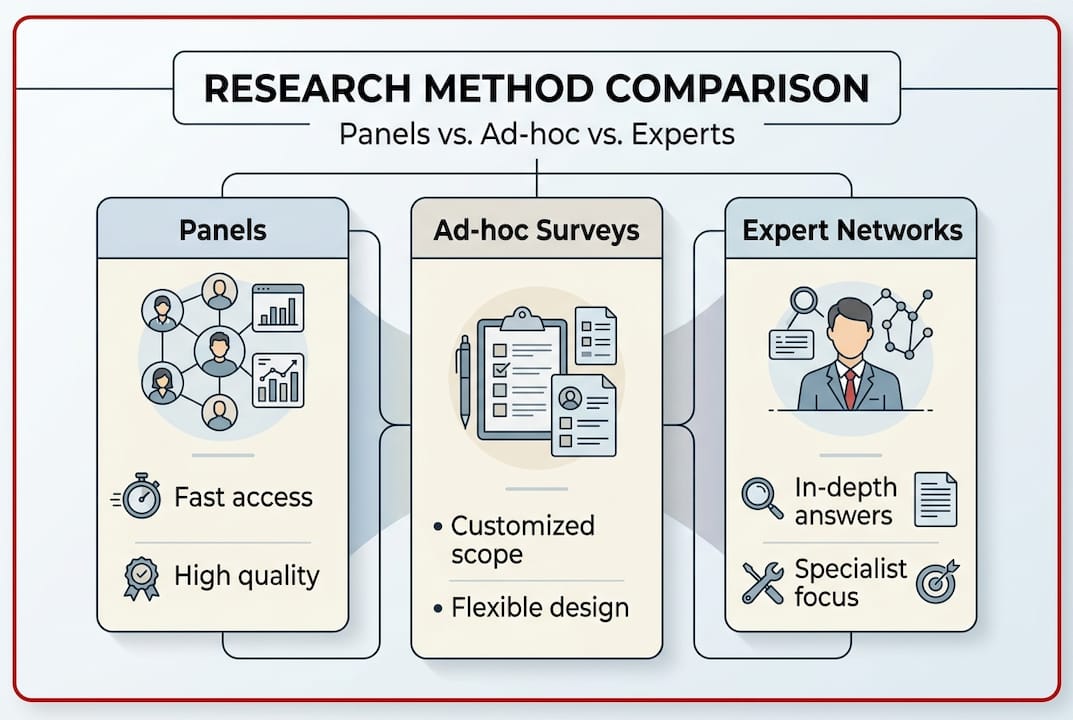
Panels outperform ad-hoc surveys in speed and quality but risk survey fatigue. Over-surveying panelists leads to declining engagement and skewed responses. Expert networks add decision-maker depth in B2B contexts, offering strategic perspectives panels cannot capture at scale. For example, a panel survey might quantify product feature preferences among IT managers, while expert interviews reveal the strategic reasoning behind those preferences.
Mixed approaches work best. Use panels for broad quantitative insights and expert networks for deep qualitative exploration. This combination avoids common market research pitfalls like over-reliance on a single method or missing strategic context.
| Method | Speed | Sample quality | Depth of insight | Best use case |
|---|---|---|---|---|
| Research panels | Fast (days to weeks) | High with quality controls | Moderate (quantitative focus) | Broad segmentation, feature testing, brand tracking |
| Ad-hoc surveys | Slow (weeks to months) | Variable (depends on recruitment) | Moderate | One-off projects, exploratory research |
| Expert networks | Moderate (weeks) | Very high (senior decision-makers) | Very high (qualitative, strategic) | In-depth B2B interviews, strategic insights |
When to use each method:
- Research panels: Quantitative studies requiring fast turnaround and precise targeting across B2B or B2C segments
- Ad-hoc surveys: Exploratory projects where panel access is unavailable or research needs are highly specialized
- Expert networks: Strategic qualitative research needing C-suite or senior decision-maker perspectives
Combining panels with expert networks maximizes value. Panels provide statistical validation, while experts explain the why behind the numbers. For consulting firms or brand managers, this dual approach delivers both breadth and depth.
Practical tips for leveraging research panels effectively
Successful panel use starts with recruitment and profiling. Define your target audience by job role, industry, company size, or behavioral traits. Use double opt-in to verify panelist commitment. Profile participants with detailed demographic, firmographic, and psychographic data. This upfront investment ensures your sample matches research objectives and reduces wasted effort on irrelevant respondents.
Incentive design matters. Match reward value to survey length and complexity. For B2B panels targeting senior executives, premium incentives reflect time scarcity. For B2C panels, points systems encourage ongoing participation. AI matching assigns surveys to panelists whose profiles fit the criteria, reducing fatigue and improving completion rates.
Quality controls are non-negotiable. Use attention checks to identify careless responses. Apply speed traps to flag rushed completions. Validate consistency across related questions. These mechanisms filter unreliable data and improve ROI.
Combining panels with expert networks enhances insights. Panels quantify trends; experts explain strategic reasoning. For example, a panel survey might reveal declining interest in a product feature, while expert interviews uncover the competitive or technological factors driving that shift.
Step-by-step guide to effective panel use:
- Define your target audience with precise demographic, firmographic, or behavioral criteria
- Recruit panelists using double opt-in to ensure quality, especially for targeting B2B job roles
- Profile participants with detailed data to enable precise segmentation and AI matching
- Design incentives that balance reward value with survey length and respondent scarcity
- Apply quality controls like attention checks, speed traps, and consistency validation
- Combine panels with expert networks for mixed-method insights that blend quantitative breadth with qualitative depth
Pro Tip: Avoid over-surveying panelists. Track participation frequency and rotate surveys to prevent fatigue. This protects panel quality and sustains engagement over time.
Following B2B research best practices ensures your panel delivers actionable insights. Proper recruitment, profiling, and quality controls transform panels from convenient samples into strategic assets.
How Veridata Insights can support your research panel needs
Veridata Insights specializes in market research that combines speed, precision, and flexibility. Our team recruits and manages research panels for B2B, B2C, healthcare, and hard-to-reach audiences, delivering the targeted samples your projects demand. Whether you need quantitative surveys, qualitative interviews, or mixed-method studies, we provide full-service support from consultation and design through data collection, processing, and reporting.
We understand the challenges of panel recruitment and quality control. Our expertise ensures your research reaches the right decision-makers and delivers reliable, actionable insights. From customized B2B survey design to understanding B2B audience research, we handle the complexity so you can focus on strategic outcomes. Contact Veridata Insights to discuss how we can support your next research panel project.
Learn more about BizKnowledge – Veridata Insights’ validated panel – here.
Frequently asked questions
What are research panels and how do they differ from other research methods?
Research panels are pre-recruited groups of individuals profiled and ready to participate in surveys or studies. Unlike ad-hoc surveys that require recruiting respondents for each project, panels provide immediate access to targeted audiences. This saves time and improves sample quality through upfront profiling and verification.
How can I ensure high response rates and data quality with research panels?
Use targeted recruitment to align panelists with research criteria. Apply double opt-in processes to verify commitment and reduce dropouts. Implement quality controls like attention checks and speed traps to filter unreliable responses. Incentive design also matters; match rewards to survey complexity and respondent scarcity to sustain engagement.
When should expert networks be used alongside research panels?
Expert networks complement panels when you need deep qualitative insights from senior decision-makers. Panels quantify trends across broad samples; experts explain the strategic reasoning behind those trends. For B2B research, combining both methods delivers statistical validation and strategic context, maximizing the value of your insights.
What are the main advantages of using research panels for B2B market research?
Panels provide fast access to niche B2B professionals like IT directors, procurement managers, or C-suite executives. Pre-profiling enables precise targeting by job role, industry, or budget authority. Quality controls and AI matching reduce survey fatigue and improve data reliability, making panels ideal for strategic decision-making and competitive analysis.
How do I avoid survey fatigue in research panels?
Track participation frequency and rotate surveys to prevent over-surveying. Use AI matching to assign relevant surveys, reducing irrelevant invitations. Balance incentive value with survey length to maintain engagement. Monitor completion rates and adjust recruitment or engagement strategies if fatigue signals appear, protecting panel quality over time.
Recommended
- Market Research Buyers: What Agencies and Panels Should Deliver – Veridata Insights
- Why Veridata Insights Is the Online Panel Provider That Sets the Standard for Market Research – Veridata Insights
- Why Market Research Is a Valuable Tool for Stock Market Investing – Veridata Insights
- The Best Market Research Agencies for Tough Audiences – Veridata Insights