


Many nonprofit leaders believe passion and mission alone drive success. While dedication matters, this mindset overlooks a critical ingredient: research. Organizations that leverage data-driven insights consistently outperform those relying solely on intuition. Research transforms how nonprofits identify community needs, measure program effectiveness, and secure funding. This article reveals why research is your nonprofit’s strategic advantage and provides practical guidance for integrating it into your planning process.
Table of Contents
- Understanding The Strategic Value Of Research For Nonprofits
- Types Of Research Nonprofits Use And How To Choose The Right Approach
- Applying Research Insights To Maximize Nonprofit Impact
- Summary: Why Embracing Research Empowers Nonprofit Leadership
- Get Expert Support For Your Nonprofit Research Needs
Key takeaways
| Point | Details |
|---|---|
| Research drives decisions | Data replaces guesswork, enabling leaders to allocate resources where they create maximum impact. |
| Community needs identification | Systematic inquiry reveals what beneficiaries actually need versus what organizations assume they need. |
| Stakeholder trust building | Transparent, ethical research practices strengthen relationships with donors, partners, and communities. |
| Program effectiveness measurement | Evidence-based evaluation shows what works, what doesn’t, and where to innovate. |
| Funding opportunities expansion | Compelling research findings support grant proposals and demonstrate accountability to funders. |
Understanding the strategic value of research for nonprofits
Nonprofit research encompasses systematic data collection, analysis, and interpretation focused on mission-related questions. Unlike corporate market research aimed at profit maximization, nonprofit research centers on social impact, community wellbeing, and mission alignment. It answers critical questions: Are we serving the right populations? Do our programs create meaningful change? Where should we focus limited resources?
Research offers nonprofits actionable insights that improve strategic planning and program focus. When you understand your community’s evolving needs, you design programs that resonate. When you measure outcomes rigorously, you identify what drives success and what drains resources without results. This evidence base transforms board discussions from opinion-based debates into data-informed strategy sessions.

The benefits extend beyond internal decision making. Research optimizes resource allocation by revealing which interventions deliver the strongest outcomes per dollar spent. It enhances program relevance by keeping services aligned with actual community conditions rather than outdated assumptions. Funders increasingly demand evidence of impact, making research essential for competitive grant applications and donor retention.
Nonprofits commonly use several research types:
- Surveys to gather broad feedback from beneficiaries, staff, or community members
- In-depth interviews to explore complex experiences and motivations
- Focus groups to understand community perspectives and test program concepts
- Impact assessments to measure program outcomes against stated goals
- Market analysis to identify service gaps and competitive positioning
- Needs assessments to prioritize community challenges requiring intervention
Pro Tip: Integrate research into your annual planning cycle rather than treating it as a one-time project. Regular data collection keeps your organization adaptive, revealing emerging needs and shifting conditions before they become crises.
Types of research nonprofits use and how to choose the right approach
Quantitative research relies on numerical data, statistical analysis, and measurable variables. Surveys with scaled responses, program participation rates, and outcome metrics all fall into this category. This approach excels at answering “how many” and “how much” questions. You can track changes over time, compare different populations, and demonstrate impact with concrete numbers that funders appreciate.
Qualitative research explores experiences, motivations, and contexts through interviews, focus groups, and observation. It answers “why” and “how” questions that numbers alone cannot address. Partnering with qualitative research firms can deepen understanding of beneficiary experiences and stakeholder perspectives, revealing the human stories behind statistics and uncovering unexpected barriers to program success.
| Aspect | Quantitative Research | Qualitative Research |
|---|---|---|
| Data Type | Numerical, statistical | Narrative, descriptive |
| Sample Size | Large, representative | Smaller, purposive |
| Analysis | Statistical tests, trends | Thematic coding, patterns |
| Best For | Measuring impact, tracking metrics | Understanding experiences, exploring barriers |
| Cost | Moderate to high for large samples | Moderate, depends on depth |
| Timeline | Can be quick with online tools | Time-intensive for analysis |
| Generalizability | High with proper sampling | Limited, focuses on depth |
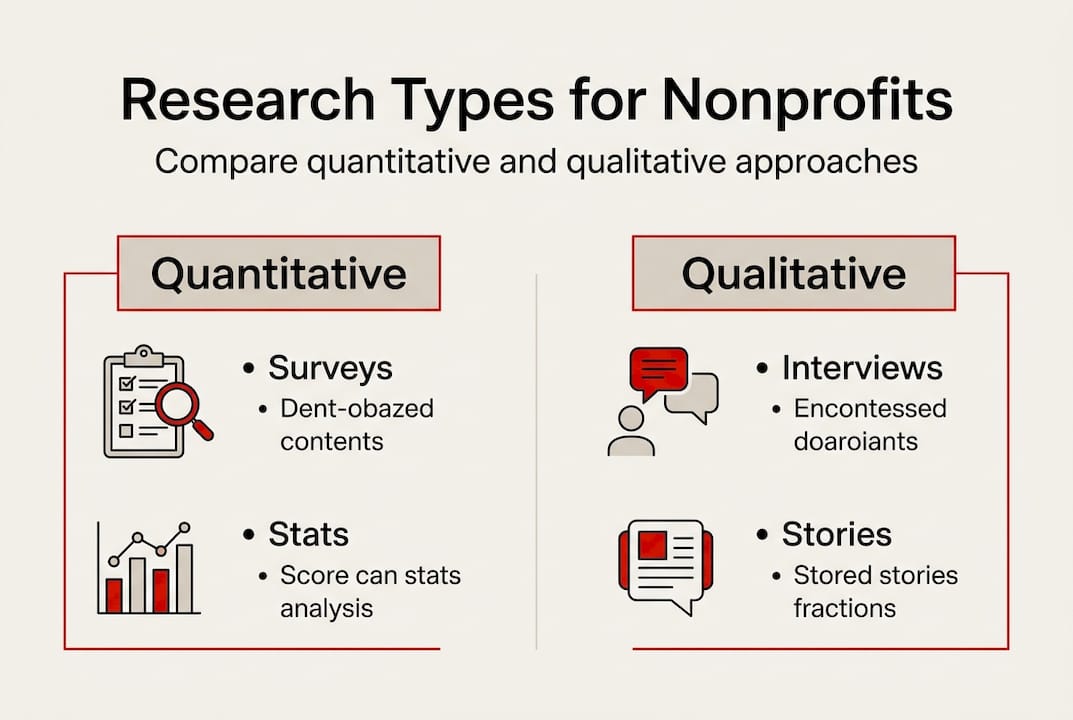
Mixed methods approaches combine both research types for comprehensive insights. You might survey 500 community members to identify prevalent needs, then conduct 20 interviews to understand why those needs exist and what solutions would work. This strategy delivers both breadth and depth, satisfying funders who want numbers while giving program staff the contextual understanding they need for effective implementation.
When choosing your research approach, consider these factors:
- Budget constraints and available funding for research activities
- Specific goals driving the inquiry and questions requiring answers
- Timeline for completing research and applying findings
- Target audience characteristics and accessibility for data collection
- Type of data needed to inform decisions or satisfy stakeholder requirements
- Internal capacity for managing research or need for external partnership
Your research question should drive methodology selection, not the reverse. If you need to understand why program dropout rates increased, qualitative interviews with participants who left will provide more valuable insights than a statistical analysis of demographic variables.
Applying research insights to maximize nonprofit impact
Collecting data means nothing without translating findings into action. Follow these steps to integrate research into your nonprofit’s operations:
- Translate raw data into clear insights by identifying patterns, themes, and actionable conclusions rather than presenting endless tables and charts.
- Communicate findings to stakeholders using accessible language, compelling visuals, and explicit connections between data and organizational priorities.
- Facilitate interpretation sessions where board members, staff, and beneficiaries discuss what findings mean for program design and strategic direction.
- Develop specific action plans with assigned responsibilities, timelines, and success metrics based on research recommendations.
- Implement program changes systematically, monitoring early results to ensure modifications achieve intended improvements.
- Document lessons learned and share knowledge across your organization to build a culture of continuous learning and adaptation.
Building stakeholder trust requires transparency about research methods, limitations, and findings. Ethical research practices build trust and strengthen nonprofit partners’ relationships with communities and donors. Share how you protected participant confidentiality, obtained informed consent, and ensured data security. When findings reveal program shortcomings, acknowledge them honestly rather than hiding uncomfortable truths. Stakeholders respect organizations that demonstrate accountability and commitment to improvement.
Research strengthens grant proposals by providing evidence of community need, program effectiveness, and organizational capacity. Instead of claiming your services are needed, cite specific data showing gaps your programs address. Replace vague outcome statements with concrete metrics from previous evaluations. Demonstrate your commitment to learning and adaptation by explaining how research informs continuous improvement.
Pro Tip: Engage frontline staff and program participants in interpreting research findings. They bring practical knowledge that prevents misinterpretation and ensures recommendations are realistic given operational constraints and community context.
Avoid common pitfalls that undermine research value. Don’t cherry-pick data that supports predetermined conclusions while ignoring contradictory findings. Resist overgeneralizing results from small samples or specific contexts to your entire service population. Ensure your sampling approach doesn’t systematically exclude important voices, creating bias that skews understanding. When research reveals unexpected or unwelcome findings, treat them as learning opportunities rather than threats.
Summary: why embracing research empowers nonprofit leadership
Research transforms nonprofit leadership from reactive to proactive, from assumption-based to evidence-informed. It provides the clarity needed to navigate complex social challenges, the effectiveness metrics that demonstrate accountability, and the innovation insights that keep programs relevant as communities evolve. Organizations that embrace research build stronger stakeholder relationships because they can demonstrate impact with credible evidence rather than compelling stories alone.
The mindset shift from intuition to evidence doesn’t diminish the importance of passion and mission commitment. Instead, it channels that dedication more effectively by ensuring energy flows toward interventions that actually work. When you know which program elements drive outcomes and which consume resources without results, you maximize impact with limited budgets.
“Nonprofits using regular research to inform strategy report 40% higher program effectiveness scores and secure 35% more grant funding compared to organizations relying primarily on anecdotal evidence and institutional assumptions.”
Now is the time to initiate or expand your research initiatives. Start small if necessary, perhaps with a simple beneficiary satisfaction survey or a brief needs assessment in one service area. As you experience the value of market research for strategic consulting, you’ll find ways to integrate systematic inquiry throughout your organization. The investment pays dividends through stronger programs, more satisfied stakeholders, and greater mission achievement.
Get expert support for your nonprofit research needs
Veridata Insights specializes in research partnerships tailored to nonprofit organizations navigating complex community needs and accountability requirements. We understand the unique challenges you face, from limited budgets to diverse stakeholder expectations, and we design flexible research solutions that deliver actionable insights without overwhelming your capacity.
Our commitment to ethical practices ensures your community relationships remain strong while you gather the evidence needed for strategic decision making. Whether you need quantitative impact measurement, qualitative program evaluation, or mixed methods approaches, we provide full-service support from design through analysis and reporting. Contact Veridata Insights to discuss how customized research consultation can strengthen your strategic planning and program development. We excel at partnering with a qualitative research firm approach that honors your mission while delivering the rigor funders demand.
FAQ
Why is research critical for nonprofit strategic planning?
Research provides evidence to make informed decisions, identify community needs, and measure impact, which are essential for effective strategic planning. It replaces assumptions with facts, revealing where services should expand, contract, or pivot to achieve maximum mission alignment. Data-driven planning minimizes risks associated with launching programs based on hunches rather than documented community conditions. Organizations using systematic research allocate resources more efficiently and demonstrate stronger outcomes to boards and funders.
How can nonprofits afford quality research with limited budgets?
Nonprofits can prioritize high ROI research solutions by focusing on questions with the greatest strategic importance rather than pursuing comprehensive studies addressing every curiosity. Phased projects spread costs over time while delivering incremental insights that inform immediate decisions. Partnering with firms offering flexible pricing and no project minimums makes professional research accessible even for small organizations. Leveraging existing administrative data, combining research with operational activities, and using mixed methods strategically can reduce costs while maintaining quality and rigor.
What are common pitfalls nonprofits should avoid in research?
Common pitfalls include bias, poor methodology, and neglecting ethical considerations that compromise data quality and stakeholder trust. Sampling bias occurs when research excludes important voices, creating skewed understanding of community needs or program effectiveness. Ignoring contradictory findings because they challenge organizational assumptions prevents genuine learning and improvement. Ethical lapses like inadequate informed consent, poor confidentiality protection, or exploitative data collection damage community relationships. Ensure proper research design with clear objectives, appropriate methods, and transparent reporting that acknowledges limitations alongside strengths.
How do I choose the right research partner for my nonprofit?
Look for firms with demonstrated nonprofit experience who understand mission-driven organizations’ unique needs and constraints. Verify their commitment to ethical research consulting partnerships through transparent practices, community-centered approaches, and respect for vulnerable populations. Assess methodological flexibility to ensure they recommend approaches based on your needs rather than pushing predetermined solutions. Check references from similar organizations and confirm alignment with your values around equity, inclusion, and community empowerment. The right partner views research as collaborative learning rather than extractive data collection.
What types of research deliver the fastest results for nonprofits?
Online surveys using existing contact lists can generate quantitative data within weeks, providing quick snapshots of satisfaction, needs, or preferences. Rapid qualitative assessments using brief phone interviews or focus groups deliver contextual insights faster than extensive ethnographic studies. Secondary data analysis examining existing program records, community statistics, or prior research offers immediate evidence without new data collection. However, speed shouldn’t override quality. Quick research with flawed design wastes resources and misleads decision making, so balance timeline pressures against methodological rigor.
How often should nonprofits conduct research?
Integrate research into regular organizational rhythms rather than treating it as occasional special projects. Annual beneficiary satisfaction surveys track service quality trends over time. Biennial community needs assessments ensure programs remain aligned with evolving conditions. Ongoing program monitoring collects operational data continuously for real-time adjustments. Major strategic planning cycles every three to five years warrant comprehensive research examining organizational positioning, community landscape changes, and impact evidence. The specific frequency depends on your operating environment’s stability, with rapidly changing communities requiring more frequent inquiry than stable contexts.
Recommended
- How Market Research Drives Strategic Decision-Making in Consulting – Veridata Insights
- Leveraging Market Research for Strategic Consulting – Veridata Insights
- What Consulting Clients Expect from Market Research-Driven Strategies – Veridata Insights
- High ROI Research Solutions for Cost-Conscious Firms – Veridata Insights