



Marketers who segment their campaigns can boost revenue by up to 760% compared to generic approaches. Yet many still waste budget by treating all customers the same way. Modern consumers expect personalized experiences, and audience segmentation is the strategic tool that makes targeted marketing effective. This guide covers what audience segmentation is, its benefits, types, common misconceptions, methods, and how to apply it successfully.
Table of Contents
- Definition And Importance Of Audience Segmentation
- Types Of Audience Segmentation
- Benefits Of Audience Segmentation
- Common Misconceptions About Segmentation
- How To Perform Audience Segmentation
- Comparison Of Segmentation Methods And Criteria
- Segmentation In B2B Versus B2C Marketing
- Future Trends And Technology In Audience Segmentation
- Discover Expert Audience Segmentation Solutions
Key takeaways
| Point | Details |
|---|---|
| Audience segmentation divides a broad audience into distinct groups for personalized marketing | Splitting audiences by shared traits enables tailored messaging that improves relevance and campaign effectiveness |
| Five main types exist: demographic, geographic, psychographic, behavioral, and firmographic | Each type serves different marketing goals and can be combined for stronger results |
| Effective segmentation improves relevance, customer loyalty, and ROI significantly | Personalized communication increases engagement and reduces wasted marketing spend |
| Common misconceptions about complexity and data sufficiency limit segmentation success | Segmentation can start simple and scale; demographic data alone is insufficient |
| Combining segmentation types and continuously refining segments maximizes campaign impact | Hybrid approaches and regular updates deliver 20-30% better performance |
Definition and importance of audience segmentation
Audience segmentation divides a large audience into smaller groups sharing common characteristics to enable tailored communication and improve marketing relevance. Instead of broadcasting the same message to everyone, you create personalized content that resonates with specific subsets of your audience. This targeted approach transforms how campaigns perform.
Segmentation allows personalized communication that improves campaign effectiveness dramatically. When you understand what motivates each group, you craft messages that speak directly to their needs and pain points. This relevance builds trust and drives action.
Targeted campaigns reduce wasted marketing spend significantly. By focusing resources only on receptive audiences, you eliminate the cost of reaching people who will never convert. Every dollar works harder when directed at segments proven to engage with your offerings.
“Audience segmentation is the foundation of effective marketing in 2026. Without it, you’re essentially shouting into a void and hoping someone listens.”
The strategic value extends beyond immediate campaign results. Segmentation reveals insights about customer preferences, behaviors, and values that inform product development, pricing strategies, and customer service improvements. Understanding your audience at this granular level creates competitive advantages that compound over time.
Types of audience segmentation
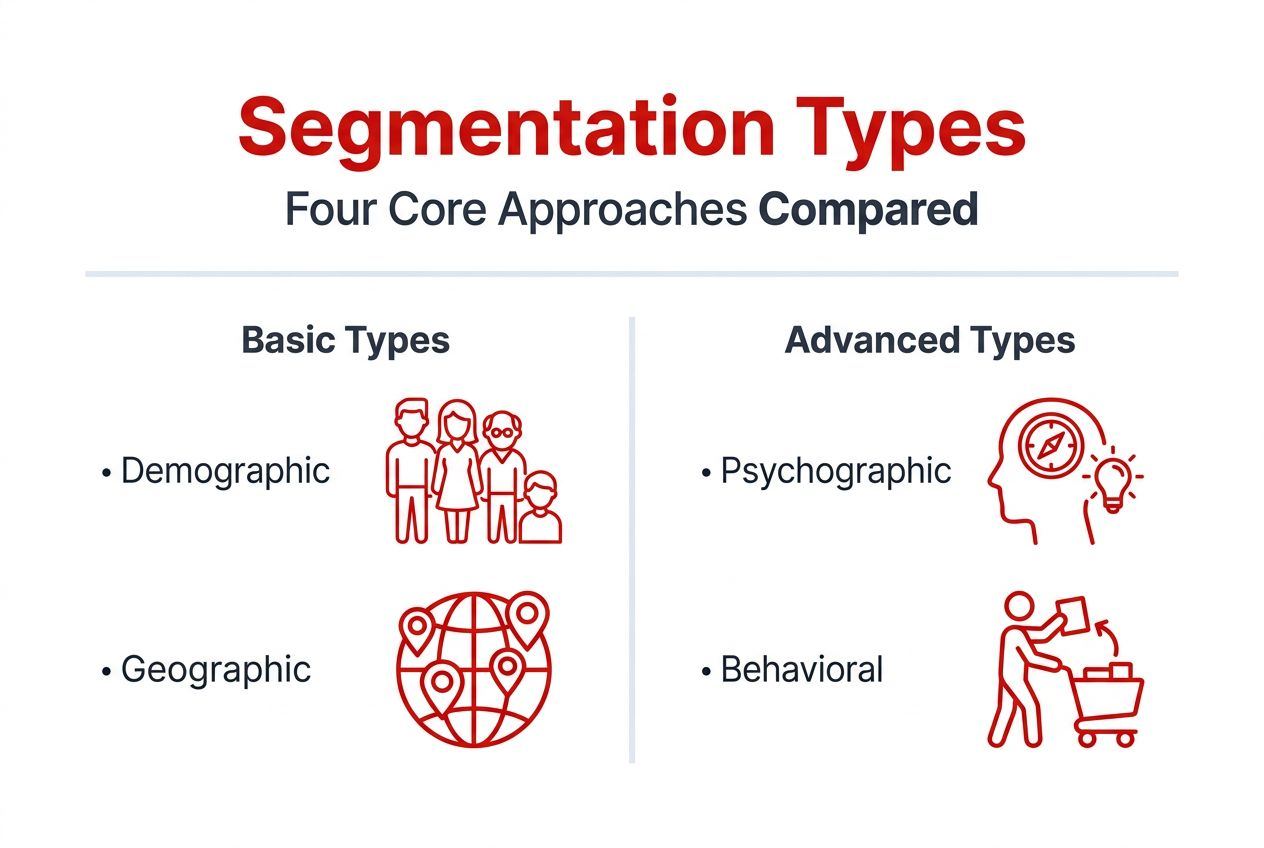
Marketers use five main segmentation types to classify audiences, each offering unique insights into customer characteristics and preferences. Understanding these categories helps you choose the right approach for your marketing goals.
- Demographic segmentation: Divides audiences by age, gender, income, education level, occupation, and marital status. This is the most common and accessible type because demographic data is readily available through public records and customer databases.
- Geographic segmentation: Groups customers by location factors such as country, region, city, climate, or population density. A winter clothing brand would prioritize cold climate regions while a surfwear company targets coastal areas.
- Psychographic segmentation: Focuses on values, interests, personalities, attitudes, and lifestyle choices. This deeper approach reveals why customers make purchasing decisions beyond surface demographics.
- Behavioral segmentation: Analyzes purchase behavior, usage frequency, engagement level, brand loyalty, and buying stage. This data driven method tracks what customers actually do rather than who they are.
- Firmographic segmentation: Applies to B2B marketing by examining company attributes like size, industry, revenue, location, and number of employees. This helps target organizations most likely to need your business solutions.
Each type serves different purposes, and savvy marketers often combine multiple types for richer insights. A software company might use firmographic data to identify target industries, then layer behavioral data to find companies actively searching for solutions. This hybrid approach creates precise targeting that outperforms single variable segmentation.
Benefits of audience segmentation
Implementing audience segmentation delivers measurable business value that justifies the investment in data collection and analysis. The benefits extend across customer experience, financial performance, and operational efficiency.
- Enhanced personalization: Segmentation improves customer experience and loyalty by delivering communication that feels emotionally relevant and relatable to different segments. Customers notice when brands understand their specific needs.
- Revenue growth: Segmented campaigns can boost revenue up to 760% versus generic approaches. This dramatic improvement comes from matching offers precisely to customer interests and readiness to buy.
- Increased customer satisfaction and loyalty: When marketing messages consistently address real customer needs, satisfaction rises and churn decreases. Loyal customers cost less to retain and spend more over their lifetime.
- Optimized marketing spend: Resources flow only to receptive audiences, eliminating waste on uninterested prospects. This efficiency means smaller budgets achieve bigger results when properly targeted.
- Better product development: Segmentation insights reveal unmet needs within specific customer groups, guiding product improvements and new offerings that address real market gaps.
Pro Tip: Use cross-platform audience measurement to deepen insights and refine segments continuously. Customers interact across multiple channels, and tracking these touchpoints reveals behaviors invisible in single channel data.

The compounding effect of these benefits creates sustainable competitive advantages. Companies that master segmentation build deeper customer relationships, operate more efficiently, and adapt faster to market changes than competitors using broad targeting.
Common misconceptions about segmentation
Several myths prevent marketers from fully leveraging audience segmentation strategies, creating unnecessary barriers to adoption. Correcting these misconceptions enables smarter implementation.
- Myth: Segmentation is too complex and costly: Reality shows you can start simple and scale over time. Begin with basic demographic or geographic splits, then add layers as you gather more data and refine processes.
- Myth: Demographic data alone suffices: Demographics provide a starting point but miss crucial context about motivations and behaviors. Combining data types improves outcomes significantly because surface traits rarely predict purchasing decisions accurately.
- Myth: Segmentation is static: Effective segmentation requires continuous refinement as customer behaviors evolve, markets shift, and new data emerges. Segments that worked last year may miss opportunities or waste resources today.
- Myth: More segments equal better results: Creating too many micro segments dilutes resources and complicates execution. Focus on meaningful distinctions that justify separate messaging and resource allocation.
Hybrid segmentation combining multiple criteria consistently outperforms single variable approaches. A retailer using only age segments misses that 35 year old urban professionals have vastly different needs than 35 year old rural parents. Layering psychographic and behavioral data onto demographics creates actionable segments.
The belief that segmentation requires massive datasets also holds marketers back. Small businesses with limited customer data can still segment effectively by starting with observable behaviors and gradually enriching profiles through surveys, purchase history, and engagement tracking. Quality matters more than quantity when building segments.
How to perform audience segmentation
Successful segmentation follows a systematic process that transforms raw data into actionable marketing strategies. These steps ensure your segments deliver real business value.
- Define clear marketing objectives: Establish what you want segmentation to achieve, whether increasing conversions, improving retention, or entering new markets. Specific goals guide data collection and segment creation.
- Collect and integrate accurate data: Gather information from multiple sources including CRM systems, website analytics, purchase records, and customer surveys. Data quality determines segment reliability.
- Choose segmentation criteria: Select criteria aligned with your marketing goals and available data. B2C brands might prioritize behavioral and psychographic factors while B2B focuses on firmographic attributes.
- Create distinct segments: Build groups with clear shared characteristics and meaningful differences from other segments. Each segment should be large enough to justify targeted campaigns yet specific enough to enable personalization.
- Test segment performance: Launch campaigns targeting specific segments and track engagement metrics, conversion rates, and ROI. Compare results across segments to identify top performers.
- Continuously refine segments: Update segments regularly based on performance data, new customer information, and market changes. Segmentation succeeds through iteration, not one time setup.
Pro Tip: Use case studies and research insights to validate your segmentation strategy effectiveness. Learning from successful approaches to recruiting hard-to-reach audiences prevents common pitfalls and accelerates results.
Prioritize data quality over quantity throughout this process. A small dataset of accurate, relevant information creates better segments than massive databases filled with outdated or unreliable records. Start with what you have, prove the concept with initial segments, then expand as you demonstrate ROI and secure resources for deeper analysis.
Real world success stories demonstrate this approach works. Companies applying systematic segmentation see immediate improvements in campaign performance, with refinements delivering compound gains over time. The segmentation success case study shows how strategic audience identification transforms marketing effectiveness.
Comparison of segmentation methods and criteria
Each segmentation method offers distinct advantages and limitations that influence when and how to apply them. Understanding these tradeoffs helps you select approaches matching your resources and goals.
| Method | Ease of Use | Insight Depth | Data Requirements | Best For |
|---|---|---|---|---|
| Demographic | High | Low | Minimal | Broad market entry, simple products |
| Geographic | High | Low to Medium | Minimal | Location based services, regional campaigns |
| Psychographic | Medium | High | Moderate to High | Lifestyle brands, emotional purchases |
| Behavioral | Medium | High | High | E-commerce, subscription services |
| Firmographic | Medium | Medium | Moderate | B2B sales, enterprise targeting |
Demographic segmentation remains widely used because data is easily accessible and implementation is straightforward. However, it provides limited personalization since people within the same demographic category often have vastly different preferences. Use demographics as a foundation, not the complete strategy.
Psychographic segmentation delivers rich insights into customer motivations but requires complex data gathering through surveys, focus groups, and behavioral analysis. The investment pays off for brands where emotional connection drives purchases, such as luxury goods or values based products.
Behavioral segmentation proves highly actionable because it tracks what customers actually do rather than who they claim to be. This data intensive approach requires robust analytics infrastructure but consistently delivers results driven targeting. E-commerce businesses particularly benefit from behavioral segmentation.
Firmographic segmentation is crucial for B2B targeting and account based marketing strategies. Understanding company characteristics helps sales teams prioritize prospects and customize pitches to address organization specific challenges.
Hybrid and multi-variable segmentation strategies yield the best results by combining strengths of several methods. This approach can boost campaign effectiveness by 20 to 30% compared to single variable segmentation.
- Use demographic segmentation for initial market understanding and broad targeting
- Apply geographic segmentation when location significantly impacts product relevance
- Employ psychographic segmentation to connect with customers on values and lifestyle
- Leverage behavioral segmentation for retention campaigns and personalized recommendations
- Implement firmographic segmentation in B2B contexts to qualify leads efficiently
Working with specialized market research agencies accelerates the implementation of sophisticated segmentation strategies, particularly when targeting complex or niche audiences that require expert methodology.
Segmentation in B2B versus B2C marketing
B2B and B2C environments require fundamentally different segmentation approaches because purchase processes, decision makers, and motivations vary dramatically between business and consumer contexts.
Firmographic segmentation is essential for B2B, focusing on company size, industry vertical, annual revenue, and organizational structure. These attributes predict which businesses need your solutions and have budget authority to purchase. A software vendor targeting enterprise clients uses completely different messaging than one serving small businesses, even when selling similar products.
B2B buying cycles are longer and involve multiple stakeholders compared to B2C purchases. Segmentation must account for various decision makers including users, influencers, and final approvers. Each role requires tailored content addressing their specific concerns, from technical specifications for users to ROI calculations for executives.
Communication styles and messaging tone differ significantly between contexts. B2B marketing emphasizes logic, efficiency, and business outcomes with formal professional language. B2C marketing often leverages emotion, lifestyle benefits, and casual conversational tones. Understanding why B2B audience research matters helps marketers avoid tone deaf messaging.
Key differentiation points include:
- Decision criteria: B2B focuses on ROI and operational efficiency; B2C emphasizes personal satisfaction and emotional fulfillment
- Purchase volume: B2B involves larger transactions with negotiated pricing; B2C typically uses fixed pricing for smaller individual purchases
- Relationship duration: B2B seeks long term partnerships; B2C relationships may be transactional or loyalty based
- Content complexity: B2B requires detailed technical documentation; B2C favors simplified digestible content
Segmentation drives account based marketing success in B2B contexts by identifying high value targets and orchestrating coordinated outreach across multiple touchpoints. This precision targeting would overwhelm B2C campaigns but proves essential when selling complex solutions to organizations.
Recognizing these fundamental differences between B2B and B2C marketing research ensures your segmentation strategy aligns with how your audience actually makes decisions. Applying B2C tactics to B2B audiences wastes resources, while B2B approaches in consumer contexts feel impersonal and alienating.
Future trends and technology in audience segmentation
Emerging technologies and evolving privacy landscapes are reshaping how marketers approach audience segmentation in 2026 and beyond. Staying ahead of these trends creates competitive advantages.
- AI powered predictive segmentation: AI improves targeting accuracy by 25% through machine learning algorithms that identify patterns invisible to human analysis. These systems predict future behaviors based on historical data, enabling proactive rather than reactive marketing.
- Real-time dynamic segmentation: Live data streams allow instant message adjustments based on current customer behavior and context. A retail app can shift promotions based on weather, location, and browsing history in real time.
- Privacy first data strategies: Ethical data use and compliance with evolving regulations remain critical concerns. Marketers must balance personalization with transparency, obtaining explicit consent and protecting customer information.
- Continuous performance monitoring: Advanced analytics tools enable constant segment refinement through automated testing and optimization. AI systems identify underperforming segments and suggest improvements without manual intervention.
- Cross channel identity resolution: Unified customer profiles across devices and platforms provide complete views of customer journeys, revealing how touchpoints interact to influence decisions.
Pro Tip: Integrate AI and advanced analytics early to future proof your segmentation strategies. Companies adopting these technologies now build capabilities that compound over time, while late adopters struggle to catch up.
The shift toward AI-driven segmentation accelerates as tools become more accessible and affordable. Small businesses now access predictive analytics previously available only to enterprises with massive data science teams. This democratization levels the playing field.
Voice and visual search create new segmentation opportunities based on how customers interact with technology. 2026 trends in AI show conversational interfaces revealing customer intent and preferences through natural language patterns that traditional search queries miss.
The future belongs to marketers who balance technological sophistication with human insight. AI handles data processing and pattern recognition at scale, but strategic decisions about positioning, messaging, and creative execution still require human judgment. Successful segmentation in 2026 combines algorithmic precision with marketing intuition.
Discover expert audience segmentation solutions
Mastering audience segmentation requires both strategic thinking and practical execution expertise. Whether you need help identifying target segments, gathering quality data, or implementing advanced analytics, professional guidance accelerates results.
Veridata Insights specializes in B2B audience research and sophisticated segmentation strategies that transform marketing effectiveness. Our team brings decades of experience applying segmentation across industries, from healthcare to technology to consumer goods. We handle projects of any scope with no minimums, working 365 days a year to meet your deadlines.
Our full service approach covers consultation and design, methodology selection, data collection, analytics, and visualization. We excel at recruiting hard to reach audiences and building segments that drive measurable ROI improvements. Contact Veridata Insights to discuss how customized segmentation solutions can maximize your targeting effectiveness and campaign performance.
FAQ
What is audience segmentation?
Audience segmentation divides a broad audience into smaller groups sharing common characteristics, traits, or behaviors. This enables marketers to deliver personalized, relevant messages that resonate with specific subsets rather than generic broadcasts. Effective segmentation improves engagement, conversion rates, and overall marketing efficiency.
How do I choose the best segmentation method?
Your choice depends on marketing objectives, available data, and customer complexity. Start with accessible methods like demographic or geographic segmentation, then layer additional criteria as you gather richer data. A hybrid approach combining multiple methods often delivers the best results because it captures different dimensions of customer identity and behavior. Working with specialized agencies helps navigate complex segmentation decisions.
What are the most common segmentation mistakes?
Relying only on demographic data without incorporating behavioral or psychographic insights limits effectiveness dramatically. Failing to update segments regularly as customer behaviors evolve wastes resources on outdated targeting. Ignoring privacy regulations and ethical data use damages customer trust and exposes legal risks. Starting with overly complex segmentation before proving basic approaches work also causes many initiatives to fail.
Can AI improve audience segmentation?
AI enables predictive and real-time segmentation that improves targeting accuracy by up to 25% compared to manual methods. Machine learning algorithms identify subtle patterns in customer data that humans miss, predicting future behaviors and preferences. AI supports continuous refinement through automated testing and optimization, enabling hyper-personalization at scale. Integrating AI in market research creates competitive advantages that compound over time.
Recommended
- Unlocking Growth with Market Segmentation – Veridata Insights
- How to Recruit Hard-to-Reach Audiences for Market Research – Veridata Insights
- The Best Market Research Agencies for Tough Audiences – Veridata Insights
- Why You Should Conduct Customer Research and Segmentation – Veridata Insights
- 2026 Trends in Public Speaking: AI’s Transformative Role | Pavone Academy