

The single most important thing you can do for a multilingual survey is use a TRAPD-style team workflow with documented human review at every stage. Add machine translation and post-editing only when the review and adjudication steps stay intact. Skip that review, and you risk measuring something different in each language without ever knowing it.
Quick verdict by stakes:
- High-stakes instruments (clinical scales, policy surveys, cross-national tracking studies): require full TRAPD with pretesting and cognitive interviews before fielding.
- Lower-stakes surveys (internal pulse checks, exploratory screeners): an adapted committee approach with a single translator, one internal reviewer, and an adjudicator is acceptable, provided documentation is kept.
- First task this week: identify every target language, define the target population and dialect for each, and assign an adjudicator who has authority to make final wording decisions before files go to programming.
Key Takeaways
Research-grade survey translation requires a TRAPD-style team workflow with documented adjudication, human review at every stage, and pretesting to verify that translated questions measure the same construct across languages.
| Point | Details |
|---|---|
| Use TRAPD or an adapted version | Preserve review, adjudication, and documentation even when you reduce the number of translators. |
| MT needs full post-editing | Light post-editing is too risky for scale items; full PE paired with TRAPD review is the minimum for MT use. |
| Pretest with real respondents | Cognitive interviews with target-population respondents per language catch errors that bilingual review misses. |
| Document every decision | An adjudication log and translation table are deliverables, not optional extras; they protect reproducibility and future waves. |
| Veridata Insights covers end-to-end | From questionnaire review and TRAPD management to programming QA, Veridata Insights handles the full workflow for high-stakes and resource-constrained projects alike. |
Table of Contents
- Why survey translation is different from general translation
- How the TRAPD workflow protects your data across languages
- A reproducible pre-programming translation workflow
- When does machine translation actually help?
- Localizing demographics, sensitive items, and respondent-facing content
- How to pretest and QA a translated survey
- Planning your timeline, budget, and vendor selection
- Platform implementation: what to check before you go live
- How Veridata Insights runs a multi-language translation project
- Veridata Insights handles the full translation workflow for you
- Sources
Why survey translation is different from general translation
Translating a survey is not the same as translating a document or a website. The goal is not a fluent rendering of the source text. The goal is conceptual equivalence: a respondent reading the translated question should interpret it the same way a respondent reading the source version does. That distinction changes everything about how you approach the work.
Survey translation covers four distinct layers of text, and each one carries its own risk. Question stems and response options carry the construct you are measuring. Interviewer instructions shape how the question is administered. Introductory text and consent language set respondent expectations. System strings, such as “Next,” “Back,” “Required,” and error messages, affect the respondent experience without ever appearing in a questionnaire document. Miss any layer, and you introduce error you cannot see in the data.
Literal vs. conceptual errors in practice. A classic example: the English phrase “How often do you feel blue?” translates literally into several languages as a question about color perception. A literal translator produces a nonsense item; a conceptual translator finds the culturally appropriate idiom for low mood. The data from the literal version is simply not comparable to the source. Less obvious errors are more dangerous because they look fine on paper. A scale anchor like “somewhat agree” may have no clean equivalent in a language that expresses agreement in binary terms, so a translator picks the closest word without flagging the mismatch, and the response distribution shifts.
Regional variants add another layer of complexity. European Spanish and Latin American Spanish share a grammar but diverge on vocabulary, register, and idiomatic expression in ways that matter for survey items. A question about household income that works in Mexico City may read oddly in Madrid, and vice versa. Right-to-left scripts such as Arabic and Hebrew require not just linguistic translation but a full UI flip: scale directions, matrix orientations, and progress indicators all need to be mirrored, or respondents read the scale backwards.
Pro Tip: Before sending your questionnaire to translators, run a source-text edit pass. Remove idioms, abbreviations, culturally specific references, and double-barreled questions. A cleaner source text produces better translations faster and reduces adjudication time. Pairing this with reliable question design at the outset saves significant rework downstream.
How the TRAPD workflow protects your data across languages
TRAPD stands for Translation, Review, Adjudication, Pretesting, and Documentation. Pew Research Center uses this approach for its global surveys, and it remains the gold standard for research-grade questionnaire translation because it separates the work of producing a translation from the work of evaluating it.
The five TRAPD steps
- Translation. Two independent translators each produce a full translation of the source instrument. Working independently matters: it surfaces genuine ambiguities in the source text and produces alternative renderings the review team can compare.
- Review. A bilingual reviewer who was not involved in translation reads both versions against the source and flags discrepancies, awkward phrasing, and items where the construct may not transfer cleanly.
- Adjudication. A senior bilingual researcher or project lead resolves flagged items, selects or synthesizes the best wording, and documents the rationale for every decision. This person has final authority.
- Pretesting. The adjudicated translation goes to a small sample of target-population respondents, typically through cognitive interviews, to verify that questions are understood as intended.
- Documentation. Every translation decision, query, and rationale is recorded in a decision log. This log is one of the most underused but highest-leverage deliverables in the whole process: it enables reproducibility, supports future waves of the study, and makes your measurement decisions transparent to peer reviewers.
Role definitions
The translator needs native-level fluency in the target language and familiarity with the subject matter. The reviewer needs strong bilingual skills and ideally some background in survey methodology. The adjudicator needs authority over the final instrument and enough bilingual competence to evaluate competing options. The pretesting team recruits target-population respondents and conducts cognitive interviews. The documentation lead maintains the decision log throughout, not just at the end.
Adapting TRAPD for smaller teams and tighter budgets
Full TRAPD with two independent translators is not always feasible. Research on adapted committee approaches shows that a single translation paired with a rigorous internal interdisciplinary review and a designated adjudicator can capture most of TRAPD’s benefit at a fraction of the cost. The key is preserving review and adjudication even when you reduce the number of translators.
Three practical variants, in descending order of rigor:
- Full TRAPD: two independent translators, external reviewer, adjudicator, cognitive interviews, full documentation. Use for measurement-critical instruments, cross-national tracking studies, and clinical or policy surveys.
- Adapted committee approach: one external translator, one internal bilingual subject-matter reviewer, one adjudicator, abbreviated pretesting, full documentation. Appropriate for most commercial research projects.
- Single translation + internal review: one external translator, one internal reviewer who flags issues, adjudicator resolves. Acceptable for low-stakes exploratory surveys when budget is severely constrained, but document everything.
| Dimension | Full post-editing (full PE) | Light post-editing (light PE) | Human-only translation |
|---|---|---|---|
| Quality ceiling | Near-human for strong language pairs | Variable; riskier for nuanced items | Highest, most consistent |
| Speed | Fast (MT draft + editor) | Fastest | Slowest |
| Cost | Moderate | Lowest | Highest |
| Risk level | Low when paired with TRAPD review | Medium to high | Lowest |
| Best use case | High-volume, strong MT language pairs | Internal, low-stakes content only | All high-stakes instruments |
Pro Tip: Never skip adjudication to save time. The adjudicator is the person who catches the translation that is technically correct but conceptually wrong. That is the error that silently breaks your data.
A reproducible pre-programming translation workflow
Getting files organized before translation starts saves hours of back-and-forth with programmers and vendors. Here is a workflow your team can follow for any project.
Pre-translation preparation
Define your root language (the source version from which all translations are made) and list every target language with its specific regional variant. “Spanish” is not a sufficient specification: document whether you need Mexican Spanish, Colombian Spanish, or Castilian Spanish, and note the target population for each. Collect a project glossary that defines key constructs, brand names, and technical terms that must remain consistent across all language versions. Brief your translators on the study’s purpose, the respondent population, and any sensitive topics before they begin.
File format guidance
Most survey platforms export translatable strings in one of three formats. Excel templates are the most common and easiest for translators to work with: each row is a string, columns separate source and target text, and context fields can be added manually. XLIFF (XML Localization Interchange File Format) is preferred when working with professional translation management systems, because it preserves tags and variable placeholders automatically. CSV works for simple surveys but strips formatting and makes tag preservation harder to manage.
Pro Tip: Always add a “Context” column to your translation file. Translators who can see that a string is a scale anchor, a question stem, or an error message make better decisions than translators working from a decontextualized list of strings. Expert survey programming teams routinely include context fields as a standard deliverable.
Translation table template
Every project should have a master translation table. The columns below cover the minimum fields needed to track a translation from source to final QA.
| Column | Purpose |
|---|---|
| String ID | Unique identifier tied to the programming file |
| Source string | Exact source text, including tags and placeholders |
| Context | Item type (question stem, response option, instruction, system string) |
| Target string | Translator’s output |
| Translator notes | Flags, alternatives considered, ambiguities in source |
| Adjudication decision | Final wording selected and brief rationale |
| QA flag | Open/resolved status for programming QA |
Preserve every tag, HTML element, piping marker, skip-logic variable, and placeholder exactly as it appears in the source string. A broken pipe variable in a translated string produces a fielding error that can be invisible until the survey is live. Version your translation files with a date stamp and language code in the filename (e.g., SurveyName_ES-MX_v2_2026-03-15.xlsx) so programmers always know which file is current.
When does machine translation actually help?
Machine translation has a real place in survey workflows, but only when it is paired with human post-editing and kept inside the TRAPD review structure. Controlled experiments integrating MT with full post-editing into TRAPD found that for some language pairs, such as English to German and English to Russian, the review outputs were comparable in quality to all-human translation. Light post-editing showed mixed results and is riskier for nuanced survey items.
Pros of MT + post-editing:
- Faster first draft, especially for high-volume surveys with many strings
- Lower per-word cost compared with full human translation from scratch
- Consistent terminology when a translation memory or glossary is loaded into the MT engine
Cons and risks:
- MT tends toward literal translation, which is exactly the failure mode surveys cannot afford
- Quality varies significantly by language pair; low-resource languages often produce poor MT output
- Subtle meaning shifts in scale anchors or sensitive items may survive light editing undetected
Recommended MT + post-editing process
- Load your project glossary and any prior translation memory into the MT engine before generating output.
- Run MT on the full string set and generate a draft translation file.
- Assign a qualified post-editor to perform full post-editing: every string is read against the source, meaning is verified, and idiomatic phrasing is corrected.
- Pass the post-edited file to the TRAPD reviewer as you would a human-translated draft.
- Adjudicate flagged items and document decisions in the translation table.
- Pretest when the instrument is measurement critical.
Light post-editing, where the editor corrects only obvious errors without verifying meaning, is acceptable only for internal, low-stakes content. Never use light PE for scale items, sensitive questions, or any string that carries a construct you will analyze.
When to allow MT
Use MT when the language pair has strong neural MT quality (English to French, German, Spanish, Portuguese, Japanese, and Chinese are generally well-supported), when the survey is high-volume and low-stakes, and when a qualified post-editor is available. Pilot the MT workflow on a small sample of strings in each target language before committing the full instrument. If the pilot output requires heavy correction on more than a third of strings, human-only translation is more efficient.
Capture every correction your post-editor makes in a glossary or translation memory file. That file becomes a reusable asset for future projects in the same language.
Localizing demographics, sensitive items, and respondent-facing content
Demographic questions are among the hardest items to translate well because the categories themselves are culturally constructed. Education systems differ: a U.S. “some college” category has no direct equivalent in many countries. Income brackets denominated in U.S. dollars mean nothing to a respondent in another currency. Household composition categories that assume a nuclear family structure may not reflect the living arrangements common in the target population.
The guiding principle is to maintain comparability where possible and document where you cannot. If you are running a U.S.-only study with Spanish-speaking respondents, you can keep U.S. income brackets and translate the labels. If you are running a cross-national study, you need locally normed income categories for each country, which means the data will require harmonization before cross-country comparison.
Gender-inclusive language and sensitive topics
Gender-inclusive language varies by language in ways that have no clean parallel in English. Spanish, French, and Portuguese are grammatically gendered languages, and the conventions for gender-neutral phrasing are still evolving and contested. Brief your translators on your study’s requirements and document the approach chosen. For sensitive topics such as mental health, substance use, or sexual behavior, the translator needs to know the respondent population’s likely vocabulary and comfort level. Clinical terminology may be accurate but alienating; colloquial phrasing may be accessible but imprecise.
| Localization challenge | Recommended approach |
|---|---|
| Education categories | Use locally recognized credential names; add a crosswalk note in the documentation log |
| Income brackets | Use local currency and locally normed bands for cross-national studies; keep source brackets for single-market studies |
| Gender response options | Brief translators on study requirements; document the chosen convention |
| Sensitive topic vocabulary | Provide translators with population-appropriate register guidance |
| RTL script layout | Mirror all UI elements; test scale direction and matrix orientation separately |
| Date and number formats | Use locale-specific formats (DD/MM/YYYY vs MM/DD/YYYY; period vs comma as decimal separator) |
Pro Tip: For RTL languages, test the survey on an actual device set to the target locale, not just in a desktop browser preview. Scale alignment errors and truncated labels often appear only on mobile devices with RTL system settings.
How to pretest and QA a translated survey
Pretesting is where you find out whether your translation actually works. A translation that reads well to a bilingual reviewer may still confuse a monolingual respondent in the target population. Cognitive interviewing is the most direct method for diagnosing those gaps.

Cognitive interview protocol
A cognitive interview asks respondents to think aloud as they answer each question. The interviewer uses scripted probes to surface four types of problems: comprehension (does the respondent understand the question as intended?), retrieval (can the respondent recall the information needed to answer?), judgment (does the respondent interpret the response options correctly?), and response (can the respondent map their answer onto the available options?).
Scripted probe examples:
- “What does the word [term] mean to you in this question?”
- “How did you decide on that answer?”
- “Is there anything about this question that was confusing or unclear?”
- “What time period were you thinking about when you answered?”
Sample sizes and respondent selection
For each target language, plan for a small number of cognitive interviews in the pretesting phase. Prioritize respondents who represent the lower end of the literacy range in your target population: if the survey works for them, it will work for everyone. For studies covering multiple dialects of the same language, run at least 3–5 interviews per dialect variant.
Research on cross-cultural adaptation consistently recommends pretesting with multiple translators and real target-population respondents to improve validity and reliability. Back-translation alone, where a second translator renders the target-language version back into the source language, is not sufficient. It catches gross errors but misses cultural adaptation gaps and subtle meaning shifts that pretesting surfaces directly.
QA matrix for tracking issues
- Export the final translated strings from the translation table.
- Program a test version of the survey in the target language.
- Complete a full run-through in the target language, checking every routing path.
- Log each issue in the QA matrix below.
- Assign each issue to a responsible party and set a resolution deadline.
- Re-test after corrections before releasing to field.
Pro Tip: Routing logic and numeric/text entry fields are the highest-risk items in any localized survey. Test every skip pattern in the target language explicitly, and verify that numeric fields accept locale-specific formats (comma as decimal separator, for example) before launch. Data quality verification methods can catch fielding errors that slip through pre-launch QA.
Planning your timeline, budget, and vendor selection
Translation projects run late when teams underestimate the number of distinct steps and the dependencies between them. A single-language survey with an adapted committee approach typically requires a few weeks from source-text finalization to a QA-cleared translated instrument. A multi-language multinational study using full TRAPD with cognitive interviews can take several weeks per language, with some steps running in parallel.
Budget is driven primarily by word count, number of languages, language pair difficulty, and whether pretesting is included. Rare-language pairs (languages with fewer professional translators available) carry a significant premium. Full TRAPD with two independent translators and cognitive interviews costs more than an adapted approach, but the cost of a measurement error discovered after fielding is almost always higher.
| Scope | Approach | Approximate lead time |
|---|---|---|
| 1 language, short survey | Adapted committee | 2–3 weeks |
| 1 language, long survey | Adapted committee or full TRAPD | 3–5 weeks |
| 3–5 languages, medium survey | Full TRAPD with parallel language tracks | 6 weeks |
| 6+ languages, multinational | Full TRAPD with cognitive interviews | 10 weeks |
What to ask a translation vendor
Ask vendors to describe their process for survey-specific translation, not general document translation. The right vendor will distinguish between the two without prompting. Key questions:
- Do you use independent dual translation or single translation with review?
- Who serves as adjudicator, and what are their qualifications?
- How do you handle programming tags, piping variables, and skip-logic markers?
- Can you provide a sample translation table with adjudication notes from a prior project?
- What is your policy on machine translation, and how is post-editing documented?
- Do you have subject-matter translators for this study’s topic area?
Red flags: a vendor who cannot show you a sample decision log, who cannot explain how they preserve programming tags, or who has no subject-matter reviewers for your topic. Adapted committee research shows that small projects achieve high quality by outsourcing translation but retaining internal reviewers and an adjudicator. That model works well when you cannot find a single vendor who does everything.
Pro Tip: If you are working with a language that requires specialized local knowledge, consider pairing your translation vendor with a local language expert for review. Local reviewers catch register and dialect issues that even fluent translators miss when they are not embedded in the target community.
Platform implementation: what to check before you go live
Survey platforms handle multilingual surveys in broadly similar ways. Most let you add target languages, export a translation template (usually Excel or XLIFF), upload the completed translations, and set a default or fallback language. Microsoft Dynamics 365 Customer Voice documentation illustrates the standard workflow: add languages in the settings panel, download the Excel template with source strings pre-populated, fill in target strings, and upload. The platform then serves the correct language version based on the respondent’s browser locale or an explicit language selector.
Platform setup checklist:
- Confirm that all system strings (navigation buttons, error messages, required-field indicators) are included in the export template and translated.
- Set a fallback language so respondents whose browser locale does not match a translated version see the source language rather than an error.
- Verify that the language selector, if visible to respondents, displays language names in the target language (e.g., “Español,” not “Spanish”).
- Check that RTL languages trigger a full UI flip, not just text direction.
Device and rendering checks
- Test the survey on iOS and Android devices set to the target locale.
- Verify that long translated strings do not truncate scale labels or response options on small screens.
- Check matrix question alignment in RTL languages on both desktop and mobile.
- Confirm that numeric entry fields accept the locale’s decimal and thousands separators.
- Test every email invitation template in the target language, including subject line, body text, and survey link.
Respondent language assignment works best when it is automatic: detect the browser locale and serve the matching language version without asking the respondent to choose. When automatic detection is not reliable (for example, in a panel where respondents may have set their device to a non-native locale), add an explicit language selector at the start of the survey. Document which approach you used, because it affects how you interpret language-version data in analysis.
How Veridata Insights runs a multi-language translation project
Veridata Insights recently managed a multi-language translation and localization project covering five languages across three modes of data collection. The scope included a 60-item quantitative questionnaire, a set of show cards for in-person interviewing, and a recruiter briefing document. Languages included Spanish (two regional variants), Mandarin, French, and Portuguese.
The project followed an adapted TRAPD workflow: one external translator per language, one internal bilingual subject-matter reviewer per language, and a single adjudicator with authority over all five language versions. Machine translation was used as a first-draft tool for the French and Portuguese versions, with full post-editing by qualified translators before the TRAPD review step. Human-only translation was used for Mandarin and both Spanish variants, where MT quality in the pilot pass was insufficient.
Deliverables
The client received a complete translation table for each language with all five columns (source string, context, target string, translator notes, adjudication decision). An adjudication log documented every item where the two translation options diverged and the rationale for the final choice. The tested questionnaire included cognitive interview findings summarized by language. Programming files were delivered with all tags and variables intact, verified by a programming QA pass. A QA report documented every issue found and its resolution status.
| Outcome metric | Finding |
|---|---|
| Translation issues found in QA | Items flagged across 5 languages; all resolved before fielding |
| Tag/variable errors caught | Broken pipe variables corrected before programming sign-off |
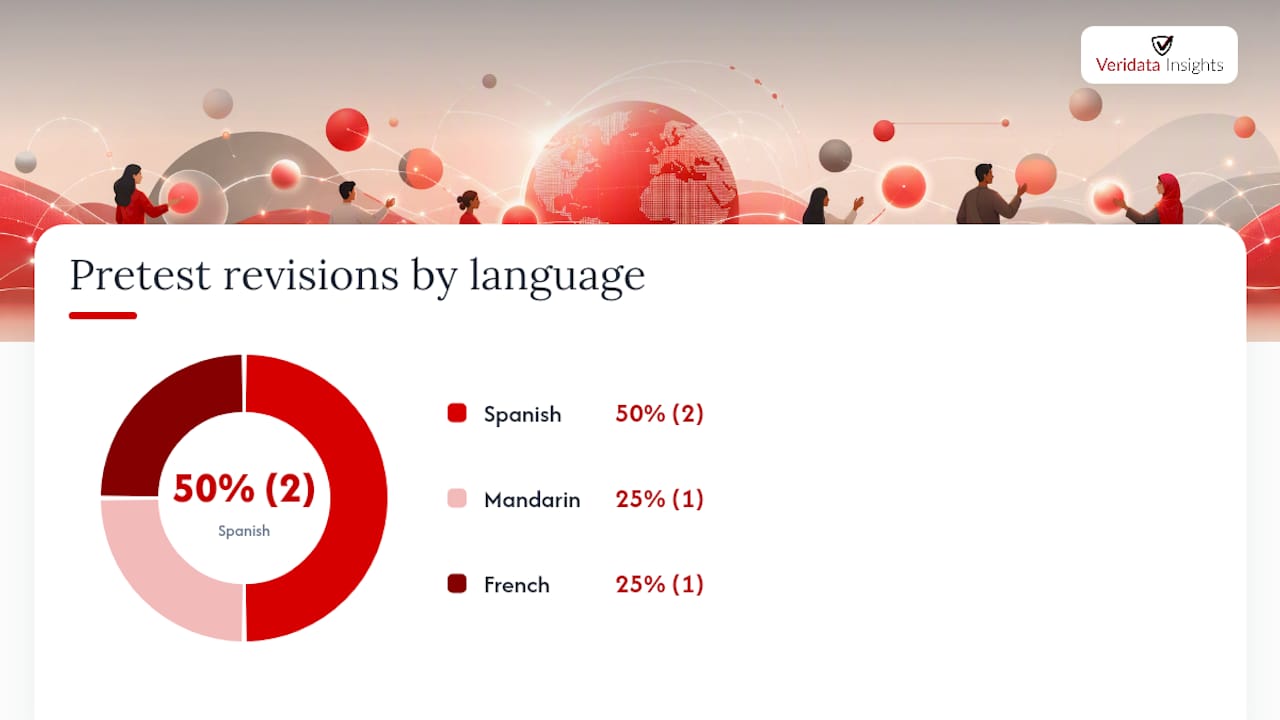
| Cognitive interview comprehension issues | 4 items revised after pretesting (2 Spanish, 1 Mandarin, 1 French) |
| Item nonresponse rate post-field | Comparable across language versions, within expected range |
The most consistent lesson from the project: translators who were briefed on the study’s purpose and respondent population produced first drafts that required significantly less adjudication than translators who received only the string file. That briefing investment pays back in reduced review time.
Pro Tip: Build your translation memory from day one. Every adjudicated string from this project becomes a reusable asset for the next wave. Veridata Insights’s questionnaire review process includes translation memory management as a standard part of multi-wave project delivery.
Veridata Insights handles the full translation workflow for you
Translating a survey well takes more than sending a file to a vendor. It takes methodology, coordination, and a team that understands what measurement equivalence actually means in practice. Veridata Insights manages every step: questionnaire review for translatability, TRAPD project management, MT + post-editing orchestration, cognitive interviewing and pretesting, and programming QA across all language versions. No project minimums, available seven days a week, 365 days a year.
Relevant services for this guide’s audience:
- Questionnaire review and source-text editing for translatability
- TRAPD and adapted committee workflow management
- Machine translation + full post-editing coordination
- Cognitive interviewing and pretesting in target languages
- Multilingual survey programming and QA
Ready to get your multilingual survey right the first time? Contact Veridata Insights for a project consultation and estimate.
Sources
The methodology in this guide draws on the following primary sources. Each is worth reading in full if you are designing or managing a research-grade translation project.
- Using Machine Translation and Post-Editing in the TRAPD Approach: Effects on the Quality of Translated Survey Texts – PMC
- Development of a Practical Translation Approach for Survey Research Projects | Survey Practice
- Create a multilingual survey – Microsoft Dynamics 365 Customer Voice – Learn
Recommended
- Translating Research into Client-Friendly Presentations and Recommendations – Veridata Insights
- Translating Market Data into Strategic Recommendations – Veridata Insights
- Case Study: Programming, Sample & Translations For US Election Night News – Veridata Insights
- Custom Research Design and Implementation – Veridata Insights