

TL;DR:
- Research aims to generate generalizable knowledge, whereas evaluation assesses an intervention’s merit, design, and outcomes. Both rely on rigorous data analysis but serve distinct purposes and regulatory requirements in different industries and settings.
Research and evaluation are systematic processes with different objectives: research generates generalizable knowledge, while program evaluation assesses the merit, design, and outcomes of specific programs or interventions. Both rely on rigorous data analysis techniques, but they serve distinct purposes and carry different regulatory implications. Authoritative sources including the UK Magenta Book, the CDC Program Evaluation Framework, and NIH-OHSRP guidance each define these disciplines with precision. Professionals in healthcare, market research, and consulting who understand the difference make faster decisions, avoid costly regulatory delays, and produce evidence that actually holds up.
How do research and evaluation differ in purpose and method?
Research and evaluation share methodological DNA, but their goals diverge sharply. Research aims to produce findings that apply beyond a single program or context. Evaluation, as the UK Magenta Book defines it, is a systematic assessment of an intervention’s design, implementation, and outcomes to understand effects and estimate cost-effectiveness. That distinction shapes everything from study design to what you do with the results.

| Dimension | Research | Evaluation |
|---|---|---|
| Primary goal | Generate generalizable knowledge | Assess program merit and inform decisions |
| Audience | Scientific community, policymakers | Program managers, funders, stakeholders |
| Regulatory trigger | Often requires IRB review | May not require IRB if not generalizable |
| Methods used | RCTs, cohort studies, surveys | Process studies, impact assessments, cost analyses |
| Output | Published findings | Program reports, decision briefs |
The practical difference shows up clearly across industries. In healthcare, a randomized controlled trial testing a new drug protocol is research. An internal review of whether a hospital’s discharge process reduces readmissions is evaluation. In consulting, a market sizing study generating industry benchmarks is research. A post-project review measuring whether a client’s new sales training improved close rates is evaluation. In market research, a nationally representative survey on consumer attitudes is research. A brand tracker measuring campaign effectiveness for one client is evaluation.
NIH-OHSRP guidance reinforces that regulatory classification depends on design intent and whether the activity contributes to generalizable knowledge, not on whether findings get published. That single clarification prevents a lot of wasted time in regulated environments.
Pro Tip: Decide early whether your project is research or evaluation. NIH-OHSRP recommends using screening questions focused on generalizable knowledge to make that call before you design the study, not after.
What frameworks guide research and evaluation practices in 2026?
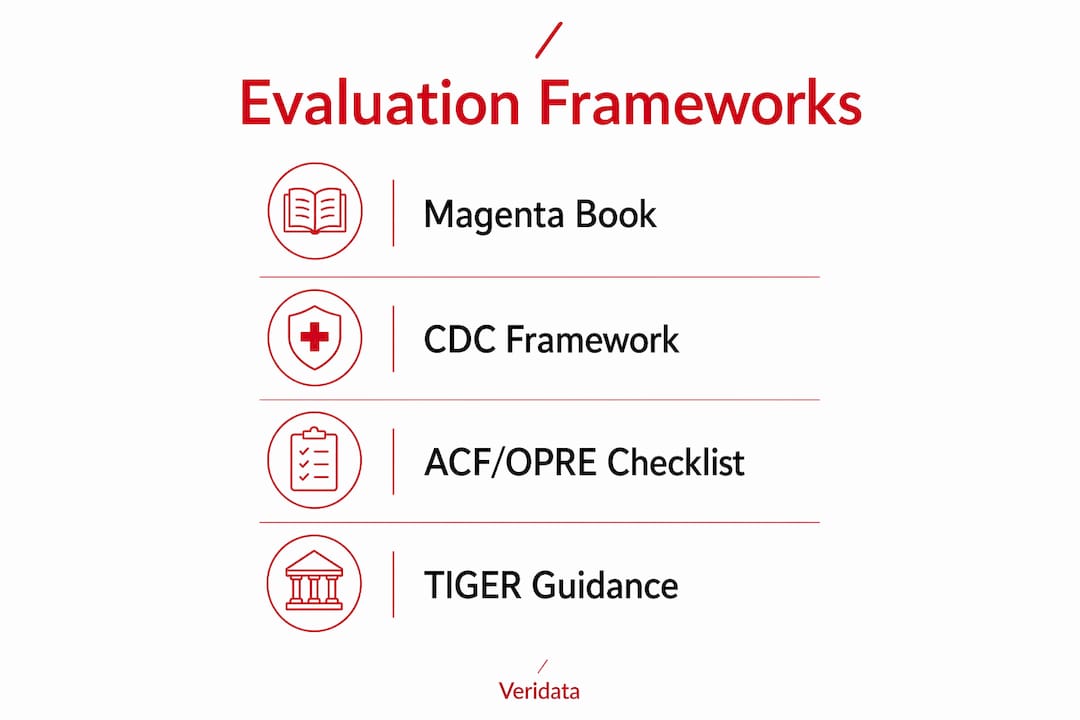
Three frameworks dominate professional practice in 2026: the UK Magenta Book, the CDC Program Evaluation Framework, and the ACF/OPRE Program Evaluation Planning Checklist. Each brings a different lens, and together they cover the full spectrum of evaluation methodology.
The UK magenta book
The Magenta Book organizes evaluation into three complementary types: process evaluation, impact evaluation, and value-for-money evaluation. The Magenta Book describes these as integrated components, not mutually exclusive choices. Process evaluation examines how a program is delivered. Impact evaluation measures whether it changed outcomes. Value-for-money evaluation weighs those outcomes against costs. Running all three together produces a complete picture.
The Magenta Book also introduced TIGER, the Transparency in Government Evaluation Research guidance. TIGER outlines transparency as a quality mechanism that prevents goalpost shifting and builds stakeholder confidence by making evaluation assumptions and uncertainty visible. Practically, this means publishing your analysis plan before you collect data, documenting any changes to your design, and making your data available for reuse where possible.
The CDC program evaluation framework
The CDC’s framework gives evaluators a structured path through six steps: engage stakeholders, describe the program, focus the evaluation design, gather credible evidence, justify conclusions, and share lessons learned. The 2026 CDC Action Guide emphasizes that cross-cutting evaluation standards must be integrated at every stage, not bolted on at the end. Those standards cover utility, feasibility, propriety, accuracy, and evaluation accountability.
The CDC framework works especially well in public health settings where programs serve diverse populations and stakeholder buy-in is non-negotiable. It forces evaluators to define success criteria with stakeholders before data collection begins, which eliminates a lot of post-hoc disagreement about what the results mean.
The acf/opre planning checklist
The ACF/OPRE checklist covers 12 planning elements for both randomized controlled trials and process studies. Those elements include defining evaluation questions, selecting data collection methods, planning for analysis, and addressing ethical considerations. The checklist works as a quality gate. If you cannot answer all 12 elements before fieldwork starts, your evaluation design has gaps.
Pro Tip: Use the ACF/OPRE checklist as a pre-launch audit. Walk through each element with your team and document your answers. Gaps you find at that stage cost far less to fix than gaps you find during analysis.
How can professionals integrate research and evaluation effectively?
The strongest programs treat research and evaluation as a continuous loop, not separate projects. Here is a practical workflow that Veridata Insights recommends for organizations running complex programs:
- Define the evaluation question first. Before selecting a methodology, write out exactly what decision the evaluation needs to support. Vague questions produce vague evidence.
- Map your evidence needs to evaluation types. Use the Magenta Book’s three-type framework to identify whether you need process data, impact data, cost data, or all three.
- Build monitoring into program design. The Magenta Book and CDC Framework both emphasize that integrating monitoring data alongside evaluation enhances interpretation and supports adaptive designs in real time. Waiting until a program ends to collect data is a structural mistake.
- Lock your analysis plan before data collection. Transparent protocols act as contracts with stakeholders. Document any changes and explain why you made them.
- Engage stakeholders at every stage. The CDC framework makes stakeholder engagement step one for a reason. People who helped design the evaluation trust the results.
“Evaluation protocols and analysis plans act as contracts with stakeholders; locking decisions early and transparently documenting changes safeguard trust and integrity.” — TIGER Transparency Guidance, GOV.UK
The integration of data-driven insights into program cycles is where consulting firms and healthcare organizations consistently see the highest return. When monitoring data feeds directly into evaluation design, you catch implementation problems early and can adjust before they compromise your outcomes.
Pro Tip: Build an evaluation matrix that maps each program goal to a specific evaluation type, a data source, and a decision point. This single document keeps your team aligned and prevents scope creep.
What are the most common pitfalls in research and evaluation?
Misclassifying an activity as research when it is evaluation, or vice versa, is the most expensive mistake organizations make. The regulatory consequences are real. IRB review requirements, approval timelines, and consent procedures all depend on that classification.
Here are the pitfalls that show up most often in professional settings:
- Assuming publication equals research. NIH-OHSRP clarifies that publishing evaluation findings does not automatically make an activity research requiring IRB approval. Design intent and generalizability are the deciding factors.
- Treating evaluation types as mutually exclusive. Organizations that run only an impact evaluation without process data cannot explain why their program worked or failed. The Magenta Book explicitly warns against this incomplete approach.
- Skipping transparency protocols. Evaluations without pre-registered analysis plans are vulnerable to accusations of cherry-picking results. This is especially damaging in healthcare and government-funded programs where credibility is the currency.
- Starting evaluation after program launch. Retrofitting an evaluation design onto a running program produces weaker evidence. Baseline data is gone, and implementation variation is already baked in.
- Underestimating stakeholder resistance. Evaluations that stakeholders did not help design often face data access problems, low response rates, and contested findings.
A healthcare organization that Veridata Insights has worked alongside ran an internal quality improvement study, shared the results at a conference, and then received an IRB inquiry because a reviewer assumed publication implied research. Early classification using NIH screening questions would have prevented that entirely.
Pro Tip: When you are unsure whether your activity is research or evaluation, run it through NIH-OHSRP’s screening questions before you design anything. That 30-minute exercise can save months of regulatory back-and-forth.
Key takeaways
Effective research and evaluation require clear classification, integrated frameworks, and transparent protocols from the start, not as afterthoughts.
| Point | Details |
|---|---|
| Classify early | Determine whether your activity is research or evaluation before designing the study to avoid IRB delays. |
| Use integrated evaluation types | Combine process, impact, and value-for-money evaluations for complete program assessments. |
| Apply established frameworks | The Magenta Book, CDC Framework, and ACF/OPRE checklist each provide proven structures for rigorous evaluation. |
| Build in transparency | Pre-register analysis plans and document changes to protect credibility and stakeholder trust. |
| Integrate monitoring data | Continuous data collection during program implementation strengthens impact assessment and supports real-time decisions. |
Why i think most organizations get evaluation backwards
I have spent years watching organizations treat evaluation as a reporting obligation rather than a decision tool. They launch a program, run it for two years, and then commission an evaluation to justify what they already did. That is not evaluation. That is post-hoc rationalization with a methodology section.
The organizations that get the most value from their evaluations start the design conversation before the program launches. They ask: what would we need to see to change course? That question forces clarity about goals, metrics, and decision thresholds that most programs never achieve.
The open science movement is pushing this in the right direction. TIGER’s transparency requirements and the CDC’s emphasis on pre-specified standards are making it harder to run evaluations that conveniently confirm what you hoped to find. That is good for the field, even when it is uncomfortable for individual programs.
My honest advice: treat your evaluation framework as a living document, not a compliance checkbox. Embed it in your program design from day one. Assign someone ownership of the monitoring data pipeline. And when your results are inconvenient, publish them anyway. The credibility you build by being transparent about what did not work is worth more than any single positive finding.
The common pitfalls in market research and evaluation are almost always organizational, not methodological. The tools exist. The frameworks are solid. The gap is almost always in how early and how seriously organizations commit to the process.
— Daniel
How veridata insights supports your research and evaluation work
Veridata Insights brings full-service research and evaluation support to organizations across healthcare, consulting, and market research. Whether you need help designing an impact assessment, selecting the right evaluation framework, or building a data collection and analysis plan from scratch, the team at Veridata Insights handles as much or as little as your project requires. No project minimums. Seven days a week. From consultation and questionnaire design through data processing, reporting, and visualization, every engagement is built around your specific objectives. If you are ready to move from planning to execution, reach out to the team and get started.
FAQ
What is the difference between research and program evaluation?
Research aims to generate generalizable knowledge applicable beyond a single program. Program evaluation assesses the design, implementation, and outcomes of a specific intervention to inform decisions.
Does publishing evaluation findings make an activity research?
No. NIH-OHSRP clarifies that publication alone does not determine research status. Design intent and whether the activity contributes to generalizable knowledge are the deciding factors for IRB classification.
What are the three types of evaluation in the magenta book?
The UK Magenta Book identifies process evaluation, impact evaluation, and value-for-money evaluation as complementary types that should be integrated rather than used in isolation.
When should i apply the CDC program evaluation framework?
The CDC framework works best for public health and social programs where stakeholder engagement and accountability are priorities. Apply it from the start of program design, not after implementation begins.
How do i choose between qualitative and quantitative methods in evaluation?
The choice depends on your evaluation question. Quantitative methods measure outcomes and test causal claims. Qualitative methods explain how and why a program worked, which is especially useful in process evaluations.