


What are client surveys and why do they matter?
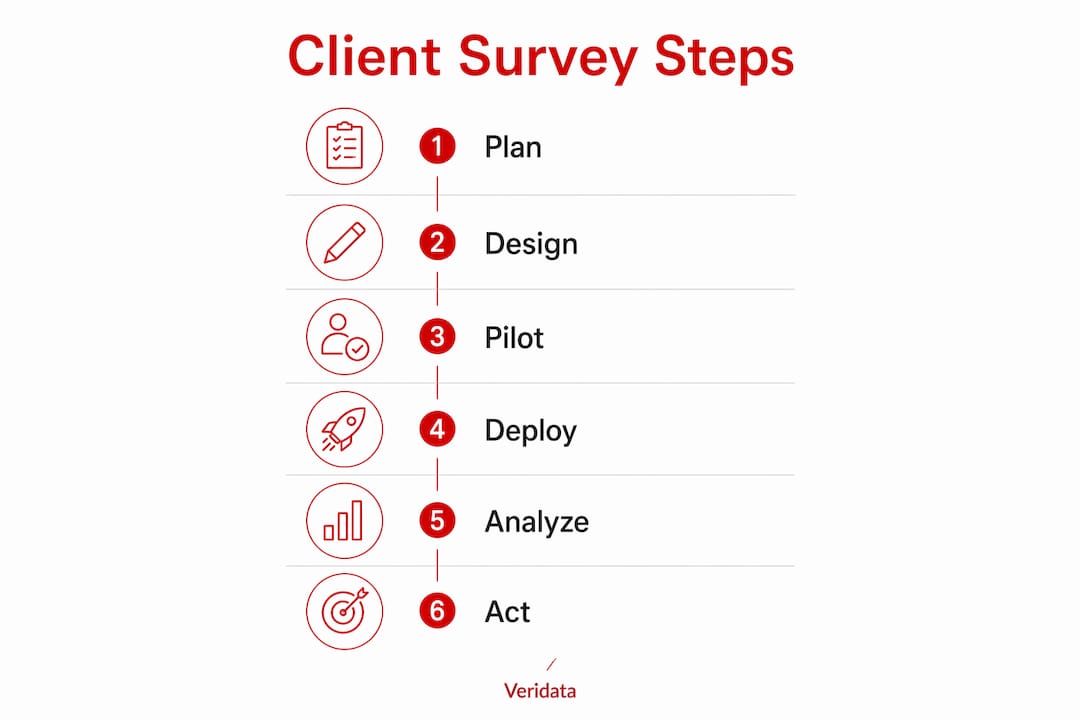
Client surveys are structured feedback tools designed to measure relationship health, service quality, and overall satisfaction in B2B and professional services contexts. They are fundamentally different from the quick “rate your purchase” forms you see after buying something online. A client satisfaction survey focuses on ongoing relationships, the kind you find in law firms, consulting agencies, wealth management practices, and enterprise SaaS companies.
Why does that distinction matter? Without structured feedback, firms operate on assumptions. Client surveys replace guesswork with evidence. They detect churn risk early, help prioritize high-value accounts showing declining scores, and validate which service improvements actually resonate with clients.
Here is what well-designed client feedback forms typically measure:
- Relationship health: How clients feel about communication, responsiveness, and trust
- Service quality: Whether deliverables meet expectations and timelines
- Loyalty signals: Net Promoter Score (NPS) questions that reveal advocacy potential
- Diagnostic drivers: Specific pain points in onboarding, billing, or project delivery
- Open-ended perceptions: Qualitative feedback that numbers alone cannot capture
The mix of quantitative scales and open-ended questions is what gives client surveys their strategic power. Numbers tell you where a problem exists. Open responses tell you why.
Table of Contents
- How to create an effective client survey
- What question types work best in client surveys?
- How to deploy surveys and get clients to actually respond
- How to interpret results and turn feedback into real improvements
- Why client surveys reveal more than you expect
- Veridata Insights brings full-service survey expertise to your program
- Key Takeaways
How to create an effective client survey
Good survey design starts before you write a single question. You need a clear objective first. Are you measuring satisfaction after a project? Assessing the overall relationship annually? Identifying churn risk in a specific account segment? The objective shapes everything else.
- Identify the interaction or experience to measure. Post-project completion, onboarding milestones, and annual relationship reviews each call for different question sets.
- Set a focused objective. One survey, one primary goal. Trying to measure everything at once produces surveys that measure nothing well.
- Choose question types deliberately. Mix Likert scales for benchmarking, NPS for loyalty, multiple-choice for diagnostics, and one open-ended question for qualitative depth.
- Keep it short. Response rates drop sharply after 5–7 questions. Aim for 3–5 focused questions that a client can complete in under five minutes.
- Personalize the invitation. A note from the relationship manager outperforms a generic system email every time. More on that in the next section.
- Time it strategically. Post-project surveys work best within 48–72 hours of delivery, while annual relationship surveys land well in November before fiscal year-end planning begins.
- Review and revise before sending. Read each question aloud. If it sounds confusing or double-barreled, rewrite it.
Pro Tip: Pilot test your survey with one or two internal colleagues before sending it to clients. They will catch ambiguous wording and awkward flow that you have read past too many times to notice.
For a deeper look at structural pitfalls, Veridata Insights covers the most common survey design mistakes that undermine even well-intentioned feedback programs.

What question types work best in client surveys?
The right question format depends on what you need to know. Effective client surveys blend quantitative and qualitative formats to capture both measurable scores and nuanced client perspectives.

| Question Type | Example | Purpose |
|---|---|---|
| Core CSAT (Likert scale) | “Overall, how satisfied are you with our firm?” (1–5 scale) | Headline satisfaction metric |
| NPS | “How likely are you to recommend us to a colleague?” (0–10 scale) | Loyalty and advocacy indicator |
| Diagnostic (multiple choice) | “How satisfied are you with our response times?” (1–5) | Pinpoints specific service drivers |
| Open-ended | “What one change would most improve our collaboration?” | Qualitative depth and client voice |
A few things worth knowing about each format:
- Likert scales work best for consistent benchmarking across time periods. Use the same scale wording every cycle so year-over-year comparisons stay valid.
- NPS classifies respondents as Promoters (9–10), Passives (7–8), or Detractors (0–6). The gap between Promoters and Detractors is your NPS score.
- Multiple-choice diagnostic questions efficiently surface which service dimensions are underperforming without requiring clients to write paragraphs.
- Open-ended questions are where the real intelligence lives. Limit yourself to one or two per survey, or completion rates suffer.
How to deploy surveys and get clients to actually respond
Timing and delivery method determine whether your survey gets thoughtful responses or gets ignored. Surveys conducted once per project or annually strike the right balance between staying informed and respecting your clients’ time. Over-surveying reduces attentiveness and response quality.
Timing windows that work:
- Post-project: within 48–72 hours of delivery
- Onboarding checkpoints: 30 days after kickoff, 90 days before renewal
- Quarterly relationship pulses: March, June, September, December
- Annual strategic surveys: November
Channels and response rates:
- Personalized email from the relationship manager: 25–35% response rate
- Generic system-generated email: roughly 10% response rate
- Phone interviews: rich qualitative feedback, but carry a high no-show risk
- In-app or portal surveys: effective for tech-forward clients
Online surveys are cost-effective and quick, but they can exclude clients with limited digital access. For complex, high-value accounts, a blended approach works better: send the digital survey first, then follow up personally with key contacts.
Pro Tip: For enterprise accounts, collect feedback from multiple stakeholders, not just your primary contact. A project manager and a C-suite executive often hold very different views of the same engagement, and combining both gives you the complete picture.
Data privacy is non-negotiable. If your firm operates under GDPR or CCPA, use encrypted survey links, define data retention policies (12–24 months is a common standard), and segment data by industry, region, or account manager with role-based access controls.
How to interpret results and turn feedback into real improvements
Raw survey data does not improve client relationships. What you do with it does. Start with the quantitative layer: calculate average CSAT scores, NPS distribution, and year-over-year trends. Then segment results by client type, because clients onboarded after a service change often score differently than long-tenured accounts, and that gap tells you whether your improvements are landing.
For open-ended responses, use thematic coding. Read through all responses, tag recurring themes (communication delays, billing confusion, onboarding friction), and count how often each theme appears. The themes with the highest frequency and the lowest satisfaction scores are your priorities.
Here is a practical sequence for turning survey data into action:
- Identify your top 3–5 issues by frequency and severity across the response set
- Assign ownership for each issue to a specific team or individual
- Set a timeline for addressing each item, typically within the next 6–12 months
- Report results internally so every team that touches the client relationship understands what clients said
- Close the loop with clients by communicating what you heard and what you are doing about it
Professional client surveys with personalized invitations typically achieve reasonably good response rates. If you are consistently below that range, the problem is usually survey length, invitation wording, or timing, not client indifference.
Why client surveys reveal more than you expect
Surveys are not just data collection tools. They create a controlled process for surfacing invisible factors: client perceptions, beliefs, and knowledge gaps that never show up in project reports or billing records. A client who pays invoices on time and renews annually can still be quietly dissatisfied and actively evaluating alternatives. A well-designed survey catches that signal before it becomes a lost account.
Face-to-face or personal follow-ups remain the strongest supplement to digital surveys for deep client relationships. The survey opens the conversation. The personal follow-up deepens it.
Neglecting feedback loops erodes trust in a specific, measurable way. Clients who respond to surveys and receive no visible follow-through become less likely to respond next time, and less likely to stay. The act of asking without acting signals that the feedback was performative, not genuine.
Veridata Insights applies this principle directly in its research work. In one medical company survey project, the team combined structured survey programming with expert consultation to surface nuanced stakeholder perceptions that standard reporting had missed entirely. That kind of methodology, blending quantitative rigor with qualitative depth, is what separates a survey that drives change from one that collects dust.
For professional services firms specifically, Veridata Insights recommends B2B survey design approaches that account for multi-stakeholder accounts, long relationship cycles, and the sensitivity of client feedback in high-trust industries.
Veridata Insights brings full-service survey expertise to your program
Running client surveys well takes more than a form builder and a send button. It takes methodology, question design, programming, data processing, and reporting that actually tells you something useful. That is exactly what Veridata Insights delivers, with no project minimums and availability seven days a week, 365 days a year.
Whether you need a single post-project pulse survey or a full annual relationship study across hundreds of accounts, Veridata Insights handles the entire process: consultation and design, questionnaire review, programming, data collection, coding, and analytics. We specialize in B2B, B2C, healthcare, and hard-to-reach audiences, so no client segment is out of reach.
Ready to build a client feedback program that actually drives retention? Contact Veridata Insights to get started.
Key Takeaways
Well-designed client surveys, executed with the right methodology and followed by real action, are one of the most direct paths to stronger client retention and service improvement.
| Point | Details |
|---|---|
| Keep surveys short | Response rates drop sharply after several questions; aim for a small number of focused questions. |
| Personalize invitations | Personalized emails from relationship managers yield notably higher response rates than generic system-generated messages. |
| Segment your results | Split responses by client type or tenure to reveal where satisfaction gaps actually exist. |
| Act on what you hear | Surveys that produce no visible follow-through erode client trust and reduce future response rates. |
| Veridata Insights | Offers full-service survey design, programming, and analytics for B2B and professional services clients, with no project minimums. |