


What is the questionnaire research method?
The questionnaire research method is a standardized data collection tool consisting of a set of questions designed to gather targeted information directly from respondents for analysis. Think of it as a written interview at scale. You ask the same questions, in the same order, to every participant, which means your data stays consistent and comparable across the entire sample.
Here is a distinction worth locking in early: a questionnaire is the instrument itself, the actual set of questions. A survey is the broader process of collecting, analyzing, and interpreting data. The questionnaire is the measuring instrument within that process. Getting this right matters when you are designing your methodology and writing it up for academic or professional review.
Questionnaires can collect both quantitative data (ratings, frequencies, yes/no responses) and qualitative data (open-ended explanations, narratives). That flexibility is one of the biggest reasons researchers across disciplines reach for this method first.
The three main questionnaire types you will work with:
- Structured questionnaires: Fixed questions with predetermined response options. Best for quantitative research where you need clean, comparable data.
- Semi-structured questionnaires: A mix of fixed and open-ended questions. Useful when you want numbers but also need context or nuance.
- Unstructured questionnaires: Primarily open-ended questions with no fixed response categories. Suited for exploratory qualitative work where you want respondents to speak freely.
Strengths and limitations worth knowing before you commit
Questionnaires have a genuinely strong track record as a data collection method, but they come with real trade-offs. Here is an honest look at both sides.
Strengths:
- Cost efficiency: Mailed or online questionnaires reach large samples at a fraction of the cost of interviews or focus groups. You can collect data from hundreds of respondents without proportionally increasing your budget.
- Standardization: Every respondent answers the same questions in the same order, which makes results replicable. A second researcher can administer the same instrument and check for consistency.
- Scalability: Whether your sample is 50 people or 5,000, the questionnaire format scales without requiring additional interviewers or fieldwork infrastructure.
- Anonymity: Respondents often answer more honestly on sensitive topics when they know their identity is protected, which can improve data quality on topics like health behaviors or workplace attitudes.
- Quantifiable output: Closed-ended questions convert responses into data that supports statistical analysis, from simple frequency counts to regression models.
Limitations:
- Response bias: Social desirability bias leads respondents to answer in ways they think are expected or acceptable rather than truthfully. Question wording can also push respondents toward particular answers without the researcher realizing it.
- Low response rates: With some questionnaires suffering response rates can sometimes be very low, design and distribution strategy matter enormously. A poorly designed or cold-distributed questionnaire often gets ignored.
- No clarification opportunity: In a self-administered format, respondents cannot ask what a confusing question means. Ambiguous wording produces unreliable data with no way to recover it after the fact.
- Measurement error: Poorly worded questions, unclear response scales, or illogical question ordering all introduce error that distorts findings.
- Limited depth: Closed-ended formats capture what respondents choose from your options, not what they actually think. You can miss the unexpected insight that an interview would surface.
The good news? Most of these limitations are manageable through careful design, piloting, and choosing the right administration mode. We will get into exactly how to do that.
Types of questionnaires and question formats
Questionnaires are classified into structured, unstructured, and semi-structured types, each serving different research needs. The format of your questions shapes what kind of data you get and how you can analyze it.
Closed-ended question formats:
- Nominal (dichotomous or polytomous): Yes/no questions or multiple-choice items where responses fall into categories without any inherent order. Example: “Which department do you work in?”
- Ordinal (Likert scale): Respondents rate items on a scale, typically 1–5 or 1–7, capturing the strength of an attitude or opinion. The Likert scale is one of the most widely used formats in social science research.
- Interval scale: Equal spacing between response options, allowing for more precise statistical analysis. Semantic differential scales, which ask respondents to rate a concept between two bipolar adjectives, fall into this category.
- Multiple choice: Respondents select one or more answers from a predefined list. Responses compile more easily than open-ended answers and support straightforward frequency analysis.
Open-ended questions allow respondents to answer in their own words without preset options. They yield richer qualitative information and work well for complex questions that cannot be captured in a few categories. The trade-off is that they take longer to analyze and require coding or thematic analysis rather than simple tabulation.
Most questionnaires mix both formats. Closed-ended questions give you the numbers; open-ended questions give you the story behind them.
Administration modes also shape your data. The main options:
- Online (self-administered): Fast, low-cost, and easy to distribute widely. Best for literate populations with internet access.
- Face-to-face (researcher-administered): Higher completion rates and allows real-time clarification, but costs more in time and staff.
- Telephone: Works well for populations without internet access; response rates vary by demographic.
- Mail: Useful for reaching specific geographic populations, though mail surveys typically see low return rates unless follow-up strategies are used.
Pro Tip: If your research involves sensitive topics or hard-to-reach populations, a self-administered online format often produces more candid responses than face-to-face administration. Respondents tend to be more honest when they feel no one is watching.
Should you build a new questionnaire or use an existing one?
This is one of the most consequential decisions in your research design, and it does not get enough attention. Before you write a single question, evaluate whether a new questionnaire is actually necessary. Consider your budget, your timeline, and whether validated instruments already exist for your construct.
Reasons to use a pre-existing questionnaire:
- Validated instruments come with established reliability and validity evidence, which strengthens your methodology section considerably.
- Using the same instrument as prior studies allows direct comparisons across populations or time points.
- It saves development time and reduces the risk of introducing new measurement error.
- Peer-reviewed journals often look favorably on recognized scales like the PHQ-9 for depression screening or the General Self-Efficacy Scale for motivation research.
Reasons to develop a new questionnaire:
- Your research topic is novel and no validated instrument exists for your specific construct.
- Existing instruments were developed for different populations and do not translate well to your context.
- Your research questions require a combination of constructs that no single existing tool covers.
When adapting an existing instrument, always check the licensing terms. Some scales require permission or payment for use. Adapting questions without proper attribution or authorization creates ethical and legal problems. Document every change you make and explain your rationale in your methodology.
For sample size decisions tied to your questionnaire choice, the rule of thumb is that larger samples reduce sampling error, but the right size depends on your research design, expected effect size, and the level of statistical confidence you need. A census approach works for small, defined populations; probability sampling is the standard for larger groups where you need results to generalize.
How to design and validate a research questionnaire
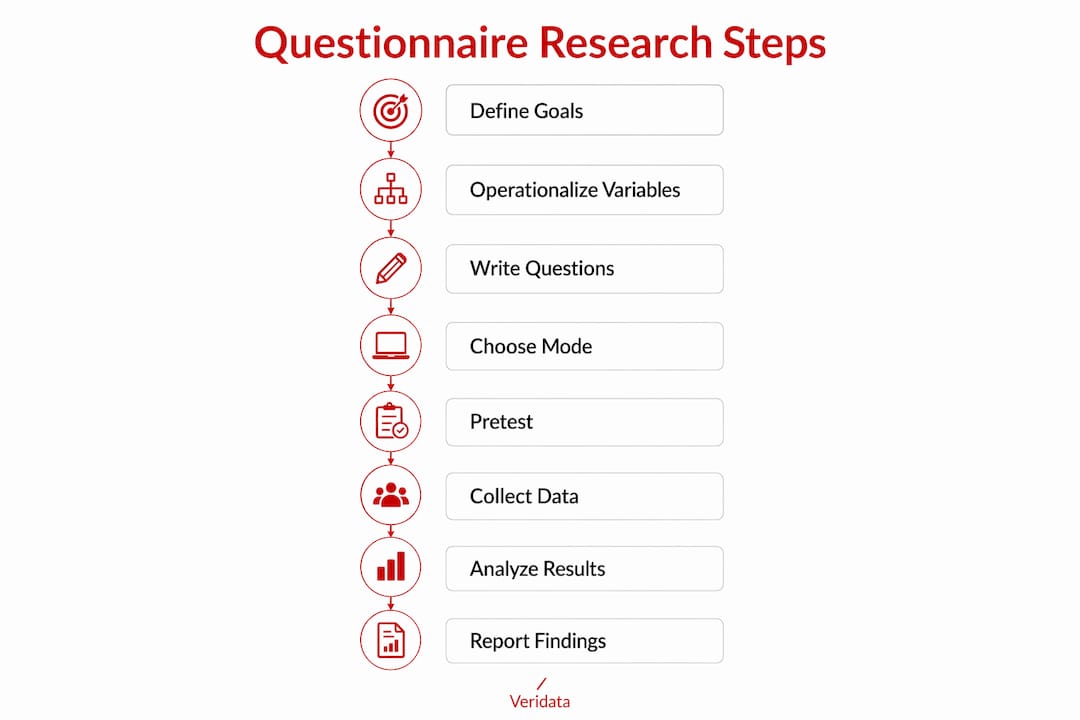
Good questionnaire design follows a systematic workflow that moves from goal setting through sampling, pretesting, distribution, and analysis. Skipping steps does not save time. It creates problems you cannot fix after data collection begins.
Step 1: Define your research objectives clearly. Every question on your questionnaire should trace back to a specific research objective. If you cannot explain why a question is there, cut it. Vague objectives produce vague data.

Step 2: Operationalize your variables. Decide exactly how you will measure each concept. “Customer satisfaction” means nothing until you define whether you are measuring it through a single rating, a multi-item scale, or a combination of behavioral and attitudinal indicators.
Step 3: Write clear, unbiased questions. Avoid leading questions, double-barreled questions (asking two things at once), and jargon that your respondents may not understand. Questions should progress logically from general to specific, and from less sensitive to more sensitive topics.
Step 4: Choose your administration mode. The mode of administration substantially influences data quality. Researcher-administered methods work better for complex data collection; self-administered methods favor cost efficiency. Match the mode to your research goals and your respondents’ characteristics.

Step 5: Address ethical requirements. Questionnaires require informed consent and confidentiality protections to protect respondents. Participants need to know what the research is for, how their data will be used, and that participation is voluntary. This is not optional. Institutional review boards in the United States require it for most human subjects research.
Step 6: Pretest with cognitive interviewing. Cognitive interviewing identifies hidden misunderstandings and ambiguities that standard pilot studies miss. Ask a small group of representative respondents to think aloud as they answer your questions. Verbal probing techniques, such as asking “what does that term mean to you?” reveal where your wording breaks down. A pilot study alone will tell you if people completed the questionnaire. Cognitive testing tells you if they understood it the way you intended.
Step 7: Maximize response rates through transparency. Non-response error is a greater threat to validity than questionnaire length. Explaining your research purpose clearly, keeping the questionnaire as short as the objectives allow, and following up with non-respondents all improve participation. Don Dillman’s Total Design Method, developed at Washington State University, has demonstrated average return rates of 73% when applied consistently, compared to the 30% or lower typical of cold-distributed mail surveys.
Step 8: Plan your analysis before you collect data. The way you design your questions determines how you can analyze your data. Likert scale items support ordinal analysis; interval-level data supports parametric tests. If you plan to run regression analysis, your questionnaire needs to capture the right variables at the right measurement levels. Working backward from your analysis plan to your question design prevents the frustrating discovery that your data cannot answer your research question.
Pro Tip: Before finalizing your questionnaire, run it through questionnaire design review with someone outside your research team. Fresh eyes catch leading questions, confusing response scales, and logical flow problems that you stop seeing after the tenth revision.
For researchers who want expert support at any stage of this process, Veridata Insights offers full-service questionnaire review, programming, data collection, and analysis, with no project minimums and availability seven days a week. Whether you need a quick methodology check or end-to-end research execution, reach out to the team to talk through your project.
Key Takeaways
A well-designed questionnaire is the foundation of reliable research: define your objectives first, pretest with cognitive interviewing, and match your administration mode to your respondents and resources.
| Point | Details |
|---|---|
| Questionnaire vs. survey | A questionnaire is the standardized instrument; the survey is the broader data collection process it serves. |
| Cognitive pretesting matters | Cognitive interviewing uncovers ambiguous wording that pilot studies alone miss, protecting data validity. |
| Non-response is the bigger risk | Non-response error threatens validity more than questionnaire length; explain your purpose clearly to improve participation. |
| Mode affects data quality | Administration mode substantially influences data quality, with researcher-administered methods better for complex data. |
| Pre-existing instruments save time | Validated scales offer established reliability and allow cross-study comparisons, making them worth evaluating before building from scratch. |