

The canonical Net Promoter Score question asks: “How likely is it that you would recommend [Company/Product/Service] to a friend or colleague?” on a scale from 0 to 10, as explained in this classic NPS overview. Respondents who answer 9 or 10 are Promoters, those at 7 or 8 are Passives, and anyone from 0 to 6 counts as a Detractor. Subtract the percentage of Detractors from the percentage of Promoters and you get your NPS, a number that always lands somewhere between −100 and +100.
TL;DR:
- Always use a 0–10 scale and keep the word “recommend” in the question to ensure comparability and proper measurement.
- Use clear, consistent wording for the object of recommendation, whether for the company, product, or service, and avoid marketing adjectives that bias responses.
- Separate relational and transactional NPS questions, tailoring the wording to reflect overall brand perception or specific recent interactions for accurate insights.
- Avoid changing survey wording or scales mid-stream, as this can break trend data and produce misleading results unless thoroughly tested and documented.
- Follow up with an open-ended question tailored by respondent segment to obtain actionable feedback and close the loop effectively for higher retention.
Table of Contents
- What is the correct NPS question wording and scoring formula?
- Relational vs. transactional NPS: which wording to use and when
- NPS wording best practices that keep your data trustworthy
- What follow-up question should you ask after the score?
- Common NPS survey mistakes that quietly wreck your data
- Ready-to-adapt NPS question templates by use case
- How to preserve NPS comparability wave after wave
- How does Veridata Insights review NPS wording for clients?
- Where to go for deeper NPS research
- Sources
What is the correct NPS question wording and scoring formula?
That single sentence, “How likely is it that you would recommend [Company] to a friend or colleague?”, isn’t an accident of survey history. Fred Reichheld and the team behind the original Net Promoter research tested dozens of loyalty questions against actual referral and repurchase behavior, and this one predicted growth better than satisfaction scores or attitude questions ever did. The 0 to 10 scale won out over 5-point and 7-point alternatives because it gives respondents enough room to differentiate without turning the survey into a research project.
Here’s the mechanic behind it: the word “recommend” forces a respondent to think about their own reputation, not just their mood that day. Telling a friend or colleague to try a product carries social risk. Somebody who’s mildly satisfied but wouldn’t stake their credibility on a recommendation will usually settle into Passive territory rather than inflate their score out of politeness. That’s part of why the phrasing around a “friend or colleague” produces a more conservative, more predictive signal than something generic like “How satisfied are you?”
Run the math on a small sample and the formula clicks fast. Say you collect 100 responses: more than half land in the 9 to 10 range, some sit at 7 or 8, and the remainder fall at 6 or below. The NPS is calculated as the percentage of Promoters minus the percentage of Detractors, yielding a number between -100 and +100. Simple arithmetic, but the number only means something if the underlying question never drifts.
A few things worth locking in before you launch anything:
- Always use the 0–10 scale. Never substitute a 1–5 or 1–7 range for “simplicity.”
- Always use the verb “recommend.” Swapping in “would you use again” or “are you satisfied with” measures a different construct entirely.
- Always calculate NPS as %Promoters − %Detractors, not an average of raw scores.
Quick reference: Promoters score 9–10, Passives score 7–8, Detractors score 0–6, and the resulting index ranges from −100 to +100.
Relational vs. transactional NPS: which wording to use and when
Relational NPS measures how customers feel about your company or product overall, usually surveyed on a quarterly or semiannual cadence. Transactional NPS measures how someone felt about one specific interaction, fired off within hours or days of a support ticket, purchase, or onboarding step. They answer different business questions, and using the wrong wording for the wrong context is one of the fastest ways to muddy your data.
Relational surveys should keep the question broad and company-level: “How likely are you to recommend [Company] to a friend or colleague?” You’re tracking brand health and overall loyalty trend over time, so the object of the question has to stay stable across every wave.
Transactional surveys narrow the frame to the moment: “Based on your recent support interaction, how likely are you to recommend [Company] to a friend or colleague?” or “How likely are you to recommend [Product] based on your experience today?” The point is diagnostic. You want to know whether a specific touchpoint is helping or hurting loyalty, not how the customer feels about the whole relationship.
Practical templates by context:
- Company-level (relational): “How likely is it that you would recommend [Company] to a friend or colleague?”
- Product-level (transactional): “How likely are you to recommend [Product Name] to a friend or colleague, based on your recent use?”
- Service interaction (transactional): “Based on your recent interaction with our support team, how likely are you to recommend us to a friend or colleague?”
Mixing the two without labeling them clearly in your reporting is where teams get burned. A relational score of 35 and a transactional score of 35 after a rocky onboarding week don’t mean the same thing, and treating them as interchangeable in a dashboard will send the wrong signal to leadership.
NPS wording best practices that keep your data trustworthy
Good NPS wording is boring on purpose. The value of the metric comes from consistency, not creativity, and every deviation from a clean, neutral question chips away at your ability to trust the trend line. Here’s how to keep it tight.
- Write one sentence, and keep “recommend” in it. Don’t pad the question with context, don’t explain why you’re asking, and don’t combine it with a satisfaction question. “How satisfied are you, and how likely would you recommend us?” is two questions wearing one sentence, and it will confuse both your respondents and your analysis.
- Never touch the 0–10 scale. This is the single most common self-inflicted wound in NPS programs. A well-meaning product manager decides a 5-point scale is “easier for users,” and now you can’t compare this quarter’s number to last year’s without a conversion headache. If you must test an alternative scale, do it as a separate research project, not inside your tracking survey.
- Name the object explicitly, and keep it fixed. Are you asking about the company, the product, or a specific experience? Pick one and hold it constant wave over wave. A vague “would you recommend us” is fine for a first draft, but tighten it to “recommend [specific product name]” if that’s what you actually want to track, then never change it.
- Strip out marketing adjectives. “How likely are you to recommend our award-winning platform to a friend or colleague?” is leading. Any adjective that implies quality, uniqueness, or achievement before the respondent has answered is a thumb on the scale. Neutral, plain wording protects the integrity of the score.
- Document the wording and its placement in the survey flow. Where the question sits (first, middle, or after a long list of other questions) affects response patterns. Write down the exact phrasing, the scale labels, and the position, and treat that document as the source of truth for every future wave.
Pro Tip: Keep a single locked “canonical question” file that nobody edits without sign-off. The moment a well-meaning teammate tweaks wording for a one-off survey, you’ve created a comparability problem that shows up months later when nobody remembers the change was made.
What follow-up question should you ask after the score?
The rating number tells you what happened. The follow-up tells you why, and skipping it is the single biggest waste of a good NPS program. A short, universal prompt does most of the work: “What’s the primary reason for your score?” Keep it open-ended, keep it optional, and resist the urge to add multiple follow-up boxes.
Where the real diagnostic value shows up is in routing that follow-up by segment. A Detractor and a Promoter aren’t going to give you equally useful answers to the same generic prompt, so tailor the ask:
- Detractors: “What’s one thing we could have done better?” This surfaces specific failure points you can route to a recovery workflow.
- Passives: “What would it take to make this a 9 or 10?” This question tends to produce the most actionable product or service feedback, since Passives are the closest segment to converting.
- Promoters: “What do you value most about working with us?” This gives you language for testimonials, case studies, and advocacy programs.
Context matters for phrasing too. A relational survey might ask, “What’s the main reason for your score today?” while a transactional survey after a support ticket should be tighter: “What’s the primary reason for your score based on this interaction?” Onboarding surveys benefit from specificity: “What’s the main reason for your score, based on your setup experience so far?” And B2B contexts often do better naming a role: “What’s the primary reason for your score, from your team’s perspective?”
Two structural notes worth remembering. First, branching logic lets you show a segment-specific prompt without lengthening the survey for everyone. Second, one open-ended question is almost always enough. Stacking three or four follow-up boxes onto a two-minute survey tanks completion rates and rarely produces proportionally better insight.

Common NPS survey mistakes that quietly wreck your data
Most NPS programs don’t fail because the concept is flawed. They fail because of small wording decisions that seemed harmless at the time.
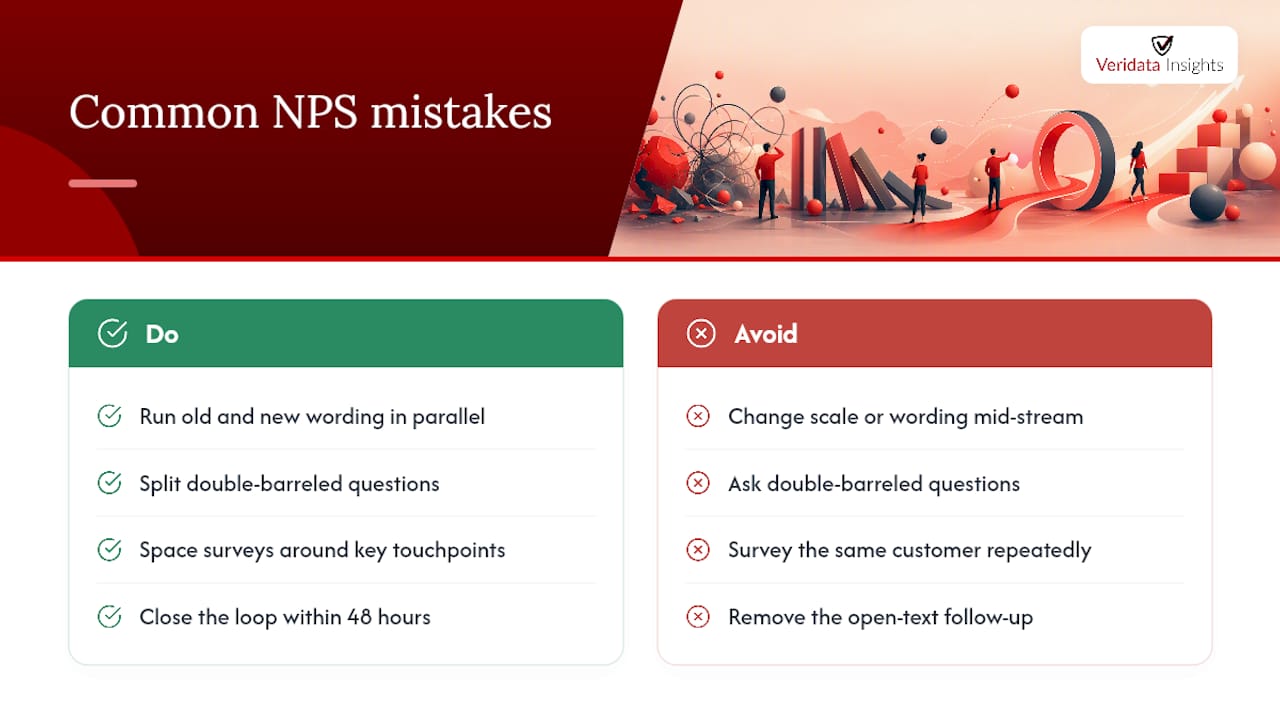
Changing the scale or the wording mid-stream. Swapping from a 0–10 scale to a 1–5 scale, or rewording “recommend” to “would you use again,” breaks your trend without warning anyone. If a change is genuinely necessary, run the old and new wording in parallel on a split sample first, measure the offset, and record a documented break in your trend line so future analysts know exactly where the discontinuity happened.
Double-barreled questions. Any question asking about two things at once (“How satisfied are you and how likely would you recommend us?”) produces a score nobody can interpret cleanly. Split it into two separate questions if you need both metrics.
Over-surveying the same customers. Firing an NPS survey after every single interaction fatigues respondents and drives down both response rate and answer quality. Space transactional surveys around meaningful touchpoints, not every click.
Ignoring the open-text field. Removing the follow-up question to shorten the survey throws away the one piece of data that tells you what to actually fix.
Not closing the loop. A Detractor who explains what went wrong and never hears back is more disengaged than a Detractor who was never surveyed at all.
Pro Tip: Set a service-level target for responding to Detractor comments, even a simple 48-hour rule. The act of closing the loop matters more for retention than the score itself.
Ready-to-adapt NPS question templates by use case
Copy-ready phrasing saves you from reinventing wording every time a new team wants to launch a survey. Adapt these, but resist rewriting the core structure.
- Relational, quarterly, company-level: “How likely is it that you would recommend [Company] to a friend or colleague?” Followed by: “What’s the primary reason for your score?”
- Transactional, post-support interaction: “Based on your recent support interaction, how likely are you to recommend [Company] to a friend or colleague?” Followed by a segment-routed follow-up.
- Onboarding/activation, post-setup: “Now that you’ve completed setup, how likely are you to recommend [Product] to a friend or colleague?” This timing captures loyalty right when first impressions solidify.
- B2B, adding professional context without bias: “Based on your organization’s experience with [Company], how likely are you to recommend us to a colleague in your industry?” Naming the professional context helps respondents anchor their answer without steering it toward a particular sentiment.
A few notes on adapting these for different populations. Consumer audiences generally respond well to the plain “friend or colleague” phrasing as-is. B2B and healthcare audiences sometimes need the object of recommendation spelled out more precisely, since “recommend the company” can mean something different to a purchasing manager than to an end user. If you’re running research across multiple markets or languages, translation quality matters as much as English wording; a literal translation of “recommend” doesn’t always carry the same social weight in every language, so pressure-test translated versions before rolling them into a tracking wave. Veridata Insights handles this kind of translation and localization work directly, and it’s worth planning for the sample templates in our survey question examples guide as a starting point rather than building from scratch.
How to preserve NPS comparability wave after wave
The number is only as trustworthy as the discipline behind it. A short internal checklist prevents most of the damage:
- Write down the canonical question, the exact scale, how you define your respondent cohort, and where the question sits in the survey flow.
- If wording absolutely must change, run an overlap test on a split sample before switching over completely, and document the break point in your trend so nobody misreads a shift in methodology as a shift in customer sentiment.
- Report the response base and response rate alongside every NPS number, not just the score itself. A 40 built on 800 responses means something different from a 40 built on 12.
- Note which segments were included or excluded, and describe how the open-text follow-up gets coded and themed.
- Close the loop on Detractor feedback fast. Bain’s own research on the Net Promoter System treats the score as one part of a management process, not a standalone number, and closed-loop follow-up is what makes that process work.
How does Veridata Insights review NPS wording for clients?
We’ve reviewed enough NPS instruments to know that most wording problems come from good intentions. A team wants the survey to feel “friendlier” or “on-brand,” and suddenly the canonical question has three extra clauses and an adjective it didn’t need. Our review checklist locks the rating question to the standard 0–10 wording, confirms the object of recommendation is named consistently, and pairs it with exactly one open-ended follow-up in almost every commercial wave we run, because that’s the combination that keeps completion rates high and verbatim data usable.
We have spent years reviewing survey instruments across B2B, healthcare, and consumer research before they go into field. Our take: the biggest lift in data quality rarely comes from adding questions. It comes from removing the ones that don’t earn their place.
If your team is building or auditing an NPS program and wants a second set of eyes on the wording before you launch, contact Veridata Insights and we’ll walk through your instrument with you, no minimum project size required.
Where to go for deeper NPS research
Bain’s Net Promoter System remains the foundational source for the methodology and the management philosophy behind it. For wording and follow-up structure, QuestionPro’s NPS guide and Perspective AI’s breakdown of survey timing and follow-up offer practical templates. For how modern practice is evolving beyond a single tracking number, Harvard Business Review’s Net Promoter 3.0 is worth the read.
Sources
- The NPS survey in 2026: questions, timing, and the follow-up that matters | Perspective AI
- Net Promoter 3.0 — Harvard Business Review