


TL;DR:
- Legal data collection involves systematically gathering, preserving, and documenting electronic and physical records for court admissibility. Proper planning, validated tools, and thorough documentation are essential to avoid costly errors and legal challenges.
Legal data collection step by step is a systematic process for gathering, preserving, and documenting electronically stored information (ESI) and physical records in a way that holds up in court. The industry term for this practice is forensic data collection, and it sits at the heart of every defensible litigation or compliance investigation. Global eDiscovery expenses reached $15.16 billion in 2025, a figure that reflects how costly poorly planned collection can become. Get the process right from the start, and you protect both your evidence and your budget.
What does legal data collection step by step actually require?
Legal data collection is not a single action. It is a sequenced methodology that begins long before anyone touches a hard drive or exports a file. Forensic acquisition must comply with ISO/IEC 27037 standards, using validated tools that generate cryptographic hashes and qualified timestamps. Those hashes prove the data was not altered between collection and review. Without that proof, opposing counsel can challenge admissibility, and the entire collection effort may be wasted.

The process also requires a documented chain of custody from the first moment data is identified. Litigation data collection must maintain “who, what, where, and how” documentation of every step to prove data was not altered. That documentation standard applies equally to a forensic image of a laptop and to a set of exported emails from a cloud platform.
What prerequisites must you complete before collecting legal data?
Planning is where most collections succeed or fail. Early, proactive collaboration between legal and forensic/IT teams is the single most effective way to prevent costly mistakes. That collaboration needs to happen before any data is touched, not after the first collection attempt reveals gaps.
The planning phase covers five core areas:
- Custodian identification. Map every person whose data is potentially relevant. Include former employees, contractors, and third parties with access to relevant systems.
- Legal hold issuance. Send written holds to all custodians and their IT administrators. Failure to track legal hold acknowledgments thoroughly undermines defensibility, so maintain a verifiable log of every response.
- Scope definition. Specify data types (email, chat, documents, databases), date ranges, and geographic locations. Narrow scope too aggressively and you risk missing critical evidence.
- Source mapping. Catalog every data source: on-premises servers, cloud storage, mobile devices, collaboration platforms, and backup systems.
- Compliance documentation. Identify applicable regulations, including GDPR for European data, HIPAA for health records, and any cross-border transfer restrictions.
| Planning requirement | Purpose | Common tool category |
|---|---|---|
| Legal hold notices | Preserve data and notify custodians | Hold management platforms |
| Custodian acknowledgment log | Prove compliance in court | Audit trail software |
| Data source inventory | Prevent gaps in collection scope | Asset management systems |
| Scope definition document | Align legal and IT on boundaries | Shared project documentation |
| Chain of custody form | Track data from source to review | Forensic documentation templates |
Pro Tip: Create your scope definition document as a living file. Update it every time a new custodian or data source is identified. A static scope document is a liability waiting to happen.
How do you execute the stepwise collection of legal data securely?
Execution is where the legal data gathering guide meets real-world complexity. Three primary collection methods exist, and each carries different compliance implications.
- Full forensic imaging. The collector creates a bit-for-bit copy of an entire storage device. This method captures deleted files, metadata, and system artifacts. It is the most defensible option but also the most data-intensive.
- Targeted collection. The collector applies search terms, date filters, or custodian-specific criteria to extract a defined subset of data. Targeted collection is an iterative scoping tool, not a one-time shortcut. Overly narrow criteria risk missing critical evidence and can lead to sanctions.
- Remote collection. Collectors use agent-based software to gather data from devices without physical access. This method suits distributed workforces but requires careful validation to confirm completeness.
Regardless of method, every collection must follow this sequence:
- Verify the chain of custody form is ready before touching any device or system.
- Use a validated forensic tool to create a cryptographic hash (MD5 or SHA-256) of the source data.
- Collect the data to a write-protected or forensically clean destination.
- Generate a second hash of the collected data and confirm it matches the source hash.
- Document the collector’s name, date, time, device identifiers, and collection method.
- Store the collected data in a secured, access-controlled environment.
- Log every person who accesses the data after collection.
Cloud data and collaboration platforms add a layer of complexity. Standard exports of Slack and Microsoft Teams data are often unreadable; specialized connectors that preserve native formatting and metadata are the recommended approach for forensic defensibility. Native format preservation matters because metadata such as send timestamps, read receipts, and thread structure can be critical evidence.
Pro Tip: Always collect in native format first. Converting files to PDF or other formats during collection strips metadata and weakens your evidentiary position before review even begins.
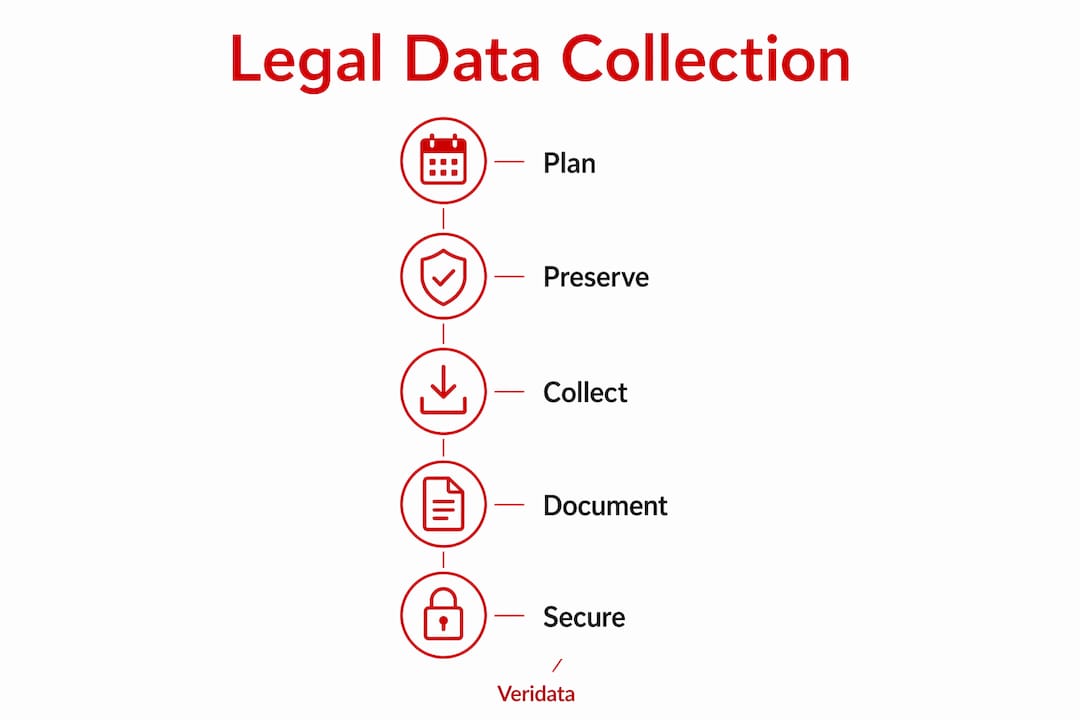
The role of data quality in litigation cannot be overstated here. A collection that is technically complete but poorly documented is nearly as problematic as one with missing data.
What are the most common mistakes in legal data collection?
Even experienced legal teams make predictable errors. Knowing them in advance is the best defense.
- Scoping too narrowly from the start. Tight keyword filters feel efficient but frequently exclude relevant documents. Treat initial scope as a hypothesis, not a final answer.
- Ignoring custodian acknowledgment tracking. Legal hold acknowledgments must be tracked with verifiable logs to serve as primary evidence in case of spoliation challenges. A spreadsheet with no timestamps does not qualify.
- Overlooking cross-border data restrictions. Multi-jurisdictional collections that pull European personal data without a transfer mechanism violate GDPR. This creates regulatory exposure on top of litigation risk.
- Using standard platform exports for chat data. Exporting Slack or Teams through native admin tools produces files that are often incomplete or formatted in ways that make review impractical.
- Failing to update the legal hold after scope expands. When new custodians or data sources are identified mid-collection, the hold must be updated and re-acknowledged. Skipping this step creates a gap in the compliance record.
Multi-jurisdictional matters deserve special attention. Anchoring your strategy on record type, event location, and issuing authority increases efficiency and reduces delays when collecting public records across different jurisdictions. The same logic applies to ESI: know which legal framework governs each data source before collection begins.
Pro Tip: Run a “gap audit” after your first collection pass. Compare the data you collected against your custodian list and source inventory. Any mismatch is a red flag that needs resolution before review starts.
What best practices make legal data collection cost-effective and compliant?
The most effective legal compliance data collection programs treat efficiency and defensibility as the same goal, not competing ones. Data culling using eDiscovery tools can reduce the volume of ESI by up to 86%, cutting review costs and time significantly. That reduction only holds if the culling is applied after a complete, defensible collection, not as a substitute for thorough gathering.
Key practices that deliver both compliance and cost control:
- Use specialized connectors for cloud and collaboration platforms. These tools preserve metadata, threading, and native formatting that standard exports destroy.
- Establish repeatable workflows. Document your collection protocol so every matter follows the same steps. Consistency is what makes a workflow defensible across multiple cases.
- Apply date and custodian filters iteratively. Start broad, then narrow. Each refinement should be documented with a rationale so opposing counsel cannot argue the filtering was arbitrary.
- Maintain a complete audit trail. Every access, transfer, and processing step should generate a timestamped log entry. This trail is your proof that the data was not altered after collection.
- Coordinate legal and IT teams throughout, not just at the start. Technology environments change. A cloud migration or system upgrade mid-matter can affect data availability and must be flagged immediately.
The litigation research checklist used by experienced legal teams reflects these same priorities: plan thoroughly, collect completely, document everything, and refine iteratively.
Key Takeaways
A defensible legal data collection process requires ISO/IEC 27037-compliant tools, a documented chain of custody, and early collaboration between legal and IT teams to prevent spoliation and control costs.
| Point | Details |
|---|---|
| Plan before you collect | Map custodians, issue legal holds, and define scope before touching any data source. |
| Use validated forensic tools | Generate cryptographic hashes at collection to prove data integrity under ISO/IEC 27037. |
| Document every step | Record who, what, where, and how for every action to maintain an unbroken chain of custody. |
| Treat targeted collection as iterative | Refine scope progressively and document each change to avoid spoliation sanctions. |
| Cull after complete collection | Apply eDiscovery culling tools post-collection to reduce review volume without sacrificing defensibility. |
What I have learned from watching legal collections go sideways
The most expensive legal data collection failures I have seen share one trait: someone decided to skip the planning phase because the matter felt straightforward. It never is. A “simple” email collection from three custodians turns into a multi-month remediation when one of those custodians had a personal Gmail account used for work, and nobody asked.
The chain of custody is not paperwork. It is the argument you make in court when opposing counsel claims your evidence was tampered with. I have watched technically perfect collections get challenged because the documentation was sloppy. The data was fine. The story around the data was not.
The other thing I would push back on is the idea that speed and defensibility are in tension. They are not, if you build repeatable workflows. The teams that move fastest on collections are the ones who have done it the same way twenty times before. They are not cutting corners. They have just eliminated the decision-making overhead that slows everyone else down.
Emerging trends worth watching: AI-assisted custodian identification is getting genuinely useful, and the regulatory environment around cross-border data transfers is tightening faster than most legal teams realize. Both of those trends reward organizations that invest in their collection methodology now, before a matter forces the issue.
How Veridata Insights supports your legal data collection needs
Legal data collection done right requires more than good intentions. It requires a structured methodology, documented workflows, and the kind of quality control that holds up under scrutiny. Veridata Insights brings that discipline to every engagement, whether you need support scoping a single matter or building a repeatable data collection process for your organization. Our team works with legal professionals and compliance teams to design collection approaches that are thorough, documented, and built to withstand challenge. No project minimums, seven days a week. When your matter cannot wait, we are ready. Reach out to our team to discuss your specific collection needs.
FAQ
What is legal data collection?
Legal data collection is the process of identifying, preserving, and gathering electronically stored information and physical records for use in litigation or compliance investigations. It must follow documented chain of custody procedures to be admissible in court.
What does ISO/IEC 27037 require for forensic data collection?
ISO/IEC 27037 requires collectors to use validated forensic tools that generate cryptographic hashes and qualified timestamps, proving the data was not altered between collection and review.
How do you prevent spoliation during legal data collection?
Issue legal holds immediately upon anticipating litigation, track custodian acknowledgments with verifiable logs, and document every collection step with timestamps. Untracked holds and undocumented access are the two most common causes of spoliation findings.
Why are standard Slack and Teams exports problematic for legal matters?
Standard platform exports frequently produce unreadable or incomplete files that strip metadata and thread structure. Specialized forensic connectors preserve native formatting and metadata, which is required for defensible review.
How much can eDiscovery culling reduce data volume?
eDiscovery culling tools can reduce ESI volume by up to 86%, which directly lowers review costs and time. Culling must be applied after a complete, defensible collection to avoid excluding relevant evidence.