



Recruiting specialized audiences for market research has become a high-stakes challenge where missing recruitment targets can derail timelines, inflate costs, and compromise study validity. Whether you’re pursuing niche B2B decision-makers, underrepresented patient populations, or specialized consumer segments, traditional recruitment panels and outreach methods often fall short. This guide delivers evidence-backed strategies for preparing, executing, and optimizing recruitment campaigns that successfully engage hard-to-reach audiences across B2B, B2C, and healthcare sectors, helping you secure the quality participants your research demands.
Table of Contents
- Understanding The Challenge: Why Hard-To-Reach Audiences Matter
- Preparation: Building A Foundation For Successful Recruitment
- Execution: Implementing Effective Recruitment Tactics For Hard-To-Reach Groups
- Verification And Optimization: Measuring Success And Troubleshooting Challenges
- Discover Expert Recruitment Solutions For Hard-To-Reach Audiences
- Frequently Asked Questions
Key takeaways
| Point | Details |
|---|---|
| Strategic diversity wins | Combining digital channels, community engagement, and influencer partnerships dramatically improves reach and conversion rates for niche audiences. |
| Retention protects timelines | Clear communication, flexible participation options, and ongoing respect for participant time prevent costly dropouts and deadline failures. |
| B2B demands precision | Rigorous screening protocols and tailored messaging are essential when targeting specialized professional roles with low incidence rates. |
| Digital drives efficiency | Video advertising and patient-centric digital platforms deliver 35-40% better cost performance than traditional image-based recruitment. |
Understanding the challenge: why hard-to-reach audiences matter
Hard-to-reach audiences present unique recruitment obstacles that can make or break research validity. These groups typically feature low incidence rates requiring extensive screening, meaning you must contact hundreds or thousands of prospects to identify a handful of qualified participants. This scarcity drives up costs, extends timelines, and increases the risk of incomplete or biased samples.
The consequences of recruitment failures extend beyond inconvenience. In B2B contexts, misaligned marketing can result in significant financial losses when research insights fail to represent actual decision-maker perspectives. In healthcare, clinical trial sites often miss enrollment deadlines due to recruitment challenges, delaying potentially life-saving treatments and wasting substantial research investments. Traditional recruitment panels and generic outreach campaigns consistently underperform with these populations because they fail to address the specific barriers these audiences face.
Understanding why B2B audience research matters requires recognizing the distinct characteristics that make certain groups difficult to recruit:
- Time scarcity: Senior executives, specialized clinicians, and busy professionals have limited availability and competing priorities that make participation challenging.
- Survey fatigue: Oversampled populations like IT decision-makers or frequent healthcare users become desensitized to recruitment outreach and skeptical of participation value.
- Identity verification complexity: Confirming specialized credentials, rare medical conditions, or niche consumer behaviors requires sophisticated screening beyond standard demographic filters.
- Access barriers: Geographic isolation, language differences, digital literacy gaps, and institutional gatekeepers can physically or procedurally block recruitment channels.
- Trust deficits: Marginalized communities, privacy-conscious professionals, and patients with sensitive conditions may distrust researchers or fear data misuse.
Recognizing these barriers is the first step toward designing recruitment strategies that actually work. The following sections provide actionable frameworks for overcoming each obstacle through strategic preparation, tactical execution, and continuous optimization.
Preparation: building a foundation for successful recruitment
Successful recruitment of hard-to-reach audiences begins long before first contact. Strategic preparation establishes the infrastructure, messaging, and partnerships that enable effective outreach and conversion. Start by defining your target audience with surgical precision. Generic descriptors like “healthcare professionals” or “business decision-makers” guarantee recruitment failure. Instead, specify exact roles, responsibilities, organization types, and decision-making authority. For B2B audiences, document the specific business functions, company sizes, and purchasing involvement that qualify participants. For patient populations, define medical conditions, treatment stages, and demographic characteristics with clinical accuracy.
Diverse recruitment strategies including community engagement dramatically improve reach and trust. Build relationships with community leaders, patient advocacy groups, professional associations, and industry influencers who can endorse your research and facilitate introductions. These trusted intermediaries provide credibility that cold outreach cannot match, particularly with populations that have experienced historical research exploitation or feel disconnected from traditional research institutions.
Design participation experiences that honor participant constraints and preferences. Long-term engagement requires accessible communication, clear expectations, and genuine respect for participant contributions. Offer flexible scheduling, remote participation options, and session lengths that fit professional calendars. Communicate transparently about time commitments, data usage, compensation, and how research findings will create value. Ambiguity breeds distrust and dropout.

Pro Tip: Create a recruitment readiness checklist that includes audience definition documents, channel-specific messaging templates, screening questionnaires, consent forms, and partnership agreements. This preparation prevents mid-campaign scrambling and ensures consistent quality across recruitment touchpoints.
Establish clear metrics for tracking recruitment pipeline health. Monitor screening completion rates, qualification percentages, conversion timelines, and dropout reasons at each stage. These metrics enable rapid troubleshooting when recruitment stalls and provide data for optimizing future campaigns. The table below outlines essential preparation elements and their strategic purposes:
| Preparation Element | Strategic Purpose | Key Deliverable |
|---|---|---|
| Precision audience definition | Ensures screening accuracy and messaging relevance | Detailed qualification criteria document |
| Multi-channel recruitment plan | Maximizes reach across diverse audience behaviors | Channel-specific outreach calendars |
| Community partnership development | Builds trust and access through credible intermediaries | Signed partnership or endorsement agreements |
| Flexible participation design | Reduces barriers and respects participant constraints | Remote options and scheduling flexibility |
| Pipeline tracking infrastructure | Enables real-time optimization and troubleshooting | Dashboard with stage-specific conversion metrics |
This foundational work transforms recruitment from reactive firefighting into proactive strategy execution. Understanding how to recruit hard-to-reach audiences and following market research best practices ensures your preparation aligns with proven methodologies that deliver results.
Execution: implementing effective recruitment tactics for hard-to-reach groups
With preparation complete, execution focuses on converting prospects into qualified, engaged participants through targeted outreach, rigorous screening, and retention-focused communication. In 2025, recruitment focus shifted to conversion quality and operational metrics, emphasizing efficiency over volume. This trend continues in 2026, demanding smarter tactics that prioritize participant fit and engagement sustainability.
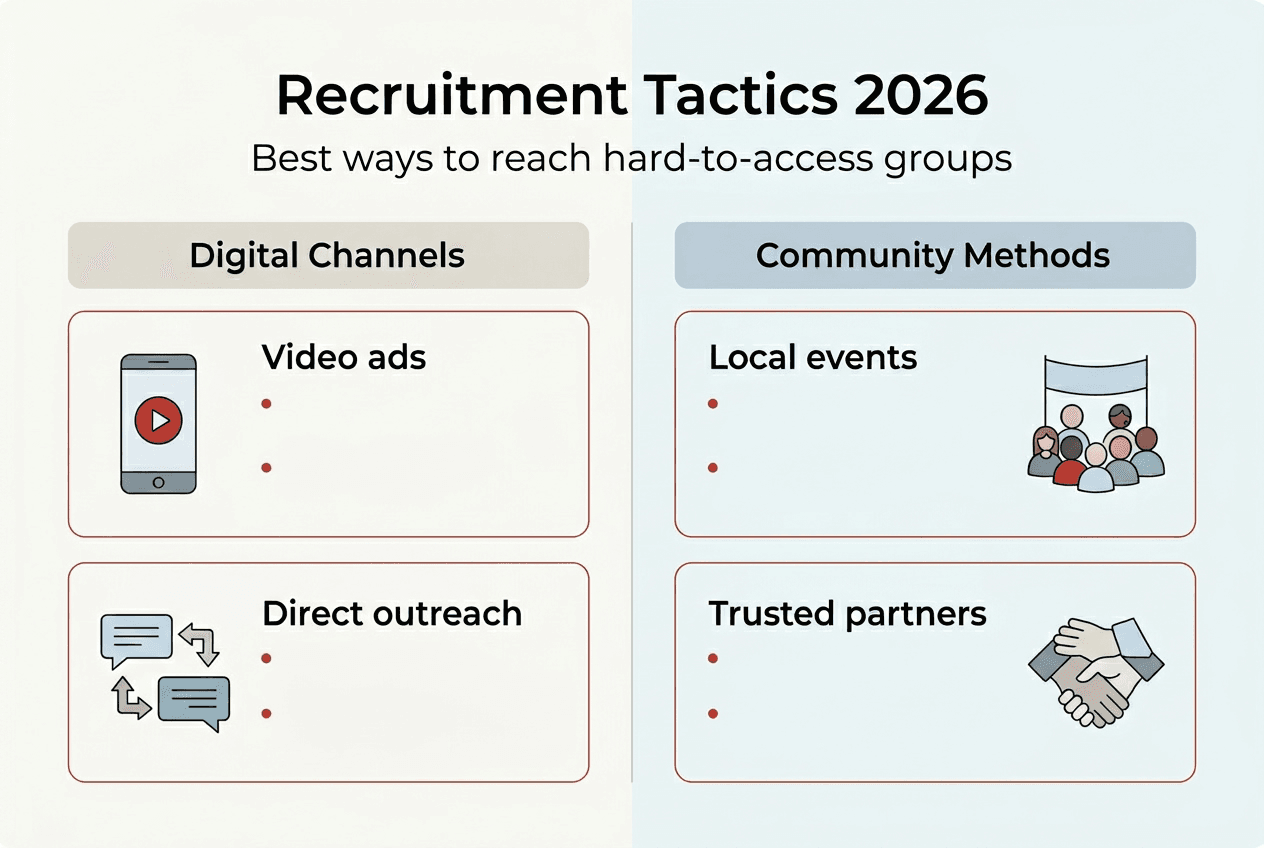
Digital recruitment channels offer unprecedented reach and cost efficiency when properly deployed. Video ads outperform image ads by 35-40% in cost efficiency, particularly when featuring patient testimonials, clear benefit messaging, and authentic storytelling. Social media platforms, professional networks like LinkedIn, and specialized digital communities enable precise targeting based on demographics, professional roles, interests, and behaviors. For healthcare audiences, patient-centric platforms and condition-specific online communities provide direct access to individuals actively seeking information and connection.
Implement these execution tactics systematically:
- Launch multi-channel outreach simultaneously to maximize initial visibility and capture diverse audience segments across their preferred platforms.
- Personalize messaging by channel and audience segment, emphasizing different value propositions for time-constrained executives versus mission-driven patient advocates.
- Deploy extensive qualification screening to ensure every participant meets precise criteria, particularly critical for B2B research best practices where role verification prevents costly misqualification.
- Respond to inquiries within hours, not days, as speed-to-contact directly correlates with conversion rates in competitive recruitment environments.
- Offer flexible participation formats including remote video sessions, asynchronous online activities, and abbreviated in-person options that accommodate varied schedules.
- Maintain ongoing communication with confirmed participants through reminder emails, preparatory materials, and check-ins that reinforce commitment and reduce no-shows.
Pro Tip: When designing customized market research surveys for B2B audiences, front-load the most critical qualification questions to minimize time waste for both researchers and prospects who ultimately do not qualify.
The table below compares recruitment approaches across key dimensions:
| Approach | Reach Potential | Cost Efficiency | Trust Building | Best For |
|---|---|---|---|---|
| Traditional site outreach | Low to medium | Low | Medium | Local patient populations |
| Digital advertising | High | High | Low to medium | Broad awareness and volume |
| Community partnerships | Medium | Medium | High | Marginalized or distrustful groups |
| Professional networks | Medium | Medium to high | Medium to high | B2B specialized roles |
| Patient advocacy collaboration | Medium | Medium | Very high | Rare conditions and underrepresented patients |
Combining approaches strategically based on audience characteristics and research constraints maximizes both reach and conversion quality. Digital channels provide volume and efficiency, while community partnerships deliver trust and access to populations that ignore traditional advertising. Balancing these tactics according to your specific audience profile and timeline creates recruitment campaigns that consistently hit targets.
Verification and optimization: measuring success and troubleshooting challenges
Recruitment success requires continuous measurement, rapid troubleshooting, and systematic optimization based on performance data. Tracking the right metrics transforms recruitment from guesswork into a manageable, improvable process. Monitor these critical indicators weekly:
- Pipeline conversion rates at each stage from initial contact through confirmed participation, identifying where prospects drop off and why.
- Screening failure reasons to determine whether qualification criteria are too restrictive, messaging is attracting wrong audiences, or screening questions are unclear.
- Time-to-qualification metrics measuring days from first contact to confirmed participant, enabling identification of bottlenecks that slow recruitment.
- Participant retention rates tracking no-shows, early withdrawals, and completion percentages as leading indicators of engagement quality.
- Cost-per-qualified-participant across channels and tactics, revealing which investments deliver best ROI and deserve scaling.
Retention is a timeline insurance policy because each dropout adds cost and credibility risk, requiring replacement recruitment that compounds delays. Given that nearly half of clinical trial sites miss enrollment deadlines, retention optimization is not optional. Prevent dropouts through clear benefit communication, flexible scheduling, prompt incentive delivery, and ongoing appreciation for participant contributions.
Common recruitment mistakes sabotage even well-designed campaigns:
- Ambiguous or overly complex communication that confuses prospects about eligibility, time commitment, or participation value.
- Excessive participant burden from lengthy screening surveys, inconvenient scheduling, or inadequate compensation relative to effort required.
- Slow response times that allow interested prospects to lose enthusiasm or commit to competing opportunities.
- Inadequate screening rigor that allows unqualified participants through, wasting research resources and compromising data quality.
- Generic messaging that fails to address specific audience motivations, concerns, or decision-making criteria.
Use performance data to optimize continuously. If video ads outperform image ads, shift budget accordingly. If professional network outreach converts better than social media for executive audiences, double down on LinkedIn. If screening failure rates spike, revise qualification questions or adjust targeting parameters. Document learnings systematically to inform future recruitment cycles and build institutional knowledge.
The following table summarizes key optimization scenarios:
| Challenge | Likely Cause | Optimization Response |
|---|---|---|
| Low initial response rates | Poor targeting or weak messaging | Revise audience parameters and test new value propositions |
| High screening failure rates | Misaligned targeting or overly broad outreach | Tighten targeting criteria and add pre-screening questions |
| Slow conversion timelines | Process bottlenecks or scheduling inflexibility | Streamline screening steps and expand scheduling options |
| High dropout rates | Unclear expectations or excessive burden | Improve communication clarity and reduce participation friction |
| Poor cost efficiency | Overinvestment in underperforming channels | Reallocate budget to highest-converting tactics |
Systematic measurement and optimization transform recruitment from a one-time gamble into a repeatable capability. Understanding how to recruit hard-to-reach audiences through data-driven iteration ensures each campaign performs better than the last, building expertise that compounds over time.
Discover expert recruitment solutions for hard-to-reach audiences
Recruitment challenges demand specialized expertise, particularly when timelines are tight and audience scarcity is high. Veridata Insights specializes in recruiting hard-to-reach B2B, B2C, and healthcare audiences with precision and efficiency. Our tailored strategies combine digital recruitment, community partnerships, and rigorous screening to deliver qualified participants who match your exact specifications. We handle everything from audience definition through participant retention, enabling you to focus on research design and analysis while we solve recruitment complexity. Contact Veridata Insights to explore customized recruitment solutions, or review our comprehensive guide to recruiting hard-to-reach audiences and B2B research best practices for additional strategic insights.
Frequently asked questions
What are the most effective digital channels for recruiting hard-to-reach audiences?
Video ads on social platforms are highly cost-efficient, outperforming image ads by 35-40% in recruitment contexts. Targeted social media, professional networks like LinkedIn, and digital patient platforms provide precise audience targeting based on demographics, professional roles, and health interests, enabling researchers to reach specialized populations at scale.
How can researchers improve retention of specialized B2B panelists?
Maintain clear, consistent communication about expectations, deliverables, and timelines throughout the research relationship. Offer flexible participation options that accommodate professional schedules, provide competitive incentives that reflect participant expertise value, and align research topics with participants’ professional interests to sustain engagement and reduce dropout rates.
What are common mistakes to avoid when recruiting hard-to-reach healthcare patients?
Avoid ambiguous communication about eligibility criteria, time commitments, and participation benefits, which breeds confusion and distrust. Excessive participant burden from lengthy surveys, inconvenient scheduling, or inadequate compensation reduces engagement. Failure to respond quickly to inquiries and lack of clear benefit messaging cause interested prospects to disengage before completing screening.
How long does recruiting hard-to-reach audiences typically take?
Timelines vary dramatically based on audience scarcity, screening complexity, and recruitment channel effectiveness. Niche B2B audiences with incidence rates below 5% may require 8-12 weeks from launch to full enrollment, while more accessible specialized consumer segments might complete in 4-6 weeks. Building buffer time into research schedules prevents deadline pressure from compromising recruitment quality.
What incentive levels are appropriate for hard-to-reach professional participants?
Incentives should reflect participant expertise, time commitment, and opportunity cost. Senior executives and specialized professionals typically expect $200-500 per hour for qualitative research participation, while mid-level professionals may accept $100-200 per hour. Quantitative surveys require proportionally lower incentives but must still demonstrate respect for participant time and expertise to maintain engagement quality.
Recommended
- How to Recruit Hard-to-Reach Audiences for Market Research – Veridata Insights
- Video: A Fast, Flexible, Full-Service Solution For Hard-to-Reach Audiences – Veridata Insights
- The Best Market Research Agencies for Tough Audiences – Veridata Insights
- Case Study: Recruiting YouTubers For Market Research – Veridata Insights
- How to analyze ad trends for better ROI in 2026 – Palmador Blog