

If your research question asks “how many” or “how much,” you need quantitative methods. If it asks “why” or “how,” qualitative fits better. If you genuinely need both numbers and meaning, mixed methods is the answer, provided your timeline and budget can absorb the extra work. That last part trips up more theses than the methodology choice itself.
TL;DR:
- Quantitative methods are best for research questions focused on measuring or comparing quantities, requiring larger samples for statistical validity.
- Qualitative designs suit exploratory questions about experiences, meaning, or context, often involving smaller samples and in-depth data collection.
- Mixed methods provide both measurement and understanding, but demand more time and resources, suitable when a single approach cannot fully answer the question.
- Proper matching of methodology to the question depends on identifying whether evidence should be numerical, narrative, or both, guided by timeline, budget, and participant access.
- Clear planning, including specifying method, design, sample, and ethics upfront, minimizes scope creep and underpowered studies, increasing research validity.
Table of Contents
- What quantitative, qualitative, and mixed methods actually answer
- How do I match my research question to a methodology?
- Which designs and methods should you actually choose?
- Sampling, recruitment, and staying feasible
- How do you know if your analysis and evidence are solid?
- Choosing an integration pattern for mixed methods
- A step-by-step checklist you can copy into your proposal
- Veridata Insights: how our services support methodology selection and implementation
- Get methodology support from Veridata Insights
- Sources
- FAQ
What quantitative, qualitative, and mixed methods actually answer
Quantitative research uses numerical data and statistical analysis to test hypotheses and measure how variables relate to each other. Qualitative research relies on descriptive, non-numerical data, interview transcripts, field notes, open-ended responses, to explore meaning and lived experience. Put simply, quantitative research answers “how many” or “how much,” while qualitative research answers “why” or “how”. Mixed methods combine both strands in a single study when neither one alone tells the full story.
Methodology decisions follow a hierarchy that reviewers expect to see spelled out: approach, then design, then method. You name the approach (quantitative, qualitative, or mixed), pick a design within that approach (survey, case study, convergent mixed design), and only then choose the specific method (a structured questionnaire, semi-structured interviews, a validated psychometric scale). Naming the approach early in a proposal signals to your committee or funder that you understand what evidence your question actually requires, a framing that traces back to Creswell’s widely used research design taxonomy.
Three quick examples show the pattern:
- “What percentage of hospital patients report medication side effects?” → quantitative (measurement, generalization)
- “How do patients describe their experience of chronic pain management?” → qualitative (meaning, depth)
- “Does a new onboarding process improve retention, and why does it work or fail?” → mixed methods (both)
How do I match my research question to a methodology?
Start by diagnosing what kind of evidence would actually satisfy your question. Ask three things: Does the question require counting, comparing, or predicting? Does it require understanding perspective, process, or context? Or does it require both a measurable outcome and an explanation of that outcome?
From there, apply straightforward decision rules:
- If your question tests a hypothesis, measures a variable, or asks about prevalence, choose a quantitative design.
- If your question explores experience, meaning, or an under-studied process, choose a qualitative design.
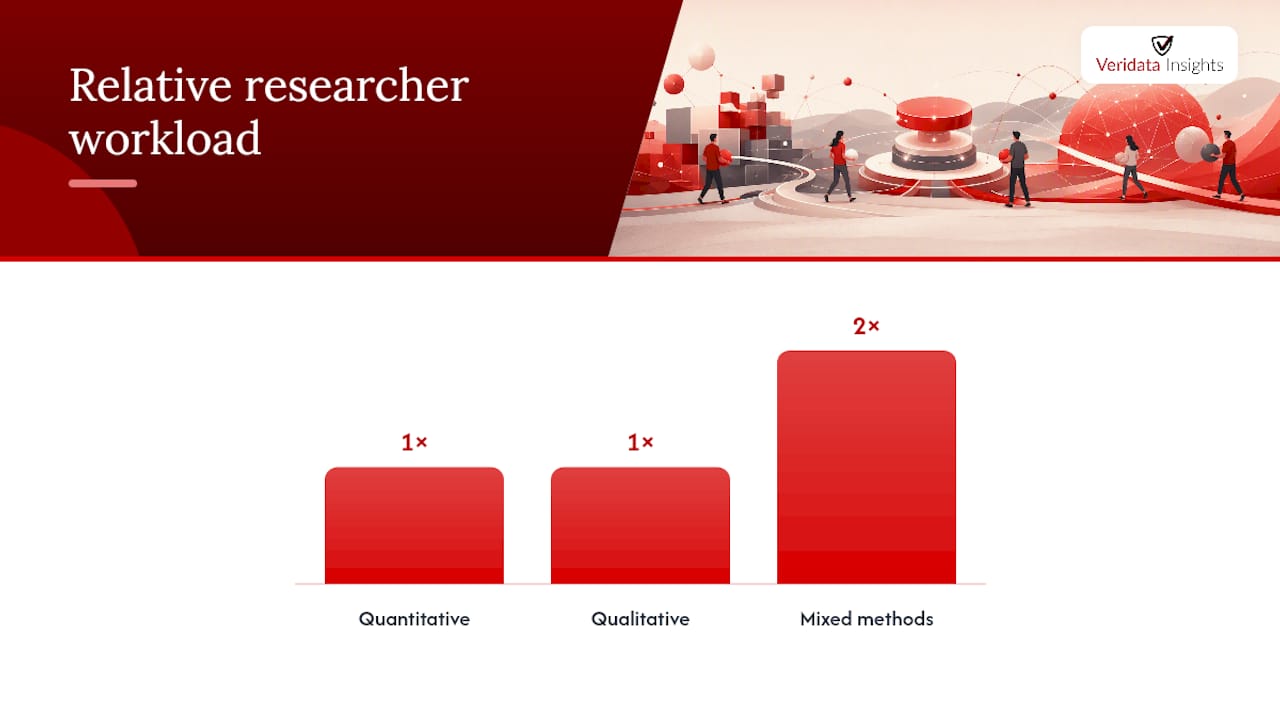
- If you need to measure an outcome and explain the mechanism behind it, choose mixed methods, understanding that this doubles most of your workload.
Two quick examples: a pharmaceutical brand manager tracking adherence rates across a drug trial needs quantitative measurement, full stop. A UX researcher trying to understand why users abandon a healthcare app mid registration needs qualitative depth, because a completion percentage alone won’t explain the “why.” Selecting a methodology means choosing the data type, collection procedure, sampling strategy, and analysis method together, not picking one piece in isolation.
Disciplinary norms sometimes override personal preference, as seen in specialized fields like cryptocurrency trading that rely heavily on data analysis in cryptocurrency for making informed decisions. A public health journal may expect randomized designs; an anthropology department may expect ethnographic immersion regardless of what you’d prefer. Objectives should drive the choice: quantitative to test or measure, qualitative to explore or understand, mixed methods when both perspectives are genuinely necessary.
Once you’ve decided, write the opening sentence of your methods section using this template: “This study uses a [quantitative/qualitative/mixed-methods] approach because [research question] requires [type of evidence].”
Pro Tip: Draft that one-sentence justification before you write anything else in your methods chapter. If you can’t complete it convincingly, your approach probably doesn’t match your question yet.
Which designs and methods should you actually choose?
Once you’ve settled on an approach, you still need a concrete design and method. Here’s what each family looks like in practice:
- Surveys (quantitative): efficient for large samples, ideal for measuring attitudes or behaviors across a population; typically need enough respondents per subgroup to detect meaningful differences.
- Experiments (quantitative): control and manipulate variables to test cause and effect; strong for internal validity, weaker for real-world generalizability.
- Structured observation (quantitative): counts or codes behavior against a fixed checklist, useful when self-report is unreliable.
- Interviews (qualitative): one-on-one conversations that produce depth on individual experience; time-intensive per participant but rich in detail.
- Focus groups (qualitative): group discussion that reveals shared language and social dynamics, though dominant voices can skew results.
- Ethnography (qualitative): extended immersion in a setting to understand culture and context; slow, but unmatched for uncovering the unspoken rules of a group.
- Case study (qualitative or mixed): deep examination of one organization, event, or individual, useful when the “case” itself is the point of interest.
Choosing among qualitative designs specifically also depends on the researcher’s own theoretical stance, whether you’re building a grounded theory from scratch or interpreting phenomena through a phenomenological lens, a distinction NIH’s methodology guidance walks through in detail.
Mixed-methods patterns follow three common shapes. A convergent design collects both survey data and interviews at the same time and compares results side by side. An explanatory sequential design runs a quantitative survey first, then uses qualitative interviews to explain surprising results. An exploratory sequential design starts with qualitative interviews to build a framework, then tests that framework quantitatively with a larger sample. Each adds real planning overhead, so pick the pattern only if a single approach genuinely leaves a gap.
Sampling, recruitment, and staying feasible
Sample-size logic diverges sharply by approach. Quantitative designs typically need larger samples to reach statistical power, while qualitative designs prioritize depth over breadth, often reaching saturation with far fewer participants. Recruitment gets harder with specialized or hard-to-reach groups, physicians with narrow subspecialties, B2B decision makers, patients with rare conditions, and mitigating that usually means widening your recruitment channels, offering fair incentives, or partnering with a firm that already has panel access to those groups.
Ethics and consent aren’t a formality to skip past. Choosing methods responsibly means factoring in inclusiveness and confidentiality from the design stage, not bolting them on after data collection starts.
Realistic timeline planning: experienced researchers commonly recommend tripling your optimistic timeline to account for recruitment delays, IRB review, and data cleaning. A study you estimate at four weeks should be budgeted at twelve.
- Build in buffer time for institutional review board approval before recruitment even starts.
- Pilot test your instrument with a handful of participants before full fielding.
- Confirm access to your target population before finalizing your design, not after.
How do you know if your analysis and evidence are solid?
Quantitative rigor rests on operationalization (defining exactly how you’ll measure an abstract concept), measurement validity, and appropriate statistical tests matched to your data type. Replication matters too: a finding that can’t be reproduced with a similar sample is a weak finding, no matter how clean the original p-value looked.
Qualitative rigor uses a different vocabulary entirely. Instead of reliability and validity, qualitative researchers lean on trustworthiness criteria, credibility, transferability, dependability, and confirmability, developed by Lincoln and Guba. Coding your transcripts consistently, triangulating across data sources, and documenting your analytic decisions all feed into those criteria.
- Build a codebook before you start coding qualitative data, not halfway through.
- Pre-register your hypotheses and analysis plan for quantitative studies whenever your field allows it.
- Document every analytic decision so a second researcher could follow your logic.
Pro Tip: Write your analysis plan before you collect a single data point. Deciding on statistical tests or coding frameworks after the data is in hand almost always leads to fishing for results that fit a story you already believe.
For mixed-methods studies, report each strand’s findings clearly before you integrate them, then explicitly show where the qualitative and quantitative results converge, diverge, or complement each other. Readers should never have to guess how you combined the two.
Choosing an integration pattern for mixed methods
Mixed methods only earns its complexity when a single approach can’t answer your full question. Three integration patterns cover most real studies:
- Convergent parallel: collect quantitative and qualitative data simultaneously, then merge results during interpretation, useful when you want to cross-validate findings quickly.
- Explanatory sequential: run the quantitative phase first, then use qualitative interviews to explain unexpected or ambiguous results.
- Exploratory sequential: start qualitative to build a theory or instrument, then test it quantitatively with a larger sample.
Each pattern adds real cost. Convergent designs demand parallel data collection teams or a tight timeline. Sequential designs stretch your project length because one phase has to finish before the next begins. The decision rule is simple: only add a second strand if it answers a piece of your research question the first strand genuinely cannot. When you write it up, state explicitly where and how the two strands connect, in your data collection timeline and again in your results section, so a reader can trace the integration without guessing.
A step-by-step checklist you can copy into your proposal
Work through this sequence, in order, and you’ll land on a defensible methodology almost every time:
- Write your research question in one sentence.
- Identify what kind of evidence would answer it: numbers, narratives, or both.
- Check your constraints: timeline, budget, and access to participants.
- Pick your approach (quantitative, qualitative, or mixed) based on steps 2 and 3.
- Choose a design within that approach (survey, case study, convergent mixed design).
- Select specific methods (structured questionnaire, semi-structured interview guide).
- Specify your analysis plan and ethics/consent procedures before collecting data.
For your proposal, copy these worksheet fields directly: research question, approach chosen and why, design, method, sample and recruitment plan, timeline (tripled from your first estimate), and ethics considerations.
Watch for two red flags. Methodological creep happens when you keep adding variables or data sources that don’t map directly to your original question, inflating scope and required sample size without adding real answers. An underpowered design happens when your sample is too small to detect the effect you’re testing for, a common and preventable failure in quantitative theses.
Veridata Insights: how our services support methodology selection and implementation
Once you know your approach, execution is where most solo researchers hit a wall, especially with recruitment for hard-to-reach audiences or programming a complex mixed-methods instrument on a tight deadline. Veridata Insights supports both stages:
- Methodology consultation and questionnaire review before fielding
- Survey programming for quantitative instruments
- Recruitment for B2B, B2C, healthcare, and specialty audiences
- Data processing, coding, analysis, and visualization once collection ends
If you’re weighing convergent versus sequential mixed designs, or your target population is a narrow clinical subgroup, a full-service partner can shorten your timeline considerably. Before reaching out to any vendor, draft a one-page brief: your question, your chosen approach, your target sample, and your deadline. That brief alone makes vendor conversations dramatically more efficient.
Get methodology support from Veridata Insights
Veridata Insights is the alternative to assembling your own patchwork of freelance programmers, recruiters, and analysts for a single study. Instead of coordinating three or four vendors separately, one team handles methodology consultation, questionnaire review, programming, recruitment, and analysis under a single project, with no minimum project size and availability seven days a week, 365 days a year.
If your study needs statistically powered survey data, our quantitative market research team can program and field it. If you need depth from interviews or focus groups, our qualitative market research services cover design through analysis. Chasing a hard-to-reach clinical or B2B population? Our respondent recruitment specialists work those panels daily. For a study that needs everything end to end, start with full-service market research and send us your one-page brief for a proposal.
Sources
- Qualitative vs Quantitative Study — NU
- Qualitative vs Quantitative Research — GCU
- Qualitative vs Quantitative Research — SimplyPsychology
- Selecting Research Methods — MIT TLL
FAQ
How Do You Choose Your Research Methodology?
Match the evidence your question requires to an approach: quantitative for measurement or generalization, qualitative for meaning or process, and mixed methods when you need both, then confirm your timeline and budget can support that choice.
What Are the Four Types of Research Methodology?
Most frameworks group methodologies into quantitative, qualitative, mixed methods, and sometimes a fourth category for descriptive or exploratory designs that don’t fit neatly into the other three; definitions vary somewhat by discipline.
What Are the Three Main Types of Research Methodologies?
The three main types are quantitative (numerical, hypothesis testing), qualitative (descriptive, meaning focused), and mixed methods, which combines both strands to answer questions neither approach can fully answer alone.
What Are the Seven Types of Research Methods?
Common method types include surveys, experiments, structured observation, interviews, focus groups, ethnography, and case studies, each sitting within a broader quantitative or qualitative approach rather than standing as separate categories.
Does Veridata Insights Help With Methodology Selection, Not Just Data Collection?
Yes. Veridata Insights offers methodology consultation and questionnaire review alongside programming, recruitment, and analysis, so you can get guidance on approach and design before fielding begins.