

Agile market research is a sprint-based approach to gathering consumer insight, built around short, iterative test cycles instead of one long linear study. It delivers faster time-to-decision, lower cost per insight, and continuous validation as a product or campaign evolves. It’s built for marketing and product teams who need answers in weeks, not quarters.
TL;DR:
- Agile market research works best for quick, small-scale tests like creative variants, UX tweaks, or early product concepts, not for large segmentation studies.
- Running a sprint involves defining a single hypothesis, choosing a focused method, and setting pre-determined success thresholds to avoid hypothesis creep.
- Speed risks bias, poor documentation, and reduced statistical rigor, which require strict sample verification and clear governance rules to maintain data quality.
- AI tools accelerate coding and analysis but still demand human oversight to prevent errors in high-stakes or nuanced responses.
- Incorporating sprint results into decision-making needs clear, concise briefs, regular review cycles, and appropriate weighting against other insights.
Table of Contents
- What Is Agile Market Research, Really?
- What Are the Benefits of Agile Market Research?
- How Does an Agile Research Sprint Actually Work?
- What Tools and Technology Support Agile Research?
- When Should You Use Agile Research (and When Should You Not)?
- How Do You Start Your First Agile Research Sprint?
- How Does Veridata Insights Support Agile Market Research?
- What Are the Challenges of Agile Market Research?
- How Do You Keep Data Quality High in Agile Research?
- How Should You Fold Agile Insights Into Decision-Making?
- What Do Real Agile Research Sprints Look Like?
- Ready to Run Your Next Agile Sprint With a Full-Service Partner?
- Sources
What Is Agile Market Research, Really?
Agile market research borrows its structure directly from software development. Instead of one massive study delivered months after the question was asked, teams run short, iterative cycles, gather feedback continuously, and adjust course as new data lands. The Agile Manifesto never mentioned surveys or focus groups, but its core values, favoring working outputs over exhaustive documentation and responsiveness over rigid plans, translate surprisingly well to research.
Four principles make that translation work in practice:
- Time-boxed sprints. Every research cycle gets a hard deadline, usually one to three weeks, so insight doesn’t wait for perfect data.
- Clear hypotheses up front. You state what you believe before you test it, so results actually confirm or kill an assumption.
- Rapid analysis. Turnaround happens in days, not weeks, which keeps insight useful while decisions are still open.
- Continuous learning. Each sprint feeds the next one; findings compound instead of sitting in a shelved report.
Academic work on Agile applied to research stresses something worth repeating: speed doesn’t have to mean sloppy. Iteration paired with documented reflexivity, writing down what you learned and why, keeps the rigor intact even when the calendar shrinks.
What Are the Benefits of Agile Market Research?
The appeal isn’t just speed for its own sake. It’s what speed unlocks downstream.
Shorter cycles mean a product manager can validate a concept in the same sprint the design team is iterating on it, instead of waiting for research to catch up three weeks later. Staged testing also controls cost: you spend a small amount validating a rough idea before committing budget to a full launch, and you kill weak concepts before they get expensive. That staged model lines up naturally with how product teams already work, since both run on short cycles and quick checkpoints.
Practically, agile research delivers:
- Faster time-to-decision, often measured in days rather than months
- Lower financial exposure through incremental, staged testing
- Tighter alignment between research output and product development sprints
- Reduced launch risk through repeated customer-centric validation
Pro Tip: Run your first agile sprint on a decision you’d make anyway, even without data. That way, a slow or messy first attempt costs you nothing you weren’t already risking.
The core trade you’re making is depth for velocity. A three-week sprint testing five headline variants won’t replace a segmentation study covering 2,000 respondents, but it will tell you which headline to ship this quarter.
How Does an Agile Research Sprint Actually Work?
A useful sprint follows the same arc every time: explore, test, validate, iterate. That cyclical structure, borrowed from practical agile frameworks, replaces one long study with several short, connected ones.
- Plan the sprint. Write down the objective, the specific hypothesis you’re testing, the success metric that will decide the outcome, and a timeline of one to three weeks. If you can’t state the hypothesis in one sentence, the sprint isn’t scoped tightly enough yet.
- Choose your tactic. Pick the format that fits the question: a mini-survey for quantifiable reactions, rapid qualitative video or text responses for nuance, an A/B test for a straight comparison, or a prototype exposure for early product feedback.
- Run and analyze fast. Collect data on a compressed timeline and turn it around within days. Name one decision owner before the sprint starts, not after the results land, and document findings in a format the whole team can act on.
- Apply iteration rules. Set your pivot and scale thresholds before you see the data. If the hypothesis fails against your success metric, pivot. If it clears the bar convincingly, scale it. If results are ambiguous, that’s your stopping criterion. Run one more short sprint instead of guessing.
Pro Tip: Decide your “scale” and “kill” thresholds on paper before the sprint launches. Reading results without a pre-set bar is how teams talk themselves into shipping a mediocre idea.
Mobile-first channels deserve a specific mention here. Video and smartphone-based feedback tends to produce faster, more candid responses than a traditional web survey, which makes it a strong fit for the “test” and “validate” stages when you need authentic reaction over statistical precision.
What Tools and Technology Support Agile Research?
Four tool categories cover most agile sprint needs: rapid-survey platforms for quick quantitative reads, rapid qualitative or video tools for nuanced reaction, analytics and visualization software to turn raw responses into a decision-ready view, and AI-assisted coding and synthesis tools that compress the time between data collection and insight.
AI has genuinely changed sprint economics. It drafts survey questions faster than a human first pass, codes open-ended responses in bulk, and synthesizes patterns across hundreds of verbatims in minutes. But AI in market research still needs a researcher checking its work, particularly on nuanced or high-stakes questions where a model can miss sarcasm, context, or a biased sample without flagging it.
A tool that speeds up coding or drafting is only as good as the human check behind it. Automation accelerates the mechanics of research; it doesn’t replace the judgment call on whether the sample and the method actually answer the question you asked.
Before adopting any tool, run it against a short checklist:
- Does it maintain sample quality at speed, or does faster mean thinner?
- What data controls and privacy safeguards are built in?
- Does it integrate with your existing reporting stack?
- Can another researcher reproduce the same result from the same data?
When Should You Use Agile Research (and When Should You Not)?
Agile methods shine on contained, fast-moving questions: testing ad creative variants before a campaign launch, validating an early product concept with a small target group, fine-tuning a UX flow after a redesign, or reading reaction to a micro-campaign before wider spend.
They hit a wall on bigger, riskier questions. Large-scale market segmentation, regulatory submissions, or any decision where a flawed sample carries real financial or legal exposure needs bespoke sampling and a deeper methodology, not a one-week sprint. A pharmaceutical company testing packaging language for regulatory compliance shouldn’t lean on a 200-response mobile poll; a startup deciding between three app icon designs absolutely should.
- Good fit: creative testing, early concept checks, UX tweaks, micro-campaign reads
- Poor fit: large segmentation studies, regulatory decisions, anything requiring probability sampling at scale
How Do You Start Your First Agile Research Sprint?
Your first sprint doesn’t need to be elaborate. It needs to be scoped tight and finished on schedule.
- Define one objective and one success metric, stated as a number or a clear threshold, not a vague impression.
- Scope the smallest testable unit. One headline, one feature, one price point. Resist the urge to test three variables at once.
- Choose your method, a rough sample size range, the channel, and a one to three week timeline, then recruit immediately. A well-designed B2B survey needs different sampling logic than a consumer poll, so match your recruitment approach to the audience.
- Deliver a one-page decision brief with a clear recommendation, not a slide deck nobody reads.
- Schedule a short retrospective within a week of the sprint closing to capture what worked before you forget it.
Before you run the first sprint, settle three governance questions with stakeholders:
| Governance question | Why it matters |
|---|---|
| Who owns the final decision? | Prevents a sprint’s findings from stalling in committee |
| What result threshold triggers scaling? | Keeps “promising” from becoming an excuse to ship anyway |
| What data quality checks run before results are trusted? | Stops a bad sample from masquerading as a clean answer |
Teams recruiting for hard-to-reach B2B or healthcare audiences often hit their first bottleneck right here, at recruitment workflow optimization, not analysis.
How Does Veridata Insights Support Agile Market Research?
Veridatainsights runs full-service research engagements built to move at sprint speed without cutting corners on methodology. Services span consultation and design, questionnaire review, programming, data collection, coding, processing, reporting, analytics, and visualization, so a sprint’s output arrives ready to act on rather than needing a second team to clean it up.
A few things set the operating model apart:
- No project minimums, so a focused three-question sprint gets the same attention as a full study
- Available seven days a week, 365 days a year, which matters when a sprint’s timeline is measured in days
- Recruitment specialists for B2B, B2C, healthcare, and other hard-to-reach audiences where a generic panel falls short
- AI and automation used to accelerate coding and synthesis, paired with methodological review so speed never comes at the cost of validity
When a sprint’s stakes rise, regulated audiences, complex B2B segments, or a decision with real budget behind it, a full-service partner earns its cost back through recruitment and design work a self-serve tool can’t replicate.
What Are the Challenges of Agile Market Research?
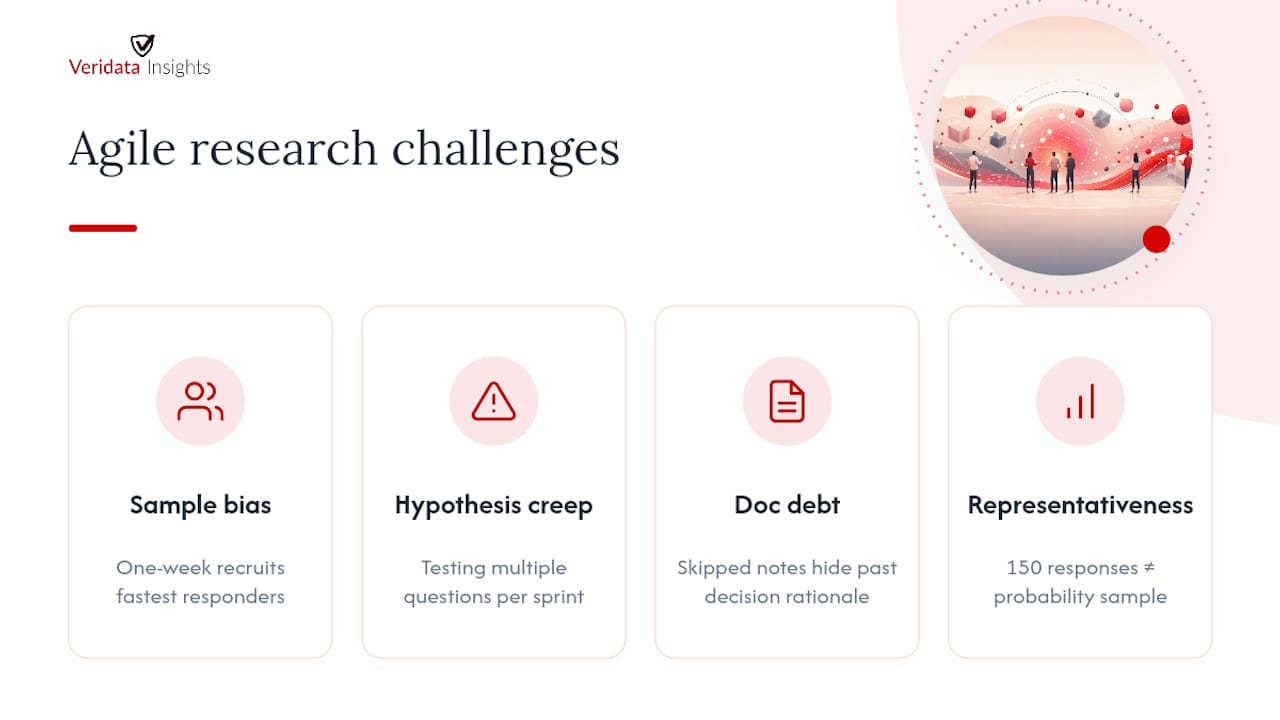
Speed creates its own failure modes. The most common one is sample bias baked into a rush: a one-week recruitment window tends to over-represent whoever answers surveys fastest, not necessarily the audience you actually care about.
A second challenge is hypothesis creep. Teams under time pressure sometimes test three questions in one sprint instead of one, muddying the result and making it impossible to say which variable actually drove the outcome. Tight sprint scoping exists specifically to prevent this, but it’s easy to abandon under deadline pressure.
Documentation debt is a quieter risk. When a sprint moves fast, it’s tempting to skip writing down the hypothesis, the sample details, and the decision logic. Six sprints later, nobody remembers why a past decision was made or whether the data behind it still holds up. The academic case for Agile in research specifically flags reflexive documentation as a safeguard against exactly this.
Finally, agile methods struggle with anything requiring statistical representativeness at scale. A five-day sprint with 150 responses can validate a creative direction; it cannot substitute for a probability-sampled study feeding a regulatory filing or a major market-entry decision. Recognizing that boundary before a sprint starts, not after a stakeholder challenges the result, is what keeps agile research credible instead of reckless.
How Do You Keep Data Quality High in Agile Research?
Fast doesn’t have to mean thin, but it takes deliberate guardrails to keep it from becoming that.
Start with sample definition before you write a single question. Decide who qualifies for the study and how you’ll verify it, then hold that line even when recruitment is slow and the deadline is close. A softened screener is the single fastest way to quietly corrupt a sprint’s results.
Pre-register your hypothesis and your success threshold in writing before data comes in. This single habit, borrowed from the documentation scaffolds academic researchers use to keep iterative work transparent, prevents the natural human tendency to reinterpret ambiguous results as a win after the fact.
Keep sample sizes proportionate to the claim you’re making. A directional read on two headline options needs far fewer responses than a claim about how an entire market segment will behave. Match your confidence level to your actual sample, not to how badly you want a clean answer.
Finally, build in one review step where a second person checks the data before the decision brief goes out, especially on AI-coded open-ends. That single check catches misclassified responses, sarcasm an algorithm missed, and skewed samples before they influence a real business decision.
How Should You Fold Agile Insights Into Decision-Making?
Insight that sits in a slide deck nobody reopens didn’t help anyone. The fix is structural: build the decision brief and the decision meeting into the sprint plan itself, not as an afterthought once results arrive.
A one-page brief works better than a full report for agile output. State the hypothesis, the result against your pre-set threshold, and one clear recommendation: scale, pivot, or run another sprint. Route it directly to the decision owner you named at sprint kickoff, so there’s no ambiguity about who acts on it.
Build a standing rhythm, not a one-off event. Teams that get the most out of agile research treat it as a recurring input into planning meetings, feeding a product roadmap review or a campaign planning session every few weeks, rather than a special project that only gets attention when something’s on fire.
Weight agile findings appropriately against other inputs. A sprint result is a strong directional signal, not a final word equivalent to a large validated study. Treat it that way in the room: it should move a decision, but it shouldn’t be the only voice in it when the stakes are high enough to warrant a second opinion.
What Do Real Agile Research Sprints Look Like?
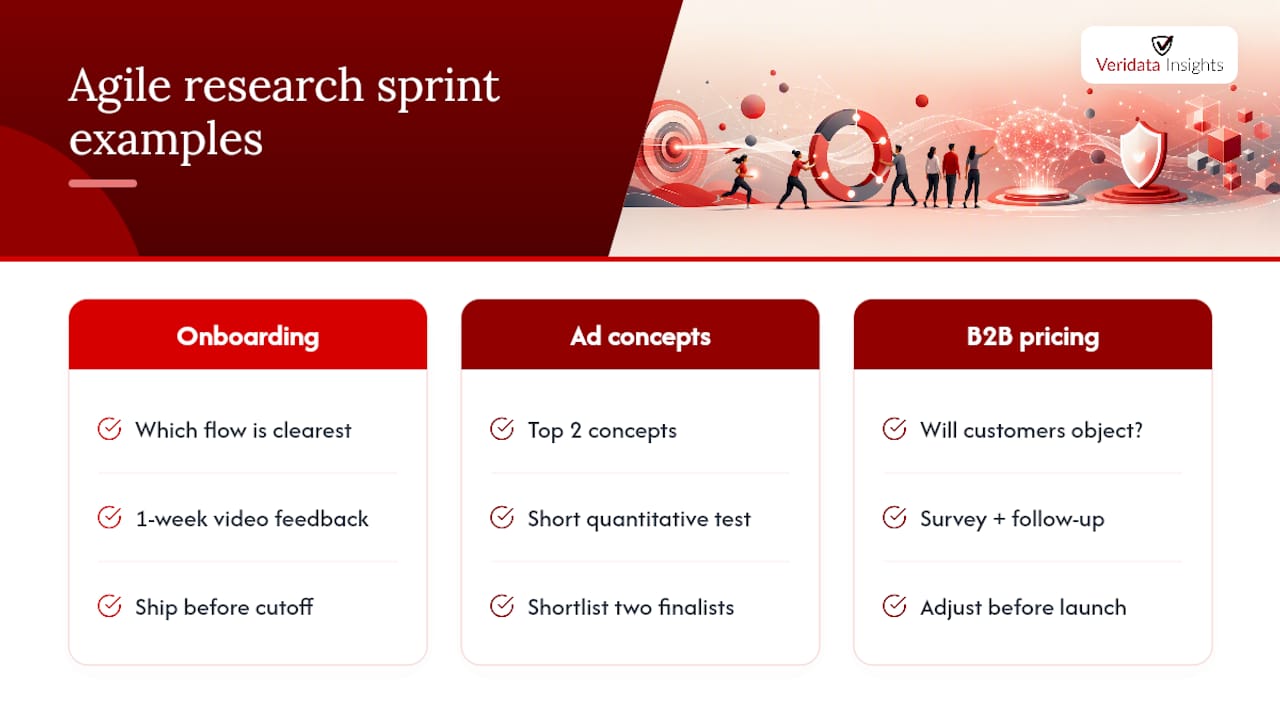
A product team testing three onboarding flow variants can run a one-week sprint using rapid qualitative video feedback, watch where users hesitate on camera, and ship the clearest flow before the next release cutoff, all without commissioning a formal usability study.
A brand team deciding between five ad concepts ahead of a seasonal campaign can run a short quantitative test, ranking concepts on recall and purchase intent, and have a shortlist of two finalists within days instead of waiting for a full creative testing study to clear a multi-week review cycle.
A B2B software company preparing a pricing change can run a smaller, targeted sprint among existing customers using a short survey and a handful of follow-up interviews, catching a pricing objection early enough to adjust messaging before the change goes public. That’s the pattern across all three: a narrow question, a short timeline, and a decision that actually gets made instead of deferred. Consulting teams managing multiple simultaneous client engagements often lean on flexible research partnerships specifically to run this kind of targeted sprint without building an internal research function from scratch. The common thread across working sprints isn’t the tool used. It’s the discipline of asking one sharp question and committing to act on the answer.
Ready to Run Your Next Agile Sprint With a Full-Service Partner?
Self-serve survey tools handle the basics, but they hand you a raw dataset and leave the sampling judgment, the coding, and the “can we trust this?” question entirely on your plate. Veridatainsights is built for teams who want sprint speed without doing that work alone: consultation and questionnaire design, programming, recruitment for hard-to-reach B2B, B2C, and healthcare audiences, plus coding, analytics, and visualization, all under one roof, with no minimum project size and service available every day of the year.
That combination suits a marketing or product team mid-launch just as well as a consulting firm juggling several client sprints at once, since flexible research services scale down to a three-question pulse check or up to a full custom study without changing partners in between. If your next sprint needs recruitment beyond what a self-serve panel can reach, or a dataset that has to hold up to real scrutiny, contact Veridata Insights to scope it before your timeline gets tighter than it needs to be.
Sources
- Agile market research (and why it’s here to stay) | Forsta
- Agile research | First Monday
- What Is Agile Market Research And How To Use It | SurveyMonkey
- The smartphone confession booth | AI Wharton