

Usability testing recruitment means defining who your real users are, finding people who match, screening them, and getting them into a session on time. Do it well and a five-person study can change your roadmap. Do it badly and you get a polished session, a confident report and findings that don’t apply to your customers. This guide covers how to define your audience, write a screener, choose a sourcing channel, budget for no-shows and decide when to bring in a research partner.
TL;DR
- Recruitment is a validity issue, not an admin step. The wrong participant gives you confident but irrelevant findings.
- Recruit on behavior and usage traits, not just demographics, and build the screener from those traits.
- Over-recruit. Plan for roughly 10% to 20% of recruits to be disqualified or unavailable, and more for niche, older-adult or minor audiences.
- A hybrid model works best for most teams: an opted-in first-party panel for repeat learning, plus external recruitment for fresh or hard-to-reach people.
- Healthcare, university, pharma and government studies need consent, privacy and often IRB review built in before the first invitation goes out.
Table of Contents
- Why recruitment decides whether your test is worth running
- Define who counts as a representative user
- Write a screener that screens
- Where to find participants
- How many people do you need?
- Over-recruit, then over-recruit a little more
- Incentives and what recruiting costs
- Write an invitation people trust
- Regulated and sensitive audiences
- A simple recruiting timeline
- When to hand recruiting to a research partner
- A pre-launch checklist
- FAQ
- Sources
Why recruitment decides whether your test is worth running
Jakob Nielsen’s core rule for simplified user testing starts with getting representative users. Representative users doing representative tasks, then careful observation. The order matters. A flawless moderator can’t rescue a session with someone who would never use your product.
Here is a common failure. A team building a procurement dashboard for hospital supply managers tests it with coworkers from the finance department. The coworkers are smart, friendly and available. They also don’t know what a par level is. The session runs smoothly, and the findings are about the wrong problems.
Size isn’t everything. Quality matters. That goes for the sample as much as for the interface.
Define who counts as a representative user
Treat recruitment as part of study design. NN/G’s recruiting guidance covers criteria, incentives, screening, scheduling, reuse, safety and privacy as one connected program, and it starts with the criteria.
Build your profile in this order:
- The task. What will participants actually do? Placing an order, configuring a device, comparing plans, reading a lab result.
- The behaviors that predict success. How often they do it, with which tools, how recently, at what level of responsibility.
- The context. Role, industry, device, environment, assistive technology.
- The exclusions. Employees of your company or competitors, people who have joined a similar study recently, anyone with a conflict of interest.
- The mix. New versus experienced users, and any segment whose problems you can’t afford to miss.
Demographics belong on the list only when they change behavior. “Women 35 to 54” tells you little. “Manages household finances and has paid a bill through a mobile app in the past month” tells you a lot.
Write a screener that screens
The screener is the short survey that decides who gets in. Most weak screeners fail the same way: they reveal the right answer.
- Hide the target. Ask “Which of these tools do you use at work?” with a list of real options and a few decoys. Don’t ask “Do you use project management software?”
- Ask about behavior, not opinion. “When did you last do X?” beats “How comfortable are you with X?”
- Use ranges and multiple choice. Open text invites guessing and slows your review.
- Add a quality check. One question that only a genuine practitioner can answer in specific terms.
- Keep it short. If it takes more than a few minutes, you lose the busy professionals you most want.
- Confirm by phone or video when stakes are high. A two-minute call catches what a form can’t.
For B2B and healthcare audiences, verify role and credentials where you can. Job title alone is a weak filter, since the same title means different things in different companies.
Where to find participants
There is no single best channel. Each trades off speed, cost, control and fit.
| Source | Best for | Watch out for |
|---|---|---|
| Your own customers and users | Existing-product studies, repeat learning | Bias toward fans, panel fatigue, consent for contact |
| Personal networks, alumni groups, niche communities | Early-stage, low-budget tests | Friendliness bias, weak control over fit |
| Intercepts on your site or app | Behavior-based targeting of actual visitors | Self-selection, privacy and notice rules |
| Online panels and recruitment platforms | Broad consumer audiences, fast turnaround | Professional respondents, thin quality checks |
| Specialist recruiters | B2B, healthcare, executives, rare audiences | Lead time, need for a tight brief |
Practitioner threads on Reddit often recommend warm intros, alumni groups, niche Slack or Discord communities and small gift cards for tiny budgets. That’s fair advice for a side project. It stops working when your participants are oncologists, plant managers or procurement leads who will not answer a community post.
The hybrid model
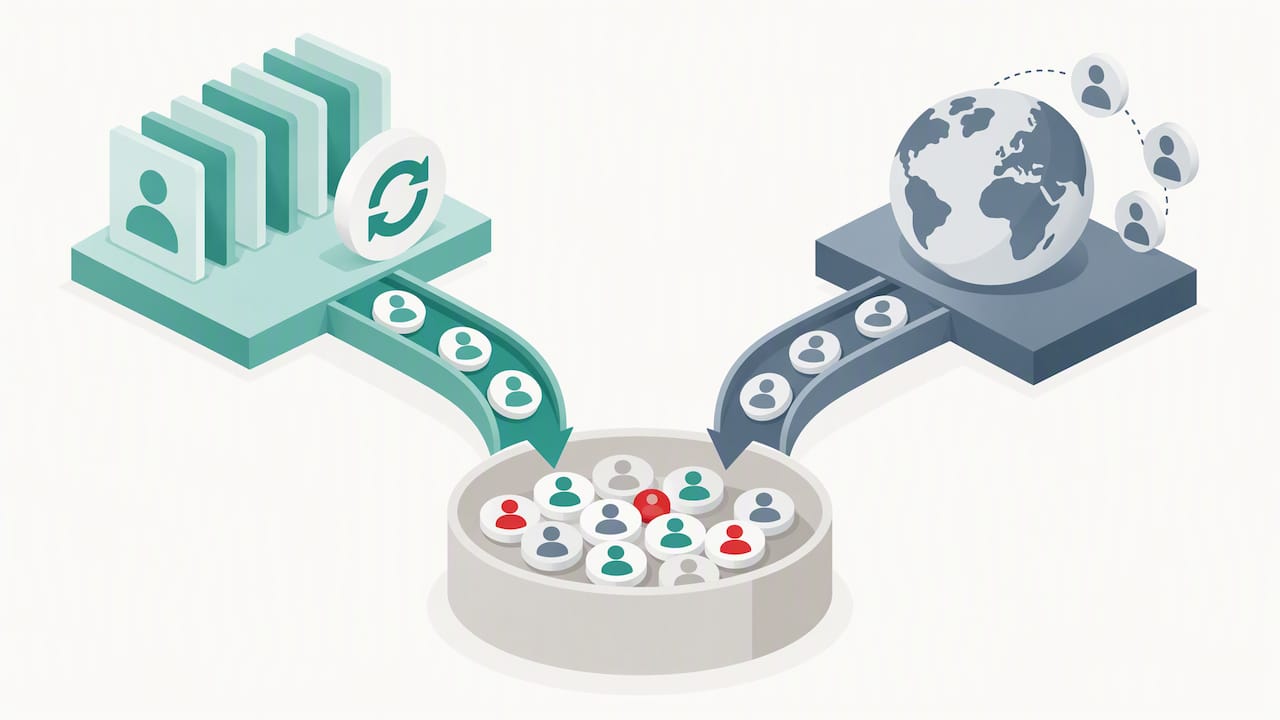
NN/G describes a hybrid approach as a strong operating model for organizations running varied studies. You keep an opted-in first-party panel of customers or professionals for repeat learning, and add external recruitment when you need fresh faces or hard-to-reach people. The panel gives you speed and relevance. The outside recruiting protects you from fatigue and gaps in coverage.
The site you are testing also matters to how people find you in the first place. If you are weighing how interface choices tie into discoverability, this piece on how user experience shapes search performance is a useful companion read.
How many people do you need?
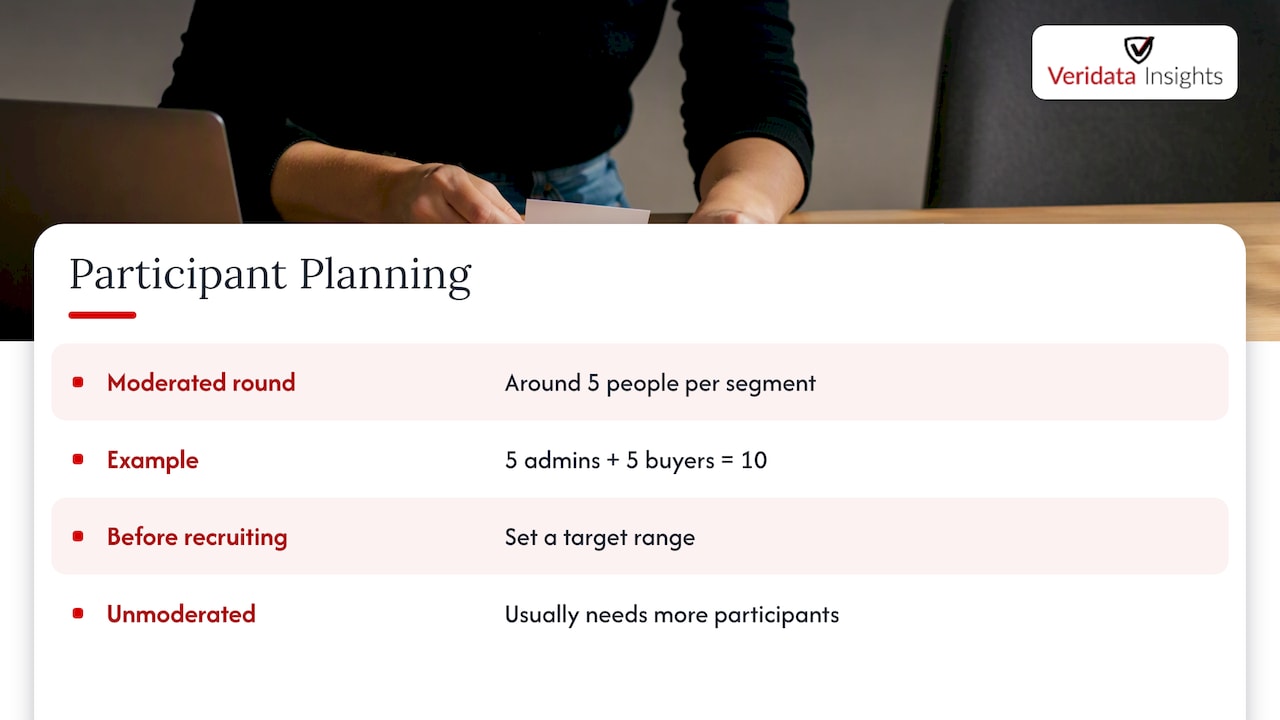
For a single round of moderated testing, small samples are normal. Many teams test with around five people per distinct segment, then run more rounds as designs change. Unmoderated studies usually need more, since nobody is there to probe.
Two rules help. First, count per segment. Five admins and five buyers is ten people, not five. Second, decide the number before recruiting, as a range. NN/G’s recruiting guidance stresses knowing how many people you want and what minimum would still let you draw conclusions.
Over-recruit, then over-recruit a little more
People cancel. Some don’t qualify once you speak to them. Some get stuck in traffic or in a meeting.
A 2025 medical-device usability guide recommends over-recruiting because approximately 10% to 20% of recruited participants may be disqualified or otherwise unavailable. That range comes from a regulated device context, so treat it as a starting point. Niche B2B, healthcare and older-adult studies deserve the high end or more.
For minors, NN/G reports that approximately one in nine recruited users fail to show up, and advises recruiting extra because both the child and the parent affect attendance. That figure is about children and shouldn’t be used as an adult no-show rate.
Practical tactics that cut no-shows:
- Send a calendar invite with a video link or address, parking details and a contact number right after confirmation.
- Remind people the day before and again two hours before.
- Keep a short list of standby participants who match the profile and can join on short notice.
- Say plainly when and how the incentive arrives.
Incentives and what recruiting costs
Incentives should respect the participant’s time and expertise. A retired shopper giving an hour and a cardiologist giving an hour are not worth the same to them, and a flat rate will either overpay the first or fail to recruit the second.
For a sense of the economics, NN/G’s older recruiting survey is useful as a benchmark, though not as a current price list. It found that organizations recruiting in-house spent an average of 1.15 staff hours per participant, and 24% spent more than two hours per participant. Agencies charged an average of $107 per participant in that survey, with $125 on the West Coast, $161 for high-end professionals and about $84 for average consumers or students. Those are figures from 2003. Today’s rates differ, and hard-to-reach audiences cost more.
The lesson holds, though. Compare an outside fee against your own staff hours, not against zero. If a researcher spends two hours chasing one executive, the “free” route isn’t free.
Write an invitation people trust
Good fit isn’t enough. People have to believe the invitation is real.
Research by Ginny Redish, Dana Chisnell and Amy Lee on recruiting older adults found that people may reject an invitation if it looks like a sales pitch or a scam, even when they fit the audience. The same experience found generic community postings and unclear flyers performed poorly. Their work involved 34 older adults in San Francisco, Tampa and Baltimore, so it is a small study, but the trust lesson applies well beyond that age group.
Your invitation should state:
- Who is asking. The sponsor or recruiter, by name.
- Where you got their contact details.
- The purpose. What you are studying, in a sentence.
- The time commitment. Session length and any prep.
- The incentive. Amount and timing.
- Privacy treatment. What you record and who sees it.
- That it is not a sales call.
Have a consent form ready to send as soon as someone qualifies, covering scope, recording and how data is handled.
Regulated and sensitive audiences
If the study touches patients, clinicians, students, government programs or pharmaceutical products, recruitment gets a compliance layer.
The HHS Office of Inspector General’s guidance on recruiting human subjects points to avoiding undue influence and inappropriate referral incentives. For studies that fall under institutional or regulated research, document voluntary participation, confidentiality, purpose, expected duration, contact information and any additional incentive. Involve the relevant IRB or privacy process before materials go out. Your institution’s compliance office or IRB makes the final call on what applies to your study.
Our overview of IRB for market research explains when US companies need to think about it. For healthcare audiences in particular, see how healthcare market research recruitment is handled.
A simple recruiting timeline
- Week 0: Agree on research goals, tasks and the participant profile.
- Week 0 to 1: Draft the screener, invitation, consent form and incentive plan. Get legal or IRB sign-off if needed.
- Week 1 to 2: Field the screener through your chosen channels. Review responses by hand.
- Week 2: Confirm, schedule, send reminders, line up standbys.
- Session week: Run sessions, track attendance and pay incentives promptly.
- After: Note who participated, with consent, so you can manage reuse and avoid over-asking the same people.
Rare audiences stretch every step. Start earlier than feels necessary.
When to hand recruiting to a research partner
Doing it yourself makes sense when your audience is broad, your budget is small and your timeline is flexible. Bring in help when:
- Your participants are executives, specialists, clinicians or other hard-to-reach professionals.
- You need a quick turnaround or many sessions across markets.
- You need verified qualifications rather than self-reported ones.
- Your study involves compliance, consent and privacy requirements you’d rather not carry alone.
- Your team’s hours are better spent on analysis than on chasing replies.
That is where Veridata Insights comes in. We are research recruitment experts for B2B, B2C, healthcare and hard-to-reach audiences, and we can do as much or as little as you need, with no project minimums. Some clients hand us only respondent recruitment. Others want full-service market research, from study design and screener review through programming, data collection and reporting. We’re available seven days a week, 365 days a year. If you want to see how we approach sourcing, our guide to recruiting participants goes deeper, and our page on recruiting hard-to-reach audiences covers the tougher cases. Tell us your profile and timeline at Veridata Insights and we’ll tell you honestly what’s feasible.
A pre-launch checklist
- Participant profile written as behaviors and context, not just demographics
- Number of sessions set per segment, with a minimum
- Screener that hides the right answers and includes a quality check
- Over-recruit planned, with standbys identified
- Invitation names the sponsor, purpose, time, incentive and privacy treatment
- Consent form ready
- Incentive amount and payment timing agreed
- IRB or privacy review done where it applies
- Reminder schedule set
- A plan for what to do when someone turns out not to qualify
FAQ
How do I recruit participants for user interviews?
The steps match usability testing. Define the behaviors that make someone relevant, write a screener that doesn’t reveal the answers, and invite people with a clear explanation of who you are and what you’ll do with their time. Use your own customers for existing-product questions and an external source for new audiences or professionals who are hard to reach.
How many extra participants should I recruit?
A 2025 medical-device guide suggests roughly 10% to 20% of recruits may be disqualified or unavailable. Go higher for niche professional, older-adult or regulated studies. For minors, NN/G reports about one in nine recruited users don’t show up, so build in extra there as well.
Can I use friends, coworkers or social media followers?
For a rough early check, yes. For decisions that carry real cost, no. People who know you tend to be kind and often don’t match your actual users. Use them only to catch obvious problems.
Do I need IRB approval to recruit for a usability study?
Not always. It depends on who the participants are and who is sponsoring the work. University, healthcare, pharmaceutical and government studies often fall under institutional or regulated review, so check with your compliance office or IRB before sending invitations.