


MaxDiff analysis is a best-worst choice method that forces respondents to pick the most and least preferred items from rotating subsets, producing relative utilities that discriminate sharply among many similar options. Use it when you need to rank, prioritize, or segment a substantial list of features, claims, or attributes. Skip it when you need absolute demand numbers or price trade-offs without extra calibration.
TL;DR:
- MaxDiff performs best for prioritizing features or claims when ranking more than eight items, but is less suited for absolute demand measurement or price trade-offs.
- Study design should include 12 to 25 items, with sets of four to five, balanced for equal item appearance and comparison rates, while limiting tasks to around 25 to prevent fatigue.
- Data analysis options range from quick counting methods to advanced hierarchical Bayes models, with the latter providing individual-level insights but requiring proper diagnostics and handling.
- Utilities from MaxDiff are relative, sensitive to the item pool, and should be interpreted using share-of-preference probabilities instead of absolute demand forecasts or sales predictions.
- Incentive alignment and anchoring significantly improve MaxDiff’s predictive validity for real purchasing behavior, especially for consequential product decisions.
Table of Contents
- What Is MaxDiff Analysis and How Does It Differ From Other Best-Worst Methods?
- When Should You Use MaxDiff, and When Should You Avoid It?
- How Do You Design a MaxDiff Study That Won’t Fall Apart in the Field?
- Which Analysis Method Should You Use to Score MaxDiff Data?
- How Do You Interpret MaxDiff Results Without Overreaching?
- A Practitioner’s Checklist From Design to Report
- How Veridata Insights Runs MaxDiff Studies From Brief to Report
- Sources
- FAQ
What Is MaxDiff Analysis and How Does It Differ From Other Best-Worst Methods?
Each MaxDiff task shows a respondent a small subset of items and asks two questions: which one is best, and which one is worst. That single pair of answers implies several paired comparisons at once. Show someone five items and ask for the best and worst, and you’ve effectively learned how that person ranks most of the pairs within that subset without asking about each pair individually.
MaxDiff is a specific model within the broader best-worst scaling (BWS) family, not a synonym for it. The core assumption is that respondents can consistently identify extremes within a set, and that these extreme judgments generalize into a stable utility scale. Researchers sometimes conflate MaxDiff with looser best-worst formats that skip the choice-modeling step entirely. The distinction matters because MaxDiff’s conclusions are conditional on the items and dimension chosen for comparison, not an independent measure of absolute importance.
That assumption weakens under two conditions: very large item pools where respondents start pattern-matching instead of evaluating, and ambiguous items that mean different things to different people. Both push error into the model, and both show up as flat, undifferentiated utilities in the output.
When Should You Use MaxDiff, and When Should You Avoid It?
MaxDiff performs best for feature prioritization, message and claims testing, attribute importance work, and any project ranking more than eight or ten items where a rating scale would produce a wall of 8s and 9s. It’s also useful groundwork for segmentation, since choice-based data tends to separate respondent groups more cleanly than Likert ratings.
It’s a poor fit for measuring absolute purchase intent without an anchoring mechanism, for questions that need respondents to explain their reasoning, and for item pools under six or seven, where a simple rank-order task works fine. When price needs to trade off directly against features, a choice-based conjoint (CBC) study usually answers the question better than MaxDiff versus conjoint analysis debates suggest. MaxDiff tells you what matters; conjoint tells you what someone will pay for it.
How Do You Design a MaxDiff Study That Won’t Fall Apart in the Field?
Design decisions matter as much as the statistical model behind them. A flawless hierarchical Bayes estimate cannot rescue a survey built on a sloppy item list or a lopsided design matrix.
Start with the pool. Practical MaxDiff studies typically test 12 to 25 items, drawn from qualitative work, stakeholder interviews, or a prior round of open-ends. Push much past 25 and you’re asking respondents to hold too much in their heads across the exercise.
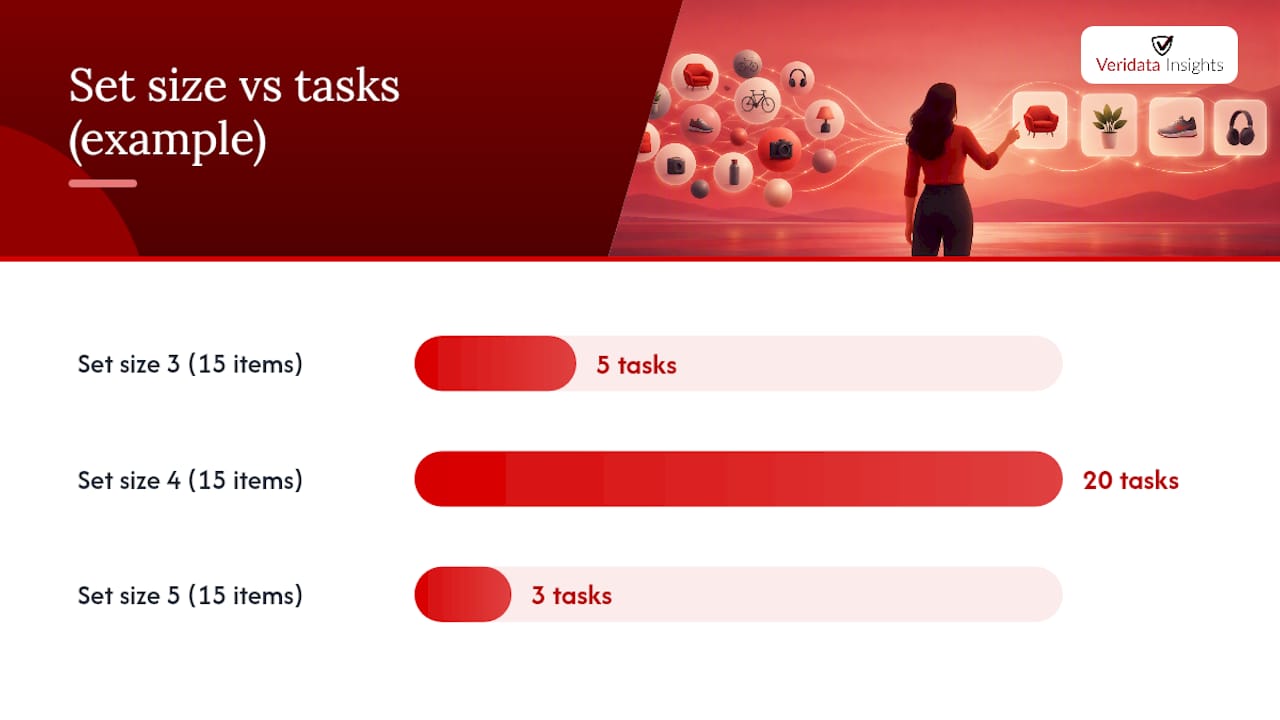
Set size and task count come next, and they trade off against each other. Set sizes of three to five items work best, and most practitioners favor four or five. On tasks, cap the exercise around 25 to keep respondent fatigue in check. Given that ceiling, more tasks with fewer items per task tend to perform well because they balance accuracy and respondent burden effectively.
Balance is essential. Every item should appear roughly equally across the design, and every pair of items should have comparable co-occurrence rates, to avoid bias. Balanced incomplete block designs or algorithmic optimization software handle this automatically. Building it by hand invites bias.
Before fielding, conduct thorough QA:
- Preview the actual survey as respondents see it, not only the design file.
- Check for duplicate or repeating items across tasks.
- Analyze completion times for signs of rushed responses.
- Monitor dropout rates by task position to identify fatigue or confusion.
- Ensure item wording is clear, focused, and consistently toned.
Pro Tip: When choosing between designs like 15 items in five sets of three and 15 items in twenty sets of four, the latter generally provides more comparisons per respondent without greatly increasing burden.
Sound questionnaire design practices, like avoiding double-barreled phrasing, apply just as much to MaxDiff items as to any other survey question.
Which Analysis Method Should You Use to Score MaxDiff Data?
Four routes exist, and the right one depends on what decision the data needs to support.
Counting analysis is the fastest option: score each chosen best item as +1, each chosen worst as -1, and tally across tasks. It’s a reasonable shortcut for near-orthogonal designs and quick internal reads, but counting alone tosses out information that a proper model would capture.
Pooled multinomial logit (MNL) estimates population-level utilities and converts cleanly into share-of-preference numbers, which is usually what a stakeholder actually wants in a slide. Latent-class MNL adds segmentation on top, sorting respondents into groups with distinct preference patterns rather than assuming one utility set fits everyone.
Hierarchical Bayes (HB) and mixed-logit approaches go further, recovering individual-level utilities alongside population estimates. This is where you diagnose real heterogeneity instead of guessing at it. Modern implementations, including PyMC-based MaxDiffMixedLogit workflows, require a reference item for identification and specific handling for ragged subsets when not every respondent sees the same number of tasks. Check sampling diagnostics like r-hat values before trusting any HB output, and use dedicated generative prediction functions for counterfactual scenarios rather than raw posterior predictive draws, which can behave oddly when conditioned on the observed choice.
How Do You Interpret MaxDiff Results Without Overreaching?
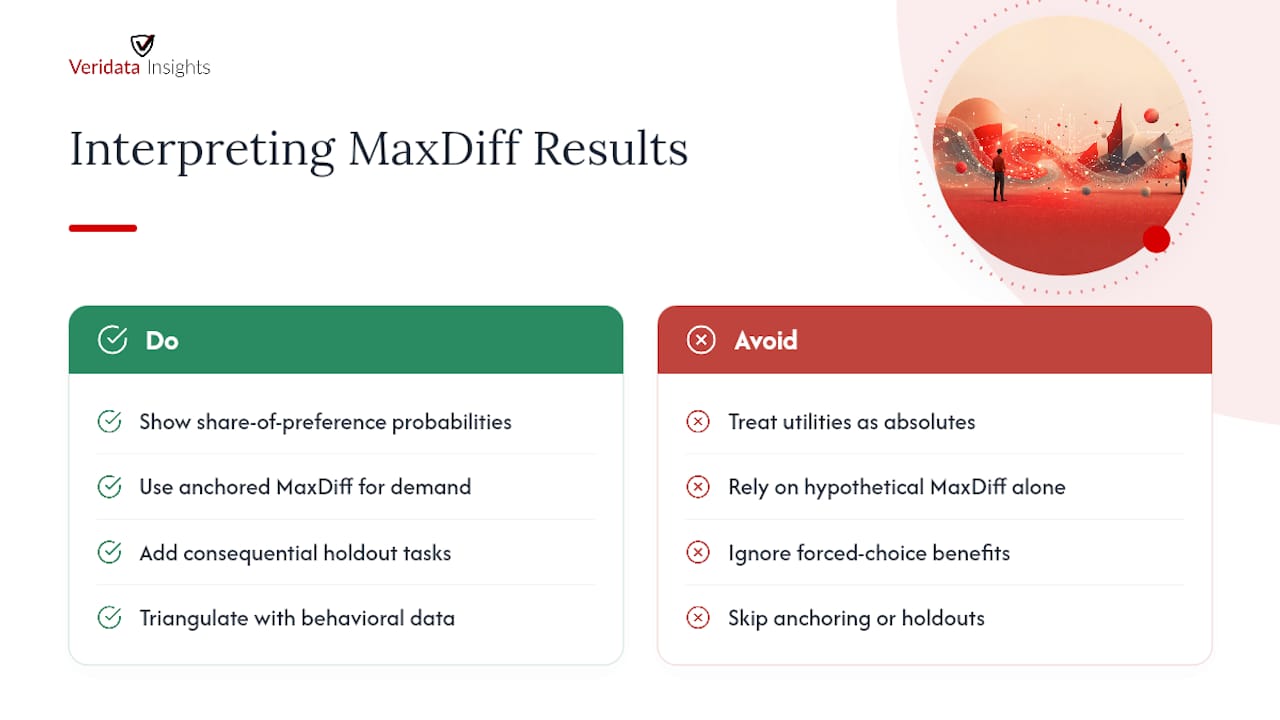
MaxDiff utilities represent relative contrasts, not absolute measures. An item’s utility is only meaningful compared to other items in the study. Presenting share-of-preference probabilities helps stakeholders understand importance without misinterpreting utilities as absolute demand forecasts.
The forced-choice format is also MaxDiff’s biggest analytical strength: it prevents the scale inflation you see when everyone rates every feature a 4 or 5 out of 5, and it produces utilities that stay comparable across items within the set.
Predictive validity is where MaxDiff earns its reputation, and where it can also mislead. A 2024 preregistered experiment with 448 respondents found that incentive-aligned, anchored MaxDiff significantly outperformed standard hypothetical MaxDiff at predicting real, consequential product choices, with incentive alignment showing a strong effect on prediction accuracy. Hypothetical MaxDiff tells you ordering; anchored MaxDiff gets closer to telling you what people will actually do.
If a decision hinges on absolute demand rather than relative ranking, don’t stop at standard MaxDiff. Run an anchored variant, add consequential holdout tasks, or triangulate stated preference against behavioral data before betting a launch decision on it.
A Practitioner’s Checklist From Design to Report
Running a MaxDiff study cleanly comes down to sequence discipline more than any single clever technique.
- Define the decision the study needs to support, then curate an item list of roughly 12 to 25 items from qualitative input.
- Design balanced subsets (four to five items per set, up to roughly 25 tasks) using block design or optimization software.
- Preview the live survey, audit for duplicate or overlapping items, and check task length against respondent attention.
- Choose an estimator, counting for a quick read, MNL or latent-class for shares and segments, HB for individual-level utilities, and run diagnostics before reporting.
- Report shares of preference, segment or individual heterogeneity, and any validation results together, not utilities alone.
When you brief a partner to run this for you, hand over the decision objective, the full item list, the target audience definition, and your timeline. That’s the whole ballgame.
How Veridata Insights Runs MaxDiff Studies From Brief to Report
You don’t need to own every step above to get a MaxDiff study done right. Veridata Insights is a full-service alternative to piecing a project together across freelancers and software licenses. We handle study design, questionnaire review, survey programming, and the balanced-design work that keeps your utilities honest, then move straight into fielding.
Recruitment is where a lot of MaxDiff studies quietly fail, since a biased or fatigued sample undermines even a perfectly designed exercise. Our team recruits B2B, B2C, healthcare, and other hard-to-reach audiences for exactly this kind of quantitative work, and we handle the analysis once data comes in, from counting checks through hierarchical Bayes modeling and visualization.
There are no project minimums, and we operate 365 days a year, so a fast pilot and a full multi-market study both get the same attention to design detail. To get started, put together your objective, your item list, and your audience definition, then reach out for a consultation. We’ll tell you honestly whether MaxDiff is the right tool before we build anything.
Sources
For design rules and fielding QA, Bentley University’s MaxDiff feature-prioritization guide is the most practical starting point. For estimation theory, Sawtooth Software’s technical paper covers counting through HB in detail. For empirical validation, the Marketing Letters anchored MaxDiff study is the strongest available evidence on predictive accuracy.
- How to Use Max Diff Survey Analysis for Feature Prioritization | Bentley University
- Incentive-aligned anchored MaxDiff predictive validity (Marketing Letters)
- MaxDiff / MaxDiffMixedLogit examples and notebook (pymc-marketing)
- The MaxDiff System Technical Paper (Sawtooth Software)
FAQ
What Sample Size Do You Need for MaxDiff Analysis?
Most practitioners prefer a sufficient number of respondents to support hierarchical Bayes modeling and recover stable individual-level heterogeneity. The right number depends on how many segments you expect to find and how fine-grained your reporting needs to be, which is worth working through with a sample-size calculation rather than a rule of thumb alone.
How Is MaxDiff Different From Conjoint Analysis?
MaxDiff ranks items against each other within a single dimension, while conjoint analysis (particularly choice-based conjoint) models trade-offs between multiple attributes, including price. Choose MaxDiff for prioritizing a long list of features or claims, and conjoint when price sensitivity or attribute trade-offs are the real question.
How Many Items Should Go in Each MaxDiff Set?
Sets of four or five items strike the best balance between task length and how much information each choice provides, based on multiple experimental design studies. Sets smaller than three lose discriminating power, and sets larger than five raise the cognitive load and hurt data quality.
Can MaxDiff Predict Actual Purchase Behavior?
Standard hypothetical MaxDiff predicts relative preference well but is weaker at forecasting real purchase decisions. Incentive-aligned, anchored MaxDiff designs have shown significantly better predictive validity for consequential choices, so anchor the design whenever a launch or investment decision depends on the result.
Does Veridata Insights Offer MaxDiff Study Design and Analysis?
Yes. Veridata Insights provides end-to-end support for MaxDiff projects, including study design, questionnaire review, survey programming, respondent recruitment, and hierarchical Bayes or MNL analysis. Pricing depends on project scope, so current details are available by reaching out directly.