


A soft launch is a small, staged release of your survey to a slice of your target sample before you open the field completely. Its job is to catch critical questionnaire, sampling, or technical errors while the cost of fixing them is still low. The immediate move: field a short, representative test round with a predefined stop rule, then decide before you push send on the rest.
TL;DR:
- Soft launches are recommended when surveys involve complex skip logic, multiple language versions, or tight quotas on hard-to-reach groups, to ensure data accuracy and technical functionality.
- A typical soft launch lasts three to seven days, starting with about 5% of the target sample, then expanding based on initial data quality and technical checks.
- Conducting real-time monitoring of key metrics such as completion rate, routing accuracy, and device coverage helps identify issues early and guides necessary adjustments.
- Analysts must set pre-defined thresholds for errors and performance metrics to decide whether to fix, revise, or proceed with full deployment after the soft launch.
- For complex or high-stakes projects, external vendors like Veridata Insights can manage the soft launch process, including recruitment, QA, and staged fielding, to reduce internal workload.
Table of Contents
- What Are Soft Launch Surveys, and How Do They Differ From Pretesting and Pilot Testing?
- When Should You Run a Soft Launch, and What Should It Achieve?
- How Long Should a Soft Launch Run, and How Big Should the Sample Be?
- How Do You Execute a Soft Launch Step by Step?
- How Do You Analyze Soft-Launch Data and Decide What Comes Next?
- What Belongs on a Compact Soft-Launch Checklist for Stakeholders?
- Veridata Insights: Full-Service Support When You Need a Second Set of Hands
- How Do You Get Help Running a Soft Launch Pilot?
- Sources
- FAQ
What Are Soft Launch Surveys, and How Do They Differ From Pretesting and Pilot Testing?
A soft launch is the delivery mechanism. It’s the act of releasing your live survey to a small group first, whether that’s 5% of your sample or a fixed number of completes, so you can watch it behave in the wild before full fielding.
Pretesting and pilot testing are the analytical activities that usually surround it. Pretesting zeroes in on the questionnaire itself: wording, flow, comprehension. Methodological guidance puts pretest samples at 12 to 50 people, enough to surface confusing items without burning through your list. Pilot testing goes further. It rehearses the entire research process, recruitment, data flow, exports, and analysis, typically with 30 to 100 participants.
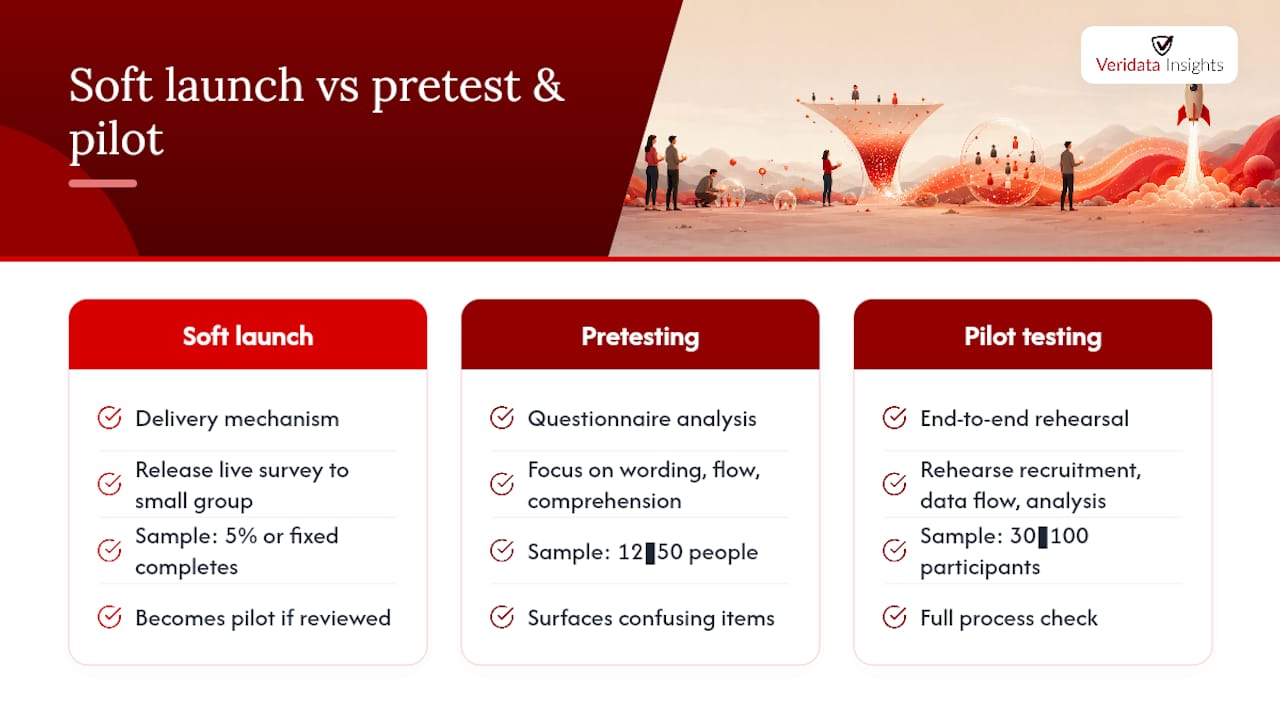
Here’s the distinction that trips up a lot of teams: a soft launch by itself is just delivery. Unless someone actually reviews the incoming data, checks routing, and reads the open-text responses, it’s not a pilot. It’s just a smaller version of a mistake, released early. Pair the launch with real analytic review, or you’ve wasted the head start.
When Should You Run a Soft Launch, and What Should It Achieve?
Not every survey needs one. A short, single-path consumer satisfaction survey with no quotas probably doesn’t. But a soft launch earns its place when your project has any of these:
- Complex skip logic or branching that’s hard to trace on paper
- Multiple language translations running in parallel
- Tight quotas on hard-to-reach subgroups
- Delivery across several devices or browsers
- A new panel, vendor, or recruitment channel you haven’t used before
Set measurable goals before you launch, not after. Confirm that routing sends respondents down the correct paths. Validate that quota and incidence rates match your assumptions. Check completion time and device coverage. Verify that your data export actually produces clean, usable variables. If you hit that, proceed. If you don’t, you know exactly what to fix.
How Long Should a Soft Launch Run, and How Big Should the Sample Be?
Three to seven days is the useful window for most soft launches. Long enough to catch time-of-day and device variation, short enough that you’re not stalling your field period over a test.
On sample size, industry guidance consistently points to 5% to 10% of your target sample, or a small fixed number of completes when your target is modest. Either rule keeps early noise manageable while still giving you enough completes to spot a pattern instead of a fluke.
Staging the release in rounds, rather than dumping the whole soft-launch batch at once, gives you room to fix problems before they compound. A common structure:
- Day 1: Invite roughly 5% of target (or a small fixed N) and watch closely.
- Day 2: If clean, invite another 20%.
- Day 3 or later: Move to full launch.
Platform guidance recommends leaving at least a day between rounds so you have time to actually implement fixes, not just notice them.
The sampling strategy matters as much as the size. Test using your intended recruitment approach, whatever panel, quota structure, or channel you’ll use for full launch, not a convenience sample of coworkers or friends. Convenience samples produce false confidence on quotas and incidence rates that won’t hold up once you’re recruiting from the real population.
Pro Tip: If your project uses a specialized or hard-to-reach audience, test your recruitment channel during the soft launch, not just your questionnaire. A perfect instrument fielded through the wrong channel still fails.
How Do You Execute a Soft Launch Step by Step?
Before you send a single invite, walk the questionnaire yourself end to end. Check every skip pattern, preview on the actual devices and browsers your sample will use, confirm translations read naturally rather than just accurately, and run a mock export to see whether your variables come out clean. Our guide to skip logic setup and QA covers this in more depth, and general questionnaire design best practices are worth a pass here too.
Once QA is done, prepare separate contact files for each round so you’re not scrambling to split lists mid-launch. Send round one, then watch your dashboard and server logs in near real time rather than checking in once at the end of the day.
Track these metrics as data comes in:
- Completes and completion rate
- Median completion time (and outliers well above or below it)
- Breakoff rate, and where in the survey people are dropping
- Item nonresponse on key questions
- Quota fill against your targets
- Any spike in flagged or nonsensical open-text responses
Soft-launch monitoring should focus specifically on routing and technical checks, since those are the failures that don’t show up until real respondents hit them. Don’t skip the qualitative side either. If you have enumerators or a small panel of test respondents, ask them directly what confused them or where they hesitated, and log every issue with a timestamp and question number so patterns are easy to trace later.
How Do You Analyze Soft-Launch Data and Decide What Comes Next?
Run a handful of quick diagnostics before you make any launch decision. Cross-tab your routing questions against the paths respondents actually took. Scan completion times for outliers that suggest people are speeding or stalling. Read the open-text responses for confusion, not just content.
Set decision thresholds ahead of time so you’re not negotiating with yourself under time pressure:
- Pause and fix: Any critical routing error, a breakoff rate meaningfully above your benchmark, or quota fill wildly off target.
- Revise and re-test: Wording problems that show up repeatedly in open-text feedback but don’t break the logic.
- Proceed: Metrics within your predefined success range and no critical errors logged.
The trickiest call is whether soft-launch responses belong in your final dataset. If you edited the questionnaire after the soft launch, either re-administer the revised items to the same respondents or exclude those responses from analyses involving the edited questions. Mixing pre-edit and post-edit data without documenting the change risks contaminating your results in ways that are hard to spot later. Our piece on survey design practices for reliable quantitative data walks through this kind of data-quality safeguard in more detail.
What Belongs on a Compact Soft-Launch Checklist for Stakeholders?
Stakeholders rarely want your full monitoring log. They want a fast, honest readout. Before you write it, confirm these are true:
- QA passed, including logic, device previews, and translation checks.
- Routing verified against every branch in the questionnaire.
- Sample strategy validated using the real recruitment channel.
- Device and browser coverage confirmed across your target platforms.
- Error log reviewed and closed out or flagged for revision.
Your readout itself should stay to three to five lines: completes, completion rate, median completion time, breakoff rate, quota attainment, and a one-line summary of anything in the error log. That’s enough for a project sponsor to say yes, wait, or let’s talk, without wading through your dashboard.
Veridata Insights: Full-Service Support When You Need a Second Set of Hands
Running a tight soft launch takes methodology chops and enough bandwidth to actually watch the dashboard in real time, which is where a lot of internal teams get squeezed. Veridata Insights is built as a full flexible-service research firm, handling both quantitative and qualitative work with a solid grounding in the methodology each project actually needs.
That includes the full arc: consultation and design, questionnaire review, programming, data collection, processing and coding, and reporting with analytics and visualization. When your project involves hard-to-reach quotas, multiple languages, or a recruitment channel you haven’t tested before, a team that lives in this work daily catches problems faster than a first attempt usually does. When your soft launch is small and your logic is simple, running it in house is often the right call.
How Do You Get Help Running a Soft Launch Pilot?
If your team is stretched thin, or your study has quotas, translations, or a hard-to-reach audience that makes a DIY soft launch risky, Veridata Insights can run the pilot for you: survey programming, respondent recruitment, staged fielding, technical QA, and the readout your stakeholders actually want to see.
Before you reach out, have your questionnaire draft, target sample and quotas, and rough timeline ready. That’s enough for a real conversation about scope. There’s no project minimum, and the team is available 7 days a week, 365 days a year, so a tight launch window doesn’t have to wait on office hours.
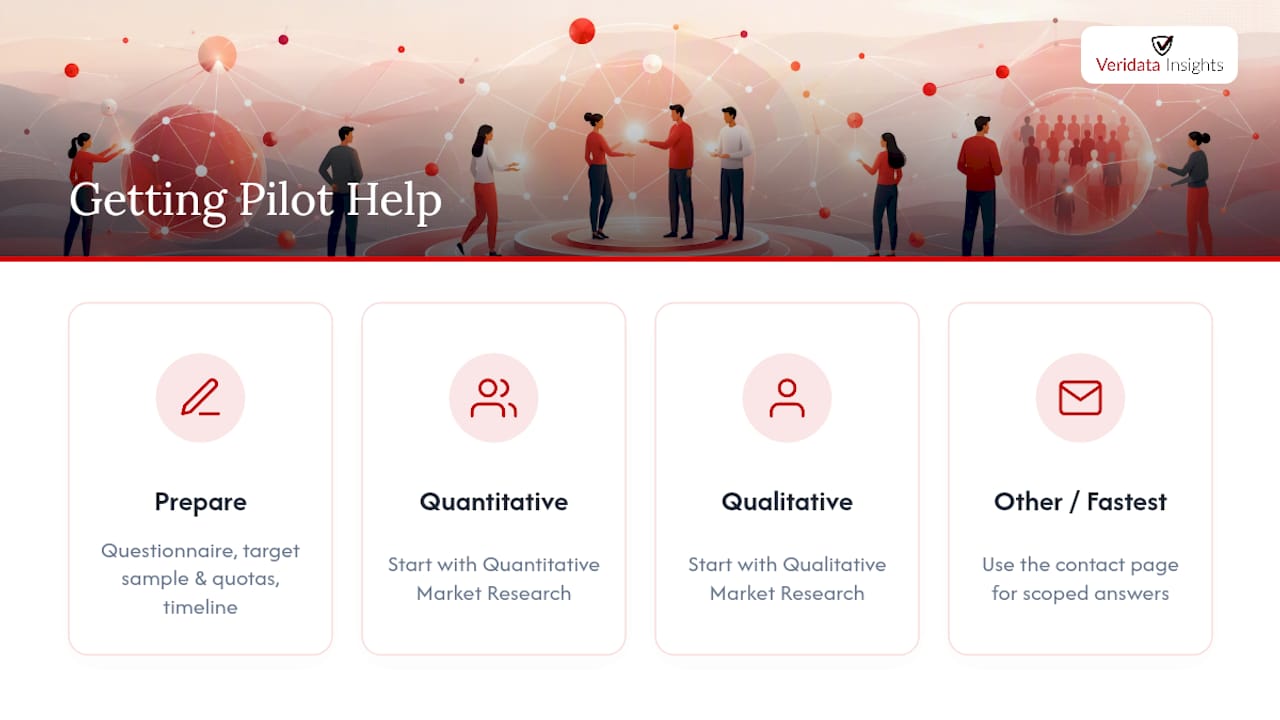
If your project leans quantitative, start with Quantitative Market Research. If it’s qualitative feedback you need during the test phase, Qualitative Market Research covers that. For anything else, the contact page is the fastest way to get a scoped answer.
Sources
- Pretesting and Pilot Testing (Ruel et al., chapter excerpt)
- Setting up a soft launch | Medallia Documentation
FAQ
What Qualifies as a Soft Launch?
A soft launch is any staged release of a live survey to a small share of your target sample, commonly 5% to 10%, before opening the field completely. It qualifies as more than just a small batch of responses when the results are actually reviewed for routing errors, technical glitches, and completion patterns before you scale up.
What Are Three Types of Surveys Used in Pre-Launch Testing?
The three main stages are pretesting, pilot testing, and soft launch fielding. Pretesting checks question wording with 12 to 50 testers, pilot testing rehearses the full research process with 30 to 100 participants, and a soft launch is the staged live release that often carries out that pilot in the field.
What Are Some Successful Soft Launch Examples?
A common pattern invites about 5% of the target sample on day one, expands to 20% on day two if the data looks clean, then moves to full launch, with at least a day between rounds to fix anything flagged. Success looks like hitting your completion rate target, confirming quota fill, and closing your error log before scaling up.
What Are Five Good Survey Questions to Test During a Soft Launch?
Useful test questions include a routing check (does everyone land on the right path?), a timing check (how long does completion take?), a device check (does the survey render correctly on mobile and desktop?), a comprehension check (do open-text answers make sense relative to the question?), and a quota check (are hard-to-reach segments filling as expected?). Each one maps to a specific metric you should already be watching on your soft-launch dashboard.
Does Veridata Insights Handle the Recruitment Piece of a Soft Launch?
Yes, Veridata Insights recruits for B2B, B2C, healthcare, and other hard-to-reach audiences, which matters most when your soft launch needs to test quota feasibility with a real sampling strategy rather than a convenience sample. Pricing is quoted per project since there’s no published flat rate, and the team confirms scope during your initial consultation.