

Question randomization shuffles the order respondents see survey items, or serves each person a random subset, to break up the order bias that skews results. It reduces primacy and recency effects, fights fatigue-driven satisficing, and lets you build stronger experimental designs. The main forms you’ll use are full shuffle, random subset (k of n), and locked or fixed positions, each suited to a different kind of question set.
TL;DR:
- Randomization is most effective for independent, non-sequential questions like attribute batteries, messages, or feature lists, where logic or flow is not dependent on order.
- Building a proper randomization setup requires grouping items, choosing modes like full shuffle or subset, locking dependent items, and previewing multiple responses before launching.
- Using random subset mode with balanced exposure ensures each item gets equal representation, especially in long attribute lists or message tests.
- Exporting and documenting randomized view data, including position variables and rules, is essential for valid analysis and detecting order effects.
- Advanced methods like rerandomization and stratified designs improve covariate balance, but require careful planning, statistical software, and documentation to ensure reproducibility.
Table of Contents
- What Is Question Randomization and When Should You Use It?
- Setting Up Question Randomization: A Platform-Agnostic Checklist
- Randomization Options Explained: Shuffle, Subset, Locks, and Exclusions
- Advanced Randomization Designs and Statistical Considerations
- Randomization Data, Exports, and What It Means for Analysis
- Implementation Checklist and QA Best Practices from Veridata Insights
- Let Veridata Insights Handle the Programming and QA
- Sources
- FAQ
What Is Question Randomization and When Should You Use It?
Order bias comes from three predictable habits. Respondents favor early options (primacy), default to whatever they saw last (recency), or start picking answers just to finish faster once fatigue sets in. Randomizing item order breaks the pattern that lets any one of those habits systematically distort your data.
Randomization works best on independent, non-sequential item pools, brand attribute batteries, attitude statements, or a list of product features rated one after another. It backfires on anything with a built-in logic: a narrative sequence, a set of questions that build on each other, or a scale that only makes sense read top to bottom.
A few decision rules keep you out of trouble:
- Randomize within a block of conceptually parallel items, not across unrelated sections.
- Skip randomization on any sequence where question B only makes sense after question A.
- Reach for stratified or adaptive designs only when you need subgroup-level inference, not for a standard cross-sectional tracker.
Setting Up Question Randomization: A Platform-Agnostic Checklist
Most survey platforms, from Qualtrics to SurveyMonkey to a custom-coded instrument, handle randomization the same conceptual way: group items, pick a mode, then test until you trust the output. Here’s the sequence that keeps things clean.
- Group the candidate items into one block or page. Randomization engines almost always operate within a block, not across an entire survey, so any items you want shuffled together need to live in the same container.
- Choose your mode. Full shuffle randomizes every item in the block; random subset (k of n) shows each respondent only some of them; fixed position locks specific items in place regardless of what happens around them.
- Mark locked and excluded items explicitly. A screening question or a mandatory demographic item usually needs a fixed slot, while a retired or pilot-only item gets excluded from the rotation entirely.
- Check skip logic against every possible order. Branching built for a fixed sequence can break when the trigger question moves. Map which downstream questions depend on which upstream answers before you turn randomization on.
- Preview the survey multiple times. Generate several respondent-level previews and confirm the block behaves as expected in each one, not just the first pass.
- Export randomized-view metadata before full launch. Confirm the platform is actually recording which order each respondent saw, not just applying the randomization silently.
Pro Tip: Run a small soft-launch batch of 20 to 30 test responses before your full field period, then pull the viewing-order export immediately. This catches broken skip logic and lopsided exposure counts while they’re still cheap to fix.
Randomization Options Explained: Shuffle, Subset, Locks, and Exclusions
Each randomization mode trades off differently between reducing bias and preserving analytic clarity.
- Full shuffle works well for short lists of five to ten parallel items, like a set of brand attributes. It maximizes bias reduction but adds cognitive noise if the list runs much longer, since respondents lose their place and start skimming.
- Random subset (k of n) shows each person a slice of a larger item bank, which is common in message testing or long attribute batteries. Vendor documentation for major platforms consistently flags that random subsets must balance exposure across items, sometimes called “evenly present elements,” so no single item ends up underexposed relative to the others. Platforms vary in how automatically they handle this, so check the setting rather than assuming it’s on by default.
- Locked positions keep screeners, consent items, or scale anchors exactly where they need to be while everything around them still rotates.
- Excluded items stay out of the randomization pool entirely, useful for retired questions you’re keeping in the instrument for version control but not fielding.
For a standard cross-sectional survey, default to shuffling within topic blocks and locking anything with dependent logic. For an experiment where item-level exposure needs to be precisely equal across conditions, random subset with balanced counts and a rerandomization check gives you a cleaner base for analysis.
Advanced Randomization Designs and Statistical Considerations
Simple random assignment is the baseline, but it’s not always the most precise tool. Rerandomization designs reduce covariate imbalance and can produce more precise treatment-effect estimates than a single random draw, which matters when your sample is small or your covariates are numerous.
- Rerandomization repeatedly draws assignments until covariate balance meets a preset threshold, then locks in that draw rather than accepting whatever the first random pass produced.
- Stratified or adaptive randomization becomes worthwhile when your research question depends on subgroup effects. Methodology experts recommend these designs specifically when detecting treatment-effect heterogeneity across subgroups is part of the study’s purpose, not an afterthought.
- Power planning has to happen jointly with sampling. A design optimized for average-effect power does not automatically deliver enough power for subgroup effects, so rare-subgroup inference needs its own sample-size math up front.
- Document the randomization seed, algorithm, and any rerandomization criteria. Reproducibility depends on someone else being able to rerun your assignment procedure and get the same logic, even if not the identical draw.
If your design calls for any of this, available R packages and methodological guidance can save you from reinventing an estimator that statisticians have already built and tested. This is also the point where looping in a biostatistician earns its cost.
Randomization Data, Exports, and What It Means for Analysis
Randomizing display order only helps if you can prove it happened. Enabling export of the randomized viewing order gives you a field, usually a variable per item or block, that records the position or subset each respondent actually received.
- Export the position variable alongside your response data, not as a separate file you have to merge later under time pressure.
- Use presentation counts to spot imbalance early. If one item in a random subset shows up in 40% of sessions and another in 60%, something in your setup, not chance, is likely the cause.
- Document every randomization rule in the study codebook, including block membership, locked items, and any exclusion criteria, so a future analyst doesn’t have to reverse-engineer your setup.
- Test position as a covariate. Running a quick check for order effects on key outcome variables tells you whether randomization actually did its job or whether some residual pattern slipped through.
Implementation Checklist and QA Best Practices from Veridata Insights
Programming randomization correctly is one skill. Catching the version that looks fine in a preview but breaks for a real respondent is another, and it’s where a lot of in-house teams lose time. Here’s the sequence we run on every quantitative program that uses randomized items.
- Confirm block membership before writing any skip logic, so the logic gets built against the final structure rather than a draft that shifts later.
- Lock every item with dependent logic, and re-verify that lock after any edit to the questionnaire, since a single reordering can silently unlock something you fixed earlier.
- Preview the survey across multiple simulated sessions, checking that fixed items stay put and randomized items actually rotate.
- Run a power check on random subsets to confirm every item gets enough exposure for a meaningful comparison, not just a plausible-looking total sample size.
- Export randomized-view data as soon as soft-launch responses come in, and scan presentation counts for anything lopsided before scaling up fielding.
- Record every randomization rule in the codebook and hand it to the analysis team before topline results, not after someone asks why the numbers look odd. Practitioner QA routines like block checks, permutation previews, and export verification catch the errors that otherwise corrupt skip logic and required-item behavior in the live field.
Pro Tip: Keep one “gold standard” test respondent profile that answers every branch condition. Rerun it against a fresh preview link every time you touch the questionnaire, even for a wording tweak that seems unrelated to logic.
Good randomization setup pairs naturally with disciplined survey design practices and clear questionnaire construction habits, since a shuffled question still needs to be well written to produce a clean answer.
Let Veridata Insights Handle the Programming and QA
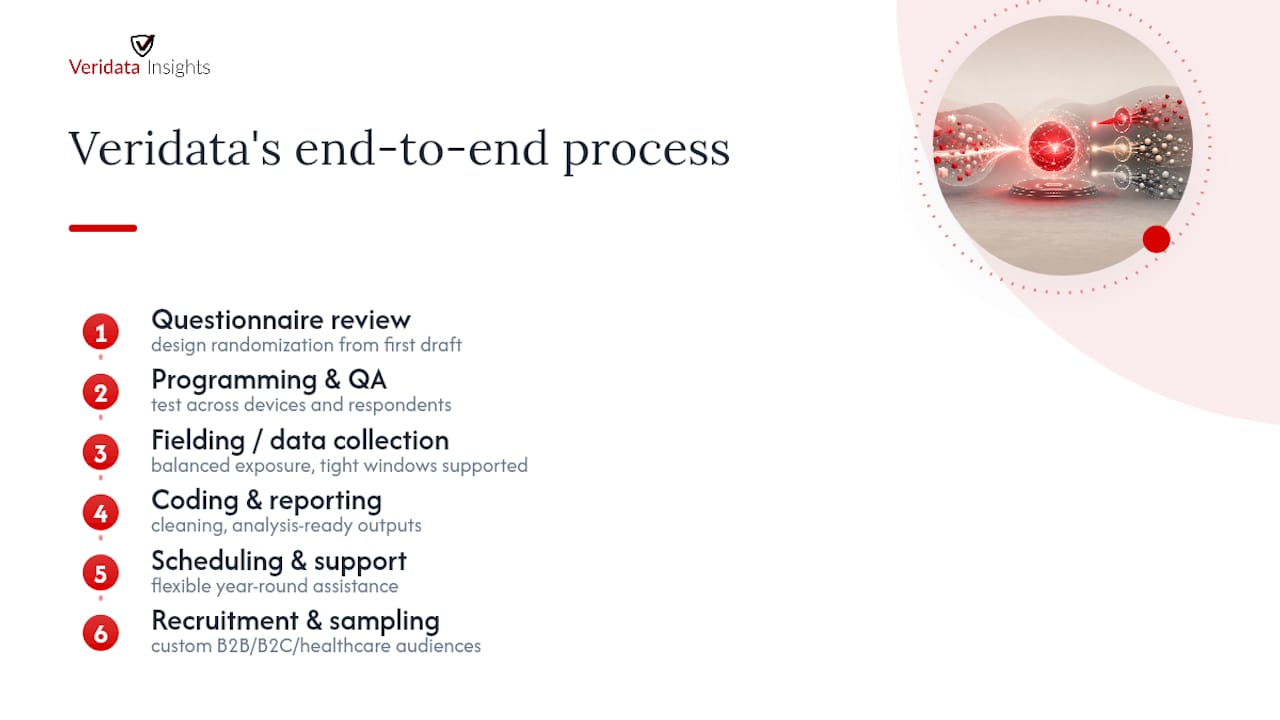
Building a randomization scheme is one thing. Making sure it survives contact with a thousand real respondents across a dozen device types is a different job entirely, and it’s the one that eats research timelines. Veridata Insights programs, tests, and fields quantitative studies with question randomization built in correctly from the first draft, not patched in after a client complaint about skip logic breaking. We handle the full arc, from questionnaire review and randomization design through data collection, coding, and reporting, for B2B, B2C, healthcare, and hard to reach audiences. We offer flexible scheduling and support throughout the year, which matters when a fielding window is tighter than the QA process should be. If your next study needs randomization done right the first time, along with exposure balancing across a large item bank, that’s exactly the kind of custom recruitment and sampling work we handle daily. Reach out through our contact page to scope your next project.
Sources
- Rerandomization with diminishing covariate imbalance and diverging number of covariates — Annals of Statistics
- Methodological recommendations for randomized experiments (PMC article)
- Designing probability samples to study treatment effect heterogeneity — Experimental Methods in Survey Research (Wiley)
- Recommendations for designing and analyzing randomized experiments (Wiley/Political Science article)
FAQ
What Does It Mean for a Question to Be Randomized?
A randomized question is one whose position, or whose appearance at all, is determined by a random process rather than a fixed order set by the questionnaire designer, which prevents any single item from systematically benefiting from where it happens to sit.
What Are Some Good Survey Question Examples for Randomization?
Attribute rating batteries, brand awareness lists, message or concept tests, and attitude statement sets all randomize well because each item stands independently of the others and doesn’t rely on a prior answer to make sense.
Can You Give an Example of Randomization in a Survey?
If a study needs each respondent to rate only a subset of product features, a random subset design would randomly select which ones each person sees, then balance those selections so every feature gets roughly equal total exposure across the full sample.
What Does “Randomize” Mean in Survey Design?
To randomize means to assign order, selection, or grouping through a chance-based process instead of a fixed rule, specifically to prevent position or sequence from influencing how respondents answer.