

Use in-depth interviews (IDIs) when you need individual depth or you’re dealing with a sensitive topic, and use focus groups when you need interaction, stimulus reaction, or fast idea generation. Most serious research programs eventually use both. Which one comes first depends on your objective, your timeline, and how comfortable your audience is talking in a room full of strangers.
TL;DR:
- Focus groups are more suitable for concept testing, idea generation, and observing social interactions, especially when group dynamics enhance insights.
- In-depth interviews are preferable for sensitive topics, expert audiences, or when deep, private understanding of individual reasoning is required.
- Cost and recruitment difficulty depend on respondent accessibility, with IDIs better for hard-to-reach, niche, or executive audiences due to easier scheduling.
- Online video formats provide most thematic depth at lower costs, while in-person sessions offer richer nonverbal data, and text-based formats excel for sensitive topics and dispersed audiences.
- Running multiple sessions and piloting guides beforehand mitigate common pitfalls like group dominance, single-group overgeneralization, and poorly managed moderation.
Table of Contents
- IDIs vs Focus Groups: A Side-by-Side Comparison
- Pros and Cons: Where Each Method Shines and Where It Breaks
- What the Research Says About In-Person, Video, and Text Formats
- How Many Interviews or Groups Do You Actually Need?
- Choosing IDIs, Focus Groups, or a Mixed Design
- A Practitioner’s Checklist for Running Either Method Well
- The Bottom Line on IDIs vs Focus Groups
- How Veridata Insights Supports Your Qualitative Research Design
- Sources
- FAQ
IDIs vs Focus Groups: A Side-by-Side Comparison
Picking between IDIs and focus groups is really a question of what you’re measuring: an individual’s private reasoning or a group’s collective reaction. That distinction drives everything else, from session length to your budget line.
An in-depth interview is a one-on-one conversation, typically 30 to 60 minutes, where a trained moderator probes a single respondent’s beliefs, behaviors, or experiences without anyone else in the room shaping the answer. A focus group puts 4 to 8 participants together for 60 to 90 minutes and uses the group’s back-and-forth to surface reactions, test concepts, and watch how ideas spread or get shot down socially. Both are qualitative research methods, but the unit of analysis is completely different: one person’s story versus a group’s dynamic.
Here’s how the two stack up across the variables that actually affect study design:
- Best for: IDIs suit sensitive topics, expert or executive audiences, and complex individual decision journeys. Focus groups suit concept testing, message reaction, brainstorming, and situations where client stakeholders want to observe reactions live.
- Typical session length: IDIs run 30 to 60 minutes per participant. Focus groups run 60 to 90 minutes for the full group, meaning each participant gets far less airtime.
- Group dynamics and social influence: IDIs eliminate peer pressure and conformity risk entirely. Focus groups introduce both a benefit (idea-building, disagreement surfacing) and a risk (a dominant voice can flatten the room).
- Data richness per participant: IDIs generate deep, uninterrupted narrative from every single respondent. Focus groups generate broader coverage of a topic but thinner individual detail, since airtime is split.
- Cost drivers: IDIs cost more per completed interview because of one-on-one moderator time, but often need fewer total sessions. Focus groups cost more per session (facility, recruiting a full room, incentives for 6 to 8 people) but each session covers more people at once.
- Recruitment difficulty: IDIs are usually easier to schedule for busy or hard-to-reach respondents, since you only need to coordinate one calendar. Focus groups require synchronizing 6 to 8 calendars, which becomes brutal with physicians, C-suite executives, or niche B2B buyers.
Social desirability bias is the variable that trips up the most first-time research buyers. In a group setting, a participant who privately disagrees with the room’s emerging consensus will often just go quiet rather than push back, especially on topics involving money, health, or workplace conflict. Practitioners consistently point to this as the single biggest reason to route sensitive research toward IDIs over focus groups, since a one-on-one setting removes the audience whose judgment the respondent is managing.
Cost and timeline don’t move in one direction. A 12-person IDI study and an 8-person, 2-group focus group study can land in a similar total budget range, but the money gets spent differently. IDI budgets skew toward moderator hours and transcription volume. Focus group budgets skew toward facility rental, recruitment incentives for a full room, and travel if you’re running multiple markets in person. Neither method is categorically cheaper; the driver is how many total respondent hours you need and how hard those respondents are to reach.
Recruitment difficulty scales with how narrow your audience is, not with the method itself. A general consumer study can fill an 8-person focus group in a week. A study targeting oncologists, supply chain directors, or people managing a rare medical condition often can’t fill a room at all, because you can’t get eight of them in the same virtual space at the same time. That’s when IDIs stop being a preference and become the only workable option.
One more comparison point worth flagging: moderator skill matters more in focus groups than in IDIs, simply because there’s more to manage. An IDI moderator needs strong probing technique. A focus group moderator needs probing technique plus the ability to referee a room, redirect a dominant talker, and draw out the quiet ones, all in real time. That’s a harder skill set to hire for, and it’s part of why focus group advantages on paper (rich interaction, fast concept testing) don’t always translate into rich interaction in practice if the moderator isn’t strong.
Pros and Cons: Where Each Method Shines and Where It Breaks
Every method has a job it’s genuinely good at and a job it gets dragged into anyway because a client insisted. Knowing the difference keeps you from designing a study that looks rigorous but answers the wrong question.
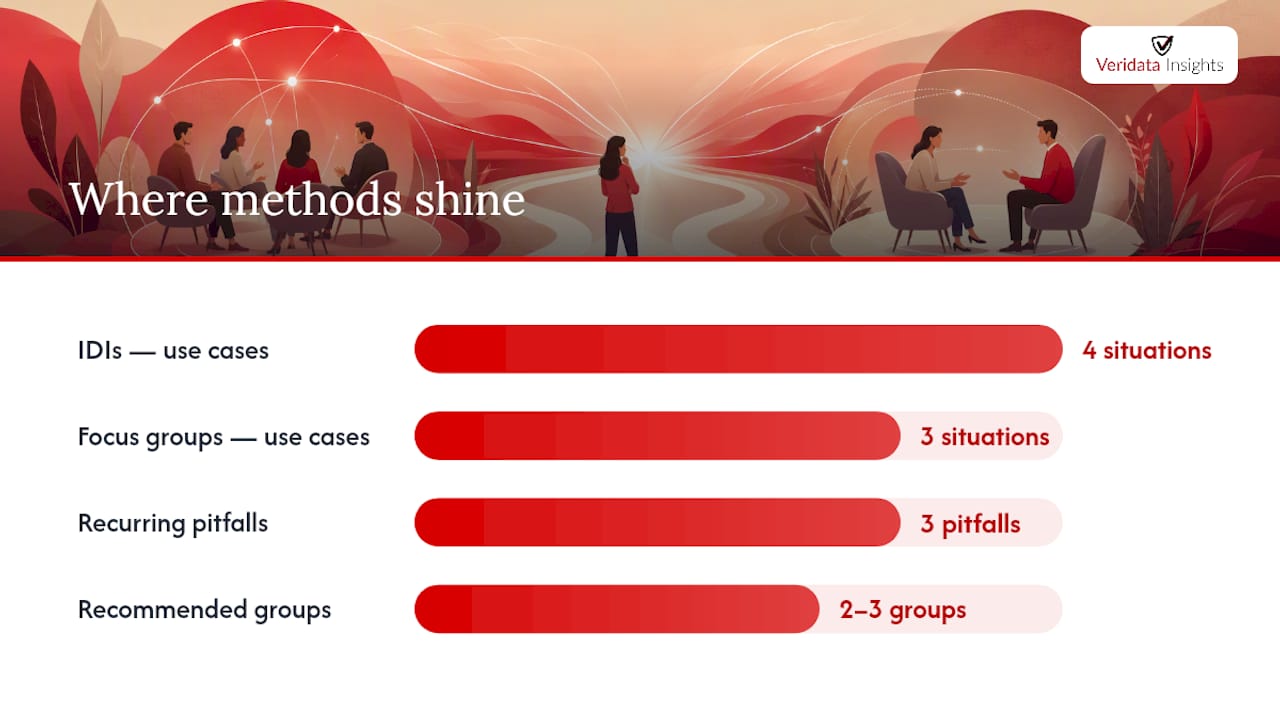
IDIs earn their keep in four situations. They deliver depth that a shared room can’t, because a respondent will say things one-on-one that they’d never say in front of five strangers. They protect privacy, which matters enormously for health, financial, or workplace-conflict topics. They allow real probing, where a skilled moderator follows an unexpected answer down a rabbit hole instead of moving on to keep the group’s pace. And they’re the default for expert or executive interviews, where scheduling a room full of surgeons or CFOs simply isn’t realistic.
Focus groups earn their keep in three different situations. They generate interaction that a solo interview can never produce, since one participant’s comment often triggers a reaction from another that neither would have volunteered alone. They’re excellent for idea generation and concept sorting, where you want a room to riff, disagree, and build on each other’s language. And they accelerate client engagement, because a sponsor watching a live group discussion (or the video afterward) reaches conviction faster than the same sponsor reading forty pages of interview transcripts, a point practitioners writing in Quirks raise directly.
Three pitfalls show up again and again, and all three are avoidable:
- Group dominance. One articulate or senior-sounding participant can quietly reset the room’s consensus, and quieter members simply stop offering dissent. A trained moderator has to actively redistribute airtime, not just let the conversation flow.
- Single-group overgeneralization. Running one focus group and treating its output as “what the segment thinks” is a common and serious error, since one group’s dynamic (who happened to show up, who happened to talk first) can skew the entire read. That’s why 2 to 3 groups per segment is the practical minimum most practitioners recommend.
- Running IDIs like a survey. Some moderators treat an interview guide as a script to read verbatim instead of a map to improvise from, which kills the depth IDIs exist to capture. If every session sounds identical word for word, you’ve turned a qualitative method into a badly disguised questionnaire.
Pro Tip: If you’re worried about group dominance but still need interaction, run a mini-group of 4 to 5 participants instead of a full 8-person panel. Smaller groups fragment less, give every voice more airtime, and often produce richer per-person data on complex topics than a full-size group does.
The most reliable mitigation across the board is piloting. Test your discussion guide on two or three respondents before the real fieldwork starts, and you catch confusing questions, awkward pacing, and stimulus-handling problems before they cost you a full dataset.
What the Research Says About In-Person, Video, and Text Formats
Modality changes how much people say, not necessarily what they say. A comparative study on qualitative data collection found that face-to-face and online video sessions produced significantly more words per participant than text-based online formats, yet the thematic codes that emerged were largely consistent across all three modalities.
That’s a genuinely useful finding for anyone deciding how to run a study on a deadline: you’re not necessarily losing thematic coverage by going text-based, but you are losing volume and nuance per response.
There’s one notable exception. On sensitive topics, text-based focus groups were more likely to surface dissenting opinions than visual formats were, a difference the same study reports at a statistically meaningful level, though the researchers themselves urge cautious interpretation given the sample. The likely mechanism: typing into a chat window feels less exposed than speaking on camera in front of a group, even when the group is virtual.
Cost and participant experience diverge across the three formats in predictable ways:
- In-person sessions cost the most (facility rental, travel, catering, in-market incentives) but deliver the richest nonverbal read, including tone, hesitation, and body language a transcript can’t capture.
- Online video sessions cut facility and travel costs almost entirely while still capturing most of the verbal richness of in-person, which is why they’ve become the default for most commercial studies.
- Text-based sessions are the cheapest and fastest to field, especially across time zones, but produce shorter responses and require a moderator skilled at typed probing to avoid painfully thin answers.
The practical takeaway: default to video for most studies, since it holds onto word count and thematic depth at a fraction of in-person cost. Reach for text-based formats specifically when your topic is sensitive enough that camera exposure might suppress honest disagreement, or when your audience is scattered across enough time zones that live scheduling is the real bottleneck. Save true in-person sessions for stimulus-heavy work like packaging, prototypes, or anything a screen genuinely can’t represent well.
Online formats also widen who you can reach in the first place. Researchers should stay alert, though, to access gaps for populations with limited internet reliability, since a purely online design can quietly exclude the very hard-to-reach segment you’re trying to study.
How Many Interviews or Groups Do You Actually Need?
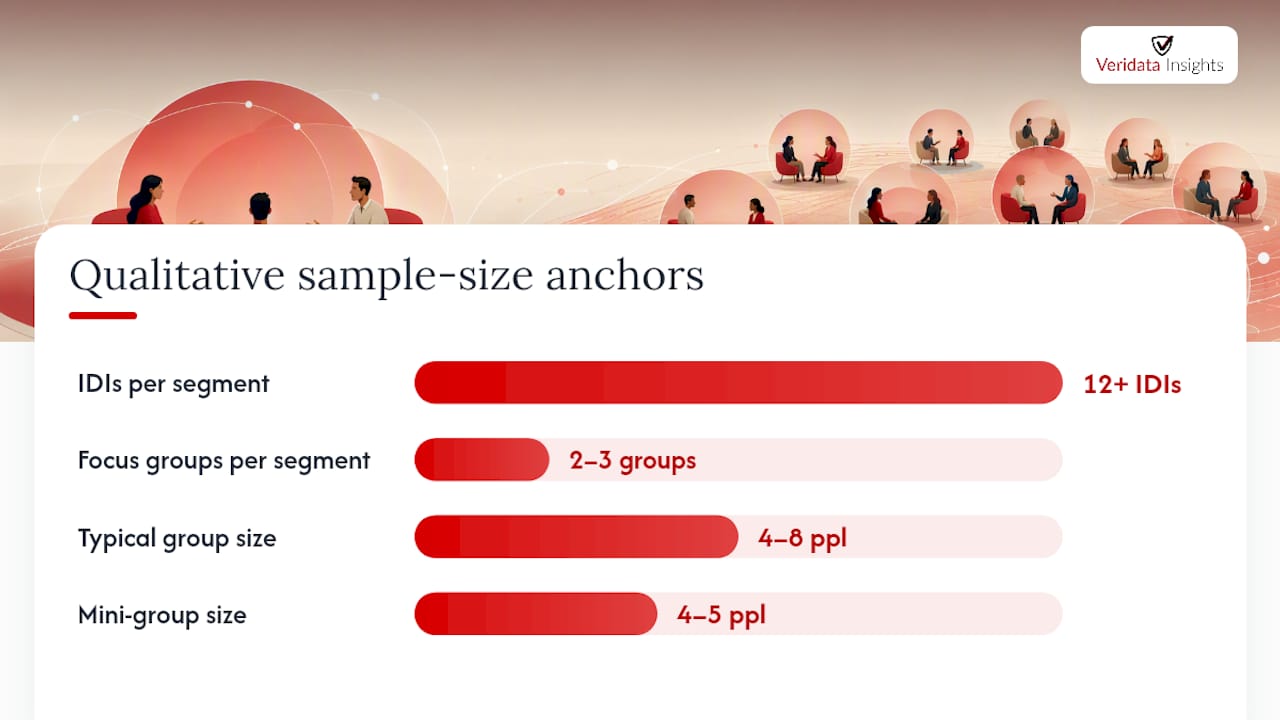
Most qualitative researchers see thematic saturation land around a dozen or more IDIs per single audience segment, a heuristic that holds up across a wide range of B2B and consumer categories. For focus groups, the working minimum is 2 to 3 groups per segment, since a single group’s dynamic (who showed up, who talked first, who dominated) isn’t reliable evidence of what the whole segment thinks, per the same practitioner consensus that shapes most commercial research design. Group size itself typically runs 4 to 8 participants, with mini-groups of 4 to 5 as a deliberate option when you want more depth per person without losing all interaction.
Recruitment difficulty is where the two methods diverge hardest. A general consumer focus group study can often fill two 8-person groups within a week using a standard panel. Try that same timeline with oncology nurses, plant managers, or regional bank compliance officers, and you’ll spend weeks just finding enough qualified people in the same time zone who can commit to a 90-minute block together. That’s exactly why IDIs tend to win for executive and hard-to-reach audiences: you only need to coordinate one calendar at a time, and a 45-minute interview slot is a far easier ask than a 90-minute group commitment.
Cost and timeline bands vary by industry, market, and recruitment difficulty, but the drivers themselves are consistent:
| Cost driver | IDIs | Focus groups |
|---|---|---|
| Moderator time | High (one-on-one, per session) | Moderate (one session covers 6 to 8 people) |
| Recruitment incentives | Per-person, easier to schedule | Per-person, harder to synchronize |
| Facility or platform costs | Low (single line, often remote) | Higher (room booking or multi-participant video setup) |
| Transcription and coding volume | Scales with number of interviews | Scales with number of groups, denser per session |
| Typical timeline pressure point | Recruiting the right individuals | Synchronizing everyone’s calendar |
Neither column is the cheap option across the board. A hard-to-reach IDI study can outspend an easy-recruit focus group study, and vice versa. The number that actually predicts your budget is how difficult your audience is to reach, not which method you picked first.
Choosing IDIs, Focus Groups, or a Mixed Design
Six questions get you to the right method faster than any amount of debate in a planning meeting:
- What’s the core objective? If you need to understand an individual decision journey or attitude in depth, lean IDI. If you need to test how people react to a concept together or generate new ideas, lean focus group.
- Does the topic require group interaction to work? Concept sorting, message testing, and brainstorming genuinely benefit from people bouncing ideas off each other. If interaction adds nothing, you’re paying for a group you don’t need.
- How sensitive is the topic? Health conditions, financial hardship, workplace conflict, and anything touching stigma push hard toward IDIs, since social desirability bias in a group setting can quietly erase your best data.
- Do you need to test physical stimulus? Packaging, prototypes, and ads sometimes work better with a group reacting in real time, though this can also work as sequential IDIs if scheduling a room isn’t realistic.
- How accessible is your sample? Executives, specialists, and rare-condition patients rarely fill a focus group calendar. General consumers usually do.
- What’s your timeline and budget? A tight timeline with a hard-to-reach audience almost always points to IDIs, since you’re not waiting on group synchronization.
Sequencing matters as much as the initial choice. Running IDIs first, then a focus group, works well when you need to build a solid understanding of individual attitudes before testing how those attitudes play out socially. Running focus groups first, then IDIs, works when you need to generate concepts broadly before drilling into why specific individuals reacted the way they did. Parallel designs, where IDIs and focus groups run simultaneously with different segments, work when your timeline is fixed and you have budget for both tracks at once. Experienced teams often land on a mixed design as the strongest option whenever budget allows, since the two methods cover each other’s blind spots.
Pro Tip: Keep the same moderator across your IDI and focus group phases whenever possible. It sharpens follow-up probes in later sessions, because the moderator already knows which themes are landing and which need more digging.
A Practitioner’s Checklist for Running Either Method Well
Good moderation makes or breaks both methods, but the failure modes differ. In an IDI, the biggest risk is a moderator who reads the guide too literally and never chases an unexpected answer. In a focus group, the biggest risk is letting one confident voice set the tone for the entire room. Watch the quiet participants as closely as the talkative ones; silence after a question is often information, not a gap to fill.
Stimulus handling deserves its own attention. Show visual concepts at the same point in every session, describe them the same way every time, and resist the urge to explain a concept before the group reacts to it cold. Note-taking should capture not just what was said but who said it and how the room responded, since that context matters when you’re coding later.
Recruitment screening needs to get sharper for harder audiences. For B2B and healthcare studies, screen for actual decision-making authority or clinical role, not just job title, since titles vary wildly across organizations. For hard-to-reach populations, build in extra recruitment lead time and consider over-recruiting by 10 to 15%, to cover no-shows, since replacing a specialist respondent on short notice is far harder than replacing a general consumer.
On the analysis side, coding consistency across a full IDI or focus group project usually means one person builds the initial codebook and a second person applies it independently to a sample of transcripts, then the two reconcile differences. Link every theme back to specific quotes in your report, since a reader trusts “62% of respondents mentioned cost friction” far less than they trust the actual sentence a respondent used to describe it. Reporting against structured checklists like COREQ and SRQR also strengthens a study’s defensibility, since sponsors and peer reviewers increasingly expect transparent documentation of who was interviewed, how, and why.
- Pilot the discussion guide on 2 to 3 respondents before real fieldwork starts.
- Document consent, recording, and confidentiality procedures separately for group versus individual sessions.
- Confirm virtual platform security settings before any session involving sensitive health or financial topics, a step piloting guidance treats as essential for virtual qualitative work specifically.
Experienced qualitative research teams have moderated enough of both formats to know the method rarely fails the study. The screener, the guide, and the moderator’s ear for silence usually do the heavy lifting, or the damage.
The Bottom Line on IDIs vs Focus Groups
The verdict hasn’t changed since the opening line: pick IDIs for depth and privacy, pick focus groups for interaction and stimulus testing, and don’t be afraid to run both if your budget and timeline allow it. Two next steps make that decision defensible on paper, not just in your head. First, pilot your guide on a handful of respondents and document your approach against COREQ or SRQR items before fieldwork starts. Second, seriously consider a mixed design if your study touches both individual attitudes and group-level reactions, since few single-method studies cover both well. If you’re weighing this decision against a live deadline, Veridata Insights can help you land on the right structure before you’ve spent a dollar on recruitment.
How Veridata Insights Supports Your Qualitative Research Design
Size isn’t everything. Quality is. We’ve seen plenty of small, sharply designed studies outperform bloated ones, the same way Scrappy-Doo proved to us that you don’t need to be the biggest one in the room to get the job done right.
Veridata Insights runs full-service qualitative research: method selection between IDIs and focus groups (or both), recruitment across B2B, B2C, healthcare, and hard-to-reach audiences, professional moderation, transcription and coding, and reporting that holds up when a sponsor asks how you got there. We work with no project minimums, seven days a week, all year, so whether you need three executive interviews or a dozen consumer focus groups across markets, we can scope it without forcing your study into a template it doesn’t fit.
If you already have a study in mind and want a second set of eyes on your method choice, sample size, or modality plan, our comparison of focus groups and in-depth interviews is a good starting point, and our team can pick up from there. Reach out through our contact page to schedule a consultation, and we’ll help you turn a method debate into a fielded study.
Sources
- Comparing Interview and Focus Group Data Collected in Person and Online
- Qualitatively Speaking: The focus group vs. in-depth interview debate
FAQ
When should you not use a focus group?
Avoid focus groups for highly sensitive topics like personal health, financial hardship, or workplace conflict, where social desirability bias suppresses honest answers, and avoid them when your audience is too specialized to synchronize a group calendar, such as senior executives or niche clinical specialists.
Are focus groups still a thing?
Yes. Focus groups remain widely used for concept testing, message reaction, and idea generation, and online video formats have kept them practical by cutting facility and travel costs while still capturing rich verbal data.
What are the key differences between focus groups and individual interviews?
Focus groups rely on group interaction and generate broader topic coverage with less depth per person, while IDIs remove social pressure entirely and deliver deeper, uninterrupted individual narratives; session length, cost structure, and recruitment difficulty also differ sharply between the two.
What are the different types of focus groups?
Common variations include traditional in-person groups of 6 to 8 participants, mini-groups of 4 to 5 for more depth per person, online video focus groups, and text-based online focus groups, which tend to surface more dissent on sensitive topics than visual formats.