


Shorter surveys raise response and completion rates, and they cut down on the skipping and careless answering that ruin data quality. Longer instruments can sharpen internal reliability for certain scales, but that gain comes bundled with predictable costs: fatigue-driven dropout, thinner answers on open-text items, and skewed samples once you add compensation to keep people finishing. The right call depends on your population and your questions, but every design should be piloted and documented, not guessed at.
TL;DR:
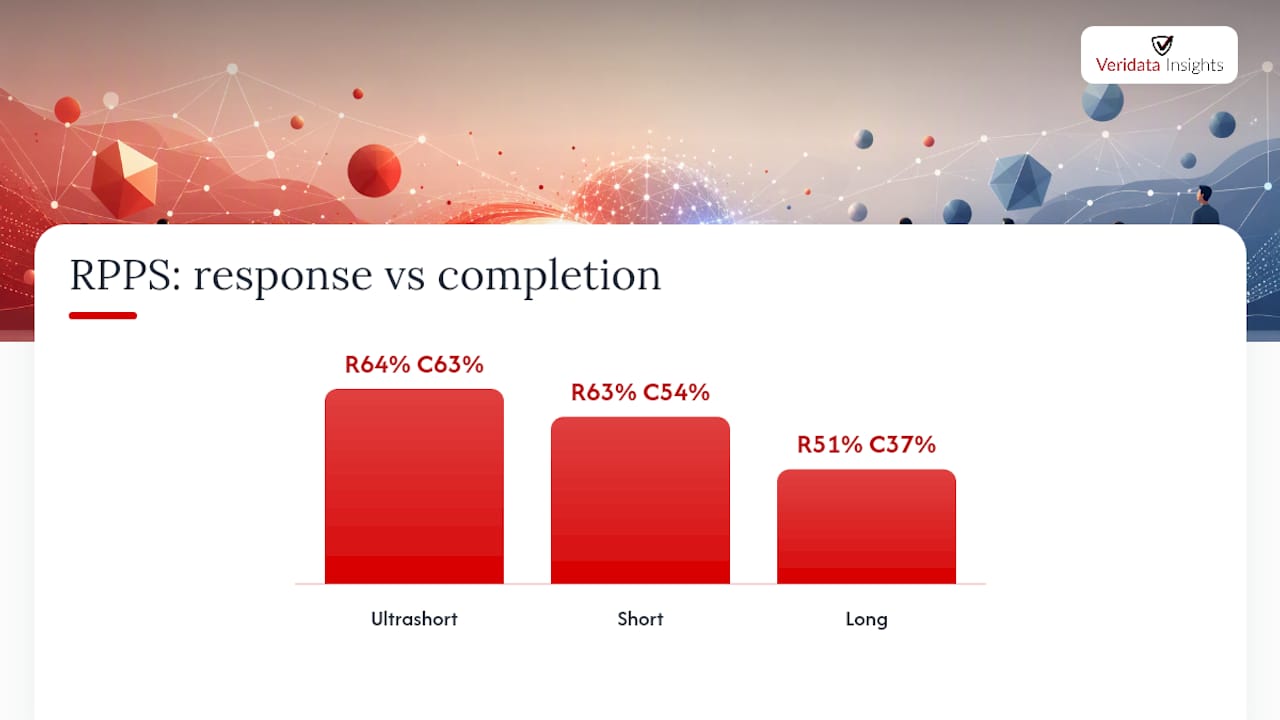
- Response rates drop significantly as survey duration exceeds 10 minutes, with completion falling from around 63% for short surveys to 37% for longer ones.
- Every additional hour of survey time increases the risk of respondents skipping questions by up to 64%, especially when open-text sections are included.
- Compensation improves completion rates but can skew the sample towards younger and more diverse respondents, affecting representativeness.
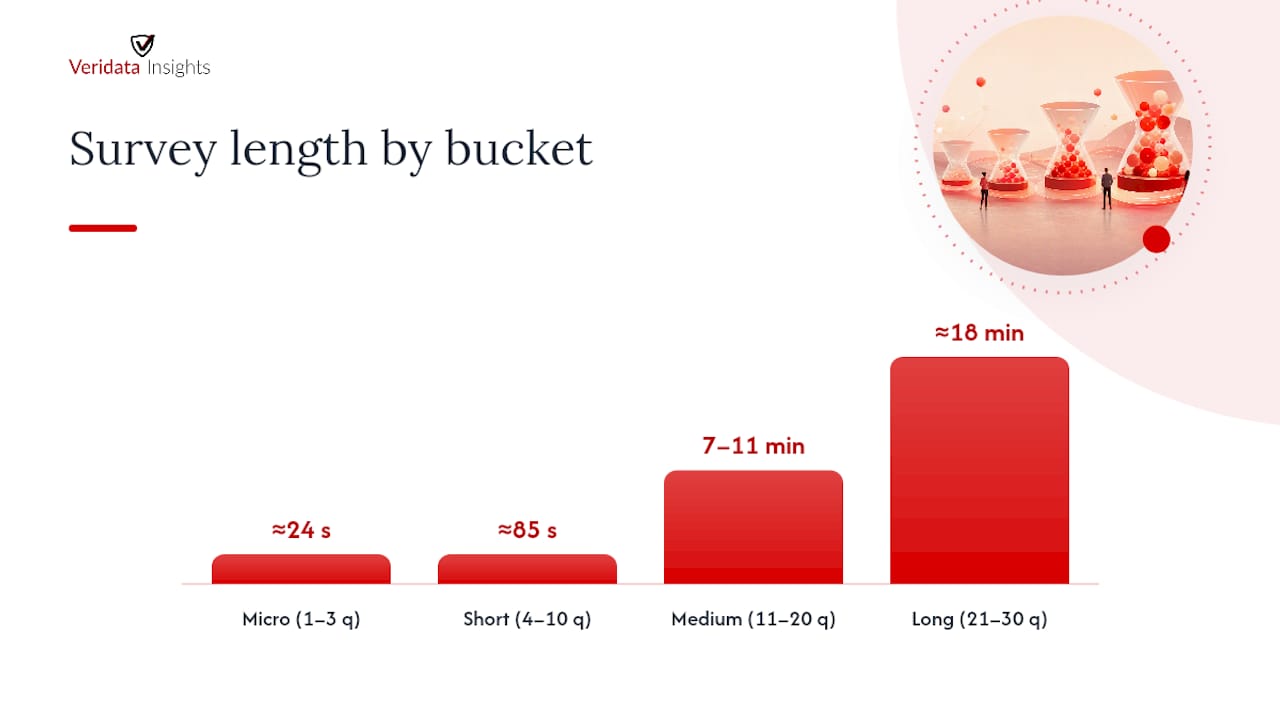
- Surveys with 1 to 3 questions typically take about 24 seconds, while those with 21 to 30 questions often require around 18 minutes, making longer surveys costlier in data quality.
- Pilot testing and analyzing paradata help determine the optimal survey length for specific populations, avoiding unnecessary respondent fatigue and biased results.
Table of Contents
- How Survey Length Effects Show Up in the Data
- Why Length Damages Response Rates and Data Quality
- What’s the Ideal Survey Length, and When Should You Break the Rule?
- How to Design Surveys That Fight Length Fatigue
- What to Measure and Report When Length Is a Variable
- How Veridata Insights Helps You Get Survey Length Right
- Sources
- FAQ
How Survey Length Effects Show Up in the Data
The clearest evidence comes from the Research Participants Perception Survey (RPPS) field test, which sent 2,228 invitees one of three survey versions: ultrashort, short, or long. Response rates ran 64%, 63%, and 51%. Completion rates told a starker story: 63%, 54%, and 37%. Length did not touch a single question wording. It just made people quit.
Fatigue compounds the problem when surveys stretch past a single sitting. Randomized-order experiments show that each additional hour of surveying raises the odds of skipping a question by 10% to 64%, and reported monetary totals, like household food spending, can drop by roughly a quarter simply because respondents give up on precision partway through.
Large-scale benchmarking backs this up with harder numbers on time itself:
- Micro surveys (1 to 3 questions): median completion around 24 seconds
- Short surveys (4 to 10 questions): about 85 seconds
- Medium surveys (11 to 20 questions): roughly 7 to 11 minutes
- Long surveys (21 to 30 questions): around 18 minutes
Quick stat: Across 7,677 surveys analyzed by Survicate in 2025, completion time does not scale evenly with question count. It accelerates, meaning the jump from “medium” to “long” hurts far more than the jump from “short” to “medium.”
Separately, panel-based research on ideal and maximum survey length puts the sweet spot around 10 minutes, with tolerance stretching to 20 to 28 minutes depending on sample and device.
Why Length Damages Response Rates and Data Quality
Length does not just cost you finishers. It changes the shape of the answers you get from the people who stick around, and it can quietly reshape who those people are.
Start with completion. The RPPS test found compensation lifted completion from 54% to 71%, but that gain traveled with a demographic shift: compensated respondents skewed younger and more racially diverse than the uncompensated group. If your study cares about representativeness, that trade-off deserves a line in your methods section, not a footnote.
Fatigue itself is measurable, not just a hunch. Question-type matters here too: benchmark data shows adding a block of open-text questions can push median completion time up by 50% or more, which is exactly the kind of section respondents abandon first.
Careless responding follows a similar curve. Research on survey length and respondent interest found that longer instruments produce more insufficient-effort responding overall, but interest moderates the effect hard. A respondent who cares about your topic will tolerate more length than one who’s answering out of obligation or for a small incentive.
Key takeaways on effects:
- Shortening a survey from long to ultrashort format can lift completion by 20+ percentage points.
- Every added hour of survey time raises item skip risk by 10% to 64%.
- Compensation boosts completion but can pull your sample younger and more diverse.
- Low-interest respondents show measurably more careless responding as length grows.
What’s the Ideal Survey Length, and When Should You Break the Rule?
Ten minutes is the number to plan around for general-population online surveys. That’s the median “ideal” length reported in panel research, with a practical ceiling of 20 to 28 minutes before dropout accelerates sharply. Treat that ceiling as a warning line, not a target.
Question-count buckets translate that guidance into something you can actually design against, based on Survicate’s benchmark data:
- Micro (1 to 3 questions): median completion near 24 seconds, ideal for quick pulse checks or NPS follow-ups
- Short (4 to 10 questions): roughly 85 seconds, the workhorse length for most transactional or satisfaction surveys
- Medium (11 to 20 questions): 7 to 11 minutes, appropriate for attitudinal studies needing multiple constructs
- Long (21 to 30 questions): around 18 minutes, justified only when the analysis genuinely needs that depth
Exceptions exist, and they matter. Interviewer-administered modes (phone, in-person) tolerate longer instruments because a live interviewer sustains engagement in ways a self-administered web form cannot. Highly invested respondents, patients discussing a chronic condition, B2B buyers evaluating a major purchase, will sit through more length than a general consumer panel. Validated multi-item psychometric scales sometimes require their full item set to preserve the construct; trimming them for speed can break the instrument’s validity entirely.
On the other end, if you’re running a broad diagnostic screen or fielding to a general panel where topic interest is low, lean short. Every extra question is a completion-rate tax you’re choosing to pay.
How to Design Surveys That Fight Length Fatigue
You can’t always make a survey shorter. But you can make its length hurt less. Here’s a working sequence for doing that:
- Identify your core items first. Run a variance-explained analysis on pilot data to find the small set of questions that account for most of the actionable insight, then field those to everyone. Prioritizing this core early protects your most important data even if attrition climbs later in the instrument.
- Consider modular or split-sample designs for the rest. Routing different respondent groups to different question modules reduces per-person burden, but it introduces multiple points where people can drop off. Practitioner guidance on modular designs recommends piloting each handoff separately to see where attrition actually concentrates.
- Swap open-text for coded options wherever the analysis allows. Fixed lists and dropdowns cost respondents far less time than free-text boxes, and they cost you far less coding time later.
- A/B test your incentive structure. Run parallel versions with different compensation levels and check completion, reliability, and demographic composition side by side before locking in a final design.
- Optimize for the channel you’ll actually use. A short widget embedded in an app behaves nothing like the same questions on a full-page desktop form. Build progress indicators for anything past medium length, and let respondents save and return if the survey can’t be trimmed.
Pro Tip: Before you finalize length, pull a small pilot sample and study the paradata, timestamps per question, not just per survey. A quantile plot of time spent by question position often reveals a single module where respondents suddenly slow down or bail, which tells you exactly where to cut.
For more on structuring questions to reduce this burden, see our guide on survey design best practices for reliable quantitative data and our questionnaire design tips.
What to Measure and Report When Length Is a Variable
Treat length as an experimental variable, not a fixed design choice, and report it like one. A handful of diagnostics separate a defensible instrument from a guess:
- Breakoff rate by question position, so you can see exactly where people quit.
- Item nonresponse broken out by where the question sits in the flow.
- Median and mean time per question, flagged for speeding (answers given too fast to have been read) and straightlining (identical answers down a matrix).
- Open-text length, since shrinking responses late in a survey are an early fatigue signal.
On the psychometric side, report Cronbach’s alpha, intraclass correlation (ICC), and Cohen’s kappa where retest data exists, and note how each shifts across your short and long versions. If you can, randomize question order or split your sample to measure fatigue directly rather than inferring it after the fact. A methods appendix with paradata summaries and a sensitivity analysis gives stakeholders the information to judge the quality trade-offs themselves, instead of taking your completion rate on faith.
How Veridata Insights Helps You Get Survey Length Right
Guessing at survey length is a bit like guessing at sample size. You can get lucky, or you can pilot it properly. Some market research firms run questionnaire reviews, split-sample pilots, and paradata analysis so you know exactly where your instrument earns its length and where it’s just burning respondent goodwill. We build the recommended core-question set, run the completion and attrition diagnostics, and hand you a short methods appendix your stakeholders can actually read.
Whether recruiting a general consumer panel or a hard-to-reach B2B or healthcare audience, a market research firm can design and field the pilot that tells you whether ten minutes is enough or twenty is too many, and do it as one project without long-term commitment. If you’re ready to test your instrument before it goes live at scale, reach out to our team and let’s design the pilot that answers the question for good.
Sources
- Impact of survey length and compensation on validity, reliability, and sample characteristics for Ultrashort-, Short-, and Long-Research Participant Perception Surveys
- Exhaustive or exhausting? Evidence on respondent fatigue in long surveys
- 2025 Benchmark Report: What’s a Good Survey Completion Time?
- Ideal and Maximum Length for a Web Survey
FAQ
What is the ideal survey length?
Panel research points to a median ideal length around 10 minutes, with a practical maximum of 20 to 28 minutes depending on sample and delivery mode.
How much does survey length affect completion rates?
In the RPPS field test, completion rates fell from 63% for short surveys to 37% for long ones.
Does offering compensation fix survey completion problems?
It helps completion (RPPS saw a jump from 54% to 71%) but shifts sample demographics younger and more diverse, so any incentive plan should be piloted and reported alongside your final results.
How many questions should a survey have?
Benchmark data groups surveys into buckets: 1 to 3 questions for quick pulse checks, 4 to 10 for standard short surveys, 11 to 20 for medium-depth studies, and 21 to 30 only when the analysis genuinely requires that depth.
Can Veridata Insights help test optimal survey length before launch?
Yes. Veridata Insights runs pilot and split-sample tests, reviews questionnaires for length and burden, and delivers paradata-backed recommendations before a study goes to full field.