

A moderator guide is the roadmap that keeps a qualitative session honest, consistent, and usable across every participant you talk to. The single design rule that separates a strong guide from a weak one: every question, activity, and stimulus must trace back to at least one research objective. Build your guide around that rule, adapt the templates below to your session length, and pilot the whole thing before you touch real fieldwork.
TL;DR:
- A moderator guide must be tightly aligned with research objectives to ensure sessions are both defensible and repeatable across various moderators and sessions.
- It should include project metadata, a detailed introduction, timing grids, question and stimulus structures, logistical checklists, and debrief protocols for consistency and clarity.
- Proper pilot testing of the guide by reading aloud, dry runs, and timing rehearsals helps identify awkward phrasing and timing issues before real fieldwork begins.
- Questions should focus on behavior first and avoid leading language, using a probe bank to maintain neutrality and clarity during sessions.
- External review and moderation support can improve guide quality, especially when dealing with sensitive topics, specific audiences, or the need for localization.
Table of Contents
- What Is a Moderator Guide and When Do You Need One?
- What Belongs in Every Moderator Guide?
- How Long Should a Moderator Guide Session Run?
- How Do You Write Questions That Don’t Lead the Participant?
- How Do You Pilot a Moderator Guide Before Fieldwork?
- What Do Practitioners Get Wrong About Guide Design?
- Get Your Moderator Guide Reviewed Before You Field It
- Where to Read More on Moderator Guide Design
- Sources
- FAQ
What Is a Moderator Guide and When Do You Need One?
A moderator guide is a working script, not a research plan. The research plan defines your objectives, sample, and analysis approach. The moderator guide translates those objectives into the actual questions, prompts, and stimulus sequence a moderator runs in the room, on the call, or in the chat window.
Guides shift shape depending on the session format:
- Depth interviews lean on a topic-led structure with flexible ordering, since you are chasing one person’s story.
- Usability tests need tight task scripts with success criteria baked into each step.
- Focus groups require more scaffolding, since a moderator manages group dynamics on top of content.
- Design sprints often mix scripted intros with loosely ordered activity blocks that adapt in real time.
Use a fully scripted introduction whenever consent, recording, or confidentiality is at stake, since those lines carry legal weight. A topic-led approach works better for the exploratory middle of the session, where rigid scripting kills the natural conversation you’re actually trying to capture.
What Belongs in Every Moderator Guide?
A moderator guide missing any of these pieces will fail someone on your team, whether that’s the moderator, the observer, or the client reading the report. Build from this checklist every time:
- Project metadata and objectives. Study name, date, session length, and 3 to 5 research objectives that every question must serve.
- Introduction script. Cover the moderator’s role, recording consent, confidentiality terms, what to do about interruptions, and an accessibility note for participants who need accommodations.
- Timing grid. Mark sections as “must-cover” or “optional” with suggested minute allocations, so a moderator running short knows exactly what to cut.
- Question blocks. Structure each topic around 3 to 5 primary questions with 2 to 3 probes attached to each.
- Stimulus handling. Note how each concept or prototype gets described, displayed, and rotated across sessions to avoid order bias.
- Logistics checklist. Platform links, backup dial-ins, recording setup, observer roles, and honorarium timing.
- Debrief checklist. What observers capture and how findings get logged immediately after the session ends.
This structure isn’t decoration. Grounding every question in a stated objective is what makes a session defensible and repeatable across multiple moderators and multiple weeks of fieldwork. Skip that step, and you get sessions that feel great in the room but produce findings nobody can act on.
Pro Tip: Print your timing grid on a single index card and tape it to your monitor. When a session runs long, you want the “must-cover” flags visible without flipping through pages.
How Long Should a Moderator Guide Session Run?
Timing grids fall apart when they’re copied from a different study without adjustment. Start from a template, then shrink or stretch each block based on your booked length.
A few adjustments make these grids work in the field:
- For 45-minute sessions, cut the warm-up first. It’s the block least tied to a research objective.
- For remote sessions, add 5 to 10 minutes at the start for tech checks and treat that window as orientation, not content.
- Write explicit screen-share and recording cues into the script itself, since remote moderators tend to forget them mid-session when they’re focused on the participant.
How Do You Write Questions That Don’t Lead the Participant?
Ask about behavior before you ask about opinion. “Tell me about the last time you tried to renew your insurance online” produces sharper data than “How do you feel about our renewal process?” because the first question anchors the answer to something that actually happened.
A few rules keep your questions clean:
- Avoid “would you” framing. It invites a hypothetical answer instead of a real one.
- Cut adjectives that signal the answer you want. “How intuitive was this screen?” is leading. “Walk me through what you were thinking here” is not.
- Build a small probe bank you reuse across sessions: clarifying probes (“What do you mean by that?”), comparison probes (“How does that compare to what you used before?”), and experience probes (“What happened right before that?”). A saved probe bank helps a less experienced moderator stay neutral instead of improvising a leading follow-up.
A bad-to-good rewrite: “Don’t you think this button placement is confusing?” becomes “What did you expect to happen when you looked at this screen?” The second version gets you a behavioral answer instead of a polite agreement.
The most common guide failures are self-inflicted: too many questions for the time allotted, one identical guide reused across formats that need different pacing, no rotation plan for stimuli, and a moderator who jumps in to rescue a struggling participant instead of letting that struggle become the finding. Cross-check your question list against your objectives before fieldwork, not after.
Pro Tip: *Read your entire guide out loud, timed, before your first session.
How Do You Pilot a Moderator Guide Before Fieldwork?
A guide that hasn’t been spoken aloud is still a draft. Pilot it using one or more of these methods before your first real participant sits down.
- Read it aloud alone. Catches awkward phrasing and questions that sound fine written but confusing spoken.
- Dry run with a colleague. Have someone unfamiliar with the study play the participant and flag anything unclear.
- Repurpose feedback from an old guide. If a past study surfaced timing problems in a similar format, apply that lesson now instead of relearning it.
- Full rehearsal with a stopwatch. This is the step teams skip and regret. Timing the script aloud exposes which sections run long before a real participant’s time gets wasted.
After each session, run a structured debrief instead of a casual chat. Go task by task, capture verbatim quotes while they’re fresh, rank findings by impact and uncertainty, and assign an owner to each follow-up. Skipping this step is how strong sessions produce weak reports.
What Do Practitioners Get Wrong About Guide Design?
Veridata Insights moderators build and revise guides across B2B, healthcare, and hard-to-reach audience studies every week, and the same failure points show up regardless of industry: guides copied from a different study without adjusting timing, and intro scripts too casual for consent-sensitive content.
Deciding whether to write the guide yourself or bring in outside help usually comes down to a few honest questions:
- Does your team have a moderator experienced with this specific audience, or a hard-to-reach population that needs specialized recruitment?
- Is the topic sensitive enough that a neutral, trained third-party moderator changes the quality of what participants share?
- Do you need the guide translated or localized for a global study, where nuance in probe phrasing matters more than usual?
If any of those answers point outward, a full-service moderation partner can review your draft guide or run the sessions directly. If not, the templates above will carry a capable in-house team through most studies.
Get Your Moderator Guide Reviewed Before You Field It
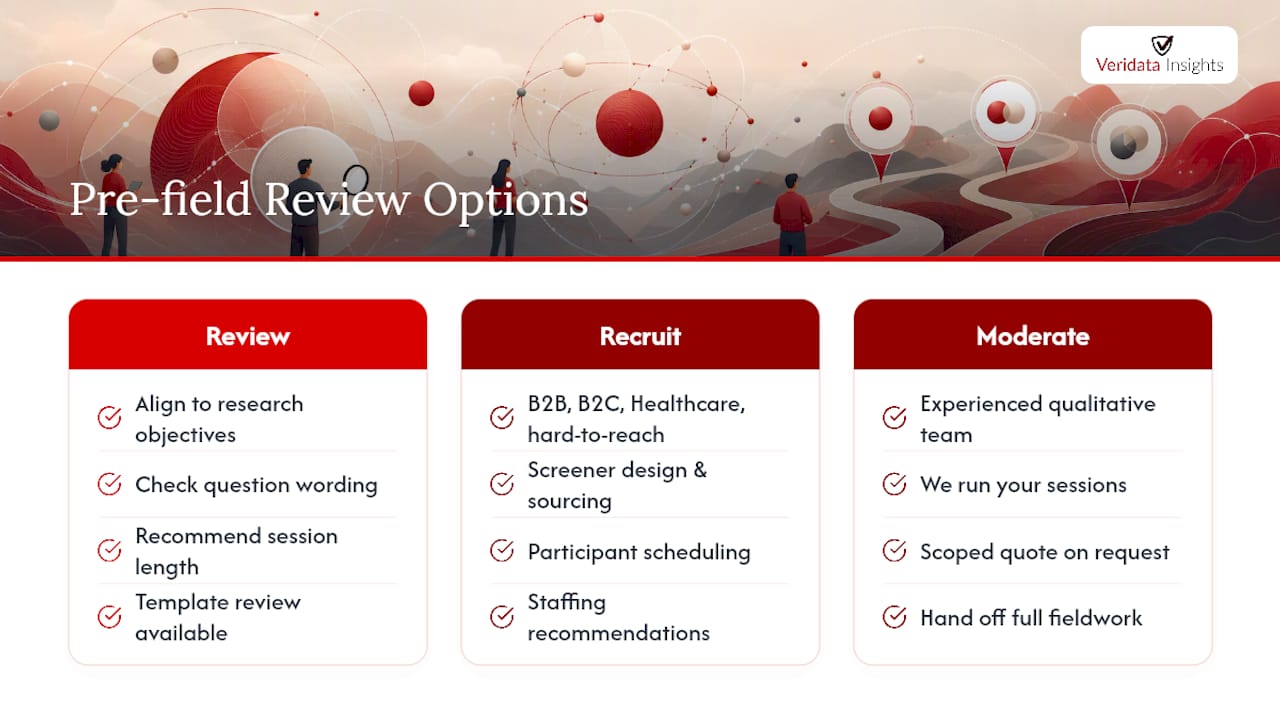
Veridata Insights isn’t just another set of templates. We review draft guides against your research objectives, staff recruitment for B2B, B2C, healthcare, and hard-to-reach audiences, and moderate the sessions ourselves when you’d rather hand off the fieldwork entirely. Our qualitative team has sat across the table from participants ranging from oncologists to procurement managers, and we know how much a guide’s phrasing changes what you actually hear back.
Whether you need a second set of eyes on your question wording or a fully staffed moderation team for your next study, request a template review or a scoped quote and tell us your session length, audience, and objectives. We’ll tell you exactly what it takes to run it right.
Where to Read More on Moderator Guide Design
For downloadable templates and sample scripts, Quali-Fi’s moderator guide breakdown and the Prototypr intro guide are strong practitioner starting points. If you want the academic backing behind why structured guides improve focus group rigor, Sage Research Methods covers the methodological case in more depth than most blog posts attempt.
Sources
- The Voltage Control Sprint moderator guide
- Intro to Moderator Guides | Prototypr
- Moderated session mechanics – ZeroBlockers
FAQ
What are the six qualities of a good moderator?
Strong moderators stay neutral, listen more than they talk, probe without leading, manage time without rushing participants, read group dynamics, and let silence sit instead of filling it. That last quality is the one most new moderators struggle to learn.
How do I introduce myself as a moderator?
State your role plainly, confirm recording and confidentiality terms word-for-word, and explain that there are no wrong answers before moving into warm-up questions. Keep the consent language scripted, but let the rapport-building parts sound like your own voice.
What are good practices for guide design in group settings like Discord?
The same core rule applies: tie every discussion prompt to a stated objective, post ground rules up front, and rotate who speaks first so one voice doesn’t dominate the thread. Community moderation guides borrow heavily from research moderation for exactly this reason.
What do moderators get paid?
Moderator compensation varies widely by session type, industry, and whether the work is in-house or contracted through a research firm. Rates depend heavily on audience difficulty, session length, and specialization, so compensation should be determined on a case-by-case basis.