

A survey questionnaire review is a structured check of every item and the instrument as a whole, run to catch flaws before they cost you clean data. The single best first move is pairing a written checklist with at least one respondent-based test, either a cognitive interview or a usability check. What follows covers the methods, a working checklist, common fixes, and the workflow a market research firm might use on client projects.
TL;DR:
- Most errors are caught early with expert review and cognitive interviewing, which should precede field testing to avoid costly mistakes.
- Automated tools can flag structural issues like length and routing, but semantic and interface problems require human respondent testing.
- Response patterns, particularly high item nonresponse and low test-retest reliability, are key indicators of lingering questionnaire issues that need revision.
- Using a small, well-documented pretest across your target audience helps identify major problems at a fraction of full-scale fieldwork costs.
- A sequential review process – expert review, respondent testing, revision, then pilot – is essential for creating reliable surveys that produce valid data.
Table of Contents
- When Should You Review a Survey Questionnaire?
- Which Evaluation Method Actually Finds Your Problem?
- What Belongs on Your Item-by-Item Review Checklist
- The Question Types That Break Surveys Most Often
- How to Run a Pretest When Your Budget Is Small
- What Do Your Quantitative Checks Actually Tell You?
- The Review Workflow We Use With Clients
- Get a Professional Questionnaire Review Without the Guesswork
- Where to Go for Primary Guidance
- Sources
- FAQ
When Should You Review a Survey Questionnaire?
Four moments almost always call for a formal review: launching a new instrument, revising an existing one, switching data collection modes, or noticing response patterns that don’t add up. If your item nonresponse suddenly spikes on a question that used to perform fine, that’s not noise. That’s a signal something upstream changed, whether it’s wording, routing, or the mode respondents are using to answer.
Review objectives should be measurable, not vague. You’re checking for clarity (does every respondent interpret the item the same way?), validity (does the item measure what you think it measures?), lower item nonresponse, and a completion time that respondents will actually tolerate. Vague goals like “make it better” produce vague reviews.
Before you start, decide your scope, because item-level, instrument-level, and mode-specific reviews call for different tools:
- Item-level review: examines individual question wording, response options, and construct clarity.
- Instrument-level review: looks at flow, skip logic, length, and overall respondent burden.
- Mode-specific review: checks how an item behaves on web versus phone versus paper, since a scale that reads fine on screen can confuse someone hearing it read aloud.
Critical appraisal guidance for published survey research backs this up directly: reviewers should expect to see documented pretesting, transparent methods, and reported response rates as baseline evidence of quality, according to a guide for readers and peer reviewers. If a questionnaire has never been tested against those markers, that’s your review’s starting point.
Which Evaluation Method Actually Finds Your Problem?
Different methods catch different errors, and picking the wrong one wastes your limited testing budget on the wrong diagnosis. Here’s how the core methods stack up against each other.
- Expert review. A trained reviewer or small panel reads through the instrument using a structured scoring sheet, flagging items for ambiguity, double meanings, or bias. It’s fast and cheap, and a peer-reviewed study found that averaged expert ratings, despite disagreement on individual items, reliably identify questions with higher item nonresponse and reporting errors. Use it first, on every instrument, before you spend money on respondents.
- Cognitive interviewing. A small number of respondents talk through how they interpret and answer each question, either through think-aloud narration or targeted probes. This is the method that catches semantic errors: comprehension gaps, wrong assumptions about reference periods, and terms that mean different things to different respondents. It’s the closest thing to watching inside someone’s head as they answer.
- Usability testing. Respondents interact with the actual survey interface, whether that’s a web form or a paper layout, while you watch for navigation problems, confusing skip patterns, or visual layout issues that have nothing to do with wording. This catches interface errors that cognitive interviewing alone will miss, which is why combining the two is efficient for web surveys: one pass addresses comprehension and interface friction at once.
- Behavior coding. Trained coders review or listen to interviewer-administered sessions and tag specific behaviors, like an interviewer rephrasing a question or a respondent asking for clarification. This method exists to catch interviewer-introduced error, and it’s most valuable when you suspect the interviewer’s delivery, not the respondent’s understanding, is driving inconsistent answers in CATI or face-to-face fieldwork.
- Pilot or field testing. A small-scale dry run of the finished instrument under real field conditions, measuring completion time, item nonresponse rates, and response distributions. This is your last check before full fieldwork, and it’s the only method on this list that tests the instrument exactly as respondents will actually experience it.
The FCSM inventory of evaluation methods recommends running these in sequence rather than picking one: expert review first to catch obvious problems cheaply, then respondent testing to catch what experts miss, then a field pilot to confirm the fixes worked under real conditions. Skipping straight to a pilot without expert review or cognitive testing means you’re paying full fieldwork costs to discover problems a $0 checklist would have caught.
Pro Tip: Run expert review and cognitive interviewing in parallel rather than back to back when your timeline is tight. You’ll get two independent diagnoses on the same draft, and where they agree on a problem, you know it’s worth fixing before you spend another dollar on testing.
What Belongs on Your Item-by-Item Review Checklist
A good checklist works at two levels: the individual item, and the instrument as a whole. Skipping either one leaves blind spots.
At the item level, check for:
- A single construct per question, not two ideas stitched together with “and” or “or.”
- A clearly defined time frame (“in the past 30 days,” not “recently”).
- A defined reference group when the question involves other people (household members, coworkers, a specific relationship).
- Response options that are mutually exclusive and collectively exhaustive, so every respondent has exactly one correct box to check.
- Balanced scales, meaning equal numbers of positive and negative response points around a neutral midpoint.
- A visible “not applicable” or “prefer not to answer” option wherever forcing a response would produce a meaningless answer.
At the instrument level, check flow and skip logic (does routing send respondents to the right next question every time?), estimated completion time under realistic conditions, placement of sensitive items (never first, rarely last), and accessibility, including plain language and terms that translate cleanly across the languages your sample actually speaks.
Automated review tools can help with some of this. Survey platform review features can flag structural issues like length, awkward routing, and estimated completion time automatically, which is useful for a fast first pass. They won’t catch semantic confusion or interface friction, though. Those require a human respondent.
Log every issue you find with a severity category, so revisions get prioritized instead of tackled at random:
| Severity | Description | Typical action |
|---|---|---|
| Critical | Item is unusable as written; produces invalid or missing data | Rewrite before any testing continues |
| Major | Item likely biases or confuses a meaningful share of respondents | Revise and retest with cognitive interview |
| Minor | Wording is imprecise but unlikely to change responses | Revise if time allows; note for next revision cycle |
| Cosmetic | Formatting or layout inconsistency only | Fix during final proofing pass |
The Question Types That Break Surveys Most Often
Certain mistakes show up in nearly every unreviewed questionnaire, and once you know the pattern, they’re fast to spot and fast to fix.
- Double-barreled questions. “Are you satisfied with the price and quality of the service?” forces one answer onto two separate judgments. The fix: split it into two items, one for price satisfaction and one for quality satisfaction, so a respondent who loves the quality but hates the price can actually say so.
- Leading or loaded wording. “Don’t you agree that the new checkout process is a big improvement?” primes the respondent toward a specific answer before they’ve formed their own opinion. The neutral rewrite: “How would you rate the new checkout process compared to the old one?” with a balanced scale underneath, letting the respondent land wherever their actual experience takes them.
- Recall-burden questions. “How many times did you visit a doctor’s office in the past five years?” asks for a level of detail almost nobody can reconstruct accurately. Bound the reference period tighter (“in the past 3 months”) or add a landmark probe (“thinking back to around your last checkup”) to anchor memory instead of asking for a raw count over years.
- Scale design problems. Unbalanced scales (four positive options, one negative) skew results toward agreement regardless of true sentiment, and scales with too many points (a 10-point agreement scale for a simple satisfaction question) add noise without adding precision. A balanced 5-point or 7-point scale with a clear midpoint label handles most attitude items cleanly, and it’s worth checking your survey question examples against a known-good pattern before finalizing wording.
How to Run a Pretest When Your Budget Is Small
You don’t need a full-scale study to catch most problems. A small, well-documented pretest catches the majority of issues a large one would find, at a fraction of the cost.
- Set your sample size using saturation, not statistics. Cognitive interviewing doesn’t need statistical power. Several interviews per respondent segment are typically enough to reach saturation, meaning new interviews stop surfacing new problems. If interview number nine still reveals a fresh misunderstanding, keep going; if numbers seven through nine repeat the same issues, you’ve likely found most of what’s there.
- Recruit remotely and across your real audience segments. Video calls and screen sharing let you run cognitive interviews without geographic limits, and modest incentives help you reach respondents who don’t usually volunteer for research, which matters if your target population includes harder-to-reach groups.
- Document everything in a structured template. Keep a probe log (what you asked and what the respondent said), an issue severity log tied to the categories from your checklist, and an action register tracking what got fixed and what’s still open. Without this, verbal feedback from five interviews turns into vague impressions instead of a prioritized revision list.
- Test the actual mode respondents will use. A phone-mode item read aloud behaves differently than the same item read silently on a screen, so testing should happen on a version that mirrors the final administration mode, not a generic draft.
Pro Tip: Record every cognitive interview, even informal ones. You’ll catch hesitations and self-corrections on the second listen that you missed while focused on taking notes in real time.
What Do Your Quantitative Checks Actually Tell You?
Once fieldwork starts, a handful of simple statistics tell you whether your qualitative fixes actually worked, or whether an item still needs attention.
Item nonresponse is your earliest warning sign. A single item with a nonresponse rate noticeably higher than the rest of the instrument usually means the wording is unclear, the topic is too sensitive for its placement, or the response options don’t cover a common real answer. Investigate any item that stands out from your survey’s overall nonresponse baseline rather than comparing it to an arbitrary universal threshold, since acceptable rates vary by topic and population.
Test-retest reliability, measured with an intraclass correlation coefficient (ICC), tells you whether an item produces a stable answer when the same respondent takes it twice under unchanged conditions. Higher ICC values indicate a stable, reliable item; values that drift low suggest respondents are interpreting the question differently each time, which is a comprehension problem, not a data collection fluke.
Internal consistency, usually reported as Cronbach’s alpha for a multi-item scale, checks whether items intended to measure the same construct move together. A systematic development and validation process treats alpha as one signal among several, not a final verdict. High alpha alone doesn’t prove validity, and when items don’t hang together as expected, factor analysis will tell you whether you’re accidentally measuring two constructs instead of one.
- Investigate any item whose nonresponse rate stands out from the rest of the instrument.
- Treat low test-retest ICC as a comprehension flag, not just statistical noise.
- Don’t stop at Cronbach’s alpha. Run factor analysis when a scale’s items don’t behave as a single construct.
The Review Workflow We Use With Clients
Every questionnaire review typically follows the same sequence, because skipping a step almost always shows up as a problem later, when it’s more expensive to fix.
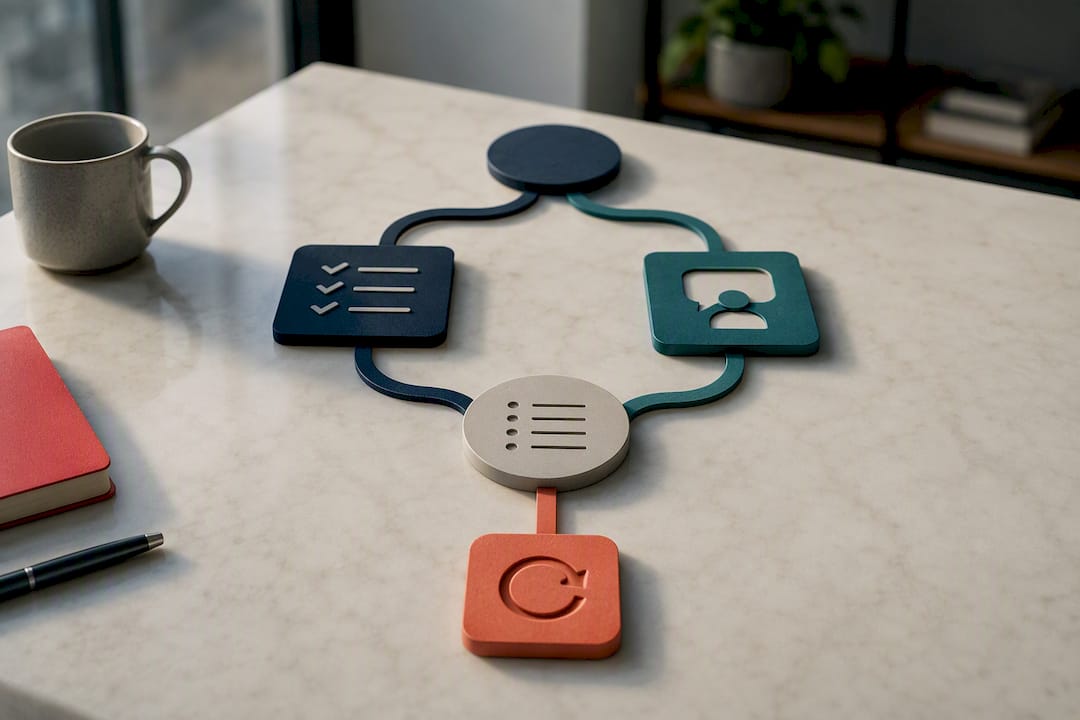
The workflow runs: structured expert review, then respondent-based testing (cognitive interviews and usability checks as needed), then revision, then a field pilot, then finalization. Each stage produces its own deliverable, so nothing gets lost between steps.
- Expert review produces a scored review sheet, itemized by severity, that becomes the revision priority list.
- Cognitive or usability testing produces an interview guide plus a probe log documenting exactly what respondents said and where they stumbled.
- Revision produces a tracked-changes version with a rationale attached to every edit, so nothing gets changed on a hunch.
- Pilot testing produces a short field report covering completion time, item nonresponse, and any unexpected response patterns before full launch.
This sequencing mirrors the Eurostat handbook’s recommended practice of iterating testing after revisions rather than treating a single pretest as sufficient. One round of fixes rarely catches everything; a second, lighter check after revisions confirms the fix actually worked instead of just moving the problem somewhere else in the flow.
For teams building or revising an instrument, pairing this workflow with a solid design foundation from the start pays off. Our own questionnaire design tips cover the drafting stage that precedes review, and a broader look at survey design best practices rounds out the sampling and mode decisions that shape how a review should be scoped in the first place.
Get a Professional Questionnaire Review Without the Guesswork
If you’ve read this far, you already know a checklist alone won’t catch everything, and neither will a single round of expert eyes. A full-service market research firm may offer structured expert review against a scored sheet, cognitive interviews and usability testing with real respondents, pilot fieldwork, survey programming, and recruitment across B2B, B2C, healthcare, and hard-to-reach audiences. That matters most for teams launching a new instrument on a tight timeline, revising one that’s producing odd results, or moving a questionnaire into a new mode for the first time.
Some firms offer flexible project start times and work schedules that accommodate client timelines rather than agency calendars. As Scrappy-Doo proved to us, size isn’t what determines whether a job gets done right. A focused two-week review cycle with the right methods applied catches more than a slow, bloated process ever will.
The next step is simple: contact Veridata Insights to scope your questionnaire and get a recommendation on which methods your instrument actually needs before you spend a dollar on fieldwork.
Where to Go for Primary Guidance
A handful of sources anchor most of the practical guidance in this article, and they’re worth bookmarking if you review questionnaires regularly.
- The FCSM inventory of evaluation methods is the most complete public catalog of testing methods and how they sequence together.
- The peer-reviewed guide to appraising survey research explains what a rigorous published survey should document, useful as a benchmark for your own instrument.
- The Eurostat handbook on questionnaire testing offers detailed, mode-specific testing practices.
- A study on expert reviewer performance shows why averaged expert scoring works despite individual disagreement.
- The Survey Practice multimethod evaluation study demonstrates that small-budget, multimethod testing still catches complementary problems.
- The partner guide to building effective surveys covers practical design habits that pair well with a formal review process.
Sources
- Evaluating Survey Questions: An Inventory of Methods (FCSM/SPWP47)
- How to appraise survey research: a guide for readers and peer reviewers
- An examination of questionnaire evaluation by expert reviewers
- Conducting small-scale multimethod questionnaire evaluation (Survey Practice)
FAQ
What are five good survey questions to model your own on?
Strong questions share traits regardless of topic: a clear time frame (“in the past 30 days”), a single construct per item, mutually exclusive response options, a defined reference group when others are involved, and a balanced scale with a neutral midpoint. Reviewing a set of sample questions against these five traits is faster than writing from scratch.
What does an example of a survey questionnaire look like?
A well-built questionnaire opens with low-sensitivity screening items, groups related questions by topic, places any sensitive items in the middle rather than first or last, and closes with brief demographic questions. Structure matters as much as individual wording.
Is survey research a legitimate source of evidence?
Survey research is a legitimate and widely used research method when the instrument follows a systematic development and testing process, including pretesting and transparent reporting, as outlined in appraisal guidance for readers and peer reviewers. Legitimacy depends on the rigor behind the specific instrument, not the method category itself.
What makes a good survey questionnaire?
A good questionnaire asks one clear question at a time, uses response options that cover every respondent’s real answer, keeps completion time reasonable, and has been tested with real respondents before full fieldwork. Instruments that skip respondent-based testing tend to carry hidden comprehension and interface problems that only show up once data collection is underway.
How is a survey questionnaire review different from just proofreading?
Proofreading catches typos and grammar; a full review checks whether each item measures a single construct correctly, whether response options are exhaustive, and whether the instrument produces stable, valid answers across a real respondent sample. Veridata Insights builds that distinction into its structured review sheets, scoring items on clarity and validity rather than surface wording alone.