

TL;DR:
- Research-driven branding links brand identity to measurable market outcomes through audience insights and tested messaging. Long-term brand marketing builds equity, enabling premium pricing and customer loyalty, but requires governance to prevent fragmentation. Effective integration relies on research, internal alignment, and digital channels to reinforce consistent, strategic brand communication.
Marketing branding is a research-driven program that connects brand identity to measurable market outcomes. Start here: commission audience research, pause any campaign spend that lacks a tested positioning statement, and brief your research partner with three questions: Who is our audience, what do they believe about us today, and what do we want them to believe?
Your three prioritized next steps:
- Commission now: Audience segmentation research and a brand perception study to establish your baseline
- Pause or align: Any active campaign that cannot trace its messaging back to a tested brand promise
- Vendor brief: Ask for a methodology proposal covering qualitative discovery, quantitative validation, and a brand awareness tracking plan
Brand equity, Net Promoter Score (NPS), and aided/unaided awareness are the three metrics that tell you whether your program is working.
Table of Contents
- What is the real difference between branding and marketing?
- Why brand marketing matters for your bottom line
- What does a research-first brand marketing process look like?
- Which research methods should you use at each stage?
- How do you measure brand success, and how long does it take?
- How do you choose the right market research partner for branding work?
- How do you integrate branding and marketing for consistent messaging?
- How do digital channels shape your brand marketing?
- Why does internal alignment matter for brand marketing?
- Key Takeaways
- Veridata Insights covers the full research stack for brand marketing
- Useful sources and further reading
What is the real difference between branding and marketing?
Branding defines identity, tone, values, and the overall customer perception. Marketing distributes that identity through channels and campaigns. One builds the asset; the other spends it.
Quick comparison:
- Branding: Long-term, identity-focused, measured by equity and loyalty
- Marketing: Short- to mid-term, tactic-focused, measured by reach, conversion, and cost per acquisition
- Primary risk: Running marketing before branding produces inconsistent messaging and diluted equity
A practical example: a B2B software firm that defines its brand as “the most transparent vendor in the category” can run marketing campaigns that consistently reinforce that promise, from case study content to sales deck language. Without that definition, every campaign team invents its own angle, and the brand fragments.
Why brand marketing matters for your bottom line
Brand marketing is a long-term, “slow-drip” strategy that builds brand equity, the added value that enables premium pricing and stronger customer loyalty. The commercial benefits compound over time.
- Premium pricing: Customers pay more for brands they trust
- Lower acquisition cost: Recognized brands convert prospects faster and cheaper
- Higher retention: Emotional connection reduces churn
- Referral lift: Loyal customers become advocates; 38% of consumers say that interacting with a business on social platforms keeps them returning
The cautionary flip side: teams that trade brand equity for short-term conversion gains, running perpetual discount campaigns or pivoting messaging every quarter, erode the very asset that makes marketing efficient. Brand marketing functions as the organization’s north star, and protecting it requires governance, not just guidelines.
What does a research-first brand marketing process look like?
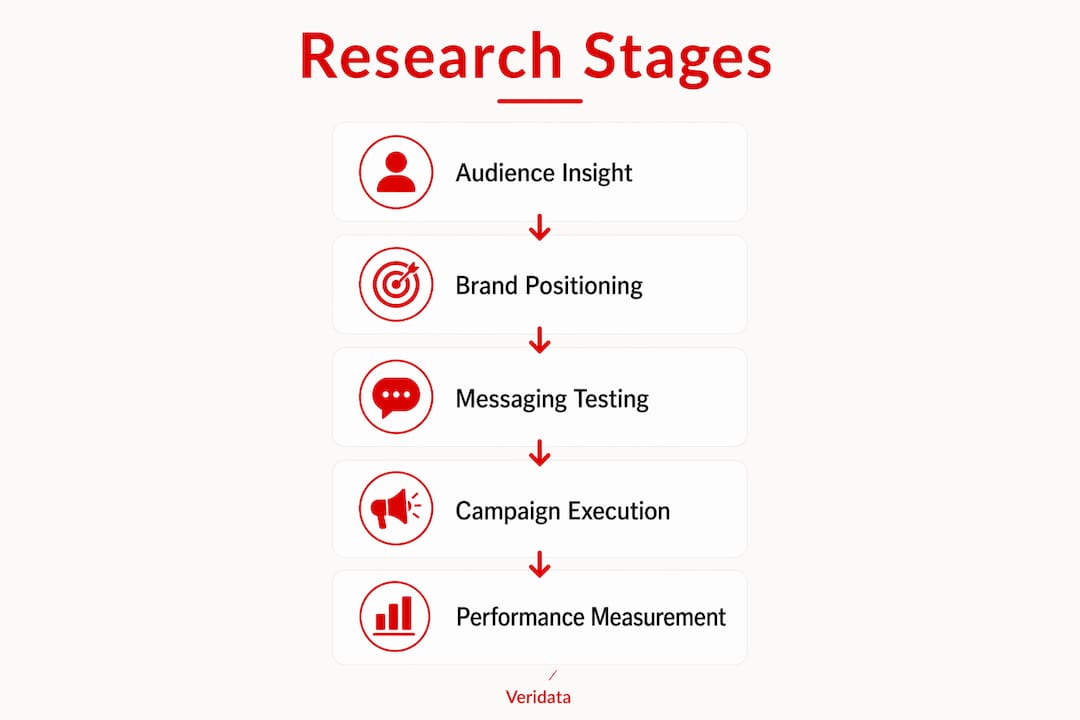
A methodical multi-step approach is required to build effective brand marketing. Here is a vendor-actionable sequence:
- Discovery and audience research. Conduct qualitative interviews and quantitative segmentation to map who your audience is, what they believe, and what language they use. Deliverable: audience framework and perception baseline report.
- Brand identity development. Use research findings to define your positioning statement, visual identity direction, and verbal tone. Deliverable: tested positioning statement and brand brief.
- Brand story and messaging. Translate positioning into a narrative and a message hierarchy. Deliverable: tested claims list and brand story document.
- Concept and message testing. Run quantitative concept tests before committing to creative spend. Small changes validated by research materially improve campaign relevance and reduce wasted budget. Deliverable: ranked message concepts with audience resonance scores.
- Rollout and channel alignment. Deploy across channels with a brand style guide and content calendar. Deliverable: channel playbook and launch brief.
- Brand governance and tracking. Establish approval workflows, living guidelines, and measurement SLAs to prevent fragmentation as you scale. Deliverable: brand governance dashboard with KPI targets.
Pro Tip: Turn research deliverables into internal decision artifacts. A one-page executive summary of your audience framework and a “tested claims” list give every team, from product to PR, a shared source of truth. Stakeholder alignment is faster when the evidence is visible.
Which research methods should you use at each stage?
| Method | Stage | Typical outputs |
|---|---|---|
| In-depth interviews (IDIs) | Discovery | Audience language, unmet needs, perception themes |
| Focus groups | Discovery, message testing | Concept reactions, emotional resonance |
| Quantitative segmentation survey | Audience research | Segment profiles, sizing, priority ranking |
| Brand perception/awareness survey | Baseline and tracking | Aided/unaided awareness, consideration, preference scores |
| Concept and message testing | Pre-launch | Ranked messages, purchase intent lift |
| NPS/loyalty survey | Ongoing tracking | Loyalty scores, advocacy rate |
Sampling guidance:
- B2C quantitative studies typically require n=300–500 per segment for reliable cuts
- B2B studies often run smaller (n=100–200) because the population is narrower; quality of respondent matters more than volume
- Hard-to-reach audiences (healthcare professionals, C-suite executives, niche industrial roles) require specialty recruitment with verified screening, higher incentives, and longer field windows
For healthcare and regulated industries, recruitment must include credential verification and IRB-compliant screening. For executive B2B panels, telephone or video-based IDIs typically outperform online surveys for response quality.
How do you measure brand success, and how long does it take?
Brand measurement combines leading indicators (awareness, perception) with lagging indicators (revenue, market share). Always-on dashboards that link brand signals to business results are the current standard for organizations that take governance seriously.
Core KPIs:
- Aided/unaided awareness: Do prospects know you exist?
- Consideration: Are you in the evaluated set?
- Preference: Do they choose you over alternatives?
- NPS/loyalty: Would they recommend you?
- Brand equity proxy: Price premium tolerance and share of wallet
| Signal type | Typical movement window | What to watch |
|---|---|---|
| Awareness and perception | 6–12 months | Unaided awareness lift, message recall |
| Consideration and preference | months | Consideration set inclusion rate |
| Business impact (CLV, conversion) | months | Customer lifetime value, repeat purchase rate |
Cost drivers to include in your vendor brief: sample size and panel complexity, custom versus syndicated tracking, qualitative depth (number of IDIs or groups), specialty recruitment for hard-to-reach audiences, and internationalization or translation requirements.
How do you choose the right market research partner for branding work?
Selection comes down to five criteria: methodology rigor, recruitment expertise, reporting and visualization capability, relevant industry experience, and flexibility on scope and timeline.
Questions to ask during an RFP or discovery call:
- How do you recruit for B2B or hard-to-reach audiences, and what quality controls do you apply?
- Can you show a sample brand tracking report or dashboard?
- What is your standard timeline for a quantitative brand perception study?
- Who on your team will manage day-to-day project delivery?
- Do you support brand governance deliverables, or only data collection?
Red flags:
- Vague answers about sampling methodology or panel sources
- One-size-fits-all pricing with no scope discussion
- No examples of visualization or reporting outputs
- No support for governance or ongoing tracking after fieldwork closes
Common research pitfalls often trace back to under-specified briefs and partners who skip the methodology conversation. Push for specifics before you sign.
How do you integrate branding and marketing for consistent messaging?
Branding and marketing work together when every campaign can trace its message back to a tested brand promise. The practical mechanism is a shared brand brief that all channel teams use as a filter before publishing.

Start by auditing existing assets: ads, social content, sales decks, and email sequences. Flag anything that contradicts the core positioning. Then build a simple approval workflow so new creative passes through a brand check before launch. Brand governance frameworks, not just style guides, are what prevent fragmentation as organizations scale. The goal is not rigid uniformity; it is coherent variation, the same promise expressed appropriately for each channel and audience.
How do digital channels shape your brand marketing?
Digital channels both amplify and test your brand identity simultaneously. Every paid ad, organic post, and email is a brand impression, and inconsistency across those touchpoints erodes trust faster than it builds it.
Leverage digital within the brand marketing process by assigning each channel a specific role: LinkedIn for B2B thought leadership, email for loyalty and retention, paid search for consideration-stage capture, and organic social for community and personality. Corporate photography and visual consistency across these channels reinforce brand perception at every touchpoint. Use digital monitoring tools to track brand mentions, sentiment, and share of voice as leading indicators between formal research waves.
Pro Tip: Digital data is a signal, not a substitute for research. Social sentiment and click-through rates tell you what happened; qualitative research tells you why. Use both.
Why does internal alignment matter for brand marketing?
Your employees are your first brand audience. A brand promise that lives only in the marketing department will fracture the moment a customer calls support or reads a sales proposal that uses different language.
Internal alignment starts with sharing research findings broadly, not just with the marketing team. When product, sales, customer success, and leadership all understand the audience framework and tested positioning, they make decisions that reinforce the brand rather than contradict it. Regular internal briefings, a living brand guide accessible to all teams, and onboarding materials that explain the brand story are practical tools. Branding impacts both customers and employees, creating a consistent internal and external culture that compounds over time.
Key Takeaways
Effective marketing branding requires research-first execution: audience insight before identity, tested messaging before campaign spend, and governance structures that protect brand equity as you scale.
| Point | Details |
|---|---|
| Branding before marketing | Define identity, positioning, and tested messaging before committing to campaign spend. |
| Research drives each step | Qualitative discovery and quantitative validation map to every stage, from audience segmentation to brand tracking. |
| Timelines are longer than expected | Awareness signals typically move in 6–12 months; business impact takes 12–24 months of sustained investment. |
| Governance prevents fragmentation | Approval workflows and living guidelines, not just style guides, keep messaging consistent as teams scale. |
| Veridata Insights as your research partner | Veridata Insights covers the full research stack, from recruitment and programming to analytics and visualization, with no project minimums. |
Veridata Insights covers the full research stack for brand marketing
Brand marketing decisions are only as good as the research behind them. Veridata Insights delivers the full research program your brand strategy needs: audience segmentation, brand perception studies, concept and message testing, qualitative recruitment, survey programming, data processing, and reporting with clear data visualization. We work with B2B, B2C, healthcare, and hard-to-reach audiences, with no project minimums and availability seven days a week. Whether you need a single discovery study or an ongoing brand tracking program, we scope to your objective. Contact Veridata Insights to brief us on your brand research needs and get a methodology proposal.
Useful sources and further reading
Veridata Insights resources:
- Measuring the impact of market insights on client success — KPIs and dashboard approaches for brand performance
- How market research drives strategic decision-making — research-to-strategy mapping for consulting and brand teams
- Using B2B research to bring a new product to market — example deliverables and B2B recruitment guidance
External references:
- IE University: Branding vs. marketing — authoritative definitions and strategic framing
- Shopify: Brand marketing strategy — step-by-step process and SMB-relevant guidance
- Monday.com: Brand marketing strategy playbook — measurement frameworks, governance, and timeline benchmarks
- VistaPrint: Brand marketing definition and strategy — practical tactics and social engagement benchmarks
- JF Photos: Corporate photography for branding — visual identity execution and campaign asset guidance
Recommended
- 5 Types of Market Research For Strategic Decisions – Veridata Insights
- How Brands Use Quantitative Research to Understand Consumer Behavior – Veridata Insights
- The Business Case for Investing in Market Research – Veridata Insights
- What is Market Research: A Guide For Business Success – Veridata Insights