

TL;DR:
- Analyst research transforms raw data into actionable insights that inform key business decisions.
- Effective reports follow a structured format tailored to stakeholder needs while ensuring compliance and clarity.
Analyst research is one of the most misunderstood disciplines in business. Most people assume it starts and ends with pulling data together. It does not. Real research, what the industry calls applied analytical research, transforms raw numbers and qualitative findings into decisions someone can actually act on. The gap between collecting data and generating a genuine insight is where most efforts fall flat. This guide covers the core methodologies, reporting frameworks, compliance requirements, and tools you need to make your analyst work count, whether you are an experienced analyst or a decision-maker who depends on research every day.
Table of Contents
- Key Takeaways
- Analyst research fundamentals: methodology and best practices
- Structuring analyst deliverables: from data to decision
- Compliance in sell-side research: what you need to know
- Tools and platforms for sourcing analyst reports
- Applying research to drive real business impact
- My honest take on where analyst research goes wrong
- Get research you can actually use with Veridatainsights
- FAQ
Key Takeaways
| Point | Details |
|---|---|
| Methodology drives quality | Selecting the right analytical research methods upfront determines whether your findings are trustworthy and usable. |
| Structure your deliverables | Reports that include an executive summary, clear goals, and next steps get adopted far more often than raw data dumps. |
| Compliance is built-in, not bolted-on | Regulatory frameworks like Regulation AC and FINRA Rule 2241 shape how research is created, reviewed, and published. |
| Access platforms strategically | Tools like LSEG Workspace have usage limits, so prioritize decision-critical content to get the most from subscriptions. |
| Collaboration closes the gap | Analysts and decision-makers produce better outcomes when research deliverables are designed around specific organizational needs. |
Analyst research fundamentals: methodology and best practices
Good analyst research is not about gathering the most data. It is about gathering the right data, validating it properly, and interpreting it with a clear question in mind. The industry term for this disciplined approach is applied analytical research, and it follows a defined process regardless of sector.
Here is the core process that holds up across financial, market, and policy research contexts:
- Define the research objective clearly. Before collecting a single data point, articulate what decision the research will inform. Vague objectives produce vague findings.
- Select your data sources. Primary sources (surveys, interviews, transactional data) and secondary sources (published reports, government data, databases) serve different purposes. Use both when the question demands it.
- Collect and clean the data. Dirty data is the silent killer of credibility. Validate sources, check for duplicates, flag outliers, and document every step.
- Choose metrics and KPIs aligned to the goal. Reporting revenue growth when the client needs customer churn context is a common and costly mismatch. Metrics must map directly to the decision at hand.
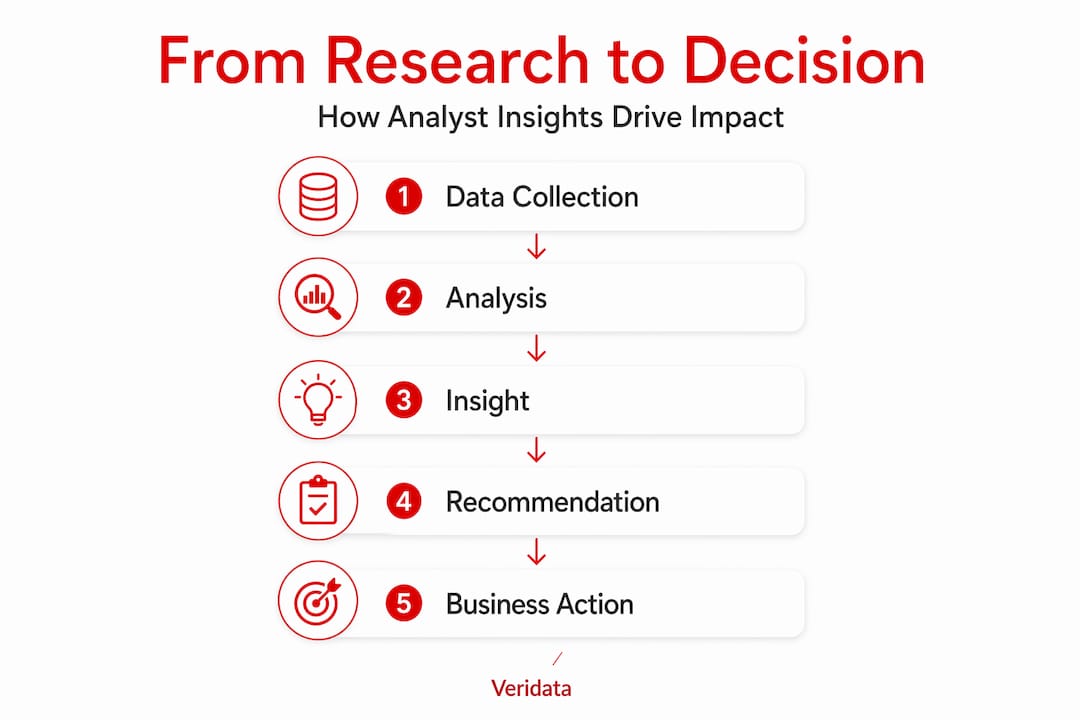
- Balance quantitative and qualitative inputs. Numbers tell you what happened. Qualitative data tells you why. Data storytelling that answers “what happened,” “why it happened,” and “what to do next” makes reports genuinely useful.
- Interpret and verify findings. Cross-check insights against multiple data sources. One data point is anecdote. Three or more pointing the same direction is evidence.
- Communicate with the audience in mind. A CFO and a product manager need very different levels of detail from the same underlying analysis.
Pro Tip: Before you finalize your methodology, ask: “If this finding came back negative, would the stakeholder change their decision?” If yes, the question is worth asking. If no, it is the wrong question.
A common pitfall in market research analysis is over-indexing on quantitative metrics while ignoring qualitative context. Survey data that shows 60% of customers are dissatisfied tells you there is a problem. An in-depth interview tells you it is the onboarding process. You need both to solve it.
Structuring analyst deliverables: from data to decision
The format of your research report shapes whether anyone acts on it. Effective data analysis reports follow a consistent structure that guides stakeholders from purpose to conclusion without losing them along the way.
Every strong analyst report includes these core components:
- Executive summary. Three to five sentences covering the purpose, key finding, and top recommendation. Decision-makers often read only this section.
- Research goal and context. What question were you answering, and why does it matter now? Include any relevant benchmarks or prior research.
- Data and methodology overview. Brief, transparent. Stakeholders need to trust the process, not audit it.
- Key insights with supporting evidence. Lead with the finding, follow with the data. Never bury the answer.
- Practical next steps. Specific, assigned, and time-bound where possible.
Here is a quick reference for tailoring report depth by audience:
| Audience | Report focus | Depth level |
|---|---|---|
| C-suite / board | Strategic implications, risk, ROI | High-level summary |
| Department heads | Operational impact, resource planning | Moderate detail |
| Analysts / technical teams | Methodology, data quality, granular findings | Full depth |
| External stakeholders | Market positioning, compliance summaries | Concise and curated |
Data visualization deserves special mention. Charts are not decoration. A well-chosen chart makes a trend impossible to miss. A poorly chosen one hides it. Use bar charts for comparisons, line charts for trends over time, and scatter plots when you are showing correlation. Label everything. Do not make readers guess what they are looking at.
Pro Tip: Write your executive summary last. Once you know exactly what the data says, you will write a far more accurate and confident summary than if you draft it upfront.
For analysts building step-by-step research reports, the structure above is not a template. It is a decision-making tool. Each section answers a specific stakeholder question.
Compliance in sell-side research: what you need to know
If your analyst work touches equity research or financial markets, compliance is not optional background knowledge. It is woven into the creation process itself.
FINRA Rule 2241 provides a principles-based framework for managing research analyst conflicts, disclosures, and supervision in sell-side equity research. Alongside it, Regulation AC requires analysts to certify the truthfulness of their expressed views and to disclose any compensation connected to those views. Both rules exist because the conflict between analysts and investment bankers is a documented, recurring problem in financial markets.
Key compliance requirements for sell-side research include:
- Personal conflict disclosures. Analysts must reveal if they hold positions in covered securities.
- Firm-level conflict disclosures. Investment banking relationships with covered companies must be disclosed.
- Certification of views. Analysts sign off that their published ratings genuinely reflect their opinions.
- Supervisory review before publication. Compliance controls are integrated into the research production process, not just attached as disclaimers afterward.
“Ensuring research compliance is not only about post-publication disclaimers. It involves controlled creation, review, and dissemination aligned with regulatory frameworks at every stage of production.”
These requirements directly affect report availability. A firm that does not meet supervisory standards may restrict or pull certain reports. For readers relying on research for business decisions, understanding why a report may be limited or qualified matters as much as reading the findings themselves.
Global regulatory differences also apply. The EU’s MiFID II rules, for example, require investment research to be paid for separately from trading commissions. That has reduced the volume of freely distributed research in European markets and pushed some firms to rethink how they price and distribute content.
For anyone managing compliance in research-adjacent roles, global compliance standards in market research extend well beyond financial services.
Tools and platforms for sourcing analyst reports
Knowing how to access and manage analyst report content efficiently separates productive research teams from overwhelmed ones.

LSEG Workspace (formerly Refinitiv) is one of the most widely used platforms for financial and market analyst insights. Bloomberg Terminal remains the gold standard for real-time financial analyst forecasting, though the cost puts it out of reach for smaller organizations. Factset and S&P Capital IQ serve a similar function with slightly different data strengths.
A practical reality most new users discover quickly: access limits on platforms like LSEG Workspace cap users at around 150 pages of downloadable analyst report content per 24-hour period. That sounds generous until you are mid-project with six reports queued up. The fix is workflow prioritization, meaning you read the executive summary and key findings sections first before deciding whether the full report earns a download.
Strategies for getting the most from research platforms:
- Build a query library. Save your most-used search strings and filters. Recreating them every session wastes time and risks inconsistency.
- Set up alerts. Most platforms offer alerts for new reports on specific companies, sectors, or topics. Use them so relevant content comes to you.
- Layer in academic sources. Platforms like JSTOR, SSRN, and government statistical databases complement commercial reports with peer-reviewed methodology and longitudinal data.
- Use AI tools for pattern detection. AI-assisted analysis can surface correlations and trends across large datasets far faster than manual review, freeing analyst time for interpretation rather than extraction.
The best analyst research workflows combine institutional platforms for depth with AI tools for speed, and human judgment for context. None of these replaces the others.
Applying research to drive real business impact
Industry analyst perspectives are only as useful as their application. Research that sits in a shared folder three weeks after it was published has failed, regardless of how good the underlying analysis is.
Here is where strong research-to-consulting workflows make the difference:
- Match deliverable format to the decision being made. A go-or-no-go market entry decision needs competitive analysis and TAM sizing. A quarterly pricing review needs elasticity data and competitor benchmarks. One template does not serve all decisions.
- Tailor depth by organizational role. Product teams want behavioral data. Finance needs margin impact. Operations cares about logistics constraints. Analysts who write one report for everyone usually serve no one well.
- Treat analyst research as a conversation starter, not a conclusion. The best business analyst strategies use findings to open structured discussion, not to close debate. Present the data, then create space for stakeholder challenge.
- Document assumptions explicitly. Every forecast rests on assumptions. If you do not surface them, someone else will, usually at the worst possible time.
In policy contexts, evidence-based research supports producing recommendations tailored to specific decision environments, whether federal agencies or corporate boards. The underlying discipline is the same: define the question, gather credible evidence, communicate options clearly.
The practical test for whether analyst research has driven impact is simple. Did someone make a different, better decision because of it?
My honest take on where analyst research goes wrong
I have reviewed hundreds of analyst reports across financial services, healthcare, and consumer markets. And the pattern I keep seeing is not bad data. It is reports designed to demonstrate rigor rather than enable decisions.
The analyst who spends 40 pages on methodology and buries the recommendation on page 38 is not serving the reader. They are protecting themselves. I get it. But the result is research that looks thorough and gets ignored.
What I have found actually works: lead with the answer, then build the evidence. Stakeholders are not grading your methodology. They are asking, “What should I do?” Get to that faster.
Compliance has also become a genuine tension. Regulatory guidance is evolving to reduce friction while preserving conflict mitigation, and that is good. But the compliance layer can still slow publication and soften conclusions in ways that reduce usefulness. The best research teams I have worked with treat compliance as integrated workflow, not a final checkpoint.
Finally: the most underrated skill in analyst research is knowing which question NOT to answer. Scope creep kills reports. A focused 12-page brief that answers one question cleanly outperforms a 60-page document that tries to cover everything.
— Daniel
Get research you can actually use with Veridatainsights
Raw data without structure is noise. Veridatainsights turns research objectives into actionable market insights through a full-service model that covers everything from methodology design to reporting and data visualization. Whether you need quantitative surveys, qualitative deep dives, or B2B audience recruitment for a hard-to-reach segment, we work around your timeline, not the other way around. No project minimums. Seven days a week. If your team is struggling to close the gap between data collection and decisions that stick, let’s talk. We build the research; you make the moves.
FAQ
What is analyst research?
Analyst research is the systematic process of collecting, analyzing, and communicating data to inform business decisions. It spans financial forecasting, market research analysis, policy evaluation, and competitive intelligence.
How is analyst research different from raw data reporting?
Raw data reporting describes what happened. Analyst research explains why it happened and recommends what to do next, making it directly useful for decision-making rather than just documentation.
What compliance rules apply to sell-side analyst research?
Regulation AC and FINRA Rule 2241 govern sell-side equity research, requiring analysts to certify their views and disclose conflicts of interest. Supervisory controls are also required before publication.
What tools do analysts use to access research reports?
Common platforms include LSEG Workspace, Bloomberg Terminal, Factset, and S&P Capital IQ. Many also integrate academic databases and AI tools to supplement commercial report access.
How should an analyst research report be structured?
A strong report includes an executive summary, a clear research goal, methodology context, key insights with supporting evidence, and specific next steps. Effective reports are built for the reader’s decision, not the analyst’s process.
Recommended
- Master the business consultant research process: clear decisions
- The Business Case for Investing in Market Research – Veridata Insights
- Data analysis step by step for market researchers in 2026 – Veridata Insights
- How Market Research Drives Strategic Decision-Making in Consulting – Veridata Insights