


TL;DR:
- Field research captures natural behaviors and contextual variables that controlled environments often miss. It involves methods like observation, interviews, and ethnography, which require careful planning, ethical considerations, and team training. Despite its resource intensiveness, fieldwork provides authentic insights critical for understanding complex social and environmental phenomena.
Most researchers assume that controlled environments produce better data. Strip away the noise, isolate the variables, and you get clean results. Field research challenges that assumption head-on. When you study human behavior, environmental systems, or market dynamics in their natural settings, you capture something a lab simply cannot replicate: reality. This guide covers what field research actually is, the methods that make it work, the real benefits and limitations you need to plan around, and the best practices that separate rigorous fieldwork from expensive guesswork.
Key Takeaways
| Point | Details |
|---|---|
| Natural settings are irreplaceable | Field research captures behaviors and context that controlled studies miss, producing richer, more authentic data. |
| Method selection drives outcomes | Matching your technique to your research objective determines whether you get surface observations or genuine understanding. |
| Fieldnotes are primary evidence | Disciplined fieldnote practice is the single most underrated skill in ethnographic and observational research. |
| Limitations require active management | Observer effects, ethical constraints, and logistics are predictable. Plan for them in your study design, not after the fact. |
| Mixed methods close the gaps | Combining qualitative fieldwork with quantitative surveys produces understanding that neither approach achieves on its own. |
What field research really means
Field research, known more formally as fieldwork in academic and social science circles, is the systematic collection of data in natural, real-world environments rather than in controlled or simulated settings. The “field” can be a neighborhood, a retail store, a construction site, a forest ecosystem, or a hospital ward. What defines it is this: the researcher goes to where the phenomenon exists, rather than bringing the phenomenon into a lab.
This distinction matters more than most people realize. Real-world data collection surfaces contextual variables, behavioral nuances, and unexpected patterns that simply do not appear when participants know they are being formally studied or when data is collected secondhand. A 2026 MSU study measuring nitrate reduction in actual agricultural fields, not simulated conditions, found a 66% reduction that validated real-world performance far beyond what laboratory estimates had predicted.
Here is what distinguishes field research from other major research types:
- Laboratory research controls variables but removes context, making findings difficult to generalize to messy real-world conditions.
- Secondary research analyzes existing data, which is fast and cost-effective but limited to what others have already measured.
- Field research sacrifices experimental control in exchange for contextual richness, authenticity, and access to behaviors people do not perform on cue.
Fieldwork can be qualitative, quantitative, or both. A sociologist conducting in-depth interviews in a community health clinic is doing field research. So is an agricultural scientist measuring soil chemistry in active crop fields. Both are working in the field. The methods differ, but the defining principle is the same: data collected where the subject naturally exists.
Primary field research methods and techniques
Choosing the right method is where study design either pays off or falls apart. There is no universally correct approach. Each technique serves different objectives, and the best fieldwork often combines several.
Observation methods
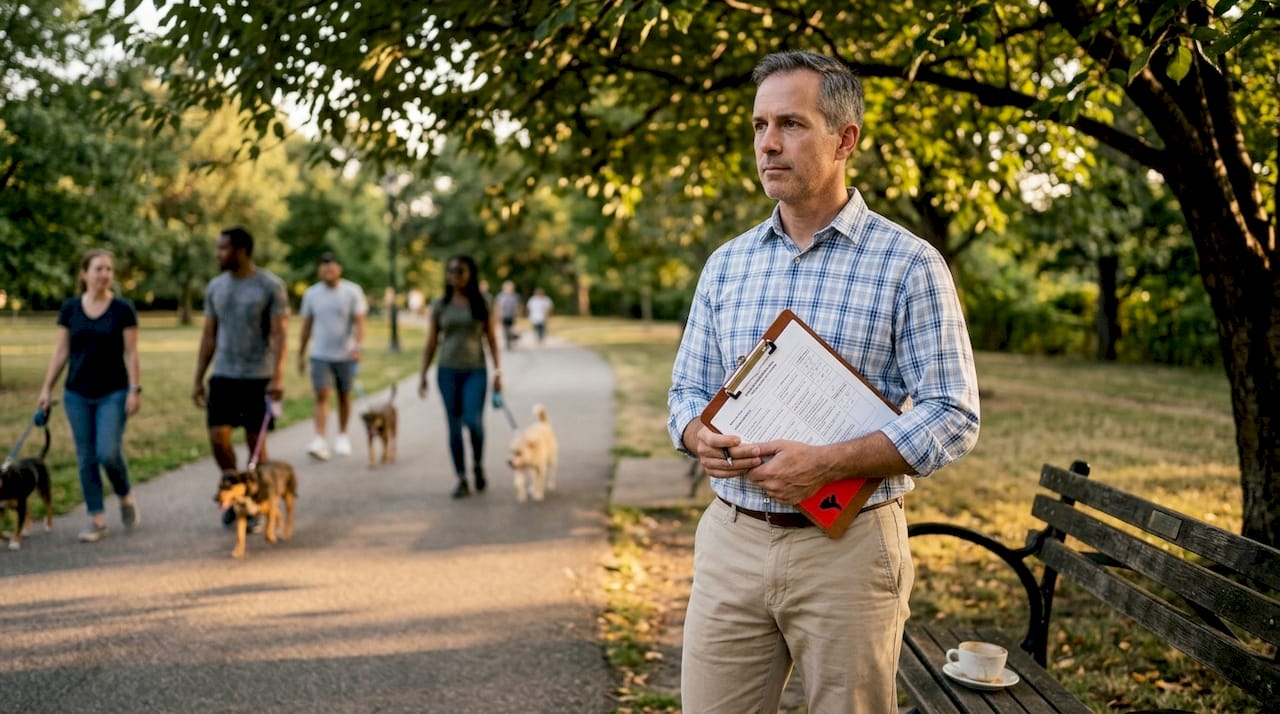
Direct observation means watching and recording behavior without participating in it. The researcher stays separate from the group or activity being studied. This works well when you need unfiltered behavioral data and when your presence is unlikely to change what people do. Think traffic flow studies, retail shopper movement analysis, or wildlife behavior documentation.
Participant observation moves the researcher into the environment as an active member. The degree of immersion varies on a spectrum from peripheral participation to near-complete integration with the group. Ethnography sits at the immersive end of that spectrum, sometimes including sensory ethnography, where researchers deliberately document sounds, smells, textures, and spatial dynamics to capture the full experiential context.
Qualitative data-gathering techniques
Qualitative interviews conducted onsite give you access to meaning, motivation, and interpretation that observation alone cannot provide. Focus groups in field settings bring together six to ten participants for structured group discussion and work particularly well when social dynamics and peer influence are part of what you are studying.
Case studies adapt naturally to field contexts. A researcher examining how a specific community responds to a policy change, or how a particular organization implements a new workflow, uses case study logic within a field setting.
A quick method comparison
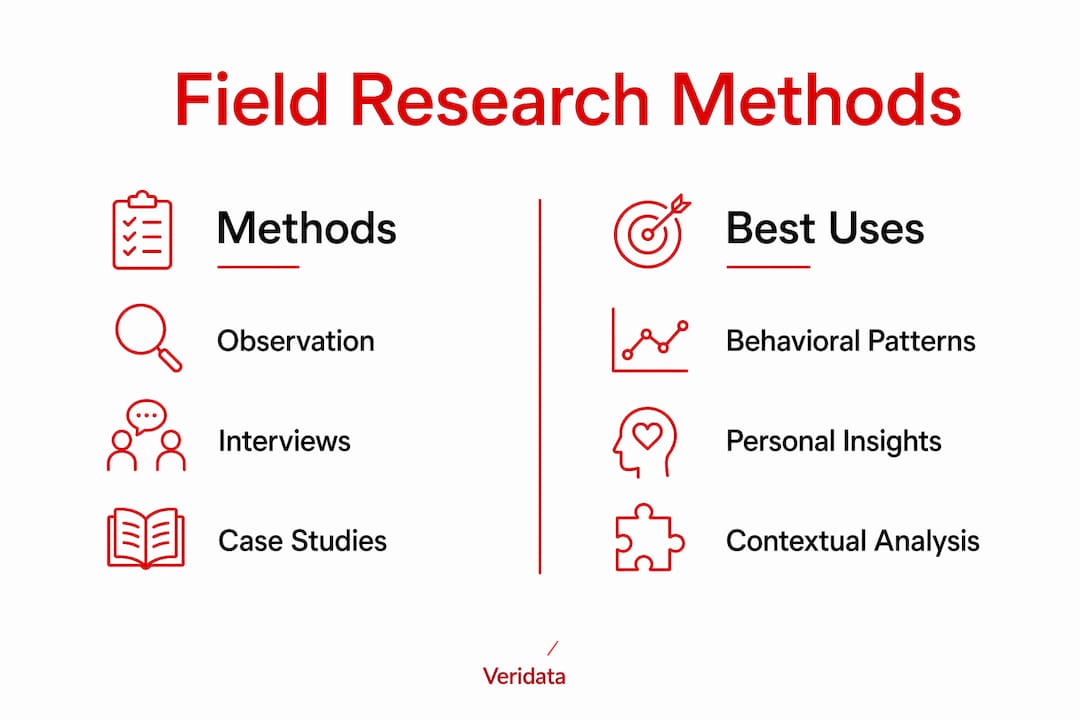
| Method | Best for | Key limitation |
|---|---|---|
| Direct observation | Behavioral patterns, process mapping | No access to motivations or feelings |
| Participant observation | Cultural norms, social dynamics | Risk of researcher bias and reactivity |
| Onsite interviews | Motivation, meaning, lived experience | Time-intensive, small sample sizes |
| Field surveys | Quantifiable patterns across large groups | Misses contextual nuance |
| Mixed methods | Depth plus breadth, cross-validation | Requires more planning and resources |
Pro Tip: Keep two sets of fieldnotes from the start: one purely descriptive (what you observed) and one interpretive (what you think it means). Keeping them separate protects your raw data from being contaminated by your own assumptions before analysis.
Fieldnotes and jottings are the backbone of any observational method. Experienced field researchers develop a personal shorthand system for capturing observations in real time without breaking the flow of their presence in the setting. Transcription happens as soon as possible after each session, ideally the same day.
Benefits of field research that justify the effort
The core benefit is simple: you learn things you would never have thought to ask about. Behavioral variation in context is real, significant, and routinely missed by surveys and experiments. Consumer preferences shift when people are actually standing in a store aisle versus sitting in a focus group facility. Community responses to health interventions look completely different when observed in practice versus when self-reported on a questionnaire.
Here is where field research genuinely outperforms other approaches:
- Unanticipated discovery. You find variables you did not know existed. This is where genuinely new knowledge comes from.
- Behavioral authenticity. People behave differently when they are in their natural environment. The data reflects actual practice, not stated intention.
- Contextual depth. Physical setting, social relationships, time of day, and ambient conditions all influence outcomes. Field research captures these.
- Interdisciplinary collaboration. Shared real-world experiences give researchers from different disciplines a common reference point. Scientists, policymakers, and community members can align around what they all witnessed together.
Field research offers a close-up lens on everyday life, capturing social processes and context that surveys or experiments often miss. This is not a methodological luxury. For research questions where context is the point, it is the only appropriate approach.
The benefits of field research extend across sectors. Environmental scientists validate models. Marketing researchers uncover how purchasing decisions actually happen. Social scientists document lived experiences that policy documents never capture. Healthcare researchers observe clinical workflows as they exist, not as they are designed to exist.
Challenges and limitations to plan around
Knowing the benefits of a method tells you when to use it. Knowing the limitations tells you how to use it well.
- Time and resource intensity. Fieldwork takes longer and costs more than most desktop research methods. Seasonal scheduling is often mandatory. Archaeological fieldwork, for example, typically runs May through August and requires advance logistics, welfare management, and participant registration.
- Observer effects and reactivity. Observer presence alters behavior. This is not a flaw to eliminate; it is a condition to manage. Researchers must acknowledge their impact on what they are measuring and treat objectivity as a spectrum rather than a fixed state.
- Limited generalizability. Field research sacrifices breadth for depth. Rich data from a small, specific setting does not automatically generalize to larger populations. This is a design consideration, not a failure.
- Ethical complexity. Informed consent in natural settings is complicated. Confidentiality requires constant attention. Researchers embedded in communities must balance participation with ethical boundaries throughout the entire engagement.
- Documentation under pressure. Recording detailed observations while remaining present and engaged in a setting is genuinely hard. It is a skill that requires deliberate practice.
- Data quality in uncontrolled environments. Noise, interruptions, unexpected events, and missing data are the norm, not the exception. Protocols need to account for real-world messiness.
Pro Tip: Plan your field research timeline backward from your analysis deadline. Most teams underestimate transcription and coding time by 40 to 60 percent. Build that buffer in before you finalize your project scope.
Mitigating these limitations does not mean eliminating them. It means designing your study to acknowledge them transparently and using mixed-methods approaches to balance depth with the breadth that fieldwork alone cannot provide.
Best practices for conducting field research effectively
Good fieldwork does not happen by accident. These practices consistently separate studies that generate real insight from those that generate expensive noise.
- Define your objectives precisely before entering the field. Vague research questions produce vague data. Know exactly what you are trying to understand and why the field is the right place to find it.
- Match your methods to your objectives and resources. If you need cultural context, ethnography is appropriate. If you need quantifiable behavioral frequencies, structured observation with coding protocols is the right tool.
- Train your research team thoroughly. Consistency across enumerators is a major data quality factor. Every team member should understand the ethics protocols, the observation criteria, and the documentation standards before day one in the field.
- Build in quality control checkpoints. Review fieldnotes and data daily. Problems caught early can be corrected. Problems caught after six weeks of fieldwork cannot.
- Develop a fieldnote practice before you need it. Effective fieldnotes require active, systematic recording with a clear distinction between what you observed and what you interpreted. Practice this before your first real session.
- Approach participant relationships with genuine cultural sensitivity. Researchers who treat communities or organizations as data sources rather than people tend to get the data that reflects that attitude. Respect earns trust and trust earns honesty.
- Use technology where it helps, not because it is available. Mobile data collection apps, audio recorders, and GPS tools can improve accuracy and speed. They can also create distance and discomfort in sensitive settings. Choose based on context.
Pro Tip: After each field session, write a brief “so what” memo to yourself. One paragraph on the most surprising thing you observed and what it might mean. These memos often become the backbone of your analysis and final reporting.
Integrating qualitative and quantitative approaches is not just methodologically sound. It is often the only way to answer research questions that require both understanding and measurement. Combining data types balances depth with breadth and gives you findings that are both meaningful and defensible.
My honest take on what field research demands
I have watched more than a few research projects collect beautiful data and produce mediocre analysis. The fieldnotes were thin. The interpretive memos never happened. The team was so focused on logistics that they forgot to actually think about what they were seeing.
Ethnographic understanding begins in the act of noticing, not in data reports. The fieldnote is not a transcription of events. It is where your perception and your interpretation meet on paper, and where real analysis starts. Treating it as an administrative chore is a serious mistake.
What I have also come to appreciate is how demanding fieldwork is emotionally. You are present in people’s lives. You are carrying what you observe. Sustained engagement with complex human realities requires balancing genuine immersion with the analytical distance you need to make sense of what you are witnessing. That balance is not a skill you learn once. You practice it every time.
The researchers I respect most in this work share one trait: humility. They know that their presence changes things. They know their sample is not the world. And they still do the work rigorously because they understand that imperfect, contextually rich data beats clean, superficial data in almost every situation that actually matters.
— Daniel
Let Veridatainsights support your next field study
If you are planning fieldwork and want a research partner who understands the full arc from study design to final analysis, Veridatainsights is built for exactly that. We handle end-to-end research projects across B2B, B2C, healthcare, and hard-to-reach audiences, with no project minimums and availability seven days a week.
Whether you need help designing your methodology, training field teams, managing data collection, or integrating qualitative and quantitative findings into a report that actually answers your question, we bring both the technical depth and the operational flexibility to get it done. Quality matters more than size. We have built our entire model around that principle. Get in touch with Veridatainsights and let us show you what that looks like in practice.
FAQ
What is field research in simple terms?
Field research is the process of collecting data in natural, real-world settings rather than in a laboratory or controlled environment. It captures authentic behaviors, social dynamics, and contextual factors that other methods cannot access.
What are the most common field research methods?
The most widely used methods include direct observation, participant observation, ethnography, onsite qualitative interviews, focus groups, and field surveys. Many studies combine multiple techniques for more complete findings.
What are the main benefits of field research?
Field research produces contextually rich, authentic data that reveals unanticipated variables and real behavioral patterns. It is especially valuable when the research question cannot be answered accurately without observing people or phenomena in their natural environment.
How do you manage observer effects in fieldwork?
Observer effects are managed by acknowledging your presence as a variable, building trust with participants over time, and treating objectivity as a spectrum rather than an absolute. Transparency in your methodology and findings is the ethical standard.
How long does a typical field research project take?
Duration varies widely by scope and sector, but most fieldwork is seasonal and requires substantial logistical planning. A well-scoped project should budget for data collection, transcription, coding, and analysis phases separately to avoid timeline compression during the most critical stages.