


TL;DR:
- Surveys provide crucial insights that internal metrics often miss, supporting continuous improvement and compliance.
- Effective survey programs require a structured process to translate feedback into actionable operational changes.
- The key success factor is organizational commitment to acting on survey results, not just data collection.
Most manufacturing leaders have dashboards full of survey data and very little to show for it on the shop floor. You’ve run the customer satisfaction surveys. You’ve done the annual employee check-ins. The data is sitting in a spreadsheet somewhere, and yet the same bottlenecks keep showing up in your operations review. The problem isn’t a lack of feedback. It’s the gap between collecting it and actually doing something with it. This article breaks down how to close that gap, giving you a practical, step-by-step path from raw survey responses to measurable operational improvements.
Table of Contents
- Why surveys matter in manufacturing operations
- Types of manufacturing surveys and when to use them
- How to design surveys for actionable insights
- From data to visible improvement: Closing the feedback loop
- Our perspective: What most manufacturing leaders miss about surveys
- Ready to advance your data-driven manufacturing transformation?
- Frequently asked questions
Key Takeaways
| Point | Details |
|---|---|
| Surveys drive change | When used effectively, surveys are a catalyst for visible operational improvement in manufacturing. |
| Action, not just data | Value is created when survey feedback leads directly to management initiatives and measurable results. |
| Build translation layers | The real differentiator is the organization’s capability to translate data into action. |
| Multiple survey types | Using customer, operator, and employee surveys at the right moments uncovers actionable insights. |
Why surveys matter in manufacturing operations
Manufacturing is a precision game. Margins are tight, schedules are demanding, and quality issues have a way of compounding fast. In that environment, gut instinct only gets you so far. Surveys give you structured, repeatable intelligence from the people closest to your processes, your customers, your operators, and your workforce.
The value isn’t just in collecting opinions. It’s in revealing the blind spots that internal reporting misses. Your production metrics might show acceptable yield rates, but a customer survey might reveal persistent delivery timing complaints that are slowly eroding loyalty. An operator survey might surface a recurring equipment issue that never makes it into a formal work order but eats 30 minutes per shift. These are the signals that only structured feedback can reliably capture.
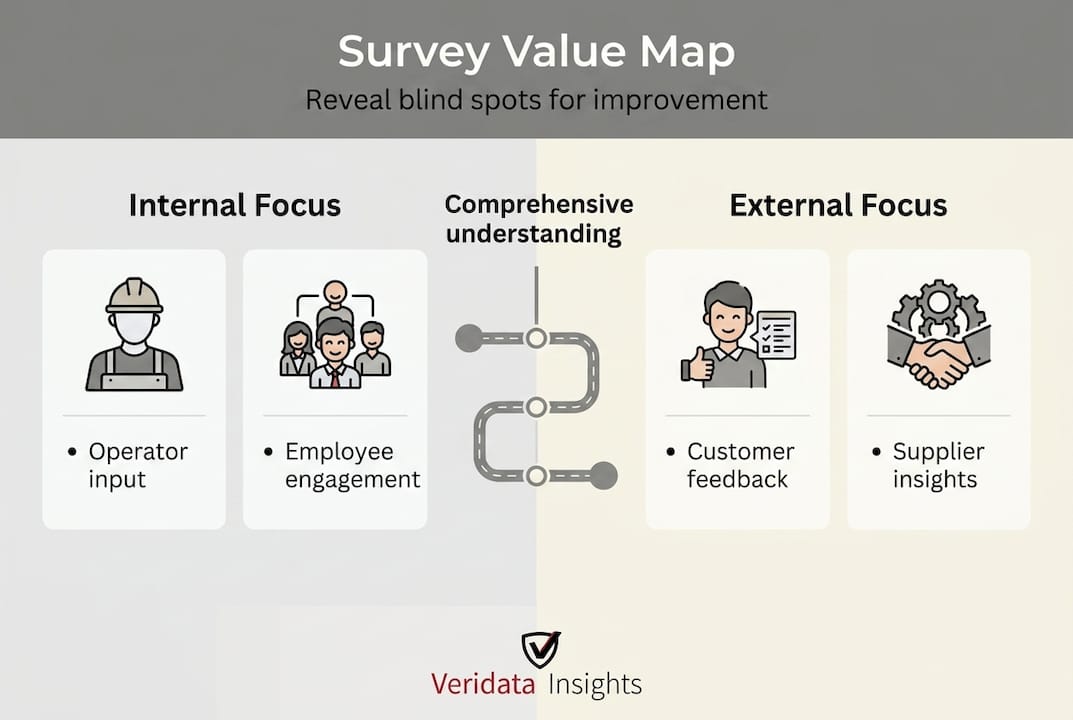
Systematic survey programs also serve a critical function in quality management frameworks. If your facility operates under ISO 9001 or similar continuous improvement standards, documented customer and process feedback isn’t just useful, it’s often required. Surveys create an auditable record of how your organization listens, responds, and improves over time.
Here’s the part most manufacturers overlook: surveys are most powerful when they are explicitly tied to operational decisions, not just tracked as scores. As Pratt & Whitney has demonstrated, customer feedback programs function as a forcing function for real transformation when results are translated into specific initiatives with accountability and follow-through.
Think about what that means for your review cycles. If a quarterly leadership meeting includes a standard agenda item for survey findings and assigned action owners, the data has a home. Without that structure, even excellent feedback drifts into irrelevance.
Key reasons systematic survey programs matter in manufacturing:
- They capture perspectives that internal metrics can’t quantify
- They create structured opportunities to surface quality and efficiency gaps
- They support continuous improvement audits and ISO compliance
- They align customer expectations with operational priorities
- They build a feedback culture where staff feel heard and engaged
“Data without a decision attached to it is just noise. The real competitive edge in manufacturing goes to organizations that build the mechanics to convert feedback into visible action.”
This is why improving customer experiences through systematic survey design is one of the highest-return investments a manufacturing organization can make. The tools are accessible. The methodology is proven. What separates high performers is the commitment to act on what they find.
Types of manufacturing surveys and when to use them
Once you understand why surveys matter, the next question is: which surveys should you be running, and when? Not all manufacturing surveys serve the same purpose. Using the wrong type at the wrong time is one of the most common ways organizations waste survey investment.
Customer surveys are designed to capture the external view of your product quality, delivery reliability, responsiveness, and service. They’re best deployed after delivery milestones, after major service events, or on an annual cycle. Pratt & Whitney Canada runs an annual civil engine operator survey specifically to inform decisions and continuous improvements, a model worth adapting for your own customer relationships.
Operator surveys target the people working directly with your equipment, processes, and materials. These are enormously valuable for identifying recurring process inefficiencies, safety concerns, and improvement ideas that rarely surface in formal reporting channels. Run them quarterly or after significant process changes.

Employee engagement surveys address workplace culture, communication quality, management effectiveness, and retention risk. These are typically annual but can be supplemented with shorter pulse surveys every quarter to track sentiment over time.
Supplier and partner surveys assess collaboration quality, delivery performance, and communication with your upstream partners. These are best aligned with contract review periods or after major procurement cycles.
Here’s a quick reference guide:
| Survey type | Primary audience | Best timing | Core focus |
|---|---|---|---|
| Customer satisfaction | External customers | Annual or post-delivery | Quality, service, loyalty |
| Operator/process | Shop floor staff | Quarterly or post-change | Efficiency, equipment, safety |
| Employee engagement | All employees | Annual with pulse checks | Culture, retention, leadership |
| Supplier assessment | Vendors and partners | Contract cycle or quarterly | Delivery, quality, communication |
Pro Tip: Synchronize your survey calendar with your business review cycles. If leadership reviews operational KPIs every quarter, make sure relevant survey data is ready and summarized ahead of those meetings. Feedback that lands at the right moment drives decisions. Feedback that arrives two weeks after the quarterly review gets filed and forgotten.
Building custom survey solutions for your specific manufacturing environment is far more effective than repurposing generic templates. Your questions need to reflect your actual processes, your product lines, and the decisions your leadership team needs to make. Generic surveys produce generic insights. Specific surveys produce specific actions.
When you’re ready to move from template to strategy, strong B2B survey design principles apply directly to manufacturing contexts. The logic of clean question design, appropriate scale use, and minimizing bias is the same whether you’re surveying enterprise software buyers or engine operators.
How to design surveys for actionable insights
Survey design is where most manufacturing organizations leave value on the table. A poorly designed survey generates data you can’t act on. A well-designed one gives you a direct line from feedback to operational decisions.
Here’s a step-by-step framework:
- Define the business question first. Before you write a single survey item, write down what decision this survey is meant to support. “We want to understand why on-time delivery satisfaction has declined” is a useful business question. “We want to know how customers feel” is not.
- Write questions that are specific and operational. Vague questions like “How satisfied are you with our quality?” produce vague answers. Specific questions like “In the last six months, how often did you receive products that met your dimensional tolerance specifications?” produce data you can act on.
- Balance quantitative and qualitative items. Numeric scales give you trackable benchmarks. Open-text responses give you the context to understand why the numbers look the way they do. Both are essential. Open-ended feedback insights are often where your most important discoveries live, especially when customers describe problems in their own words.
- Build your action plan before you launch. This sounds counterintuitive, but it works. Map out in advance: who receives results, who owns each category of findings, and what the threshold is for escalating a finding to a formal improvement project.
- Use digital tools to accelerate analysis. Manual coding of survey responses is slow and introduces inconsistency. AI-powered survey analysis tools can categorize open-text responses, identify sentiment trends, and surface recurring themes in a fraction of the time.
The constraint in most manufacturing environments isn’t a lack of data, it’s the translation from feedback to action and the operational mechanics that make improvement happen consistently.
Here’s a practical reference for balancing question types:
| Question type | Best use | Example |
|---|---|---|
| Rating scale (1-10) | Tracking satisfaction over time | “Rate the reliability of your last three deliveries.” |
| Likert scale | Measuring agreement or frequency | “Our team responds quickly to quality concerns.” |
| Multiple choice | Categorizing issues | “Which area most needs improvement: delivery, packaging, or quality?” |
| Open text | Capturing context and new ideas | “What’s one thing we could do differently to serve you better?” |
Integrating your survey program with ISO 9001 requirements ensures your feedback processes are documented, auditable, and tied directly to your corrective action framework. This isn’t just a compliance checkbox. It’s a structural guarantee that findings get reviewed and acted on at appropriate intervals.
Tips for effective survey design include keeping surveys short enough to complete in under eight minutes, piloting questions with a small internal group before launch, and reviewing survey fatigue signals like declining response rates over time.
From data to visible improvement: Closing the feedback loop
This is the section most survey guides skip. They walk you through design and collection, then stop. But the real work, and the real competitive advantage, is in what happens after the data comes in.
Organizations that succeed with surveys in manufacturing share one thing in common: they have built a translation layer between feedback and action. That means processes, tools, and management capability specifically designed to convert insights into visible improvements.
Here’s what that looks like in practice:
- Assign ownership by category. Delivery complaints go to logistics. Quality issues go to production managers. Safety observations go to the EHS lead. No owner means no accountability.
- Set action thresholds. Define in advance what score or comment volume triggers a formal corrective action versus a standard review item. This removes the subjective debate from every cycle.
- Communicate results back to respondents. This is one of the most powerful trust-building moves you can make. When customers or employees see that their feedback led to a specific change, response rates climb and honesty increases in future surveys.
- Track improvements visibly. Post results in your production areas. Update your customer communications with “here’s what we changed based on your feedback.” Make the loop visible to everyone involved.
- Use follow-up interviews for depth. Pratt & Whitney’s approach to annual survey programs includes follow-up conversations that allow deeper exploration of survey findings, giving operators a confidential and structured way to share what numeric scores can’t fully capture.
The hard truth is that many organizations have plenty of data and still fail at operational decision-making. The missing piece is manager capability, specifically the training and authority to take feedback and build actionable improvement plans without waiting for top-level approval on every item.
Pro Tip: Create a simple “feedback-to-action” log that tracks every survey finding, the assigned owner, the planned response, and the outcome. Review it monthly. Nothing kills survey engagement faster than a culture where people feel their feedback disappears into a black hole.
Enhancing feedback implementation with the right tools makes this process dramatically more manageable, especially when you’re dealing with large response volumes or multiple survey streams running simultaneously.
Building strong employee feedback programs alongside your customer and operator surveys creates a 360-degree picture of your operational health. When employee sentiment data aligns with customer complaint trends, you have a powerful, evidence-based case for prioritizing specific improvements.
Our perspective: What most manufacturing leaders miss about surveys
Here’s a hard-won lesson we’ve seen play out repeatedly: the failure point for manufacturing survey programs is almost never the survey itself. It’s the lack of a structured translation layer between feedback and execution.
We’ve worked with organizations that design genuinely excellent surveys. High response rates, rich data, clear patterns. Then the results land in a slide deck, get presented at a leadership meeting, and quietly disappear until the next survey cycle. Nothing changes. Response rates drop next year because people learned their feedback doesn’t matter.
The real challenge is that frontline managers are spending significant time cleaning and reconciling data, and only a minority can identify root causes in real time. That’s an execution problem, not a data problem.
The manufacturers who get this right treat surveys as operational levers, not reporting tasks. They invest as much energy in building their action planning process as they do in their survey design. They train managers to interpret findings and implement responses. They make improvement visible. And they close the loop with the people who gave the feedback.
Surveys done right are one of the fastest paths to real transformation. But they require organizational commitment, not just a subscription to a survey platform.
Ready to advance your data-driven manufacturing transformation?
You now have the framework. The question is execution. At Veridata Insights, we help manufacturing organizations bridge the gap between feedback and real operational improvement. From designing custom survey strategies tailored to your specific challenges, to full-service data collection, analysis, and reporting, we do as much or as little as you need. No project minimums. Available seven days a week, 365 days a year. Whether you need a one-time operator survey or an ongoing multi-stakeholder feedback program, we build the research infrastructure that turns data into decisions. Let’s talk about what that looks like for your operation.
Frequently asked questions
What types of surveys deliver the most value in manufacturing?
Customer and operator surveys that directly inform operational changes tend to provide the highest measurable benefit, particularly when structured like annual operator surveys that tie findings to specific improvements.
How do you turn survey responses into real operational improvements?
Build processes and manager capabilities for translating feedback into actionable initiatives, assign clear ownership for each finding, and track visible results because the gap is in execution, not data collection.
What is the biggest mistake in survey programs for manufacturing?
Collecting data without acting on it. The missing piece is a strong translation layer from feedback to execution, since the real constraint is operational mechanics, not access to information.
How often should manufacturing organizations conduct surveys?
Best practice is to align survey timing with operational cycles, such as annual customer reviews or after major process changes, following models like Pratt & Whitney’s annual operator survey that directly feed into decision-making.
Recommended
- Unlocking Business Growth with Custom Survey Solutions from Veridata Insights – Veridata Insights
- Tips for Designing a B2B Survey That Works – Veridata Insights
- The Value of Data-Driven Insights for Management Consulting Firms – Veridata Insights
- The Power of B2B Survey Research: How Veridata Insights Delivers Actionable Business Intelligence – Veridata Insights