


TL;DR:
- Organizations often underestimate the importance of systematic data collection for accurate insights.
- Primary data is tailored and current but expensive, while secondary data is faster and cost-effective.
- Choosing the right method and validating data ensures reliable, actionable business decisions.
Not all data is created equal, and yet many organizations treat data collection like a simple checkbox exercise. Gather enough responses, run a quick analysis, and call it a day. The problem? That approach produces noise, not insight. Decisions built on poorly collected data can misfire in costly ways, from misdirected product launches to flawed market entry strategies. Understanding how data is collected is not a technical nicety. It is a core business competency. This guide walks you through what data collection really means, which methods exist, and how to choose the right approach so your research actually moves the needle.
Table of Contents
- What is data collection and why does it matter?
- Primary vs. secondary data: Key differences for decision-makers
- Essential data collection methods explained
- How to choose the right data collection technique
- Our perspective: Why first-party data and validation matter more than ever
- Take the next step with data-driven insights
- Frequently asked questions
Key Takeaways
| Point | Details |
|---|---|
| Quality matters most | Accurate and relevant data directly supports better business decisions. |
| Primary vs. secondary data | Understanding when to use each can save resources and increase insight reliability. |
| Methodology drives results | Selecting the right data collection method ensures actionable and trustworthy outcomes. |
| Validation is essential | Testing and quality checks must happen before relying on data for major decisions. |
| Regulations drive change | Privacy laws are pushing businesses to focus on first-party data sources. |
What is data collection and why does it matter?
At its core, data collection is the systematic process of gathering information from defined sources to answer specific questions and inform decisions. The key word is systematic. Collecting data at random, without a clear objective or a validated method, introduces errors that compound over time. By the time those errors surface in a strategy meeting, they have already shaped a decision that is hard to reverse.
There are two broad categories of data every business leader should understand. Primary data is collected firsthand by your organization for a specific purpose, while secondary data draws from existing sources such as published reports, government databases, or third-party research. Each has its role, and neither is automatically superior. The real mistake is treating one as a catch-all substitute for the other.
“The quality of your data collection defines the ceiling of your insight. No amount of analysis can fix data that was gathered with the wrong tool, the wrong audience, or the wrong question.”
Here is why this matters practically for your business:
- Strategic alignment: Poorly framed data collection leads to answers that do not match the actual question your leadership team is trying to resolve.
- Compliance risk: Depending on your industry, inadequate data governance during collection can expose you to legal liability.
- Insight reliability: Data collected without consistency checks is prone to bias, making your data-driven insights unreliable when it counts most.
- Resource waste: Repeating a flawed study costs more than getting it right the first time.
The business case for understanding data collection is not abstract. It is measurable. Organizations that prioritize quality in their data gathering consistently outperform those that treat it as an afterthought.
Primary vs. secondary data: Key differences for decision-makers
Think of primary data as custom-built furniture and secondary data as off-the-shelf pieces. Both can furnish a room, but they serve different purposes and carry different costs.
Primary data is firsthand and tailored to your specific research objective. You control the questions, the sample, the timing, and the format. That precision comes at a cost in both time and money. Secondary data, sourced from existing studies, industry reports, or public databases, is far more efficient to access but may not perfectly fit your needs.
Here is a direct comparison to guide your planning:
| Factor | Primary data | Secondary data |
|---|---|---|
| Cost | Higher (design, recruitment, fieldwork) | Lower (often publicly available) |
| Speed | Slower (weeks to months) | Faster (days to weeks) |
| Relevance | Highly specific to your objective | May not align perfectly |
| Control | Full control over methodology | Limited, depends on source quality |
| Privacy risk | Requires consent and compliance | Generally lower, but varies |
| Freshness | Current, real-time | May be outdated |
When should you favor primary data? Choose it when your question is specific, when existing research does not cover your market segment, or when the decision stakes are high enough that secondhand data carries too much risk. A data analysis example might show that industry benchmarks exist, but those benchmarks may not reflect your customer base, your geography, or your price point.
Secondary data shines during early-stage research. Use it to establish market context, validate assumptions, or identify gaps before committing to a full primary study. It also works well for tracking macro trends where precision is less critical.
Pro Tip: The strongest research strategies combine both. Use secondary data to frame the landscape, then use primary data to fill the gaps that existing sources cannot answer. Firms supporting consulting firms with blended data strategies consistently produce richer, more defensible insights.
Essential data collection methods explained
Once you know what type of data you need, the next step is choosing how to collect it. The method you select shapes everything: response quality, data integrity, cost, and timeline.
Key methodologies include surveys, interviews, observations, experiments, and tracking of digital behaviors. Here is a practical breakdown:
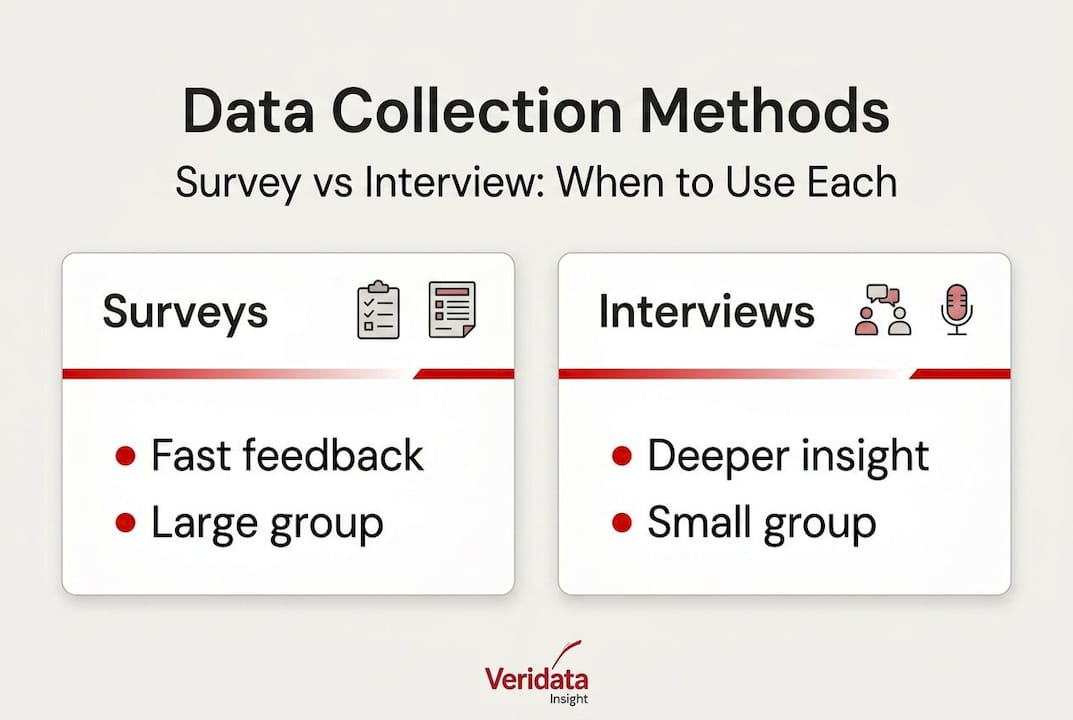
- Surveys and polls: Best for collecting quantitative data from large samples quickly. Online surveys are cost-effective and scalable, but question design heavily influences response quality.
- Interviews and focus groups: Ideal for qualitative depth. One-on-one interviews and group discussions reveal motivations, attitudes, and language patterns that surveys miss.
- Observation: Researchers observe behavior directly, either in-person or through digital analytics. Useful when self-reported data may be inaccurate.
- Experiments: Controlled settings where variables are manipulated to measure cause and effect. A/B testing in digital marketing is one common form.
- Behavioral and transactional tracking: Capturing what people actually do, such as click paths, purchase history, or app usage, rather than what they say they do.
- Secondary analysis: Reanalyzing existing datasets for new insights. Efficient, but limited by the original study’s scope and methodology.
| Method | Best for | Speed | Cost |
|---|---|---|---|
| Surveys | Large-scale quantitative research | Fast | Low to medium |
| Interviews | Deep qualitative insight | Slow | High |
| Observation | Behavioral accuracy | Medium | Medium |
| Experiments | Causal relationships | Slow | High |
| Behavioral tracking | Real-time patterns | Fast | Low to medium |
| Secondary analysis | Context and benchmarking | Very fast | Low |
Matching the method to your objective is critical. Reliable data collection does not mean using the most sophisticated tool. It means using the right tool. And whatever method you choose, data security during collection is non-negotiable, especially when handling sensitive respondent information.
Pro Tip: Before scaling any data collection method, run a pilot test with a small sample. A pilot catches flawed questions, confusing instructions, and technical issues before they corrupt your full dataset.
How to choose the right data collection technique
Choosing a data collection method without a framework is like picking a travel route without knowing your destination. You might get somewhere, but probably not where you intended.

Key factors to consider include your research objectives, available resources, the sensitivity of the topic, and the characteristics of your target audience. A technique that works perfectly for a B2C consumer sentiment study may be entirely wrong for a B2B executive survey.
Here is a practical checklist to guide your selection:
- Define the question first. What specific decision will this data inform? Vague objectives produce vague data.
- Know your audience. Hard-to-reach populations, such as healthcare professionals or niche industry experts, require specialized recruitment, not generic panels.
- Assess your budget and timeline. Qualitative interviews provide depth but take longer and cost more than a quick online survey.
- Consider sensitivity. Subjects involving health, finance, or personal behavior require methods that protect respondent privacy and encourage honest answers.
- Plan for validation. Triangulation, which means using multiple methods or sources to cross-check findings, dramatically strengthens the reliability of your results.
- Think about bias risks. Every method carries inherent bias. Acknowledging and mitigating those risks early is essential.
Validation is where many organizations cut corners, and it is exactly where quality erodes. Pilot testing, training, and quality checks prevent biases and errors from contaminating your dataset. These steps are not optional extras. They are the difference between research you can act on and research that misleads you.
Avoiding common traps is part of the equation too. Reviewing market research pitfalls before you finalize your design can save you significant time and money. And do not underestimate data privacy concerns. Respondents are increasingly protective of their information, and your collection practices need to reflect that reality.
Pro Tip: Train everyone involved in data collection, including moderators, survey administrators, and coders, using the same protocol. Inconsistency between collectors is a leading cause of unreliable data.
Our perspective: Why first-party data and validation matter more than ever
Here is an uncomfortable truth the industry does not always advertise: more data does not automatically mean better decisions. We have seen organizations collect massive volumes of data, only to base strategies on insights that were biased, outdated, or simply irrelevant to their actual question.
First-party data is increasingly preferred over third-party sources, and not just because of privacy regulations. It is because third-party data often reflects someone else’s question, someone else’s sample, and someone else’s methodology. That is a lot of distance between you and the truth you are trying to find.
Privacy regulations have accelerated this shift, and rightly so. But the smart move is not just compliance. It is building a first-party data capability that gives your organization a genuine, data sovereignty asset over time.
Validation is the other non-negotiable. Skipping pilot testing to save time is the research equivalent of skipping quality control on a production line. The errors you miss early become exponentially more expensive later. We are firm believers that ethical research practices and rigorous validation are not costs. They are investments in the credibility of every insight your organization produces.
Chase quality, not volume. The rest follows.
Take the next step with data-driven insights
Understanding data collection theory is only half the equation. The other half is execution, and that is where having the right partner makes all the difference. At Veridata Insights, we work with business leaders across B2B, B2C, healthcare, and hard-to-reach audiences to design and deliver reliable data services that actually answer the question at hand. No project minimums. Seven days a week, 365 days a year. Whether you need full-service support from design through reporting or just a specific piece of the puzzle, we are ready when you are. Connect with Veridata Insights today and let us help you turn the right methodology into measurable business value.
Frequently asked questions
What is the main purpose of data collection?
The main purpose is to gather reliable information for analysis that supports informed business decisions and sound research conclusions.
What are some common data collection methods in business?
Common methods include surveys, interviews, focus groups, observations, experiments, and behavioral tracking, each suited to different research objectives and audience types.
How do you ensure the quality of collected data?
Pilot testing, training, and quality checks are the core practices that reduce errors, minimize bias, and improve the overall reliability of your dataset.
Why is first-party data becoming more important?
First-party data is now preferred for compliance and accuracy, as privacy regulations have made third-party data sources less reliable and legally riskier to use.
Recommended
- The Power of Reliable Data Collection Services – Veridata Insights
- Why Veridata Insights Is the Best Full-Service Data Collection Partner – Veridata Insights
- Why Veridata Insights Is the Data Collection Company You Can Trust – Veridata Insights
- Data analysis step by step for market researchers in 2026 – Veridata Insights
- Complete Guide to Online Analytics for Business | Ibrandmedia