


TL;DR:
- Research evaluation methods now incorporate multiple indicators like bibliometrics, peer review, and integrity signals for a comprehensive assessment. Combining quantitative data with expert judgment produces the most credible results, especially in complex, cross-disciplinary research. Responsible evaluation relies on transparent frameworks, proper method selection, and stakeholder collaboration before data collection begins.
Research evaluation methods are the structured approaches used to measure the quality, credibility, and impact of research studies across disciplines. The field has moved well beyond simple citation counts. A Frontiers study covering 9,651 researchers found that responsible evaluation now integrates scientific production, journal impact quartiles, authorship leadership, and retractions as integrity indicators. That means no single number tells the full story. The most credible assessments combine bibliometrics, expert peer review, and systematic frameworks like the Leiden Manifesto to produce a fair, multi-dimensional picture.
What are the main research evaluation methods?
Research evaluation methods fall into two broad categories: quantitative and qualitative. Each has real strengths. Each has real blind spots. The best practice, confirmed by analysis of 705 articles on evaluation tools, is to combine them.
Quantitative methods
Quantitative research evaluation relies on measurable outputs. The most common tools include:
- Bibliometrics: Citation counts, h-index scores, and journal impact factors measure research reach and influence within a field.
- Journal impact quartiles: Ranking journals by citation performance gives context to where research is published, not just what it says.
- Altmetrics: Online attention scores from platforms like Altmetric track social media mentions, news coverage, and policy citations to capture broader societal impact.
- Count-based regression analysis: Used in large-scale studies to model relationships between researcher outputs and institutional or national performance indicators.
Quantitative data is fast, reproducible, and easy to compare across large populations. The limitation is that numbers strip away context. A researcher publishing in a niche but critical field will always look weaker on citation counts than someone in a high-volume discipline like oncology.
Qualitative methods
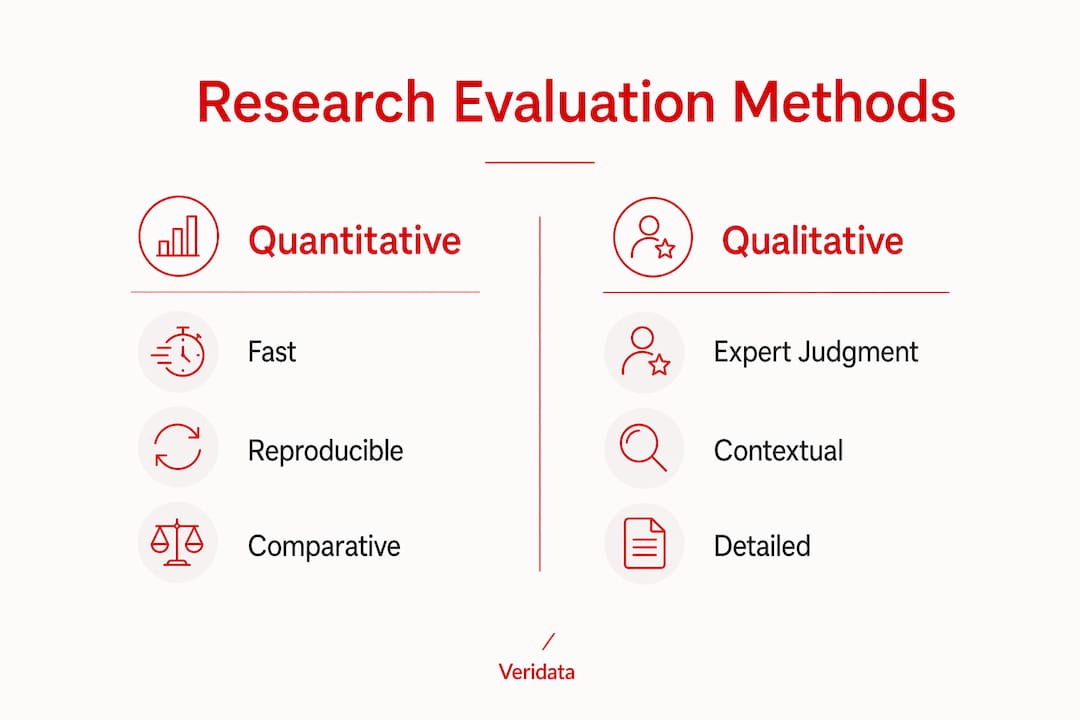
Qualitative evaluation methods bring human judgment back into the picture. Peer review remains the gold standard for assessing scientific merit. Process tracing examines the causal chain between a research program and its outcomes, making it especially useful for complex policy-relevant studies. Realist evaluation asks not just whether something worked, but why it worked and for whom.
These approaches take more time and carry the risk of reviewer bias. But they capture what numbers miss: methodological rigor, theoretical contribution, and real-world applicability. For cross-disciplinary evaluation, qualitative judgment is not optional. It is the corrective lens that keeps metrics honest.
How do advanced methodologies like ITS and theory-based approaches work?
Some research programs are too complex for a simple before-and-after comparison. That is where advanced evaluation techniques earn their place.
- Interrupted Time Series (ITS): ITS tracks an outcome variable over time and identifies whether a research intervention caused a measurable shift. It requires 8–10 pre-intervention data points to build a reliable counterfactual when no comparison group exists. A public health research program tracking disease rates over a decade, for example, is a natural fit for ITS.
- Process tracing: This method reconstructs the causal pathway from research activity to outcome. It is particularly useful in policy evaluation, where multiple actors and decisions shape results. Researchers collect documentary evidence, interview stakeholders, and test whether the predicted causal chain actually holds.
- Realist evaluation: Developed by Ray Pawson and Nick Tilley, realist evaluation builds on the question: “What works, for whom, in what context?” It is theory-driven and iterative, making it well-suited for evaluating research programs with diverse populations or settings.
- Quasi-experimental designs: When randomized controlled trials are not feasible, quasi-experimental designs like difference-in-differences or regression discontinuity offer credible causal estimates. They work best when a natural comparison group exists.
- Theory-based evaluation: This approach builds a causal model of how a research program is expected to produce change, then tests whether that model holds. It is especially valuable when large-scale programs lack credible counterfactuals and pure experimental designs are not practical.
Pro Tip: Before selecting any advanced method, map your available data first. ITS needs long time-series data. Process tracing needs documentary evidence and access to key informants. Choosing the method before auditing your data is the fastest way to end up with an underpowered evaluation.
What are the best practices for combining metrics and expert judgment?

The most credible research assessment strategies do not pit numbers against expert opinion. They use both, deliberately and transparently.
The ARIA project’s guidance on quantitative metrics is direct: metrics should never be used in isolation. They must be paired with expert judgment to produce fair and credible assessments of scientific proposals. Overreliance on a single metric, like the h-index, creates systematic bias against early-career researchers and those in fields with lower citation volumes.
The Leiden Manifesto, a widely cited set of principles for responsible bibliometrics, reinforces this position. Its core argument is that quantitative indicators should inform, not replace, expert review. The principles call for transparency about which metrics are used, why they were chosen, and how they are weighted.
Brian A. Nosek’s framework for assessing research trustworthiness adds another layer. Trustworthiness is not a single-metric check. It requires a systems approach covering accountability, transparency, bias control, and evidence warranting. That framework maps directly onto how evaluation panels should be structured.
“Quantitative metrics should be used responsibly alongside expert judgment to fairly assess scientific proposals, avoiding misleading single metric reliance.” — ARIA Project Guidance, 2026
Best practices for responsible evaluation include:
- Use multiple metrics. No single indicator captures research quality. Combine citation data, journal quartile rankings, and output counts.
- Document your methodology. The UK Magenta Book requires full disclosure of versions, prompts, and algorithms in modern evaluation design. Apply that standard to your own process.
- Include integrity indicators. Retraction rates, authorship transparency, and data sharing compliance are measurable signals of research integrity.
- Calibrate expert panels. Reviewers should be briefed on the metrics in use and trained to recognize where those metrics may mislead.
How do practical constraints shape the choice of evaluation methods?
Methodology selection is never purely academic. Evaluation method choice depends on politics, budget, stakeholder needs, and data quality. A theoretically ideal design is worthless if you cannot collect the data it requires.
| Constraint | Impact on method choice | Recommended approach |
|---|---|---|
| Limited budget | Rules out large-scale experimental designs | Use theory-based evaluation with targeted data collection |
| Poor data quality | Undermines quantitative analysis | Test on realistic, messy datasets before committing to a method |
| No comparison group | Blocks quasi-experimental designs | Apply ITS if time-series data exists; use process tracing otherwise |
| Political sensitivity | Limits access to stakeholders | Build trust through Theory of Change workshops early |
| Cross-disciplinary scope | Reduces comparability of metrics | Weight qualitative expert review more heavily |
Theory of Change workshops deserve special attention here. The UK Magenta Book recommends running these workshops with stakeholders before data collection begins. They build a shared causal framework and reduce the risk of collecting data that cannot answer the evaluation question. Skipping this step is one of the most common and costly mistakes in program evaluation.
Hybrid approaches combining experimental, quasi-experimental, and theory-based designs often prove most feasible in large-scale research impact studies. The goal is not methodological purity. The goal is a credible answer to the evaluation question given the resources and data you actually have.
Pro Tip: When stakeholders push back on your methodology, a Theory of Change workshop is your best tool. It shifts the conversation from “why are you using that method?” to “what do we all agree this program is supposed to do?” That shared foundation makes every subsequent methodological decision easier to defend.
Key takeaways
Responsible research evaluation requires combining quantitative metrics with qualitative expert judgment, guided by transparent frameworks like the Leiden Manifesto and the ARIA project’s standards.
| Point | Details |
|---|---|
| Use multiple dimensions | Combine bibliometrics, expert review, and integrity indicators for a complete picture. |
| Match method to data | Choose ITS, process tracing, or quasi-experimental designs based on what data you actually have. |
| Pair metrics with judgment | Quantitative metrics alone produce biased results; always calibrate with expert review. |
| Plan before you collect | Run Theory of Change workshops with stakeholders before data collection begins. |
| Prioritize transparency | Disclose all metrics, algorithms, and weighting decisions to maintain credibility. |
Where I think research evaluation is heading, and what worries me
I have spent a lot of time watching evaluation frameworks evolve, and the current moment is genuinely interesting. Large Language Models can now correlate with human expert scores in research assessment tasks. That is not nothing. But the 2026 analysis on LLMs and responsible evaluation is clear: AI plays a complementary role, not a replacement role. The Leiden Manifesto principles need to be adapted for AI-assisted evaluation, specifically around transparency of prompts, model versions, and scoring logic.
What worries me more than AI, though, is the persistent temptation to reduce evaluation to a single number. I see it in grant panels that rank applicants by h-index alone. I see it in institutional reports that treat journal impact factor as a proxy for quality. The evaluative research methods community has been making the case for multi-dimensional assessment for years, and the evidence base is strong. The problem is not knowledge. The problem is incentives.
Cross-disciplinary evaluation is where the real complexity lives. A physicist and a sociologist cannot be fairly assessed on the same citation benchmarks. Systems thinking, as Nosek’s trustworthiness framework argues, is the only way to handle that complexity without producing results that are technically defensible but practically misleading.
My advice for researchers adopting new methodologies: start with your evaluation question, not your preferred method. The question determines the design. The design determines the data. That sequence matters more than any single methodological choice you will make.
How Veridata Insights supports your research evaluation needs
Whether you are designing a multi-method evaluation framework or need support selecting the right assessment strategy for a complex study, Veridata Insights brings the methodological depth to get it right. We work across quantitative and qualitative approaches, from bibliometric analysis to expert panel design, with no project minimums and full service seven days a week. Our team understands that combining qualitative and quantitative research is not just best practice. It is the only way to produce findings you can stand behind. Ready to talk through your evaluation design? Reach out to our team and let us build the right methodology for your research objectives.
FAQ
What are the main types of research evaluation methods?
Research evaluation methods divide into quantitative approaches (bibliometrics, citation counts, journal impact factors) and qualitative approaches (peer review, process tracing, realist evaluation). Best practice combines both to produce fair, multi-dimensional assessments.
When should I use Interrupted Time Series in research evaluation?
Use Interrupted Time Series when you have at least 8–10 pre-intervention data points and no available comparison group. It is best suited for longitudinal research programs where outcomes can be tracked over time.
Why is a single metric not enough for research assessment?
Single metrics like the h-index systematically disadvantage early-career researchers and those in low-citation fields. The ARIA project and Leiden Manifesto both require multiple metrics paired with expert judgment for credible evaluation.
What is a Theory of Change workshop and why does it matter?
A Theory of Change workshop brings stakeholders together before data collection to build a shared causal model of how a research program produces outcomes. The UK Magenta Book recommends this step to reduce gaps between evaluation design and actionable findings.
Can AI tools replace human reviewers in research evaluation?
No. LLMs can correlate with human expert scores but must follow transparency principles adapted from the Leiden Manifesto. AI supports evaluation; it does not replace the expert judgment that gives assessment its credibility.