

TL;DR:
- In 2026, participant recruitment relies on precise criteria, AI-powered screening, and calibrated incentives to improve efficiency. Using multiple channels like panels, social media, and AI tools helps build diverse pools and reduces delays. Proper management and communication with participants are essential for high-quality data and successful research outcomes.
The participant recruitment process in 2026 is a systematic approach that covers defining precise criteria, selecting the right channels, calibrating incentives, and using AI-powered screening to enroll qualified participants efficiently. Standard incentives now run $100 for consumer interviews and $150–$300 for B2B professional sessions, with no-show rates dropping as low as 1% when compensation is set correctly. Tools like EHR pre-screening, platforms such as UserInterviews and LinkedIn, and AI persona testing have reshaped how researchers and project managers approach 2026 participant selection. Getting this process right from the start is the difference between clean, usable data and a study that has to be rerun.
What are the essential prerequisites for the participant recruitment process 2026?
Effective recruitment starts with a participant definition that goes well beyond age and zip code. Behavioral traits, purchase history, job function, and technology use all determine whether someone will give you the signal you need. A demographic profile alone produces a list of people who qualify on paper but not in practice.

Screener surveys are the first real filter. Keep them short, use branching logic to route out ineligible respondents early, and include behavior-based validation questions to block professional survey takers. A “None of the above” trap option on product category questions catches respondents who click through without reading. End the survey automatically when an invalid pattern appears.
Building a standing research pool is the single biggest time saver in the process. A pool of 20–40 opted-in participants, segmented by persona and refreshed by about one third each quarter, cuts time to first session dramatically. Opt-in consent can be as simple as a single checkbox agreeing to contact up to once per month.
Pro Tip: Run your screener on AI personas with defined demographic and behavioral attributes before going live. This dry run catches broken logic, dead ends, and disqualifying errors before you spend a dollar on real participants.
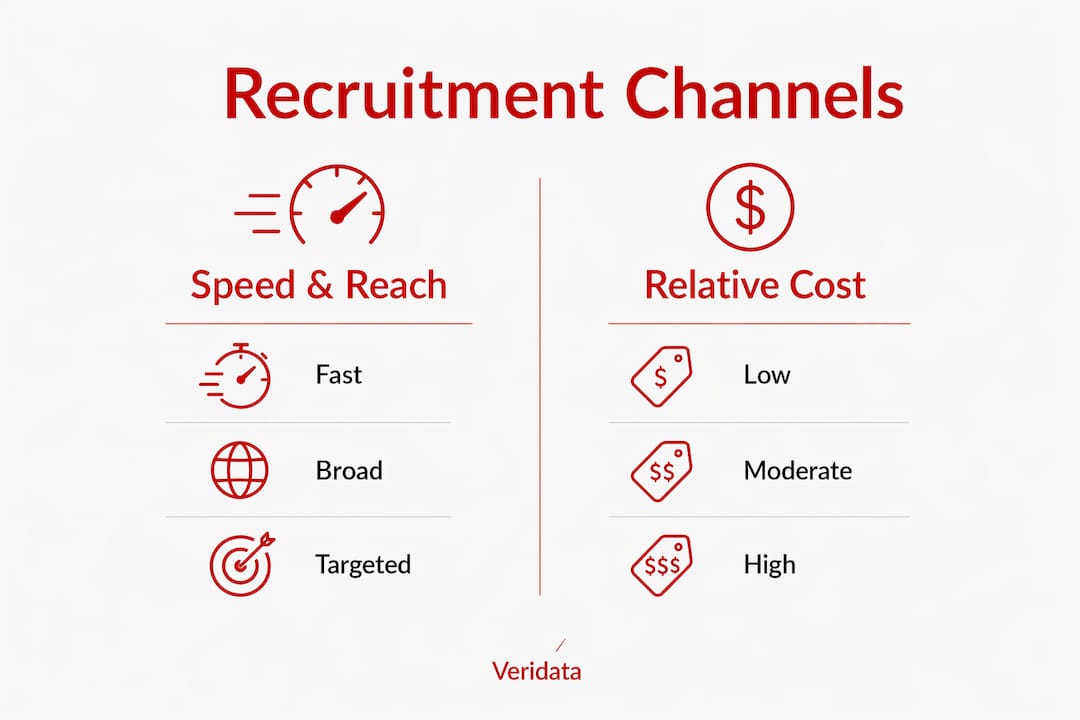
The table below compares the most common recruitment channels on speed, reach, and relative cost.
| Channel | Speed | Reach | Relative cost |
|---|---|---|---|
| User research panels (UserInterviews) | Fast | Broad consumer | Medium |
| LinkedIn targeting | Medium | B2B and professional | Medium to high |
| Existing customer database | Fast | Narrow but high quality | Low |
| Social media campaigns | Variable | Broad | Low to medium |
| AI-powered people search | Medium | Niche and B2B | Medium |
| EHR pre-screening (TriNetX, Epic) | Fast at scale | Clinical populations | High setup |
Which recruitment channels deliver the best results for diverse populations?
No single channel covers every study type. The right mix depends on your audience, timeline, and budget. Knowing where each channel excels prevents wasted spend and slow enrollment.
For niche B2B audiences, AI-powered people search tools and LinkedIn targeting outperform broad panels. LinkedIn lets you filter by job title, company size, industry, and seniority, which matters when you need a CFO at a mid-market manufacturer rather than just “a finance professional.” For consumer studies, platforms like UserInterviews provide pre-screened panels with fast turnaround.
Existing customer databases and community channels like Slack groups, Reddit communities, and LinkedIn groups produce high-quality contacts because participants already have a relationship with your product or topic. Broad social media recruitment generates higher inquiry volume, but conversion depends on following up within 24 hours. Fast follow-up triples response rates compared to delayed outreach.
Combining two or three channels is the standard practice for studies requiring diverse participant representation. One channel fills your core profile quickly; a second channel targets underrepresented segments. Timing matters too. Sending invitations on tuesday or wednesday mornings consistently outperforms friday afternoon sends for professional audiences.
Pro Tip: Over-recruit by 20–30% and schedule same-day confirmation calls. This buffer absorbs last-minute cancellations without delaying your study timeline.
For hard-to-reach or niche segments, Veridata Insights has a dedicated guide on recruiting difficult audiences that covers channel selection and outreach sequencing in detail.
How should incentives be designed to maximize participant engagement in 2026?
Incentives are not a courtesy. They are a recruitment variable with a direct impact on show rates, data quality, and participant effort. Setting them too low produces dropouts and rushed responses. Setting them appropriately signals that you respect participants’ time.
Current benchmarks for effective participant engagement in 2026 are:
- Consumer participants: $25–$50 per hour for standard interviews and usability sessions.
- B2B and professional participants: $100–$200 per hour, reflecting the higher opportunity cost of their time.
- Short surveys (under 10 minutes): $5–$10 is the accepted floor for maintaining response quality.
- Specialized clinical or expert audiences: Rates vary but should align with professional billing norms for the field.
Instant disbursement through platforms or gift card delivery at session end increases confirmation rates. Participants who know they will receive compensation immediately are far less likely to cancel. The communication sequence matters just as much as the amount. Send an immediate confirmation after scheduling, a reminder 24 hours before the session, and a final reminder one hour before. This three-touch sequence is the standard for reducing no-shows.
Ethical design requires that incentives feel fair without crossing into coercion. For vulnerable populations, including patients or low-income groups, review your incentive level against IRB or ethics board guidance before finalizing.
Pro Tip: For healthcare participant recruitment, Veridata Insights outlines incentive and compliance standards that keep your study on the right side of ethical review boards.
What are common challenges in participant recruitment and how do you fix them?
Recruitment problems fall into three categories: wrong people getting through, right people dropping out, and slow pipelines that delay the study. Each has a specific fix.
- Professional survey takers skewing data. Screeners without behavioral validation let repeat respondents game the system. Add open-ended questions about product use, include trap options, and terminate surveys automatically when responses contradict each other. Branching logic and validation in your screener design is the most reliable defense.
- Low eligibility rates. If fewer than 20% of screener respondents qualify, your criteria are too narrow or your channel is wrong. Audit both before widening your criteria. Changing the channel often fixes the problem faster than relaxing the screener.
- No-shows and last-minute cancellations. Inadequate incentives and poor communication are the two root causes. Review your incentive against current benchmarks and tighten your reminder sequence.
- Slow pipelines and lost records. Integrated recruitment dashboards that connect lead status, scheduling, and record management let site managers spot overdue follow-ups and bottlenecks without manual review. Reporting should be a byproduct of your workflow, not a separate task.
“Recruitment is most effective when treated as an ongoing relationship with a segmented pool rather than a one-time task.” — Talkful Research Recruitment Guide
Running a dry run with AI personas before launch catches screener logic errors that human reviewers miss. Define personas with specific demographic, behavioral, and technical attributes, then simulate the full screener flow. Fix every dead end before the study goes live.
How are emerging technologies shaping recruitment in 2026?
AI and connected data systems have changed what is possible in participant identification and enrollment. The gains are real and measurable, not theoretical.
Sites using AI-powered EHR pre-screening report 30–40% reductions in screen-fail rates compared to manual outreach. EHR queries pull on diagnosis codes, lab values, and medication lists at the point of care, surfacing eligible participants before a single phone call is made. Enrollment rates run 3–5 times higher than manual methods at comparable sites.
| Technology | Primary benefit | Key platforms | Main challenge |
|---|---|---|---|
| AI-powered EHR pre-screening | 30–40% fewer screen fails | TriNetX, Epic research module | Data access agreements |
| Decentralized recruitment ecosystems | Real-time progress tracking | Site networks, TrialPort | Integration complexity |
| AI persona dry runs | Screener logic validation | TheySaid | Requires defined personas |
Decentralized recruitment relies on real-time data sharing across all ecosystem participants to keep studies on schedule. When sites, sponsors, and coordinators share live progress data, manual lag disappears and enrollment gaps surface immediately. The main barrier remains data access and integration agreements, which can add weeks to setup time if not negotiated early.
Platforms like TriNetX and the Epic research module are the most widely deployed for clinical populations. For consumer and B2B research, AI-assisted screening within panel platforms is becoming standard, with tools that flag inconsistent response patterns in real time.
Key takeaways
The participant recruitment process in 2026 succeeds when precise screening, calibrated incentives, and AI-powered tools work together from the start.
| Point | Details |
|---|---|
| Define behavioral criteria first | Go beyond demographics to include purchase behavior, job function, and technology use. |
| Match incentives to participant type | Pay $25–$50 per hour for consumers and $100–$200 per hour for B2B professionals to cut no-shows. |
| Combine channels for diverse studies | Use two or three channels together to fill core profiles and reach underrepresented segments. |
| Use AI tools before and during recruitment | Run screener dry runs with AI personas and deploy EHR pre-screening for clinical populations. |
| Build a standing participant pool | Maintain 20–40 opted-in participants segmented by persona and refresh one third each quarter. |
What I have learned about recruitment that most guides skip
The biggest mistake I see researchers make is treating recruitment as a task that ends when the last session is scheduled. It does not end there. The participants you engage today are the pool you draw from next quarter, and the quarter after that. Every interaction either builds or erodes that relationship.
I have also watched teams over-invest in technology and under-invest in communication. An EHR pre-screening system that surfaces 500 eligible patients means nothing if your follow-up email goes out 48 hours later. Speed of contact is a recruitment variable that no platform can fix for you.
The other thing I would push back on is the idea that a single “best” channel exists. The step-by-step recruitment workflow that works for a B2C usability study will fail for a B2B executive panel. Channel selection is not a one-time decision. It is a study-by-study judgment call based on audience, timeline, and budget.
Finally, do not underestimate how much incentive calibration affects data quality, not just attendance. Participants who feel fairly compensated engage more fully. That shows up in response depth, task completion, and the quality of open-ended answers. Pay well, communicate clearly, and treat your participants like the professionals they are.
How Veridata Insights supports your recruitment goals
Veridata Insights specializes in participant recruitment for B2B, B2C, healthcare, and hard-to-reach audiences, with no project minimums and full-service support seven days a week. Whether you need help defining screener criteria, selecting the right channel mix, or managing incentive disbursement, the team at Veridata Insights handles as much or as little as your project requires. From best practices for participant recruitment to full-service execution, every engagement is built around your specific research objective. Ready to get started? Contact Veridata Insights to talk through your next study.
FAQ
What is the participant recruitment process in 2026?
The participant recruitment process in 2026 is a structured workflow covering criteria definition, screener design, channel selection, incentive setting, and communication sequencing to enroll qualified participants in research studies. AI-powered tools and EHR pre-screening have made the process faster and more precise than manual methods.
How much should you pay participants in 2026?
Consumer participants earn $25–$50 per hour and B2B professionals earn $100–$200 per hour, with very short surveys paying $5–$10. Correct incentive levels reduce no-show rates to as low as 1%.
What are the biggest challenges in participant recruitment?
The most common challenges are professional survey takers skewing data, low screener eligibility rates, no-shows from poor communication, and slow pipelines caused by disconnected record management. Each has a specific fix tied to screener design, channel selection, or workflow integration.
How does AI improve participant recruitment?
AI-powered EHR pre-screening reduces screen-fail rates by 30–40% and produces enrollment rates 3–5 times higher than manual outreach. AI persona dry runs also catch screener logic errors before a study launches, saving both time and incentive budget.
How do you build a standing research pool?
Maintain a pool of 20–40 opted-in participants segmented by persona, with a single consent checkbox agreeing to monthly contact. Refresh approximately one third of the pool each quarter to keep it current and representative.