


TL;DR:
- Participant quality influences the reliability and legal defensibility of litigation research findings.
- Effective recruitment involves clear criteria, rigorous screening, multiple sourcing channels, and ethical practices.
- Strategic, expert-led recruitment enhances research accuracy, avoiding misleading results and supporting strong case outcomes.
Litigation research is not just about building legal arguments. The participants you recruit shape the credibility and strength of every finding. Yet many legal professionals treat recruitment as a checkbox, not a strategy. That mindset costs cases. Whether you are preparing mock trials, assembling expert panels, or gathering witness testimony, the quality of your participant pool determines the quality of your insights. This article walks you through what litigation research recruitment actually involves, how to do it right, and why getting it wrong is a risk no legal team can afford.
Table of Contents
- Understanding litigation research recruitment
- Key components and processes in recruitment
- Comparing recruitment strategies: Panels, agencies, and DIY approaches
- Best practices for successful participant recruitment
- A fresh perspective: What most legal professionals get wrong about research recruitment
- Connect with recruitment experts for your litigation research
- Frequently asked questions
Key Takeaways
| Point | Details |
|---|---|
| Recruitment is foundational | Effective participant recruitment fundamentally shapes the quality and validity of litigation research. |
| Strategic processes matter | Following systematic recruitment steps ensures legal defensibility and credible results. |
| Choose the right method | Selecting between panels, agencies, and DIY approaches depends on project requirements and resources. |
| Ethics build trust | Adhering to ethical protocols and transparency safeguards both research outcomes and professional reputation. |
| Expert support enhances results | Partnering with recruitment specialists streamlines your process and delivers higher-quality legal data. |
Understanding litigation research recruitment
Let’s start with a clear definition. Litigation research recruitment is the process of identifying, screening, and engaging individuals who will participate in legal studies. These studies support attorneys, consultants, and legal teams in building stronger cases, testing arguments, and understanding how different audiences perceive evidence.
As research recruitment for business consulting demonstrates, litigation research recruitment involves identifying and engaging suitable participants for legal studies. That sounds straightforward, but the execution is anything but simple.
Why does participant quality matter so much? Because the insights you generate are only as reliable as the people providing them. A mock jury made up of poorly screened participants gives you misleading data. A panel of so-called experts who lack relevant experience weakens your case preparation rather than strengthening it.
Here are the most common types of participants in litigation research:
- Mock jurors: Individuals who simulate real jury deliberation to test how arguments land with a typical jury pool
- Subject matter experts: Professionals with specialized knowledge relevant to the case, such as medical, financial, or engineering expertise
- Lay witnesses: Community members who reflect the demographic profile of actual jurors or affected parties
- Focus group participants: Groups recruited to explore how certain evidence or narratives resonate with a broader audience
- Survey respondents: Larger samples used to quantify attitudes, beliefs, or behaviors relevant to the litigation
“Recruitment is not a support function in litigation research. It is the foundation. Get it wrong, and every subsequent step is built on sand.”
The role of recruitment extends beyond simply filling seats. It is about finding the right people whose perspectives, backgrounds, and qualifications align with the research objective. A well-recruited participant pool produces insights that hold up under legal scrutiny. A poorly recruited one produces noise.
Legal teams that invest early in defining their participant criteria and working with experienced recruiters consistently see stronger, more defensible research outcomes.
Key components and processes in recruitment
With the definition clear, let’s walk through the actual steps of effective recruitment. Qualitative legal case research confirms that successful recruitment follows a systematic process to ensure validity and legal relevance. Skipping steps is where things go sideways.
Here is a practical breakdown of the core recruitment process:
- Define participant criteria: Identify the exact profile you need. Age, profession, geographic location, prior legal experience, and case-relevant knowledge all matter. Vague criteria produce vague results.
- Source candidates: Use a mix of digital outreach, existing panels, community networks, and referrals. Each channel has strengths depending on the audience you need.
- Screen rigorously: Apply screening questionnaires that filter for eligibility, conflicts of interest, and legal relevance. This step protects the integrity of your research.
- Confirm and onboard: Once screened, confirm participation, communicate expectations clearly, and provide any necessary preparation materials. Surprises at this stage lead to dropouts.
- Monitor engagement: Track attendance, responsiveness, and data quality throughout the study. Replace disengaged participants promptly to maintain sample integrity.
Recruitment methods vary widely. Digital recruitment uses social media, email lists, and online panels to reach large audiences quickly. In-person and hybrid approaches work well for specialized or hard-to-reach populations. Panel providers offer pre-screened databases, while market research recruitment best practices point to the value of combining multiple channels for the most robust results.
Common challenges include low response rates, participants who misrepresent their qualifications, and difficulty finding niche expertise. The solution is layered screening, clear communication, and working with recruiters who specialize in legal audiences.
Pro Tip: Always clarify eligibility requirements and legal relevance criteria before you begin outreach. Discovering a participant is ineligible after onboarding wastes time and can compromise your timeline.
Comparing recruitment strategies: Panels, agencies, and DIY approaches
To optimize your recruitment, it’s vital to understand the available strategies. Specialized recruitment agencies and panel providers offer distinct advantages and challenges depending on your case needs, budget, and timeline.
| Strategy | Speed | Customization | Cost | Best for |
|---|---|---|---|---|
| Panel providers | Fast | Moderate | Lower | Large samples, standard profiles |
| Recruitment agencies | Moderate | High | Higher | Niche, complex, or sensitive cases |
| DIY recruitment | Slow | Full control | Variable | Small teams with internal resources |
Here is how each approach plays out in practice:
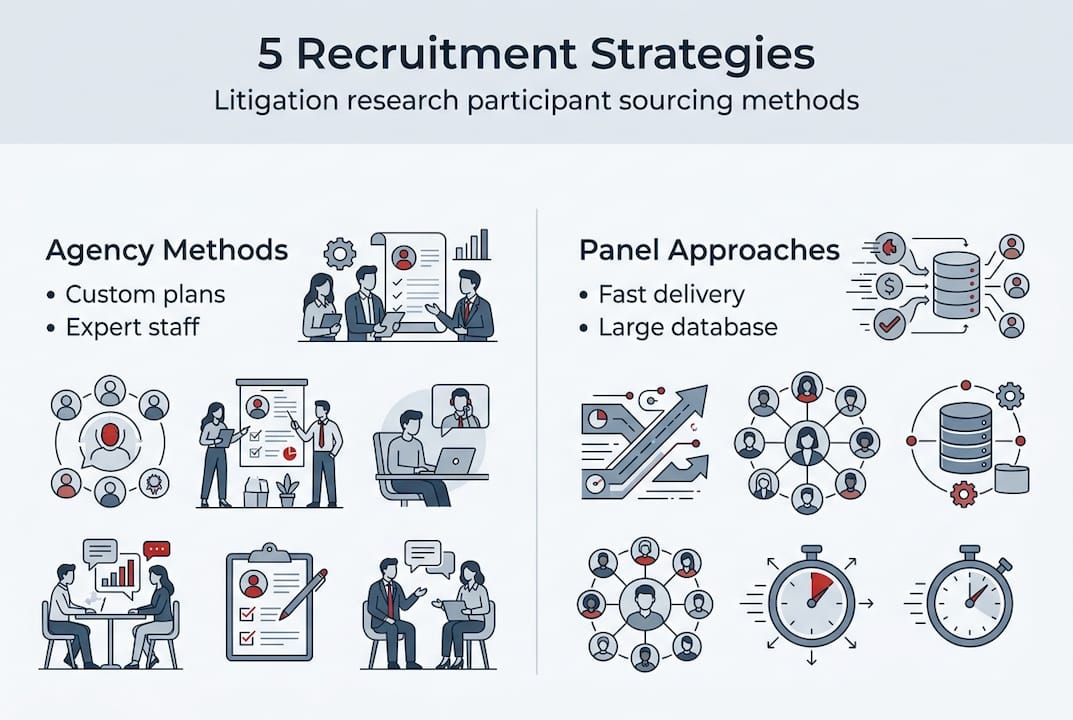
Panel providers give you speed and scale. They maintain large databases of pre-screened individuals and can deliver participants quickly. The tradeoff is that panels may not always have the niche expertise or specific demographic profiles that complex litigation research demands.

Recruitment agencies bring tailored expertise. They build custom recruitment plans around your specific criteria and manage the entire process. This is especially valuable for market research for litigators who need participants with very specific professional backgrounds or case-relevant knowledge.
DIY recruitment gives you full control but demands significant internal resources. Legal teams with dedicated research staff and established networks can make this work. For most firms, though, it stretches capacity and introduces risk.
Key considerations when choosing your approach:
- How specialized is the participant profile you need?
- What is your timeline and budget?
- Do you have internal capacity to manage screening and onboarding?
- How critical is legal defensibility of your recruitment process?
For firms newer to research, market research 101 for consulting is a great starting point to understand how these strategies fit into a broader research framework. The right approach depends on your specific situation, but combining agency expertise with panel reach often delivers the best of both worlds.
Best practices for successful participant recruitment
Once you’ve chosen your approach, putting best practices into action ensures quality results. Ethical research practices confirm that ethical recruitment builds trust and strengthens legal research outcomes. Trust is not optional in litigation research. It is essential.
Here are the practices that separate strong recruitment from weak recruitment:
- Communicate clearly from the start: Tell participants exactly what the study involves, how long it will take, and what is expected of them. Ambiguity leads to dropouts and unreliable data.
- Screen meticulously: Use multi-stage screening to verify qualifications, identify conflicts of interest, and confirm legal eligibility. One bad participant in a focus group can skew the entire session.
- Use appropriate incentives: Fair compensation increases participation rates and attracts higher-quality respondents. Underpaying signals low value and drives away the participants you actually want.
- Protect privacy and obtain informed consent: Every participant must understand how their data will be used. Consent protocols are not just ethical requirements. They are legal protections for your research.
- Maintain a diverse pool: Diversity in demographics and perspectives strengthens the validity of your findings and reflects real-world jury or community composition.
For teams working in B2B contexts, B2B research best practices offer additional guidance on recruiting professional audiences. And if you want to see what rigorous B2B recruitment looks like in action, the B2B recruitment case study from Veridata Insights is worth reviewing.
Pro Tip: Document every step of your recruitment process, from criteria definition to final participant confirmation. This documentation protects your research’s legal defensibility and gives you a clear audit trail if your methodology is ever challenged.
A fresh perspective: What most legal professionals get wrong about research recruitment
Stepping back, we want to share something we see consistently. Most legal teams treat recruitment as a logistical task. Find some people, get them in a room, run the study. Done. That approach misses the point entirely.
Recruitment is a strategic decision. The participants you choose are not just bodies filling seats. They are the lens through which your research findings are generated. Choose the wrong lens, and everything you see is distorted.
We have seen cases where brilliant legal strategies were tested on poorly recruited mock juries, producing results that led attorneys in completely the wrong direction. The research looked credible on the surface. The methodology was flawed underneath.
The uncomfortable truth? Recruitment quality is often the single biggest variable in whether litigation research produces actionable insights or misleading noise. Yet it receives a fraction of the attention that questionnaire design or data analysis does.
As research recruitment expert insights make clear, expertise in recruitment is its own discipline. It is not something you can wing. Legal professionals who recognize this early gain a real strategic advantage. Those who do not often find out the hard way.
Connect with recruitment experts for your litigation research
If you are ready to raise your recruitment standards, expert help is just a click away. At Veridata Insights, we specialize in research recruitment for legal professionals, consultants, and businesses tackling complex research challenges. We work 7 days a week, 365 days a year, with no project minimums, so we fit your timeline, not the other way around. Whether you need a handful of niche experts or a large mock jury panel, we build recruitment strategies that deliver quality participants and defensible results. Connect with litigation research experts today and let’s build a recruitment plan that actually works for your case.
Frequently asked questions
What is litigation research recruitment?
Litigation research recruitment involves sourcing and selecting participants for legal studies, such as mock trials or expert testimony panels. It is a structured process designed to ensure participant quality and research validity.
Who are typical participants in litigation research studies?
Common participants include mock jurors, subject matter experts, witnesses, and community members relevant to the case. The right mix depends on the specific research objective and case type.
What challenges do legal professionals face in recruitment?
Key challenges include finding qualified participants, ensuring compliance, and maintaining engagement throughout the study. Layered screening and clear communication are the most effective solutions.
Are there ethical requirements for litigation research recruitment?
Yes. Ethical requirements include transparency, informed consent, and privacy protection for participants. These protocols also protect the legal defensibility of your research.
How can I contact expert recruiters for litigation research?
Reach out to specialized agencies or contact Veridata Insights directly for tailored recruitment support. We are available year-round and ready to match your research needs with the right participants.
Recommended
- Qualitative Research in Legal Cases: Strategy That Wins – Veridata Insights
- Case Study: Research Recruitment For a Business Consulting Firm – Veridata Insights
- How to Recruit Hard-to-Reach Audiences for Market Research – Veridata Insights
- How to Recruit Participants for Market Research: Best Practices – Veridata Insights
- Project 7- The Pattern Archive Method How to Document Invisible Abuse So Courts Finally See What You’ve Been Living – After the Affair Series