

Panel fraud detection is the set of practices researchers use to catch bots, professional cheaters, and misrepresented respondents before bad data reaches a report. The single best practice is a layered defense: real-time metadata and behavioral checks during fieldwork, paired with forensic review after data collection closes. If you buy research from a panel vendor, start by asking for their audit logs and adjudication records before the first survey goes live.
TL;DR:
- Combining multiple detection techniques like rules-based checks, device fingerprinting, and behavioral analytics significantly improves fraud identification accuracy.
- Post-field forensic reviews, including open-end checks and statistical anomaly detection, are essential to catch sophisticated or hidden fraud patterns.
- Implementing a layered fraud prevention process from pre-field screening to governance reduces risk and enhances data integrity.
- Vendors should provide transparent documentation of verification methods, fraud logs, and SLAs to validate their fraud detection claims.
- Proactive survey design strategies, such as mid-survey attention checks and randomized question order, help deter fraud before it occurs.
Table of Contents
- What Panel Fraud Looks Like Today
- How Detection Works: Techniques, Signals, and Trade-Offs
- A Multi-Layered Panel-Fraud Detection Framework You Can Apply
- Prevention Tactics That Cut Fraud Before It Starts
- What to Demand From Panel Vendors and Suppliers
- How Veridata Insights Approaches Panel Fraud Detection
- Get Panel Fraud Detection Built Into Your Next Study
- Sources
What Panel Fraud Looks Like Today
Fraud in survey panels has evolved past the obvious “gibberish in the open-end” era. Attackers now range from crude bots to operators who mimic real human behavior closely enough to slip past a single screening layer.
The most common types you’ll encounter in delivered datasets:
- Bot-driven traffic that auto-fills close-ended questions and increasingly generates plausible open-end text using language models, making old “nonsense answer” filters far less reliable.
- Professional cheaters and repeat participants who join multiple panels under different identities to qualify for the same study more than once, often chasing high-value incentive studies in healthcare or B2B.
- Synthetic profiles built from stolen or fabricated identity data, designed specifically to pass firmographic and demographic screeners.
- Location masking through VPNs and proxy servers, which lets someone in one country claim to be a target respondent in another, a problem that hits international B2B and healthcare studies especially hard.
- Low-effort patterns like speeding through a 20-minute survey in 90 seconds or straight-lining every grid question, versus a smaller but growing group of sophisticated fraudsters who pace themselves and vary their answers just enough to look legitimate.
A peer-reviewed analysis of 31 fraud detection strategies found usable response rates in some online surveys declined significantly once sophisticated fraud entered the sample. That’s not a fringe problem. It’s a sign that fraud has scaled alongside the incentive economy that funds it. The mix of low-effort and high-effort fraud is exactly why one static rule set stops working within a few fielding cycles.
How Detection Works: Techniques, Signals, and Trade-Offs
No single tool catches everything, and vendors who tell you otherwise are oversimplifying. Detection techniques fall into a few families, and each one trades coverage for a different weakness.
Rules-based checks and screener validation catch known patterns fast. If someone answers a screener with a logically impossible combination (self-reported income of $12,000 and a $2 million home purchase last year), a rule flags it instantly. The limitation: rules only stop what you’ve already seen. Rules-based systems are consistently listed as the fastest, cheapest first line of defense, but also the easiest for adaptive fraud to route around.
Device and browser fingerprinting, IP analysis, and geolocation signals identify when the same device or network submits multiple entries under different names, or when a respondent’s claimed city doesn’t match their connection data. This is where “improbable location” checks live, one of the strongest indicators in the peer-reviewed analysis cited above.
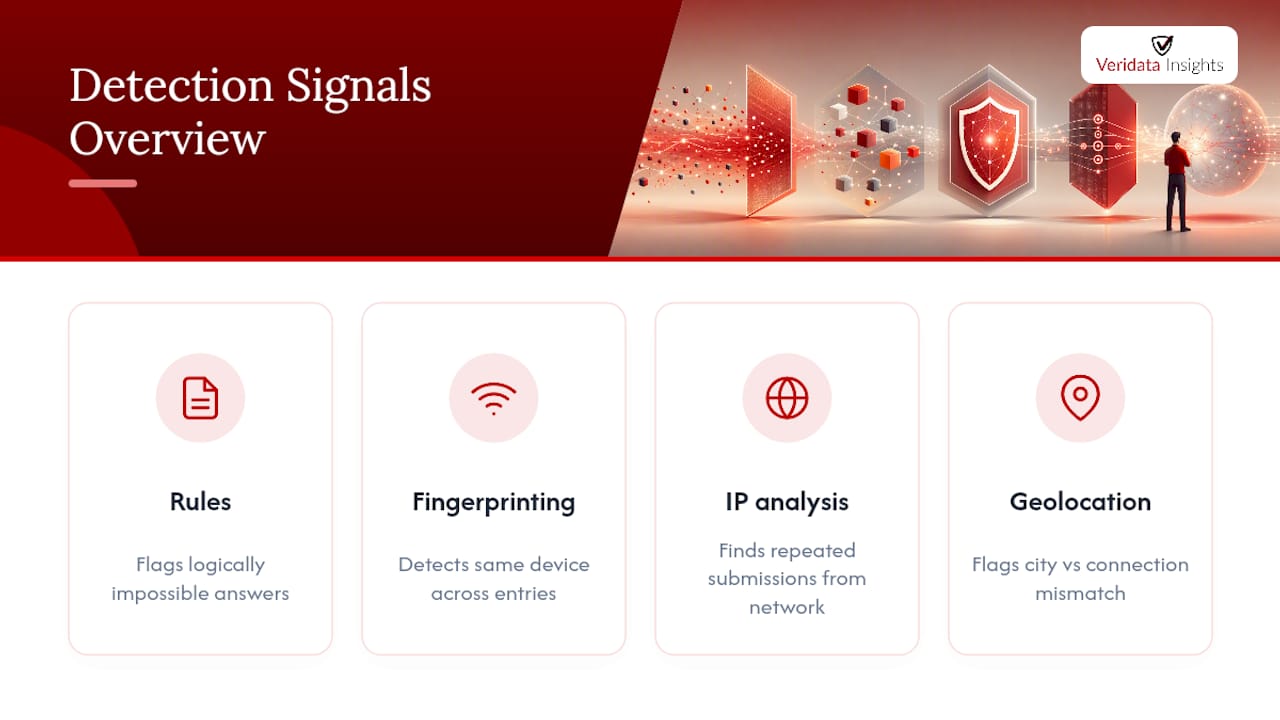
Behavioral analytics look at timing between questions, mouse movement, navigation patterns, and even keystroke rhythm to separate a human thinking through a question from a script filling in fields. Combined with machine learning anomaly detection, this layer finds patterns nobody explicitly coded for.
Open-end forensic checks examine linguistic entropy (how varied and natural the word choice is), run plagiarism comparisons against prior submissions, and increasingly screen for AI-generated text patterns.
Statistic Callout: The top-performing indicators identified across 31 fraud detection strategies included email address risk scores, consecutive submission timing, incentive opt-outs, and improbable location, according to the same peer-reviewed analysis.
The trade-offs matter as much as the capabilities. Aggressive fingerprinting can flag legitimate respondents sharing a household device. Behavioral models need retraining as fraud tactics shift, and every layer you add raises privacy and compliance questions your legal team will want answered before fieldwork starts. TransUnion’s overview of fraud detection techniques makes the same point for financial fraud: rules-based systems miss unknown patterns, and machine learning models need curated training data and human oversight to avoid false positives. The fix isn’t picking the “best” technique. It’s combining several, then having a person review what the system flags before anyone gets rejected or paid.
A Multi-Layered Panel-Fraud Detection Framework You Can Apply
Think of fraud defense in four stages, not one checkpoint. Each stage catches something the others miss.
- Pre-field screening. Verify recruitment sources before launch. For B2B studies, corroborate firmographic claims against a data API rather than trusting self-reported job title and company size. Cross-check identity signals for anything that smells like a synthetic or duplicate profile.
- In-field, real-time monitoring. Score risk as respondents move through the survey, not after it closes. Progressive profiling (asking for consistency between early and late questions) catches attention drift. Device and IP checks at the point of entry let you block or tag suspicious traffic before it consumes quota. There are platforms that demonstrate how API-based tagging can mark participants as good, suspicious, or bad in real time, checking for duplicate entries, spoofed locations, and automated submission tools as people enter the survey.
- Post-field forensic review. Run deduplication against IP and device fingerprints, scan open-ends for linguistic entropy and plagiarism, and look for statistical anomalies like clustered response times or improbable geographic concentration. Post-field statistical scans catch sophisticated fraud that slipped past in-field checks, but they need documented thresholds so you don’t strip out legitimate respondents by accident.
- Governance. Set service-level agreements with your panel suppliers, keep audit logs of every adjudication decision, and define in writing what an “acceptable fraud threshold” actually means for this study. Without documentation, you can’t defend your data to a client who asks how you know it’s clean.
Pro Tip: Build your adjudication log as you go, not after a client questions the data. A running record of every flagged, reviewed, and reinstated respondent is the single fastest way to answer “how do you know this is clean?” during a client audit.
Our guide to forensic markers and verification methods walks through how these post-field checks get documented in practice.
Prevention Tactics That Cut Fraud Before It Starts
Detection catches fraud after the fact. Prevention keeps it from showing up at all, and it’s cheaper.
Start with survey design. Attention checks placed mid-survey (not just at the start, where cheaters expect them) catch straight-liners. Validated open-end questions, ones that require a specific, checkable answer, are harder for bots to fake than generic “tell us more” prompts. Soft traps (a question with an objectively wrong answer buried among plausible ones) and randomized item order both make scripted cheating harder to automate at scale. Our survey design best practices page covers how to build these in without making the survey feel like an interrogation.
Incentive structure matters just as much as design:
- Delay full payout until after verification clears, rather than releasing incentives the moment a survey completes.
- Link reward amounts to verification status rather than completion alone, so fraud has less financial upside.
- Keep incentive profiles low-key for sensitive populations (rare disease patients, C-suite executives), since a highly attractive reward is what draws professional cheaters to a study in the first place.
Fielding controls round out the list. Manage survey links so they can’t be forwarded or shared outside your intended sample. Stagger launches instead of opening a study to full volume at once, so early fraud patterns surface before you’ve burned your whole quota. Govern your sample sources actively rather than assuming a panel partner’s default settings are enough, and keep close watch on quota hygiene so one segment doesn’t silently fill with duplicate respondents. When your internal team is stretched thin, pairing these controls with a dedicated external anti-fraud service adds a layer of coverage that’s hard to replicate in-house.
What to Demand From Panel Vendors and Suppliers
A vendor’s fraud-prevention claims are only as good as what they’ll show you in writing. Before you sign a fieldwork agreement, ask for these items:
- Verification evidence. Request documentation of device fingerprinting, IP analysis, and, for B2B studies, firmographic corroboration against a third-party data source rather than self-report alone.
- Monitoring metrics and fraud logs. Ask what percentage of traffic gets flagged, rejected, or reinstated on past studies, and whether they track metrics like consecutive-submission rate or improbable-location rate.
- Delivery artifacts. Require adjudication records showing who reviewed each flagged case and why, plus raw forensic markers and sample lineage data showing where respondents originated.
- SLAs and audit rights. Insist on a written definition of acceptable fraud thresholds for your study and the contractual right to audit their process if delivered data looks off.
Red flags to walk away from: vague language like “we use advanced AI” with no specifics, refusal to share fraud logs, or no SLA at all covering data quality. A vendor confident in their process will hand over documentation without you having to ask twice. Our breakdown of respondent validation methods covers what solid verification documentation should actually contain.
How Veridata Insights Approaches Panel Fraud Detection
We run a layered process across every custom study: consultation on fraud risk during design, verification checks during recruitment, real-time monitoring during fieldwork, and forensic markers applied before data ever reaches your report. For B2B and hard-to-reach healthcare audiences, that means corroborating professional identity, not just accepting a self-reported job title at face value.
What you get in delivery from a project built this way:
- Documented adjudication summaries showing every flagged respondent and the reasoning behind each decision
- Sample lineage and metadata so you can trace where your data came from
- Forensic markers (open-end entropy checks, duplicate detection, location plausibility) applied before final delivery, not after you ask
Our recruitment and quality-control approach for hard-to-reach audiences applies the same layered thinking to qualitative fieldwork. If you need to see exactly what an adjudication log or forensic report looks like before committing to a project, ask for a sample. We’d rather show you than tell you.
Get Panel Fraud Detection Built Into Your Next Study
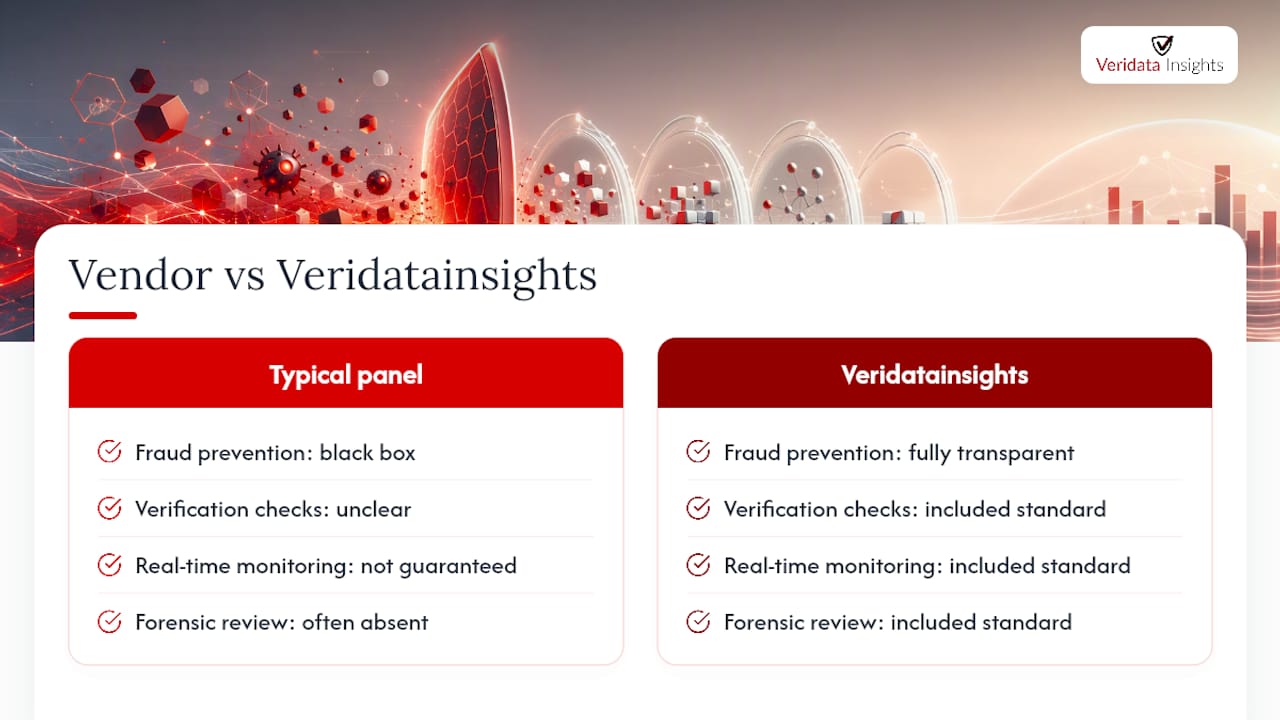
Plenty of panels will sell you sample. Fewer will show you exactly how they keep fraud out of it. Veridatainsights is the alternative to handing your fieldwork to a vendor who treats fraud prevention as a black box. Studies include verification checks, real-time monitoring, and forensic review as standard practice.
This suits research buyers who need full-service support, from questionnaire review through data processing and reporting, without managing multiple vendors. Whether your project is quantitative, qualitative, or involves B2B and healthcare recruitment, scalable support is available without project minimums.
If you want to see what a fraud-audited dataset actually looks like before your next fielding decision, contact our team and ask for a sample adjudication report.
Sources
For deeper technical grounding, the peer-reviewed analysis of 31 fraud detection strategies remains the most rigorous public study on indicator performance. TransUnion’s fraud detection overview and Protecht’s breakdown of modern fraud prevention techniques offer cross-industry context on where rules-based systems, machine learning, and behavioral analytics each fit. For a look at real-time, API-based blocking in practice.
- AI-powered fraud and the erosion of online survey integrity: an analysis of 31 fraud detection strategies
- What is the Most Common Fraud Detection? | TransUnion