

The most reliable KOL recruitment research approach is a tiered, data-driven program led by medical affairs and backed by centralized engagement records that meet Open Payments standards. Start by auditing your existing key opinion leader list against publication and trial data before you spend a dollar on outreach. Firms like Veridata Insights build these programs around verified data rather than guesswork.
TL;DR:
- A tiered, data-driven approach using multiple overlapping sources is essential for identifying influential KOLs accurately and avoiding bias.
- Frontline outreach should be led by medical affairs teams to establish credibility and prevent damage to long-term relationships.
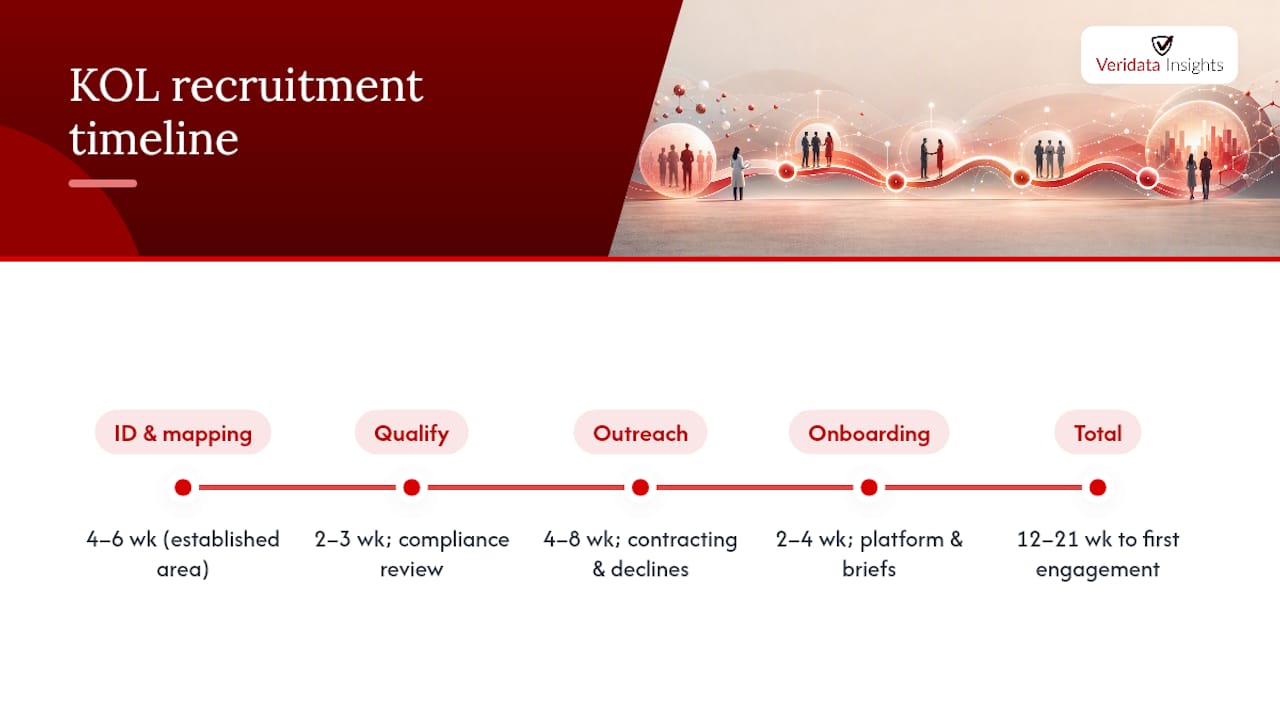
- Most programs require twelve to twenty-one weeks from identification to first engagement due to the complexity of qualification, contracting, and onboarding stages.
- Personalize outreach messages by referencing specific published work and tailor communication channels to KOL profiles to improve response rates.
- Maintaining engagement after recruitment involves regular, meaningful contact and transparent feedback to foster long-term collaboration.
Table of Contents
- What Is a Key Opinion Leader in Clinical Research?
- How Do You Identify and Map the Right KOLs?
- Who Should Lead KOL Recruitment Outreach?
- What Motivates KOLs to Participate?
- How Does a Tiered KOL Engagement Model Work?
- What Belongs in a Compliant KOL Vetting Profile?
- How Veridata Insights Executes KOL Recruitment Programs
- How Long Does a KOL Recruitment Program Actually Take?
- How Do You Personalize Outreach to Different KOL Profiles?
- What Legal and Ethical Frameworks Govern KOL Engagement?
- How Do You Keep KOLs Engaged After Initial Recruitment?
- Which Tools Streamline KOL Recruitment Workflows?
- Get Program-Ready KOL Recruitment Support
- Sources
What Is a Key Opinion Leader in Clinical Research?
A key opinion leader earns that label through demonstrated peer trust, not job title. The practical checklist runs through publication volume in indexed journals, authorship of clinical practice guidelines, and active investigator status on registered trials. Someone who checks two of those three boxes usually moves markets in their therapeutic area.
KOLs perform distinct jobs across the product lifecycle, and confusing those jobs wastes recruitment effort:
- Advisory board members shape clinical development strategy and label positioning before launch.
- Principal investigators run the trials that generate your evidence base.
- Speaker program faculty translate data into peer-to-peer education after approval.
- Research partners co-author publications and extend your scientific credibility into new territories.
A single well-mapped rheumatology KOL who sits on a treatment guideline committee can accelerate site-level trial recruitment simply by mentioning enrollment to colleagues at a regional conference. That kind of informal referral rarely shows up in a CRM, but peer-reviewed research on opinion leaders and behavior change confirms the underlying mechanism: clinicians change practice faster when a trusted peer, not a company rep, delivers the message.
How Do You Identify and Map the Right KOLs?
Reliable identification research runs on multiple overlapping data sources, never one. Relying only on an internal shortlist or a sales team’s favorite contacts introduces bias fast, since reps tend to nominate whoever answers their calls, not necessarily whoever moves prescribing behavior.
- Publication and citation analysis. Pull authorship data from PubMed and Scopus to rank clinicians by output and citation impact in your specific indication.
- Conference rosters. Cross-reference speaker and moderator lists from major congresses against your publication list to catch rising voices who haven’t published yet.
- Trial registries. Search clinicaltrials.gov for principal investigators actively running studies in your therapeutic area.
- Open Payments and claims data. Layer in transparency and prescribing-pattern data to confirm real-world influence, not just academic credentials.
- Field nominations. Ask medical science liaisons for names, but weight these lower than the hard data sources above.
- AI-driven network mapping. Run relationship-mapping software across the combined dataset to surface connections a manual review misses entirely.
Network analysis methods published in clinical research literature show that algorithmic mapping catches second-degree influencers, the quieter clinicians who don’t publish often but whom every prescriber in a hospital system calls before adopting a new protocol. AI-powered mapping tools routinely surface these emerging regional voices and digital opinion leaders that publication-only searches never catch. Combining authorship analysis with conference and trial data rather than relying on a single source is the identification best practice most programs skip, and it’s the one that costs them the most in missed talent.
Pro Tip: Refresh your KOL shortlist every two quarters. A clinician’s influence profile shifts fast once they publish a landmark study or take on a society leadership role, and stale lists lead to outreach that lands on the wrong desk.
Who Should Lead KOL Recruitment Outreach?
Medical affairs or your MSL team should make first contact, always. A commercial rep opening the conversation signals sales pitch before the KOL has heard a single scientific point, and that framing is nearly impossible to walk back. Recruitment led by medical affairs to establish scientific credibility before any commercial discussion is the structural choice that separates programs that retain KOLs from programs that burn through their list every year.
The workflow that converts identification into actual participation runs in five stages:
- Scoping. Define exactly what role you need filled, advisory input, trial leadership, or speaker faculty, before you approach anyone.
- Qualification. Confirm the candidate’s publication record, conflict-of-interest status, and availability match the role.
- Initial scientific exchange. Medical affairs opens with a genuine research conversation, not a project pitch.
- Contracting. Document fair-market-value compensation through a compliance-reviewed contract before any paid engagement begins.
- Onboarding and training. Walk the KOL through platform logistics, deliverable expectations, and timeline before the first working session.
Scheduling logistics matter more than most teams admit. Offering three time-zone-friendly slots instead of one boosts show rates noticeably, and sending a one-page briefing document 48 hours ahead of any advisory session gives KOLs time to prepare substantive input instead of improvising. A practical guide to recruiting healthcare participants covers scheduling tactics that apply directly to KOL logistics, since the audience faces the same time constraints as any busy clinician.
What Motivates KOLs to Participate?
Money is not the primary lever most programs assume it to be. KOL engagement incentives extend well beyond financial compensation: top-tier experts are frequently driven by access to proprietary scientific data, research collaboration opportunities, and a genuine chance to influence patient care guidelines. A KOL who already commands six-figure consulting fees elsewhere isn’t chasing your honorarium. They’re chasing the dataset you can offer or the co-authorship credit on a paper that matters to their career.
That said, financial compensation still needs careful handling. Document fair-market-value rates against benchmarks for the specialty and region, and keep that documentation centralized for audit purposes.
Formats matter as much as motivation:
- Synchronous advisory boards work best for complex strategic input requiring real-time discussion.
- Asynchronous digital panels fit busy clinicians who can’t commit to a scheduled call but will answer a structured survey between patients.
- Investigator-led studies engage KOLs who want ownership of the research question itself.
- Speaker programs suit KOLs motivated by peer education and visibility.
Non-financial motivators, in order of frequency cited by pharma medical affairs teams: professional development access, research collaboration, proprietary data access, and guideline influence, according to the TechTarget analysis of KOL engagement strategies.
How Does a Tiered KOL Engagement Model Work?
A four-tier structure keeps large programs from collapsing into an undifferentiated mass of “important people to call.” [Tiered engagement models built around four tiers](https://www.aissel.com/blog/from-regional-to-global-kols-how-to build-a-tiered-engagement-model-that-scales/) scale programs by matching tactics to actual reach rather than treating every KOL identically.
- Global tier. International society leadership, guideline authorship, high-volume citation counts. Tactic: multi-year advisory relationships, congress co-chairing.
- National tier. Country-level society roles, national trial leadership. Tactic: national advisory boards, speaker bureau leadership.
- Regional tier. Institutional influence across a hospital network or state. Tactic: regional panels, local investigator roles.
- Community tier. Trusted voice within a single practice group or health system. Tactic: asynchronous digital panels, peer-to-peer education pilots.
Track progression between tiers inside one system, not scattered spreadsheets across brand teams. Logging every interaction in a single system produces better succession planning and stops the redundant outreach that frustrates KOLs who get called twice by two different teams within the same company inside a month.
What Belongs in a Compliant KOL Vetting Profile?
Vetting research needs to answer one question before any outreach: can this relationship survive an audit? Pull from PubMed for publication history, clinicaltrials.gov for trial roles, Open Payments for existing industry financial relationships, and claims or affiliation data for institutional ties. Conference rosters round out the picture with visibility signals that don’t show up in databases.
A complete profile captures:
- Publication count and citation impact in the relevant therapeutic area
- Current and past investigator roles on registered trials
- Existing financial relationships disclosed through Open Payments
- Institutional affiliation and any leadership roles in professional societies
- Digital reach across professional platforms and conference speaking history
Centralize every transfer of value and fair-market-value calculation in one auditable system rather than departmental silos. Centralizing engagement data across teams prevents the fragmentation that turns a routine compliance audit into a multi-week scramble.
| Vetting Element | Primary Source | Why It Matters |
|---|---|---|
| Publication record | PubMed / Scopus | Confirms peer-recognized expertise |
| Trial involvement | clinicaltrials.gov | Verifies investigator credibility |
| Financial disclosures | Open Payments | Surfaces existing industry ties |
| Institutional reach | Claims / affiliation data | Maps real-world influence |
| Public visibility | Conference rosters | Flags rising voices early |
How Veridata Insights Executes KOL Recruitment Programs
Veridata Insights runs full-service recruitment for pharmaceutical and healthcare clients with no project minimums, seven days a week. That flexibility matters when a KOL advisory board needs to convene on six weeks’ notice instead of six months.
Services relevant to KOL programs include:
- End-to-end recruitment spanning identification, screening, and scheduling
- Healthcare and hard-to-reach audience expertise built over years of specialized fieldwork
- Questionnaire and discussion guide review alongside the recruitment itself
- Data processing and reporting that turns raw engagement into usable analysis
A recent research recruitment engagement for a business consulting firm illustrates the model: tighter qualification screening produced stronger respondent quality and faster turnaround than the client’s prior in-house process. Clients working with Veridata Insights on KOL-specific programs receive profile sheets, engagement logs, and compliance-ready documentation, exactly the paper trail an Open Payments audit or an internal compliance review will ask for later.
How Long Does a KOL Recruitment Program Actually Take?
Most sponsors underestimate the calendar time a rigorous program requires, and that miscalculation causes more advisory board cancellations than any single other factor. Build your timeline around four milestones rather than a single launch date.
Identification and mapping typically runs four to six weeks for a therapeutic area with an established publication base, longer for rare-disease or emerging-indication programs where the KOL universe is thin and scattered across smaller institutions.
Qualification and internal approval, including compliance review of proposed KOLs and conflict-of-interest checks, adds another two to three weeks. This stage gets rushed constantly, and rushing it is exactly how a program ends up contracting a KOL with an undisclosed competing relationship.
Outreach and contracting stretches four to eight weeks depending on how many KOLs decline or require contract negotiation. Global-tier experts often have standing consulting agreements elsewhere that need legal review before they can sign anything new.
Onboarding through first engagement adds another two to four weeks once contracts are signed, covering platform access, briefing materials, and scheduling around a therapeutic area’s conference calendar.
Stack those stages together and a realistic KOL program timeline runs twelve to twenty-one weeks from first identification search to first live engagement. Programs that compress this into six weeks almost always skip the qualification step, and that shortcut shows up later as compliance rework or a KOL who disengages after one session because nobody explained the commitment upfront.
How Do You Personalize Outreach to Different KOL Profiles?
Generic outreach templates get ignored by exactly the clinicians you most want to recruit. A KOL who has published forty papers on a topic doesn’t respond to the same message that works on a community-tier physician who has never been approached by industry before.
Reference the KOL’s specific published work in your first message rather than a general description of your therapeutic area. Naming their 2023 paper on a specific endpoint signals you did homework, not a mass email. For global-tier experts already fielding multiple industry requests, lead with the scientific question you’re trying to answer and let the compensation and logistics follow in a second conversation.
Community-tier and first-time KOLs need a different opening. They often don’t know what an advisory board involves procedurally, so the first message should explain the time commitment, the format, and what happens with their input in plain terms. Skipping that explanation is the single most common reason first-time KOLs decline outreach they’d otherwise accept.
Digital opinion leaders who built influence through platforms rather than traditional publication need outreach that acknowledges that path directly instead of treating them as a lesser category of expert. A guide to leveraging influencers for organic growth outlines assessment approaches for digital influence that translate well into evaluating a clinician’s online reach before you draft that first message.
Match channel to profile too. Email works for academic KOLs checking inboxes between clinic hours; a scheduled call works better for community physicians who rarely check email during the workday.
What Legal and Ethical Frameworks Govern KOL Engagement?
Compliance with Open Payments reporting is the baseline, not the ceiling. Beyond the Physician Payments Sunshine Act, programs need to manage conflicts of interest that extend past simple financial disclosure.
A KOL advising your program while under contract with a direct competitor creates a conflict even if every payment gets reported correctly. Screening for competing engagements should happen during qualification, not after a contract is signed. Similarly, transparency obligations extend to how KOL input gets used. If an advisory board’s feedback shapes a promotional claim, most regulatory frameworks expect that influence to be disclosed rather than presented as independent physician consensus.
Institutional review requirements add another layer when KOL engagement touches active clinical trials. A principal investigator serving simultaneously as a paid speaker for the same product raises questions that most institutional compliance offices will flag during contract review, so building that check into your own qualification process saves a rejected contract weeks later.
How Do You Keep KOLs Engaged After Initial Recruitment?
Recruitment is the easy part compared to retention. A KOL who does one advisory session and never hears from your team again is a KOL who takes a call from your competitor next quarter.
Build a cadence of low-effort touchpoints between formal engagements, a relevant publication shared with a short note, an invitation to a smaller working group, congress meetup coordination when your paths cross naturally. These touches cost little and keep the relationship warm without demanding another paid engagement.
Give KOLs visibility into how their input got used. Sharing a summary of how an advisory board’s recommendations shaped a protocol decision, even a brief one, tells the KOL their time mattered. Skip this step consistently and KOLs start declining future invitations, sensing correctly that their input disappears into a black box.

Succession planning matters for long-term programs. Track which regional-tier KOLs are building the publication record and society roles that could move them into the national tier, and start deepening that relationship before a competitor notices the same trajectory. Tiered programs that log every interaction in one system make this progression visible instead of guessed at.
Which Tools Streamline KOL Recruitment Workflows?
Spreadsheets manage a shortlist of twenty KOLs adequately. They collapse entirely once a program tracks two hundred experts across four tiers and multiple therapeutic areas.
A centralized CRM built for KOL management should track engagement history, compliance documentation, tier status, and communication preferences in one record per KOL, accessible to medical affairs, compliance, and any recruitment partner working the program simultaneously. Without that central system, the same KOL gets approached by two brand teams in the same quarter, an avoidable friction that damages trust fast.
Digital-first engagement platforms that support asynchronous, audit-ready contribution formats increase response rates among clinicians who can’t commit to scheduled calls but will complete a structured input session on their own time. That flexibility matters most for community and regional-tier KOLs juggling full clinical schedules.
Whatever platform you choose, the non-negotiable feature is a single source of truth for every interaction, contract, and payment record tied to a KOL. When an Open Payments audit or an internal compliance review asks for a KOL’s full engagement history, pulling it from one system in an afternoon beats reconstructing it from five people’s inboxes over two weeks.
Get Program-Ready KOL Recruitment Support
A tiered, medical-affairs-led approach only works if the underlying identification and screening data is accurate, and that’s the part most internal teams struggle to scale without adding headcount. Veridata Insights handles the recruitment execution end to end, from mapping candidates against publication and trial data to managing scheduling logistics that keep show rates high, without requiring you to hit a project minimum first.
Reach out through the Veridata Insights contact page to set up an initial consult. That first conversation covers program scope, a realistic timeline based on your therapeutic area, and sample deliverables so you know exactly what a profile sheet and engagement log look like before you commit. Teams researching B2B, healthcare, and hard-to-reach recruitment expertise will find the same qualification rigor applied to specialized KOL populations that Veridata Insights brings to any hard-to-reach audience. Size isn’t what determines whether a recruitment partner delivers quality data. Scrappy-Doo proved that to us a long time ago, and it’s held up in every project since.