


TL;DR:
- Business to business market segmentation divides target markets into decision-relevant groups to optimize marketing and sales efforts. Segmenting by firmographics, technographics, intent, personas, and buying stages helps tailor messaging and drive targeted actions effectively. Proper segmentation must be measurable, operationalized in tools like CRM, and validated through primary research to ensure decision-making value.
Business to business market segmentation is the process of dividing your addressable market into distinct, decision-relevant groups, using lenses like firmographics, technographics, intent/behavioral signals, needs-based personas, and buying-journey stage, so marketing and sales can target the right accounts with the right motions.
The lens you pick should follow your GTM goal:
- TAM sizing and territory planning: firmographics (industry, revenue band, employee count, geography)
- Account prioritization and outbound activation: intent/behavioral signals layered over firmographic filters
- Pricing tier design and packaging: value-based or needs-based segmentation
- Product roadmap decisions: needs-based personas combined with product usage telemetry
- Retention and expansion plays: buying-journey stage combined with behavioral engagement data
- Sales motion design (enterprise vs. self-serve): firmographics plus technographics
One rule applies across all of them: a segment is only useful if it tells someone what to do next. If your segmentation output cannot drive a clear marketing message, a sales routing decision, a pricing change, or a product priority, it is labeling, not strategy.
Table of Contents
- Why does B2B segmentation improve marketing and sales outcomes?
- What are the core B2B segmentation methods?
- What data sources do you need to build reliable B2B segments?
- How do you design, validate, and operationalize B2B segments?
- How do you measure whether your segmentation strategy is working?
- What are the most common B2B segmentation mistakes?
- Which tools and analytic approaches actually work for B2B segmentation?
- When should you commission custom segmentation research?
- Key Takeaways
- Veridata Insights brings your segmentation research to life
- Further reading and authoritative sources
Why does B2B segmentation improve marketing and sales outcomes?
Segmentation works because it replaces generic outreach with conversations that match what a specific type of buyer actually needs. Market segmentation transforms a generic message into tailored conversations, improving conversion rates and reducing wasted spend. That efficiency gain shows up across the funnel: higher response rates on outbound, shorter sales cycles, better win rates, and lower customer acquisition costs.
The GTM clarity it creates is just as valuable. Once you know which accounts fit an enterprise motion and which should be self-serve, your SDR team stops burning time on accounts that will never close at enterprise deal sizes. Your content team stops writing for everyone and starts writing for someone. Pricing becomes defensible because it reflects the actual value delivered to a specific segment, not a compromise across all of them.
A few business situations make segmentation projects especially urgent:
- Uneven pipeline performance across industries or company sizes with no clear explanation
- Mixed customer behavior where high-revenue accounts churn at the same rate as low-revenue ones
- Pricing pressure that suggests customers do not perceive differentiated value
- Sales cycles that vary wildly with no pattern your team can act on
B2B audience research consistently shows that firms who invest in structured segmentation allocate resources more precisely and identify opportunity areas where competitors are absent, which shifts the conversation from price to differentiated value.
What are the core B2B segmentation methods?
The five practical lenses for B2B segmentation each answer a different business question. Here is how they compare:
| Method | Best business question answered | Measurement difficulty | Key limitation |
|---|---|---|---|
| Firmographics | Who is in my addressable market? | Low | Describes accounts; does not predict behavior |
| Technographics | Which accounts use complementary or competing tech? | Medium | Data can go stale quickly |
| Intent/behavioral | Which accounts are actively researching a solution? | Medium | Signal noise; requires validation |
| Needs-based/personas | What problem is each segment trying to solve? | High | Requires primary research |
| Buying-journey stage | Where is the account in the purchase process? | Medium | Requires CRM discipline to maintain |
Firmographics are the starting point for almost every B2B segmentation project. Industry, company size (revenue and headcount), geography, legal structure, and performance metrics are all firmographic variables. They are easy to source, easy to filter in a CRM, and universally understood across sales and marketing. The limitation is that two companies with identical firmographic profiles can have completely different needs, budgets, and buying behaviors.

Technographics tell you what software and hardware a prospect already runs. A cybersecurity vendor, for example, can filter for accounts running a specific cloud infrastructure stack and prioritize those where their product integrates natively. Technographic data ages fast, so freshness matters more here than with firmographics.
Intent and behavioral signals identify accounts that are actively researching topics related to your solution, whether through content consumption, web visits, review-site activity, or product usage patterns. Layered over firmographic filters, intent data is one of the most powerful tools for account prioritization. The catch: intent signals are noisy, and a single data point rarely justifies a sales motion on its own.
Needs-based segmentation clusters accounts by the outcome they are trying to achieve, not by what they look like. This is the most predictive lens for messaging and product design, but it requires primary qualitative interviews to surface reliably. You cannot infer needs from a CRM export.
Buying-journey stage tracks where an account sits in the purchase process: unaware, evaluating, in active consideration, or post-purchase. It drives content sequencing and sales handoff timing. It only works if your CRM is consistently updated and your team agrees on stage definitions.
Hybrid approaches are where the real leverage lives. Firmographic filters narrow the universe; intent signals prioritize within it; needs-based research shapes the message. A SaaS company targeting mid-market manufacturers might filter by revenue ($50M–$500M) and industry (discrete manufacturing), then layer in intent signals for ERP evaluation, then use qualitative interviews to understand whether the dominant need is compliance, throughput, or cost reduction. Each layer adds decision value.
Pro Tip: Any segmentation framework must satisfy MECE: mutually exclusive, collectively exhaustive, and measurable with data you actually have. If two segments overlap, or if you cannot attach a metric to a segment definition, the framework will break your market sizing and confuse your sales team.
What data sources do you need to build reliable B2B segments?
Good segments are only as good as the data behind them. Here is the core signal map:
- CRM data: account status, deal history, stage progression, and revenue by account. The richest internal source, but only as clean as your team’s data hygiene.
- Product telemetry: feature usage, login frequency, and workflow depth. Indispensable for usage-based or journey-stage segmentation; irrelevant if you sell a non-digital product.
- Web analytics: page visits, content downloads, and session depth by company (requires IP-to-company resolution tools like Clearbit or 6sense).
- Third-party intent feeds: aggregated research signals from publishers and review sites. Useful for identifying in-market accounts outside your existing database.
- Technographic data providers: tools like Bombora or BuiltWith surface the tech stack of target accounts.
- Primary research: surveys and customized B2B interviews are the only reliable way to identify needs-based segments and map the buying committee.
A quick data quality checklist before you build:
- Freshness: Is the data less than 12 months old for firmographics, less than 90 days for intent signals?
- Coverage: Does the data cover at least 70% of your target account list, or will gaps skew the segments?
- Match keys: Can you join third-party data to your CRM by domain, DUNS number, or another reliable identifier?
- Bias risks: Does your CRM over-represent existing customers and under-represent the broader market?
Combining primary and secondary data is almost always necessary for a complete picture. Secondary sources (intent feeds, technographic providers, enrichment services) give you breadth. Primary research (interviews, surveys) gives you depth on motivations and needs that no database captures.
Pro Tip: Before trusting an intent signal at scale, run a sample audit. Pull 20–30 accounts flagged as “high intent” and have a sales rep do a quick outreach pass. If fewer than half show any genuine buying activity, your signal threshold is too low. Adjust the confidence band before routing the full list.
How do you design, validate, and operationalize B2B segments?
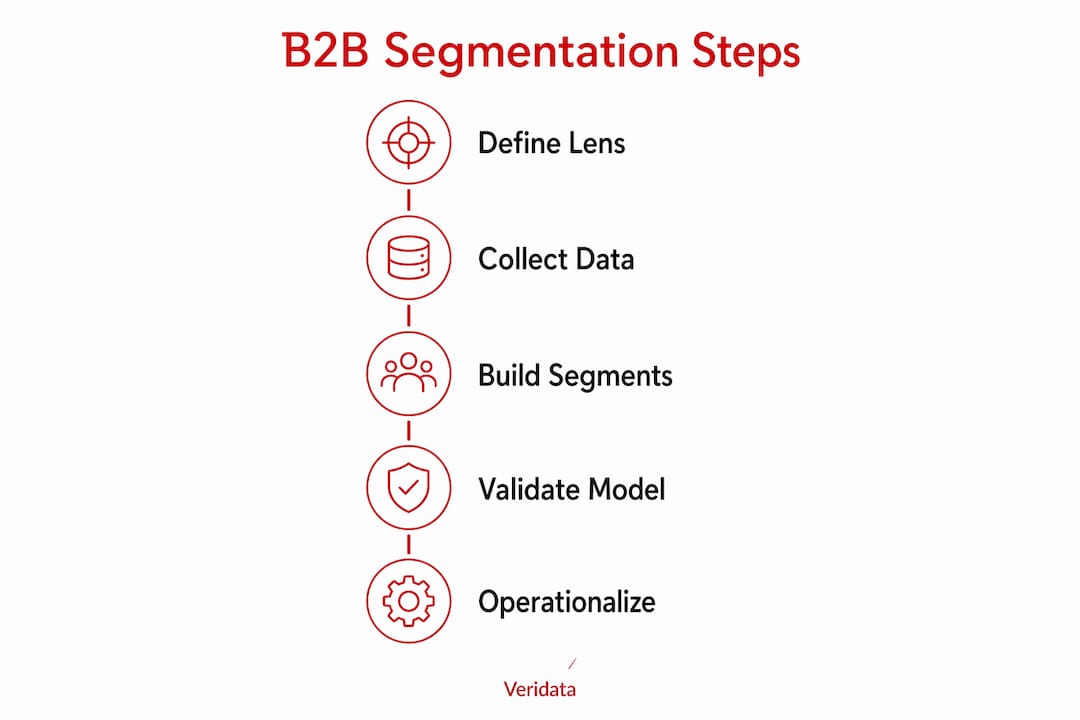
Here is a practical sequence from kickoff to activation, with honest notes on timing and cost:
- Define the decision (Week 1). Name the specific business decision this segmentation will drive: pricing tier design, SDR territory allocation, product roadmap prioritization, or something else. A segmentation project without a named decision owner rarely gets operationalized.
- Choose your lenses (Week 1–2). Select the segmentation methods that match your data availability and decision context. Start with firmographics as the base layer, then add one or two additional lenses. Resist the urge to use all five at once.
- Audit and collect data (Weeks 2–4). Pull CRM exports, enrich with a third-party provider, and scope primary research if needs-based or journey-stage segmentation is on the plan. Data enrichment is typically the first significant cost driver; budget accordingly.
- Build segment definitions (Weeks 3–5). Draft segment hypotheses using your chosen lenses. Apply the MECE test: do the segments cover the full market without overlap? Can you measure each one with available data?
- Validate with qualitative research (Weeks 4–7). Run 5–10 interviews per hypothesized segment with actual buyers or current customers. This is where needs-based assumptions get confirmed or corrected. B2B buying decisions involve multiple stakeholders, so recruit across roles: economic buyers, technical evaluators, and operational users.
- Pilot activation (Weeks 6–10). Select one segment and run a targeted campaign or sales motion against it. Measure conversion lift, response rate, and deal velocity against a control group. Keep the pilot narrow enough to be fast, broad enough to be statistically meaningful.
- Full roll-out and operationalization (Weeks 10–16). Embed segment membership in your CRM as a field. Build lead routing rules, content templates, and sales playbooks by segment. Create a reporting dashboard that tracks KPIs by segment on a recurring cadence.
Operationalization checklist before you declare the project done:
- Segment field added to CRM with clear definitions and ownership
- Lead routing rules updated to reflect segment-based assignments
- At least one content asset or sales sequence built per segment
- A named segment owner responsible for monitoring performance
- A review cadence set (quarterly is typical for most B2B markets)
B2B research best practices consistently point to the same failure mode: teams complete the analysis but never embed segments in the tools their sales and marketing teams actually use. The segmentation then lives in a slide deck and nowhere else.
How do you measure whether your segmentation strategy is working?
The right KPIs depend on what decision the segmentation was built to drive. These are the metrics worth tracking:
- Conversion rate by segment: Are targeted segments converting at a higher rate than the unsegmented baseline?
- Average deal size: Do segment-specific plays produce larger deals than generic outreach?
- Win rate: Are you winning more competitive deals in priority segments?
- Sales cycle length: Is the cycle shorter when reps use segment-specific playbooks?
- Net revenue retention: Are customers in well-defined segments expanding at higher rates?
- Customer acquisition cost (CAC): Is CAC lower for segments where messaging and routing are tightly aligned?
For a pilot experiment, the design matters as much as the metrics. Select a treatment group (accounts in the target segment receiving the new motion) and a control group (similar accounts receiving the standard approach). Run the pilot for at least one full sales cycle, typically 60–90 days for mid-market B2B. Define your minimum detectable effect before you start: if a 10% lift in conversion rate would not justify the investment, you need a larger effect or a different segment.
The most common error in segmentation measurement is evaluating results too early. A pilot that runs for three weeks in a 90-day sales cycle tells you almost nothing about win rates or deal size. Set the measurement window to match the actual buying cycle of the segment, and resist pressure to call the experiment before it has run its course.
Report segment performance monthly during the pilot, then quarterly once the segmentation is fully embedded. A simple dashboard showing conversion rate, win rate, and deal size by segment, compared to the pre-segmentation baseline, is usually enough to make the business case for continued investment.
What are the most common B2B segmentation mistakes?
Most segmentation projects fail not in the analysis phase but in the design and operationalization phases. Here are the pitfalls worth watching for:
- Over-segmentation. Creating too many narrow segments increases cost-to-serve and can turn an attractive revenue opportunity into an unprofitable one. Start broader and refine iteratively. Three to five well-defined segments almost always outperform twelve micro-segments.
- Non-MECE cuts. Segments that overlap or leave gaps in the market break your TAM model and confuse sales routing. Every account should belong to exactly one primary segment.
- Single-signal reliance. Building segments on firmographics alone misses behavioral and needs-based differences that drive actual buying decisions. One lens is a starting point, not a finished framework.
- Ignoring the buying committee. B2B purchases involve multiple stakeholders with different roles and priorities. A segment defined only around the economic buyer will produce messaging that alienates the technical evaluator who controls the shortlist.
- Failing to operationalize. The most common and most damaging mistake. Segments that exist only in a research report never change a sales motion or a marketing campaign. If the segment is not in the CRM, it does not exist.
- Skipping validation. Hypothesis-driven segments built from CRM data alone reflect your existing customer base, not the full market. Qualitative interviews catch the assumptions that data cannot.
A red flag that your segmentation is cosmetic rather than decision-useful: if you ask a sales rep which segment an account belongs to and they cannot answer without looking it up, the segmentation has not been operationalized.
Which tools and analytic approaches actually work for B2B segmentation?
The tooling landscape breaks into five categories, and the right combination depends on your data maturity and budget:
CRM and customer data platforms (CDPs) are the operational backbone. Salesforce, HubSpot, and similar platforms store account data and, once segments are embedded, route leads and trigger workflows. A CDP adds the ability to unify data from multiple sources into a single account profile.
Intent and technographic providers surface in-market signals and tech-stack data. These feeds are most useful for activation-stage segmentation, where you need to prioritize which accounts to contact this week.
Enrichment and matching services append firmographic and contact data to your existing account list, filling gaps that your CRM cannot cover from internal data alone.
Analytics and BI platforms (Tableau, Looker, Power BI) handle segment performance reporting. For more advanced work, Python or R-based clustering algorithms can surface non-obvious groupings in large datasets.
Survey and research tools are the right instrument for needs-based and persona segmentation. Online survey platforms handle quantitative work; for qualitative recruitment targeting specific buying roles, a full-service research partner is usually faster and more reliable than DIY outreach.
On the analytic side, the choice between rule-based segmentation and machine learning clustering comes down to data volume and interpretability requirements. Rule-based approaches (e.g., revenue over $10M AND industry = manufacturing AND intent score over 70) are fast to build, easy to explain to a sales team, and sufficient for most mid-market B2B use cases. AI and analytics can surface non-obvious clusters in large unstructured datasets, but they require human validation to confirm that the clusters are decision-relevant, not just statistically distinct.
Pro Tip: Whatever tooling you use, the segment membership field needs to live in your CRM and update automatically. A segment that requires a manual quarterly export to stay current will be out of date within weeks. Build the refresh logic into the data pipeline from day one.
Integration is where most tooling investments pay off or fall apart. Feeding segment membership into your marketing automation platform enables personalized nurture sequences. Feeding it into your sales engagement tool enables segment-specific call scripts and email cadences. Feeding it into your BI dashboard enables the performance tracking that justifies the next round of segmentation investment.

When should you commission custom segmentation research?
Some segmentation projects are genuinely DIY-friendly. If your segments are firmographic, your CRM is clean, and your team has the bandwidth to run the analysis, you probably do not need outside help. But several situations call for a research partner:
- Your target segments include hard-to-reach buying roles (C-suite, procurement committees, niche technical specialists) that your team cannot recruit reliably
- You need needs-based or persona segmentation and lack the qualitative research capability in-house
- Your existing customer data is too thin or too biased to represent the full market
- You need a mixed-methods approach (quantitative survey plus qualitative interviews) with statistical validation
- The segmentation output will drive a major strategic decision (pricing restructure, market entry, product pivot) where the cost of a wrong answer is high
The firms that get the most from segmentation research are the ones who treat it as a decision-support tool, not a reporting exercise. Every research question should map to a specific business decision. If you cannot name the decision a question will inform, cut the question.
Veridata Insights runs B2B segmentation projects end-to-end, from research design and questionnaire review through recruitment, data collection, analysis, and activation support. The methodology is mixed-methods by default: quantitative surveys establish segment size and statistical confidence; qualitative interviews validate the needs and motivations behind each segment. Recruitment for hard-to-reach B2B audiences, including procurement leads, technical evaluators, and C-suite buyers, is a core capability.
A typical engagement includes a scoping call to align on the decision the research will drive, a project plan with phased deliverables, segment definitions with supporting data, and a reporting package that sales and marketing teams can act on immediately. Projects are scoped per engagement with no minimums, which means you can commission a focused pilot study or a full market segmentation program depending on where you are in the process.
For teams exploring B2B market trends and trying to determine whether their current segments still reflect the market, a lighter-touch validation study is often the right starting point before committing to a full redesign.
Key Takeaways
Effective B2B segmentation requires choosing the right lens for your GTM decision, validating hypotheses with primary research, and embedding segments in the tools your teams use daily.
| Point | Details |
|---|---|
| Match the lens to the decision | Firmographics size the market; intent signals prioritize it; needs-based research shapes the message. |
| MECE is non-negotiable | Segments must be mutually exclusive, collectively exhaustive, and measurable with available data. |
| Operationalize or it does not count | Segment membership must live in your CRM with routing rules, playbooks, and a named owner. |
| Pilot before full roll-out | Run a 60–90 day pilot against a control group before scaling any new segment strategy. |
| Veridata Insights for complex projects | When segments involve hard-to-reach buyers or major strategic decisions, Veridata Insights provides full-service research from design through activation. |
Veridata Insights brings your segmentation research to life
Segmentation analysis is only as good as the data and research behind it. Veridata Insights specializes in exactly the work that makes B2B segments reliable: recruiting hard-to-reach business audiences, running mixed-methods studies that combine quantitative surveys with qualitative depth interviews, and delivering outputs that sales and marketing teams can use on day one. No project minimums, no rigid retainers, and no waiting until Monday. We work seven days a week, 365 days a year, on projects of any scope. Whether you need a focused pilot study to validate three segment hypotheses or a full market segmentation program to redesign your GTM strategy, we scope the work to fit the decision. Start your segmentation project with a scoping call and get a project plan built around your specific business question.
Further reading and authoritative sources
- 5.2 Segmentation of B2B Markets, OpenStax Principles of Marketing — Academic foundation covering firmographic, technographic, needs-based, value-based, and behavioral segmentation with clear B2B context.
- Chapter 11: Business-to-Business Market Segmentation, Handbook of Business-to-Business Marketing (Elgar) — Peer-reviewed literature review on B2B segmentation methodology and implementation challenges.
- B2B Market Segmentation research, 2022–2025 (University of Southern Denmark) — Academic research on iterative segmentation as a continuous strategic process.
- Market Segmentation Guide, EquiBrand Consulting — Practitioner guide emphasizing needs-based segmentation and qualitative research requirements.
- Segmentation Framework in Business Analysis, Road to Offer — Practical guide to MECE segmentation design with metric attachment guidance.
- B2B Market Research: Methods, Process, and Strategies, Sprinklr — Overview of mixed-methods B2B research and buying committee mapping.
- Market Segmentation Procedure: A Step-by-Step Guide, Veridata Insights — Procedural walkthrough for segmentation projects aligned with Veridata Insights’ methodology.
- Using B2B Research to Bring a New Product to Market, Veridata Insights — Applied segmentation for product launch decisions with practical examples.
- B2B Customer data segmentation guide, Vesecon — Practical steps for B2B customer data segmentation from a European data and segmentation consultancy.