


TL;DR:
- Automotive market research systematically analyzes industry data to guide strategic decisions amid a stable global sales outlook. It emphasizes segmentation, margin trends, and emerging technologies like AI and electrification to identify market shifts and regional variations. Effective insights rely on blending diverse data sources, triangulation, and clear decision-focused approaches, especially in a challenging 2026 landscape.
Automotive market research is the systematic process of collecting and analyzing industry data to understand consumer preferences, competitive dynamics, and emerging trends in the vehicle sector. For professionals navigating a market where global light vehicle sales are projected to hold steady at approximately 91.8 million units in 2026, getting your research right is not optional. Mature markets face flat growth through 2030, electrification is reshaping demand, and AI is rewriting how dealers and OEMs operate. The professionals who act on precise, well-structured research will separate themselves from those still reacting to last quarter’s numbers.
What are the key components of automotive market research?
Automotive market research, known in industry practice as automotive market intelligence, covers four core activities: market sizing, segmentation, data collection, and analytical modeling. Each one feeds the next. You cannot build a credible forecast without first knowing how the market breaks down.

Market sizing and segmentation divide the total addressable market by vehicle type (passenger car, light truck, commercial), powertrain (ICE, HEV, BEV, PHEV), geography, and consumer demographics. Segmentation reveals where demand actually lives, not where executives assume it does. A North American fleet buyer and a European urban consumer have almost nothing in common, and treating them as one segment produces bad strategy.
Data sources split into two categories:
- Primary research: Consumer surveys, focus groups, dealer interviews, and ethnographic studies that capture attitudes and purchase intent directly from the source
- Secondary research: Published sales data, syndicated industry reports, regulatory filings, and patent or IP mapping that reveal competitive positioning and technology investment bets
- Proprietary blends: Internal transaction data, warranty claims, and CRM records that no syndicated report can replicate
Data triangulation blends economics, cost benchmarking, industry trends, and patent analysis to uncover market realities that standard reports miss. This approach is the difference between confirming what you already suspect and finding the insight your competitors have not spotted yet.
Pro Tip: Run patent and IP mapping alongside your standard competitive analysis. Where OEMs and suppliers are filing patents tells you where they plan to compete in three to five years, not just where they compete today.
Analytical frameworks in this sector include quantitative demand modeling, qualitative trend identification, and disruption risk analysis. The strongest research programs blend all three rather than defaulting to spreadsheet models alone.
How is the 2026 automotive market shaping research priorities?
The 2026 market context is the single biggest driver of what research programs need to prioritize right now. Flat unit sales in mature markets do not mean flat complexity. They mean compressed margins, intensified competition, and a much higher cost of being wrong.
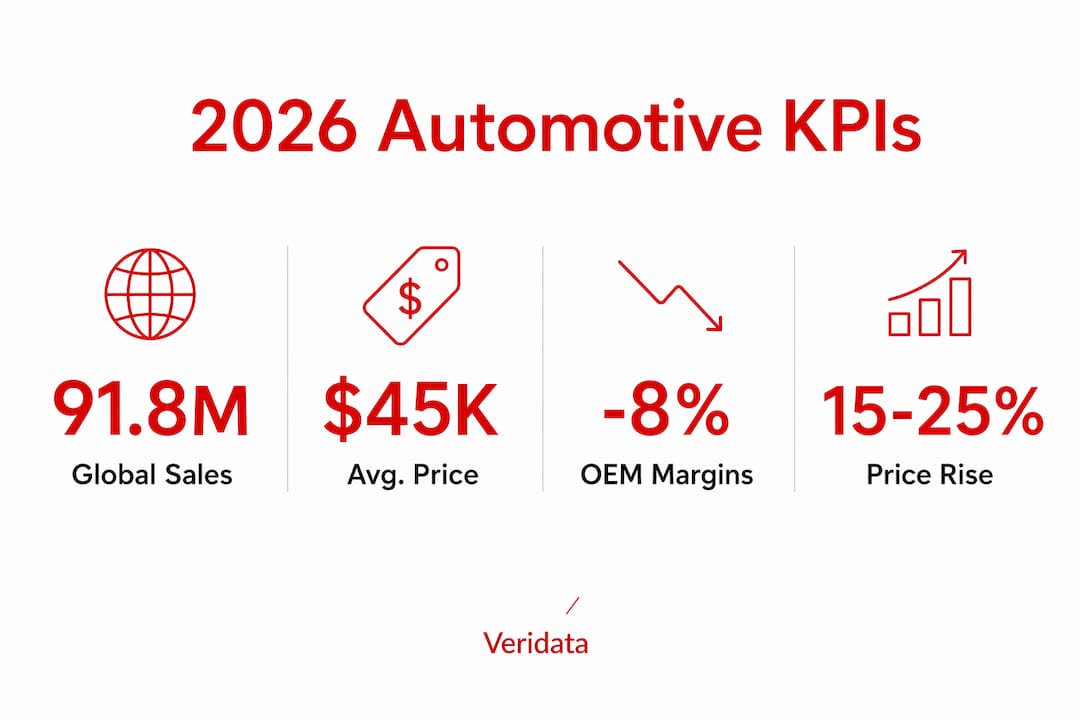
New vehicle prices in the US and Europe have risen 15–25% since 2020. The average transaction price now exceeds $45,000, and monthly ownership costs have crossed $1,000. Those numbers price out a meaningful share of the traditional buyer pool and force OEMs to rethink who their customer actually is.
| Market Indicator | 2026 Status |
|---|---|
| Global light vehicle sales | ~91.8 million units, flat vs. prior year |
| Electrified vehicle sales (BEV, PHEV, HEV) | Projected at 30 million units |
| Average US transaction price | Exceeds $45,000 |
| OEM EBITDA margin (Q3 2025) | Below 8%, down from ~11% in Q3 2024 |
| Supplier distress rate | 24% in 2025, improved from 31% in 2024 |
OEM EBITDA margins dropped from nearly 11% in Q3 2024 to below 8% in Q3 2025. That compression reflects stagnant volumes hitting fixed cost structures hard. Research programs that ignore margin dynamics and focus only on unit sales will miss the real story.
On the electrification side, global electrified vehicle sales are projected to reach 30 million units in 2026. HEVs are leading that growth while BEV adoption slows in several regions due to tariffs and model delays. China’s lower-cost EV ecosystem continues to gain export momentum, creating a pricing reference point that Western OEMs cannot ignore.
“Navigating stagnation in mature markets requires research that incorporates regionalization of vehicle architectures and supply chains. A single global model no longer reflects how the market actually works.”
Regional variation is now a research requirement, not a nice-to-have. What sells in Shanghai, what sells in Stuttgart, and what sells in suburban Texas are three different answers to the same question.
What emerging technologies should automotive research programs track?
The shift from internal combustion engine vehicles to software-defined vehicles (SDVs) and AI-defined vehicles (AI-DVs) is the most consequential structural change in the industry since the assembly line. Research programs that treat this as a future concern are already behind.
Powertrain and electronics lead M&A activity in the supplier ecosystem right now. That tells you where the industry is placing its bets. Semiconductor shortages and geopolitical tensions continue to create supply chain volatility that feeds directly into pricing and availability research.
Key technology areas every research program should be tracking:
- Software-defined vehicles: Revenue increasingly comes from software updates and subscriptions, not just hardware sales. Research needs to capture willingness to pay for over-the-air features.
- AI-defined vehicles: Autonomous capability levels and consumer trust in AI driving systems require dedicated attitudinal research, not just adoption rate tracking.
- Battery economics: Cell chemistry shifts, raw material costs, and second-life battery markets all affect EV total cost of ownership calculations.
- Semiconductor supply: Chip availability continues to constrain production planning. Research that maps supplier concentration risk adds direct operational value.
The triple conundrum facing automotive companies combines stagnating Western demand, regionalization of supply chains, and electrification cost resets. Most firms are underprepared for diversification into adjacent sectors like battery energy storage. Research that maps those adjacencies gives strategy teams a concrete starting point.
Pro Tip: Build technology adoption curves into your forecasting models. Consumer acceptance of AI driving features follows an S-curve, and the inflection point varies significantly by region and demographic. Missing that curve means missing the timing of your product window.
AI-powered software and digital transformation are now the primary tools for automotive companies moving from crisis management to growth. Research programs that incorporate AI-driven analytics produce faster, more accurate forecasts than those relying on manual data aggregation.
How can professionals apply research insights to strategic decisions?
Good research data is only valuable when it connects to a specific decision. The professionals who get the most out of automotive consumer insights are the ones who map each research output to a concrete business question before the study even begins.
- Product portfolio decisions: Use segmentation data to identify demand pockets by powertrain, price tier, and geography. A research program that shows HEV demand growing fastest among suburban buyers over 45 gives product teams a clear brief.
- Pricing strategy: Average transaction price data and monthly ownership cost research reveal the ceiling for new model launches. Pricing above consumer tolerance in a margin-compressed market is a recoverable mistake, but only if you catch it before launch.
- Market entry and exit: Regional variation data tells you where to invest and where to pull back. China’s export-driven EV pricing creates competitive pressure in Southeast Asia and Europe that requires dedicated regional analysis.
- Competitive intelligence: Patent mapping and M&A tracking reveal competitor technology bets before products reach market. This is where vehicle sales research intersects with forward-looking strategy.
- Diversification assessment: Research into battery energy storage, automation, and mobility services helps leadership teams evaluate adjacencies with real market data rather than internal assumptions.
The automotive industry’s shift from crisis survival to targeted offense using AI and digital tools defines the 2026 competitive environment. Research programs that incorporate AI-powered analytics into their forecasting workflows produce outputs that are faster and more granular than traditional methods allow.
Balancing margin preservation with innovation investment is the hardest call in the industry right now. Research cannot make that call for you, but it can tell you the cost of getting it wrong in each direction.
Key Takeaways
Effective automotive market intelligence requires blending primary consumer research, secondary sales data, and technology trend analysis to produce decisions that hold up under real market pressure.
| Point | Details |
|---|---|
| Segment before you size | Divide the market by powertrain, geography, and demographics before building any forecast. |
| Track margin, not just volume | OEM EBITDA below 8% in 2025 means unit sales data alone misses the financial reality. |
| Electrification is not one trend | HEVs are growing while BEV adoption slows; research must separate these trajectories. |
| Technology mapping is competitive intelligence | Patent and M&A tracking reveals where competitors are investing before products launch. |
| Connect research to a decision | Every study should map to a specific business question before fieldwork begins. |
The uncomfortable truth about automotive research in 2026
Working closely with automotive research programs over the years, I have noticed one consistent failure mode: teams collect the right data and then ask the wrong question. They measure unit sales when they should be measuring margin per segment. They track EV adoption rates globally when the real story is the regional divergence between HEV growth and BEV slowdown.
The 2026 market is genuinely hard. Flat volumes, compressed margins, and technology disruption arriving simultaneously would challenge any research program. But the professionals I respect most are not the ones with the biggest data budgets. They are the ones who know how to triangulate. They blend a consumer survey with a patent filing analysis and a regional pricing study, and they come out the other side with a claim their leadership team can actually act on.
The rise of AI-defined vehicles is the area I find most underresearched right now. Consumer trust in autonomous systems varies enormously by age, geography, and prior experience with driver assistance features. Most research programs are tracking adoption intent without measuring the trust gap that precedes it. That gap is where the real product and communication strategy lives.
My practical advice: run your next research program with a defined decision at the end of it. Not “we want to understand the EV market.” Instead, “we need to decide whether to accelerate our HEV lineup or hold investment until BEV costs normalize.” That specificity changes everything about how you design the study and how useful the output actually is.
Veridata Insights brings depth to automotive industry analysis
Veridata Insights works with automotive professionals who need research that goes beyond standard syndicated reports. Whether you need custom automotive research built around 2026 market realities, consumer segmentation studies for new model launches, or qualitative research with hard-to-reach buyer groups, Veridata Insights delivers full-service execution with no project minimums. From questionnaire design through data visualization, the team handles every step. If your current research program is not connecting to the decisions your leadership team actually needs to make, reach out to Veridata Insights and let’s build something that does.
FAQ
What is automotive market research?
Automotive market research is the systematic collection and analysis of data on vehicle sales, consumer preferences, competitive dynamics, and technology trends to support strategic decisions in the automotive sector.
How do I conduct automotive market research effectively?
Effective automotive market research combines primary methods like consumer surveys and dealer interviews with secondary sources like sales data and patent mapping, then applies data triangulation to surface insights that standard reports miss.
What are the biggest car market trends to track in 2026?
The three most significant trends in 2026 are flat unit sales in mature markets, HEV growth outpacing BEV adoption, and the shift from traditional vehicles to software-defined and AI-defined vehicle architectures.
Why are OEM profit margins declining despite stable sales volumes?
OEM EBITDA margins fell below 8% in Q3 2025 because elevated input costs and sticky labor expenses hit fixed cost structures hard even when unit volumes hold steady.
How does AI fit into automotive consumer insights programs?
AI-powered analytics improve forecasting accuracy and dealer productivity, and AI-defined vehicle research requires dedicated attitudinal studies to measure consumer trust in autonomous systems, not just purchase intent.