


TL;DR:
- A market assessment evaluates market size, demand, competition, and industry trends to inform strategic decisions. It combines data from multiple sources into clear, forward-looking business implications, focusing on decision-specific questions. Timing assessments around key business decisions maximizes their value and keeps strategies aligned with current market conditions.
A market assessment is the structured process of evaluating market size, customer demand, competitive dynamics, and industry trends to guide high-stakes business decisions. Unlike market research, which collects raw data, a market assessment synthesizes that data into forward-looking business implications. Think of it as the “so-what” layer that turns numbers into strategy. Frameworks like Porter’s Five Forces, TAM/SAM/SOM metrics, and SWOT analysis are the standard tools of the trade. Veridata Insights works with business leaders every day to build these assessments with the rigor and speed that real decisions demand.
What does a market assessment actually include?
A market assessment is built on five core components: market size, customer segmentation, competitive analysis, industry trend evaluation, and regulatory context. Miss any one of them and your conclusions will have blind spots. Each component answers a different strategic question, and together they give you a complete picture of where opportunity lives and where risk hides.

Market size: TAM, SAM, and SOM
Market sizing uses three nested metrics. Total Addressable Market (TAM) is the full revenue opportunity if you captured every possible customer. Serviceable Available Market (SAM) narrows that to the segment your business model can realistically reach. Serviceable Obtainable Market (SOM) is the slice you can win given your current resources and competition. These three numbers anchor every investment thesis and growth plan worth taking seriously.
Customer segmentation beyond demographics
Demographic segmentation tells you who your customers are. Behavioral segmentation tells you what they actually do. Behavioral segmentation analyzing purchase frequency, lifetime value, and usage patterns uncovers pricing sensitivity and product-market fit that age and income data simply cannot reveal. Moving beyond demographics to behavioral metrics gives your growth strategy a more defensible foundation.
Competitive landscape and industry trends
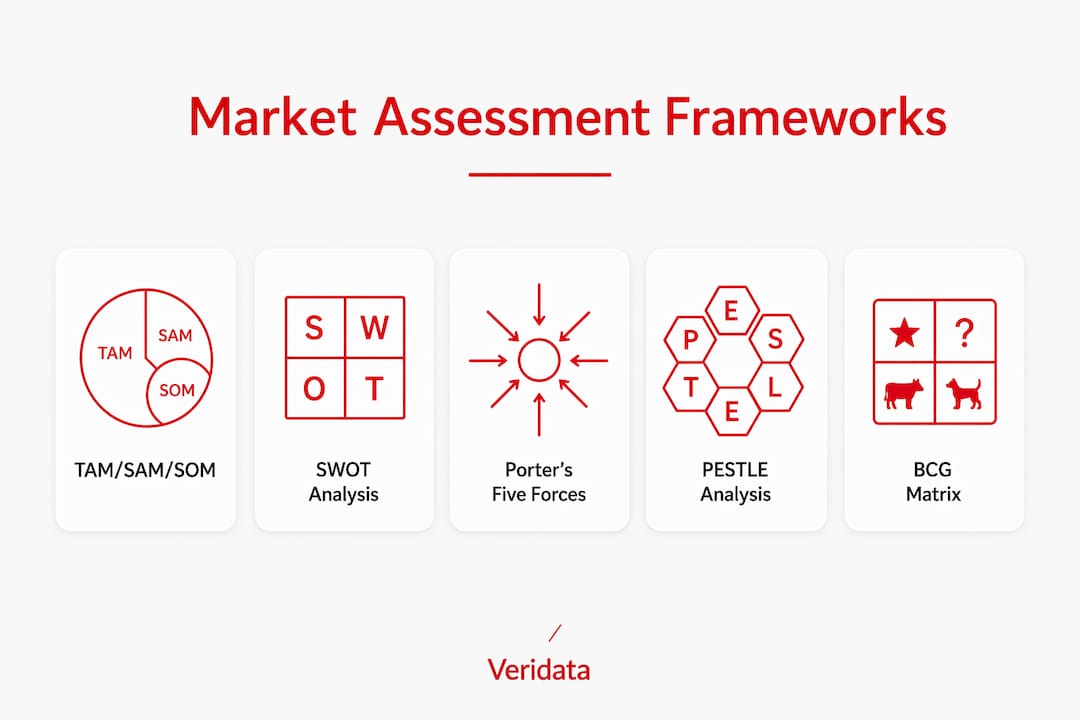
Porter’s Five Forces alongside SWOT, BCG Matrix, and PESTLE are the most widely used frameworks for structuring competitive and environmental analysis. Each framework surfaces a different dimension of market pressure. Porter’s Five Forces maps supplier power, buyer power, substitutes, new entrants, and rivalry. PESTLE captures political, economic, social, technological, legal, and environmental factors that shift market conditions over time.
| Component | What it answers | Common tools |
|---|---|---|
| Market size | How big is the opportunity? | TAM, SAM, SOM |
| Customer segmentation | Who buys and why? | Demographic, behavioral, psychographic analysis |
| Competitive landscape | Who else is competing and how? | Porter’s Five Forces, competitive benchmarking |
| Industry trends | Where is the market heading? | PESTLE, trend reports, regulatory tracking |
| Regulatory environment | What rules shape the market? | Government databases, legal counsel |
Pro Tip: Define your SOM before your TAM when presenting to investors or boards. Executives trust a grounded, winnable number far more than a headline market figure.
Which research methods work best for market assessments?
The most reliable market assessments combine primary and secondary research. Primary research generates data you collect directly. Secondary research draws on data others have already gathered. Neither alone is sufficient. Multi-method triangulation involving at least three distinct data sources, including primary research, secondary research, and competitive intelligence, yields higher confidence in market conclusions.
Primary research: surveys and focus groups
Surveys are the workhorse of primary research. Well-designed surveys can deliver results within days when questionnaire design and sample size are handled with rigor. Speed matters when decisions are time-sensitive. Focus groups add depth that surveys cannot. Standard focus groups involve 6–10 participants, a size that balances discussion depth with manageable group dynamics. For B2B assessments, Veridata Insights specializes in recruiting hard-to-reach professional audiences that generic panels miss entirely.
Secondary research and competitive intelligence
Secondary sources include industry reports, government databases, academic studies, and trade publications. First-party data such as CRM logs, transaction histories, and website analytics are among the most reliable signals of customer behavior available to any business. Competitive intelligence uses website traffic data, product reviews, and job postings to infer competitor strategy and market momentum. These signals are often more current than any published report.
Recommended data sources for a thorough market analysis include:
- Customer surveys and in-depth interviews
- Focus groups with target buyer segments
- CRM and transaction data from your own systems
- Industry analyst reports (IBISWorld, Statista, government census data)
- Competitor website traffic and review platforms
- Job posting trackers to monitor competitor hiring patterns
- Regulatory filings and public financial disclosures
Pro Tip: When designing B2B surveys, keep questionnaires under 15 minutes and front-load the most critical questions. Response quality drops sharply after the 12-minute mark.
How do you turn market assessment findings into strategy?
Raw data does not make decisions. Synthesis does. Market assessment integrates quantitative data and qualitative insights into forward-looking evaluations, providing the business implications that market research alone cannot deliver. The goal is not a thick report. The goal is a clear answer to a specific business question.
Frameworks for synthesis
SWOT analysis maps your internal strengths and weaknesses against external opportunities and threats. Scenario planning takes that one step further by modeling how your position changes under different market conditions, such as a new entrant, a regulatory shift, or a demand spike. Use both together. SWOT gives you a snapshot. Scenario planning gives you a stress test.
Segmentation and customer lifetime value
Segmentation at the analysis stage means ranking your customer groups by revenue potential, not just size. Customer lifetime value (LTV) analysis tells you which segments are worth acquiring at a higher cost. A segment with high purchase frequency and strong retention justifies more aggressive investment than a large but low-value segment. This distinction drives smarter budget allocation.
KPIs to track after an assessment
Post-assessment monitoring keeps your strategy grounded in real market signals rather than assumptions made months earlier.
| KPI | What it measures | Review frequency |
|---|---|---|
| Market share by segment | Competitive position over time | Quarterly |
| Customer acquisition cost (CAC) | Efficiency of growth spend | Monthly |
| Net Promoter Score (NPS) | Customer satisfaction and loyalty | Quarterly |
| Revenue by segment | Segment-level growth performance | Monthly |
| Churn rate | Retention and product-market fit | Monthly |
Market research reduces risk by grounding strategy in evidence rather than assumptions, though no research eliminates uncertainty entirely. That caveat matters. The goal is better decisions, not perfect ones.
Pro Tip: Build your assessment around three to five core business questions before collecting a single data point. Decision-driven analysis produces sharper insights than data-collection-first approaches every time.
When should you commission a market assessment?
Timing a market assessment correctly is as important as the assessment itself. Market assessments deliver the most value when big decisions are on the table, such as capital activity, new market entry, or competitive repositioning. Commissioning one during a quiet period with no pending decisions wastes resources and produces findings that go stale before anyone acts on them.
The right moments to initiate a market analysis include:
- New product or service launch. Validate demand and identify the right customer segment before committing development resources.
- Geographic or vertical market entry. Understand local competitive dynamics, regulatory requirements, and customer behavior before you invest.
- Competitive repositioning. Assess how your brand and offer compare after a competitor makes a major move.
- Capital raise or M&A activity. Investors and acquirers expect a grounded view of market size and growth trajectory.
- Annual strategic planning. Align your plan with current market realities rather than last year’s assumptions.
Scope and speed must match the decision at hand. A product launch decision may need a fast, focused survey-based assessment completed in two weeks. A market entry decision may require a three-month deep dive combining primary research, expert interviews, and competitive analysis. Align the depth of the assessment with the size of the decision, not with a standard template.
Continuous monitoring between formal assessments keeps your strategy current. Set up dashboards tracking key market signals, competitor activity, and customer behavior metrics. Treat the formal assessment as the foundation and ongoing monitoring as the maintenance. One without the other leaves gaps. The market research process works best when it is built into your planning cycle, not bolted on as a one-time event.
Key Takeaways
A market assessment is most valuable when it synthesizes multiple data sources into clear, decision-ready business implications rather than simply reporting raw findings.
| Point | Details |
|---|---|
| Assessment vs. research | Market assessment synthesizes data into strategy; market research collects raw data. |
| Core components | TAM/SAM/SOM, behavioral segmentation, Porter’s Five Forces, and PESTLE form the foundation. |
| Research method mix | Combine surveys, focus groups, CRM data, and competitive intelligence for reliable conclusions. |
| Timing matters | Commission assessments when major decisions are pending, not as a routine exercise. |
| Monitor continuously | Use KPI dashboards between formal assessments to keep strategy grounded in live market signals. |
Why most market assessments fail before they start
I have seen business leaders commission thorough, expensive market assessments and then make the same decision they had already planned to make. That is not a research problem. That is a framing problem. The assessment was built around data collection rather than around the specific question that needed answering.
The most common mistake is treating a market assessment like a report card. Leaders want to know how big the market is and whether competitors are growing. Those are fine questions, but they are not decision questions. A decision question sounds like: “Should we enter the Southeast market in Q3 or wait until we have a local distribution partner?” That question shapes the entire research design and produces findings you can actually act on.
The second mistake is confusing confidence with certainty. A well-executed assessment built on custom market research dramatically narrows the range of bad outcomes. It does not eliminate risk. Leaders who expect certainty from research end up either paralyzed by residual uncertainty or dismissive of findings that do not confirm what they already believe.
The third mistake is doing it once. Markets move. Competitors pivot. Customer behavior shifts. An assessment from 18 months ago is a historical document, not a strategic guide. The leaders I respect most treat market intelligence as a continuous discipline, not a project with a delivery date.
Veridata Insights and your next market assessment
Veridata Insights delivers full-service market research with no project minimums, seven days a week, 365 days a year. Whether you need a fast survey-based demand assessment or a full qualitative and quantitative study, the team handles everything from questionnaire design and programming to data collection, analysis, and reporting. Veridata Insights specializes in B2B, B2C, healthcare, and hard-to-reach audiences, which means you get the right respondents, not just the easiest ones to find. If a market decision is on your desk right now, reach out to the team and get a research plan built around your specific question.
FAQ
What is a market assessment?
A market assessment is a structured evaluation of market size, customer demand, competitive dynamics, and industry trends that synthesizes data into forward-looking business implications. It goes beyond data collection to answer the question: what does this mean for our strategy?
How is a market assessment different from market research?
Market research collects raw data through surveys, interviews, and secondary sources. A market assessment uses that data as an input and synthesizes it into strategic conclusions and business recommendations.
What frameworks are used in a market assessment?
SWOT, Porter’s Five Forces, PESTLE, BCG Matrix, and TAM/SAM/SOM metrics are the most widely used frameworks. Each one structures a different dimension of market and competitive analysis.
How long does a market assessment take?
Timeline depends on scope. A focused survey-based assessment can deliver findings within days when designed efficiently. A comprehensive multi-method assessment covering primary research, competitive intelligence, and expert interviews typically takes several weeks to complete.
When should a business conduct a market assessment?
Market assessments are most valuable before major decisions such as new product launches, geographic market entry, competitive repositioning, or capital raises. Aligning the assessment to a specific pending decision produces the most useful findings.
Recommended
- Market Benchmarking: Gaining an Edge in Competitive Landscapes – Veridata Insights
- Market Analysis Model: A Guide for Business Decision-Makers
- How Do I Conduct Effective Market Analysis to Support a New Product Launch Strategy? – Veridata Insights
- Why You Should Conduct Market Assessment – Veridata Insights