

TL;DR:
- Respondent validation involves confirming research accuracy by sharing findings with participants, ensuring interpretations resonate. It varies between qualitative and quantitative contexts, focusing on participant perspectives in one case and data integrity in the other. Properly conducted, it enhances credibility, reduces errors, and builds trust, but is often overlooked or poorly implemented.
Respondent validation is one of those terms that gets used loosely, misunderstood often, and skipped entirely too much. Whether you’re leading a qualitative study or cleaning a quantitative dataset, knowing what is respondent validation and how it works in your specific context is the difference between research you can defend and research that quietly falls apart under scrutiny. This article breaks down the definition, the methods, the distinctions between qualitative and quantitative applications, and the practical steps that make respondent validation work as a real quality measure, not just a checkbox.
Table of Contents
- Key takeaways
- What is respondent validation?
- Respondent validation methods that actually work
- Respondent validation versus other quality measures
- Why the importance of respondent validation is hard to overstate
- How to conduct respondent validation without the headaches
- My perspective on where respondent validation is heading
- Work with Veridatainsights on your next research project
- FAQ
Key takeaways
| Point | Details |
|---|---|
| Respondent validation is context-dependent | The term means different things in qualitative vs. quantitative research, so clarify your application upfront. |
| It’s about resonance, not unanimous agreement | The goal is confirming whether your interpretations ring true for participants, not getting everyone to sign off. |
| Structured methods outperform passive review | Guided follow-up interviews produce far more useful feedback than simply sending transcripts to participants. |
| Quantitative validation requires documentation | Data quality exclusions must be recorded and applied before weighting to protect result integrity. |
| Skipping it has real consequences | Unvalidated findings risk misrepresentation, reduced credibility, and research that stakeholders won’t trust. |
What is respondent validation?
Let’s start with the definition and get specific, because terminology varies across fields in ways that genuinely cause confusion in research methodology discussions.
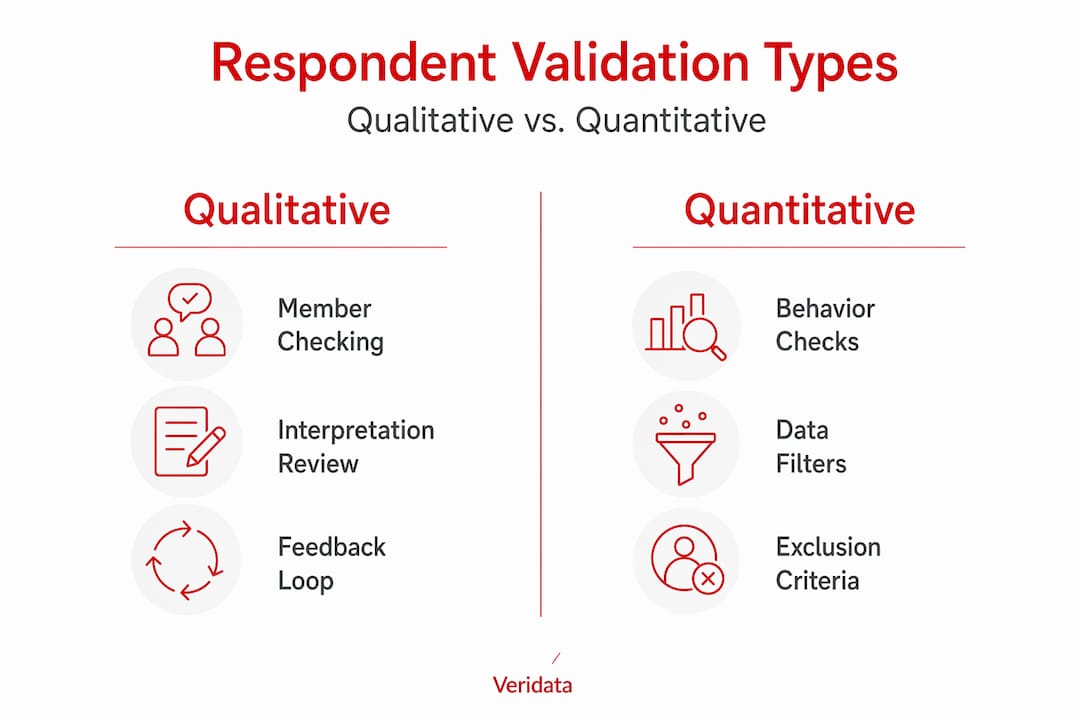
In qualitative research, respondent validation goes by several names: member checking, participant validation, and respondent feedback are all used interchangeably depending on the discipline. At its core, it refers to the practice of sharing your interpretations, themes, or findings with the people who participated in your study, and asking whether those findings accurately reflect their experiences and perspectives. It is not asking participants to approve your report. It is asking whether you got the meaning right.
Here is what respondent validation does in a qualitative context:
- Confirms accuracy of interpretation. Participants review how their input was characterized and flag distortions or gaps.
- Adds context you may have missed. Participants often surface nuance during validation that wasn’t fully captured in the original data collection.
- Challenges researcher bias. When a participant says “that’s not quite what I meant,” it’s an opportunity to refine your analysis rather than defend it.
- Establishes trustworthiness. The goal of qualitative research isn’t perfect objectivity. It’s credibility, and trustworthiness of qualitative findings depends significantly on whether interpretations resonate with those who lived the experience.
In quantitative research, respondent validation takes a very different form. Here, the focus shifts to respondent behavior rather than meaning. It involves identifying and removing low-quality responses, such as satisficing patterns, straight-lining, or speeding, before analysis begins. This is less about dialogue with participants and more about data integrity checks applied systematically to your dataset.
Both uses are legitimate. What is participant validation in one context becomes respondent behavior validation in another. Keeping those distinctions clear in your methodology section prevents a lot of confusion downstream.
Respondent validation methods that actually work
The importance of respondent validation is only matched by how often it’s done poorly. Sending a transcript to a participant with a vague “does this look right to you?” question is not respondent validation. It’s wishful thinking. Structured member checking produces far more usable feedback because it gives participants a clear framework for responding.
Here’s how to conduct respondent validation effectively in a qualitative context:
- Schedule a brief follow-up session. A 10 to 15 minute guided interview after presenting your preliminary findings works far better than asynchronous email review. Participants can ask questions, and you can probe their reactions.
- Ask targeted questions. Generic prompts produce generic responses. Instead, ask things like: “How accurately does this theme capture your experience?” or “Is there anything in these findings that feels off or incomplete?”
- Focus on themes, not transcripts. Participants reviewing raw transcripts often get sidetracked by minor wording issues. Sharing thematic summaries keeps the conversation focused on interpretation.
- Document every exchange. Note what was confirmed, what was challenged, and how you incorporated feedback into your final analysis. This documentation becomes part of your methodology.
- Treat disagreement as data. When a participant pushes back on a finding, that’s not a problem to smooth over. It’s meaningful input that could sharpen your analysis or reveal a genuine gap.
- Keep the process iterative if the project allows. A single round of validation is better than nothing, but high-stakes qualitative research benefits from building validation loops into the research design from the start.
Pro Tip: When designing your member checking questions, clarify explicitly whether you’re asking about the accuracy of themes or the accuracy of literal statements. Participants give much better feedback when they understand exactly what they’re being asked to evaluate.
In quantitative research, the process looks more like a structured data review protocol. Identify your exclusion criteria in advance, apply them before any weighting or analysis occurs, and document your rationale in the methodology. Quality exclusions before weighting are critical because applying them after the fact can introduce bias into your results.

Respondent validation versus other quality measures
Researchers sometimes treat respondent validation as just another item on a quality checklist, equivalent to running a spell-check. It’s not. It occupies a specific and meaningful place among the credibility criteria used to evaluate research rigor.
In qualitative research, trustworthiness is typically assessed across four dimensions: credibility, transferability, dependability, and confirmability. Respondent validation sits primarily under credibility. It’s the mechanism by which you verify that your portrayal of participants’ realities is accurate. No other quality measure does that specific job. Triangulation checks consistency across sources. Thick description supports transferability. Peer debriefing tests your reasoning with colleagues. Only respondent validation puts interpretations back in front of the people who generated the data.
Here’s a quick comparison to make the distinctions concrete:
| Dimension | Qualitative respondent validation | Quantitative respondent validation |
|---|---|---|
| Primary purpose | Verify accuracy of interpretation | Protect data integrity from low-quality responses |
| Who is involved | Original study participants | Research team applying exclusion criteria |
| Output | Refined themes, confirmed or revised findings | Clean dataset ready for analysis |
| Timing | After preliminary analysis | Before weighting and analysis |
| Documentation goal | Reflexive audit trail | Transparent methodology report |
The two applications share a commitment to accuracy, but they operate through entirely different mechanisms. Conflating them in your methodology language creates confusion for readers and reviewers.
Pro Tip: In quantitative studies, always apply and document your respondent exclusion criteria before any data weighting. The sequence matters as much as the criteria themselves.
For researchers working across both methodologies, the article on combining qualitative and quantitative research offers useful context on how these validation approaches interact when mixed-method designs are in play.
Why the importance of respondent validation is hard to overstate
Some researchers treat respondent validation as a nice-to-have, something to include when time permits. That framing underestimates what’s actually at stake.
Here’s what respondent validation actually delivers when done well:
- It catches interpretive errors before publication. Researchers bring assumptions to analysis. Participants often catch where those assumptions led you astray, saving you from publishing a finding that doesn’t hold up.
- It strengthens authenticity. Findings that participants recognize as true carry more weight with stakeholders, clients, and review boards than findings that emerge purely from researcher interpretation.
- It incorporates lived context. Participants know things about their own experience that no amount of data analysis will reveal. Validation creates a channel for that context to enter the final report.
- It builds participant trust. When people feel their input was understood rather than simply extracted, they’re more likely to participate in future research and more likely to give candid answers.
- It reduces the risk of misrepresentation. Resonance with participants is not just a methodological nicety. It is a safeguard against findings that distort or flatten the complexity of human experience.
Skipping respondent validation doesn’t just weaken your methodology section. It creates the real possibility that your conclusions are subtly wrong in ways that neither you nor your colleagues will catch.
How to conduct respondent validation without the headaches
Planning matters more than most researchers realize. Respondent validation that’s bolted on at the end of a project is always harder to execute than validation designed into the workflow from the beginning.
Here’s what separates smooth execution from a scramble:
- Build it into your timeline and consent process. Participants who agreed to a follow-up session at enrollment are far easier to re-engage than those being contacted cold after data collection ended.
- Be clear about purpose. Tell participants you’re sharing findings to check accuracy, not to seek approval or debate the results. That framing reduces anxiety and keeps conversations productive.
- Use structured interviews over surveys. Structured follow-up interviews consistently produce better participant input than written surveys because the dialogue creates space for nuance.
- Document your validation criteria. What counts as confirmation? What triggers a revision? Setting those criteria in advance keeps your process defensible and transparent.
- Refine, don’t reverse. Participant feedback should inform your final analysis, not override your professional judgment. You are the researcher. Incorporate what’s useful and document how you handled disagreements.
Pro Tip: Treat respondent validation as an ongoing dialog rather than a single pass. Even a second brief check-in after incorporating feedback can meaningfully improve the accuracy and credibility of your final findings.
Data quality measures in online surveys cover the quantitative side of this process in depth, including forensic markers and verification methods that complement respondent behavior validation in survey-based research.
My perspective on where respondent validation is heading
I’ve seen a consistent pattern across research projects: the ones that skip respondent validation do so for one of two reasons. Either the timeline got compressed and it felt like something that could be cut, or the research team quietly feared what participants might say.
Both are understandable. Neither is a good enough reason.
What I’ve found is that the feedback researchers dread most is usually the feedback that improves the work most. A participant who says “you got that backwards” is doing you a favor. The finding you would have published confidently was wrong, and now you know before it’s in the hands of a client or a review committee.
I also think the field undersells respondent validation as a form of genuine intellectual humility. It’s a structured acknowledgment that your interpretation of someone else’s experience is a hypothesis, not a fact. That reframing changes how you approach the process entirely. You stop defending your analysis and start testing it.
The future of respondent validation, in my view, involves tighter integration with mixed-method workflows and better tooling for structured follow-up interviews. Researchers who build it in as a design principle rather than a methodology afterthought will consistently produce more credible work.
— Daniel
Work with Veridatainsights on your next research project
At Veridatainsights, we know that data quality doesn’t happen by accident. It’s built into every stage of the research process, including respondent validation. Whether you’re designing a qualitative study that requires rigorous participant validation methods or a quantitative project that needs systematic data quality protocols, we have the expertise to support both. No project minimums, no rigid service packages. Just solid methodology and the execution to match. Reach out to us and let’s talk about what your research actually needs.
FAQ
What is respondent validation in simple terms?
Respondent validation is the practice of sharing your research findings or interpretations with study participants to confirm accuracy. In qualitative research, it checks whether your themes reflect participants’ actual experiences. In quantitative research, it refers to removing low-quality responses before analysis.
Is respondent validation the same as member checking?
Yes, in qualitative research these terms are used interchangeably. Member checking, participant validation, and respondent validation all describe the process of verifying researcher interpretations with the people who provided the original data.
How long does a respondent validation session take?
A structured member checking interview typically runs 10 to 15 minutes. That’s enough time to cover targeted questions about thematic accuracy and collect meaningful participant feedback without overburdening respondents.
When should you conduct respondent validation?
In qualitative research, conduct it after preliminary analysis and before finalizing findings. In quantitative research, apply respondent quality exclusions before any data weighting or analysis to protect the integrity of your results.
What happens if a participant disagrees during respondent validation?
Disagreement is treated as data, not a problem. When a participant challenges an interpretation, document their feedback and assess whether it reveals a genuine interpretive error or reflects an alternative perspective worth noting in the final report.