

TL;DR:
- Combining primary and secondary research enhances confidence and client satisfaction.
- A hypothesis-driven framework improves research clarity, speed, and decision alignment.
- Professional research drives measurable productivity and wage growth over time.
Many organizations pour months of work into research that never makes it past a slide deck. They gather data, build reports, and still walk into major decisions without real clarity. That’s a costly gap. The business consultant research process exists to close it. When executed well, a structured consulting research approach connects the right methodology to the right question, turning raw information into confident strategy. This guide walks you through every critical phase, from selecting your methodology to verifying real-world impact, so your next research investment actually moves the needle.
Table of Contents
- Understanding the business consultant research process
- Step-by-step: Consultant research frameworks
- Balancing speed and depth in business consultant research
- Verifying insights and measuring impact
- Our perspective: What most guides miss about consultant research
- How Veridata Insights supports your research process
- Frequently asked questions
Key Takeaways
| Point | Details |
|---|---|
| Combine research methods | Using both primary and secondary research increases satisfaction and depth of insights. |
| Follow a structured framework | A hypothesis-driven, stepwise process improves clarity and actionable outcomes. |
| Balance speed and depth | Use AI and clear priorities to meet deadlines without sacrificing research quality. |
| Measure real impact | Consultant research processes lead to measurable productivity and wage improvements when done right. |
Understanding the business consultant research process
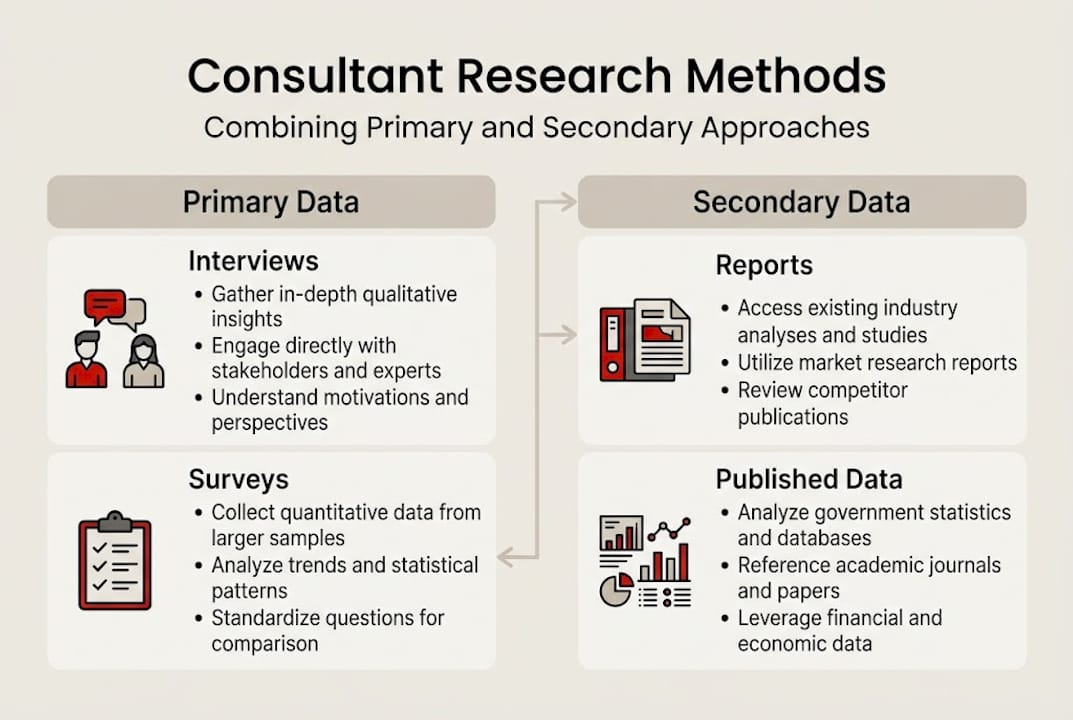
Before you can master the process, you need to understand what it actually includes. At its core, the business consultant research process combines two major branches: primary research and secondary research.
Primary research means collecting new data directly. Think in-depth interviews, surveys, focus groups, and observational studies. You design the questions, recruit the participants, and gather fresh insights that don’t exist anywhere else yet. It’s resource-intensive, but it gets you exactly what you need.
Secondary research means working with what already exists. Industry reports, academic studies, market databases, published articles, and government data all count. It’s faster and less expensive, but it may not answer your specific question with precision.
The real power comes from combining both. Combining primary and secondary research yields 35% higher client satisfaction on consulting projects, and it’s easy to see why. Primary data validates secondary findings. Secondary data provides context for primary insights. Together, they reduce blind spots.
Strong consulting research strategies also recognize that good research strengthens more than just deliverables. Done right, it research strengthens client relationships and builds long-term trust between your firm and its stakeholders.
Overview of research methodologies
| Methodology | Common sources | Typical tools |
|---|---|---|
| Primary quantitative | Surveys, polls | Online survey platforms, CATI |
| Primary qualitative | Interviews, focus groups | Discussion guides, video platforms |
| Secondary quantitative | Market databases, reports | Industry databases, government data |
| Secondary qualitative | Case studies, articles | Academic journals, news archives |
When to use each approach:
- Use primary research when your question is unique, your audience is specialized, or existing data is outdated
- Use secondary research when you need context, benchmarks, or historical trend data quickly
- Use both when you need full confidence before a major strategic or investment decision
- Use qualitative methods when you need to understand the “why” behind behavior
- Use quantitative methods when you need to measure, compare, or project at scale
Step-by-step: Consultant research frameworks
Knowing your methodology is one thing. Executing it inside a proven framework is what separates sharp consulting research from expensive guesswork.
The most widely respected approach in the industry is the hypothesis-driven research framework. McKinsey employs a hypothesis-driven approach: define the problem, structure a MECE issue tree, plan data collection, analyze, synthesize, and deliver recommendations. This keeps teams focused on what matters, not everything that’s interesting.

MECE stands for Mutually Exclusive, Collectively Exhaustive. It’s a logic discipline that ensures your research categories don’t overlap and don’t leave anything out. Pair it with the Pyramid Principle, which means leading with your conclusion and supporting it with evidence, and you have a framework that is both rigorous and immediately actionable.
Here’s how the process unfolds in practice:
- Define the problem clearly and in terms of a specific business decision
- Form an initial hypothesis about the most likely answer
- Build a MECE issue tree to structure all sub-questions logically
- Plan data collection by assigning sources and methods to each branch
- Analyze the data with your hypothesis in view, adjusting as evidence builds
- Synthesize findings using the Pyramid Principle, starting with the answer
- Deliver recommendations tied directly to the original business decision
The comparison below shows why this approach outperforms the alternative.
Hypothesis-driven vs. exhaustive research approaches
| Factor | Hypothesis-driven | Exhaustive search |
|---|---|---|
| Speed | Fast, decision-focused | Slow, broad coverage |
| Clarity | High, structured narrative | Variable, often overwhelming |
| Risk of scope creep | Low | High |
| Stakeholder alignment | Early and continuous | Often delayed |
| Best for | Strategic decisions | Academic or exploratory work |
Avoiding common market research pitfalls often comes down to this framework choice. Teams that skip hypothesis formation tend to collect data without direction and then struggle to connect findings to real decisions.
Pro Tip: Before you begin any research, write down the exact business decision this work is meant to inform. If you can’t name it in one sentence, your scope isn’t ready yet.
Balancing speed and depth in business consultant research
Every consulting engagement has a clock on it. The pressure to deliver fast is real, and so is the risk of cutting corners on rigor.
Typical consulting research projects run 4 to 12 weeks, with timeline variance driven by audience complexity, recruitment difficulty, and the number of data verification steps required. Fast-paced industries with narrow audiences, like healthcare or niche B2B sectors, tend to push toward the longer end.
“The biggest time killers in consulting research aren’t data collection. They’re unclear objectives, late stakeholder alignment, and underestimated recruitment timelines. Fix those first.”
That’s why modern research teams are turning to technology and smarter process design. AI can automate over 90% of research tasks and improve analysis quality by 12%, which fundamentally changes what a small team can accomplish in a compressed timeline.
Here’s how high-performing consulting teams stay fast without losing depth:
- Use AI for literature reviews and data synthesis to cut secondary research time dramatically
- Recruit panels in advance for specialized or hard-to-reach audiences, especially B2B and healthcare respondents
- Apply continuous synthesis throughout the project, not just at the end, so findings accumulate in real time
- Set decision checkpoints at each phase so stakeholders stay aligned without requiring full-report reviews
- Leverage rapid research solutions designed specifically for consulting firm timelines
Exploring AI and advanced analytics as part of your standard toolkit is no longer optional. It’s a competitive necessity.
Pro Tip: Start with a “Day 1 answer.” That’s your best hypothesis on day one, stated openly to stakeholders. It creates alignment early and gives your team a live target to confirm, refine, or disprove as data comes in.
Verifying insights and measuring impact
Research that can’t prove its value doesn’t get repeated. And if your findings don’t connect to measurable business outcomes, they won’t drive real decisions.
The good news is that the evidence for professional consulting research is strong. Clients see 3.6% labor productivity improvement and 2.7% wage growth within five years of engaging professional consulting research. These aren’t soft benefits. They’re measured, real-world shifts tied directly to better-informed strategy.
Expected outcomes by firm type
| Firm type | Productivity gain | Wage improvement | Research adoption rate |
|---|---|---|---|
| High-productivity firms | 3.6% or more | 2.7% or more | High |
| Low-productivity firms | Minimal short-term | Flat or minimal | Low |
| Firms with structured process | Sustained gains | Consistent | Very high |
Verifying and communicating research impact doesn’t have to be complicated. Follow this sequence:
- Tie every finding to the original business decision, not just general themes
- Define success metrics before data collection begins, so you have a baseline to measure against
- Cross-verify key insights using at least two independent sources or methods
- Quantify implications wherever possible, even rough estimates are better than vague claims
- Present findings in business language, not research language, so stakeholders can act immediately
Leading with B2B research best practices ensures that both the methodology and the output meet the standards that decision-makers actually need. Review the full consulting impact benchmarks to set realistic expectations for your own projects.
Our perspective: What most guides miss about consultant research
Most articles about the business consultant research process focus on tools, templates, and timelines. That’s useful. But it misses the bigger point.
The real differentiator is not how much data you collect. It’s how clearly you defined the decision before you started. We see this constantly. Teams with smaller budgets and tighter timelines outperform larger efforts because they stayed hypothesis-driven from day one. They used MECE and Pyramid structure to cut noise, not add rigor for its own sake.
The myth of “more data equals better insight” is one of the most expensive beliefs in consulting. It leads to bloated research scopes, delayed deliverables, and stakeholders who tune out before the recommendations land.
AI is accelerating this shift. AI transforming consultant research isn’t about replacing judgment. It’s about freeing researchers to focus on the human-centered interpretation that frameworks alone can’t do. The firms winning right now combine structured thinking, fast synthesis, and smart technology. That combination produces research that actually changes what organizations do next.
How Veridata Insights supports your research process
We built Veridata Insights around one belief: your research should work as hard as you do. Whether you need full end-to-end support or just a specific piece of the puzzle, we are here for it, with no project minimums, seven days a week, 365 days a year.
From consultation and questionnaire design through data collection, processing, and reporting, we cover every phase of the business consultant research process. We specialize in recruiting for B2B, B2C, healthcare, and hard-to-reach audiences, so your research doesn’t stall waiting for the right respondents. Reach out to our team through our expert research help page and let’s build something worth acting on.
Frequently asked questions
What is the main goal of the business consultant research process?
The goal is to gather and verify actionable insights that drive confident, strategic business decisions. A clear, structured process consistently produces higher satisfaction and measurable impact than unstructured approaches.
How long does a typical consultant research project take?
Most consulting research projects last between 4 and 12 weeks, depending on scope and audience complexity. Timeline norms of 4 to 12 weeks reflect the time needed for quality recruitment, data collection, and stakeholder verification.
What are the measurable benefits of using professional consultant research?
Organizations see up to 3.6% productivity gains and meaningful wage growth over five years from expert research engagements. These are empirically measured outcomes, not projected estimates.
How is AI changing the research process for consultants?
AI automates over 90% of research tasks in leading firms, freeing consultants to focus on strategic interpretation and stakeholder communication rather than manual data processing.
Recommended
- How Market Research Drives Strategic Decision-Making in Consulting – Veridata Insights
- The Market Research Process Simplified for Consulting Teams – Veridata Insights
- What Consulting Clients Expect from Market Research-Driven Strategies – Veridata Insights
- Overcoming Common Pitfalls in Market Research for Consulting Firms – Veridata Insights