

TL;DR:
- A structured, step-by-step market research process greatly improves decision-making and reduces costs.
- Effective research begins with clear objectives, core questions, and leveraging existing data sources.
- Applying validated methods and continuous validation ensures actionable insights and ongoing improvement.
Without a structured approach, market research becomes expensive guesswork. Resources get wasted, decisions get delayed, and opportunities slip by unnoticed. The good news? A methodical, step-by-step process changes everything. Structured processes are 3x more likely to drive actionable decisions, yet many organizations still skip the fundamentals. This guide walks you through every phase, from preparation to verification, with practical examples and expert tips at each turn. Whether you are entering a new market, adjusting pricing, or sizing up the competition, the right process makes all the difference.
Table of Contents
- What you need before you start market research
- Step-by-step market research process explained
- Choosing the right research methods and tools
- Troubleshooting, common pitfalls, and expert advice
- Verifying and applying your market research results
- Our perspective: Rethinking market research for 2026 and beyond
- Get expert help for your market research
- Frequently asked questions
Key Takeaways
| Point | Details |
|---|---|
| Follow a proven process | A structured six-step market research process leads to more actionable, impactful results. |
| Start with secondary data | Using existing sources first is faster and cost-effective before you gather new data. |
| Blend methods for best insights | Combining qualitative and quantitative research offers a fuller, more reliable picture. |
| Validate and apply findings | Always benchmark, validate, and connect your research results to real business actions. |
What you need before you start market research
Now that you understand why a systematic approach is critical, let’s cover what you need in place before starting the research process.
The single biggest mistake teams make? Jumping into data collection without knowing what decision the research is supposed to support. Research must tie back to decision-oriented questions and business objectives. Before you touch a survey tool or pull a single report, get crystal clear on why you are doing this research.
Start by identifying your core business decision. Are you evaluating a new market entry? Reconsidering your pricing model? Trying to understand why customers churn? Each decision requires a different research focus. Once that is defined, build your five core questions around it:
- What is the total market size and growth rate?
- Who are the key competitors and what are their positions?
- What pricing models exist and what does the customer expect?
- What are the primary risks in this market?
- What customer segments are underserved?
Next, gather your existing materials. Pull together any internal reports, past studies, CRM data, or industry benchmarks you already have. Assign clear team roles so everyone knows who owns data collection, analysis, and reporting. If your research involves industry classification, identify the relevant NAICS codes early. They will save you time when pulling federal data.
Here is a quick overview of essential tools and resources:
| Tool/Resource | Best used for |
|---|---|
| U.S. Census Bureau | Market sizing, demographics |
| Industry benchmarks | Competitive context |
| Google Analytics | Digital behavior data |
| Project management tools | Team coordination |
| Survey platforms | Primary data collection |
Pro Tip: Apply the MECE principle (Mutually Exclusive, Collectively Exhaustive) when structuring your research questions. It ensures you cover every angle without overlap or redundancy. Pair this with the market research steps framework to keep your project on track from day one.
Step-by-step market research process explained
With objectives and resources established, proceed to execute the process step by step.
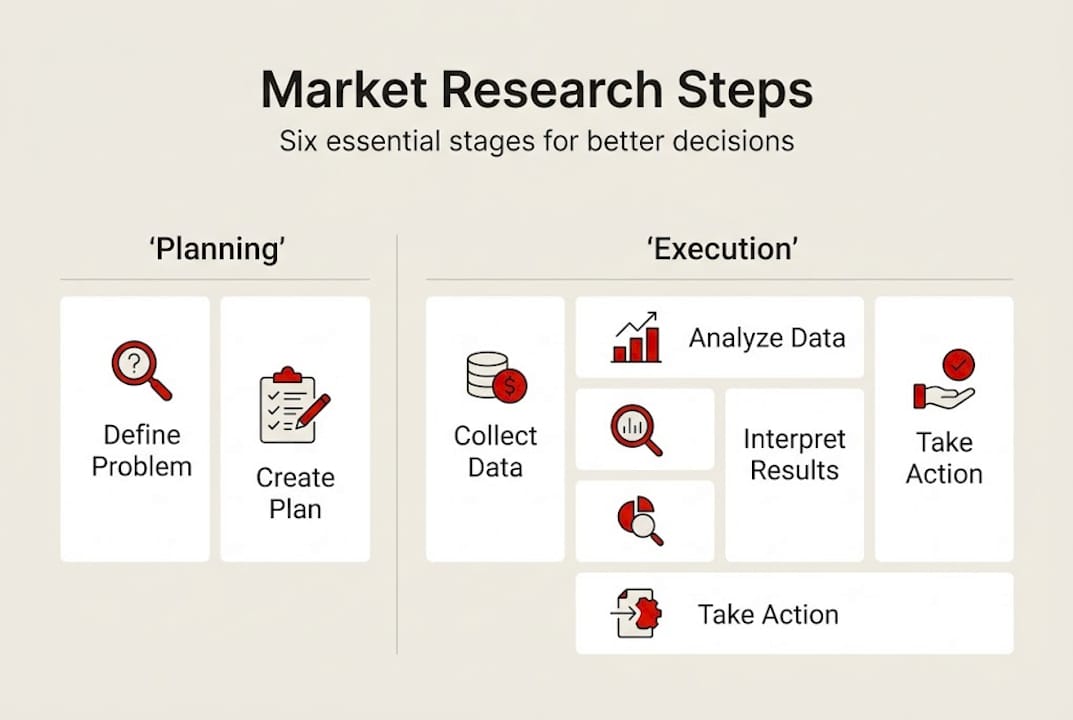
The six standard steps for market research are: define, plan, collect, analyze, interpret, and act. Simple in theory, but each step has real depth. Here is how to work through them:
- Define the problem. State the exact business question you need to answer. Vague problems produce vague research.
- Create a research plan. Choose your methods, set timelines, assign responsibilities, and outline your budget.
- Collect data. Start with secondary data, then use primary research to fill gaps. This sequencing saves significant time and money.
- Analyze the data. Look for patterns, outliers, and correlations. Use statistical tools where appropriate.
- Interpret results. Connect what the data says to what it means for your specific business decision.
- Act on insights. Turn findings into recommendations and execution plans.
Secondary research (published reports, federal databases, industry studies) should always come first. It is faster and cheaper. Primary research (surveys, interviews, focus groups) fills the gaps that secondary data cannot answer. Use the simplified process guide to map this sequence to your specific project.
| Method | Pros | Cons | When to use |
|---|---|---|---|
| Primary research | Specific, tailored | Time-intensive, costly | Gaps in secondary data |
| Secondary research | Fast, affordable | May be outdated | Early-stage exploration |
Always tie your research back to a specific business action. Data without a decision attached to it is just noise.
Pro Tip: Pilot-test your surveys with a small group before full launch. Vague or leading questions are the fastest way to collect data you cannot use.
Choosing the right research methods and tools
A major part of market research is choosing the right approach and tools.
Not all research methods are created equal, and the wrong choice can send your entire project sideways. Mixing qualitative and quantitative methods gives you the most complete picture. Qualitative research (think focus groups and in-depth interviews) explores the why behind behavior. Quantitative research (surveys, analytics, conjoint analysis) measures the what at scale.
Here is when to use each:
- Qualitative: Early-stage exploration, concept testing, understanding motivations
- Quantitative: Validating hypotheses, measuring market size, tracking trends
- Mixed methods: Complex decisions requiring both depth and statistical confidence
Modern tools have expanded what is possible. AI and LLM-powered tools are emerging fast but must be validated with real human data to avoid bias. Use them to speed up scenario modeling, not to replace foundational research.

| Tool | Type | Best for |
|---|---|---|
| Typeform / SurveyMonkey | Survey | Quantitative data collection |
| Google Analytics | Analytics | Digital behavior tracking |
| LLM simulators | AI | Scenario exploration |
| U.S. Census Bureau | Secondary | Market sizing and demographics |
For a deeper look at how AI in market research is reshaping methodology, the landscape is evolving quickly and worth staying current on.
Pro Tip: Never present AI-generated findings without validation from a traditional data source. AI can hallucinate patterns that look convincing but do not hold up under scrutiny.
Troubleshooting, common pitfalls, and expert advice
Even with a solid plan and strong tools, pitfalls can derail your market research.
The most common mistakes we see are not exotic. They are avoidable. Here are the ones that show up most often:
- Skipping secondary research and going straight to expensive primary data collection
- Asking vague questions that produce ambiguous, unusable responses
- Failing to validate AI outputs with real-world data before acting on them
- Ignoring reputable benchmarks from federal or industry sources
- Treating research as a one-time event rather than an iterative process
When you are researching a new market or a product with no history, use exploratory research and validate AI predictions with real data. Historical data cannot tell you what has never existed yet. Exploratory methods, such as expert interviews and ethnographic observation, give you a foundation when there is no precedent.
Applying frameworks like MECE and using NAICS codes consistently improves the quality of your analysis and makes your findings easier to benchmark. These are not bureaucratic extras. They are precision tools.
For a thorough review of what goes wrong and how to fix it, explore common market research pitfalls and the practical remedies that work.
Teams with a repeatable process are three times more likely to generate actionable insights. Discipline in process is not optional. It is the differentiator.
Pro Tip: After you implement a decision based on research, track the outcome. Did the prediction hold? What would you measure differently next time? That feedback loop is where research gets sharper with every cycle.
Verifying and applying your market research results
Now let’s make sure your research translates into real competitive advantage.
Data sitting in a slide deck helps no one. Research must drive actual business actions and be benchmarked for effectiveness. Here is how to move from findings to execution:
- Interpret your results in the context of your original business question.
- Compare against benchmarks using industry reports, federal data, or TAM/SAM/SOM frameworks.
- Present findings clearly with a focus on implications, not just data points.
- Define specific action items with owners, timelines, and success metrics.
- Monitor outcomes after implementation and feed learnings back into your next research cycle.
The TAM/SAM/SOM framework (Total Addressable Market, Serviceable Addressable Market, Serviceable Obtainable Market) is especially useful for presenting market sizing findings to stakeholders. It grounds your recommendations in realistic opportunity.
| Finding type | Strategic action |
|---|---|
| Market gap identified | Develop or reposition product offering |
| Competitor weakness found | Adjust messaging and targeting |
| Customer pain point surfaced | Prioritize product or service improvement |
| Pricing misalignment detected | Revisit pricing strategy with data support |
For a closer look at how research-driven strategy connects to real decisions, the link between rigorous research and strategic outcomes is well documented and worth exploring.
Remember: research is not a project with an end date. It is an ongoing capability. The organizations that treat it that way consistently outperform those that treat it as a one-off task.
Our perspective: Rethinking market research for 2026 and beyond
In wrapping up, let’s look at what sets the most successful organizations apart.
Here is something we see constantly: teams invest in expensive research platforms and sophisticated AI tools, then skip the free federal data that would have answered half their questions in an afternoon. The U.S. Census Bureau, Bureau of Labor Statistics, and industry trade associations publish mountains of reliable data. Most of it goes unused.
Generative AI is genuinely exciting. It can accelerate scenario modeling and surface patterns faster than any human analyst. But it is not a replacement for process discipline or human judgment. AI-augmented research works best when it is layered on top of a solid methodological foundation, not used as a shortcut around one.
The organizations that consistently produce reliable, repeatable research are not necessarily the ones with the biggest budgets. They are the ones with the strongest habits. Structured processes. Clear objectives. Iterative improvement cycles.
So here is the provocation worth sitting with: what if the missing link in your research program is not a better tool, but a better habit?
Get expert help for your market research
Ready to put it all together or need a proven partner to guide your next market research initiative?
At Veridata Insights, our consultancy works with organizations at every stage of the research process. Whether you need help designing a study from scratch, choosing the right methodology, or turning raw data into decisions your leadership team can act on, we are here for it. No project minimums. Seven days a week. We handle everything from questionnaire design and programming to data collection, coding, and reporting. If you are unsure where to start or want a team that gets it right the first time, speak with our market research advisors and let’s build something that actually moves the needle.
Frequently asked questions
What are the six steps in the market research process?
The six steps are defining the problem, creating a plan, collecting data, analyzing it, interpreting results, and implementing insights. Each step builds directly on the one before it.
Should I use primary or secondary research first?
Start with secondary research to save time and resources, then use primary research to fill the gaps secondary data cannot answer.
How does AI change market research in 2026?
AI tools speed up analysis and scenario modeling but require human validation to produce reliable, bias-free insights.
Why is benchmarking important in market research?
Benchmarking lets you compare your findings against proven industry standards, making it easier to spot real opportunities and flag genuine risks.
Recommended
- Data analysis step by step for market researchers in 2026 – Veridata Insights
- The Market Research Process Simplified for Consulting Teams – Veridata Insights
- How Market Research Drives Strategic Decision-Making in Consulting – Veridata Insights
- Video: Our Market Research Process – Veridata Insights
- Why invest in digital marketing: boost growth & leads for SMBs