

TL;DR:
- Only 45% of PR professionals are confident in measuring campaign ROI.
- Outcome-focused metrics and qualitative insights are essential for meaningful PR evaluation.
- AI tools should complement human judgment to enhance creativity and business impact.
Only 45% of PR professionals are confident they can measure campaign ROI, even as analytics tools multiply across the industry. That gap is striking. More data does not automatically mean better decisions, and more dashboards do not guarantee smarter strategy. The real challenge is not collecting data. It is knowing which data matters, what it tells you about your audience, and how it connects to actual business results. This guide walks through how PR professionals and agency managers can move from measurement confusion to confident, outcomes-focused analytics that genuinely moves the needle.
Table of Contents
- From intuition to strategy: Why analytics matters in modern PR
- What to measure: Outputs, outtakes, and outcomes in PR analytics
- Tools and techniques: Building the modern PR analytics stack
- Pitfalls, critiques, and creative balance: What most PR teams miss
- A smarter path: Why outcomes-focused analytics beats vanity metrics
- Ready to level up your PR analytics?
- Frequently asked questions
Key Takeaways
| Point | Details |
|---|---|
| Prioritize outcomes | Measuring business impact and ROI is more valuable than tracking media coverage alone. |
| Integrate the right tools | A tailored analytics stack—including AI and sentiment monitoring—drives better PR results. |
| Avoid vanity metrics | Focusing on meaningful data over impressions or AVEs ensures strategic decision-making. |
| Balance creativity and data | Combining analytics with human insight keeps PR strategies both original and effective. |
From intuition to strategy: Why analytics matters in modern PR
For decades, PR ran on relationships, instinct, and the art of a good story. Those things still matter. But the industry has shifted, and the teams winning today are the ones pairing creative instincts with solid data.
Analytics in PR means more than counting press mentions. It means measuring what happened, evaluating whether it mattered, and pulling out insights that shape your next move. Done right, it connects your communications work to real business outcomes, not just media noise.
Analytics transforms PR from intuitive to strategic, enhancing personalization, crisis response, and ROI proof, but success requires integrating qualitative and quantitative methods and focusing on business-aligned outcomes.
The global benchmark for this kind of thinking is the Barcelona Principles 4.0, a framework developed by the International Association for Measurement and Evaluation of Communication (AMEC). It sets clear standards for ethical, outcome-focused PR measurement and explicitly rejects shortcuts like Advertising Value Equivalents (AVEs), which assign a dollar value to earned media based on ad rates. AVEs feel satisfying on a slide deck, but they measure the wrong thing entirely.
Here is where many PR teams go wrong:
- Treating impressions as proof of impact
- Reporting outputs (what was published) instead of outcomes (what changed)
- Using AVEs to justify campaign value to leadership
- Measuring activity volume rather than audience response
- Skipping qualitative data that explains the “why” behind the numbers
The good news is that analytics in strategic consulting has shown us repeatedly that organizations making the shift from output tracking to outcome measurement see sharper decisions and stronger business alignment. PR is no different. When you measure what actually matters, you can defend your budget, refine your approach, and prove your value in language that leadership understands.
What to measure: Outputs, outtakes, and outcomes in PR analytics
Not all metrics are created equal. Understanding the difference between outputs, outtakes, and outcomes is the foundation of any serious PR measurement strategy.
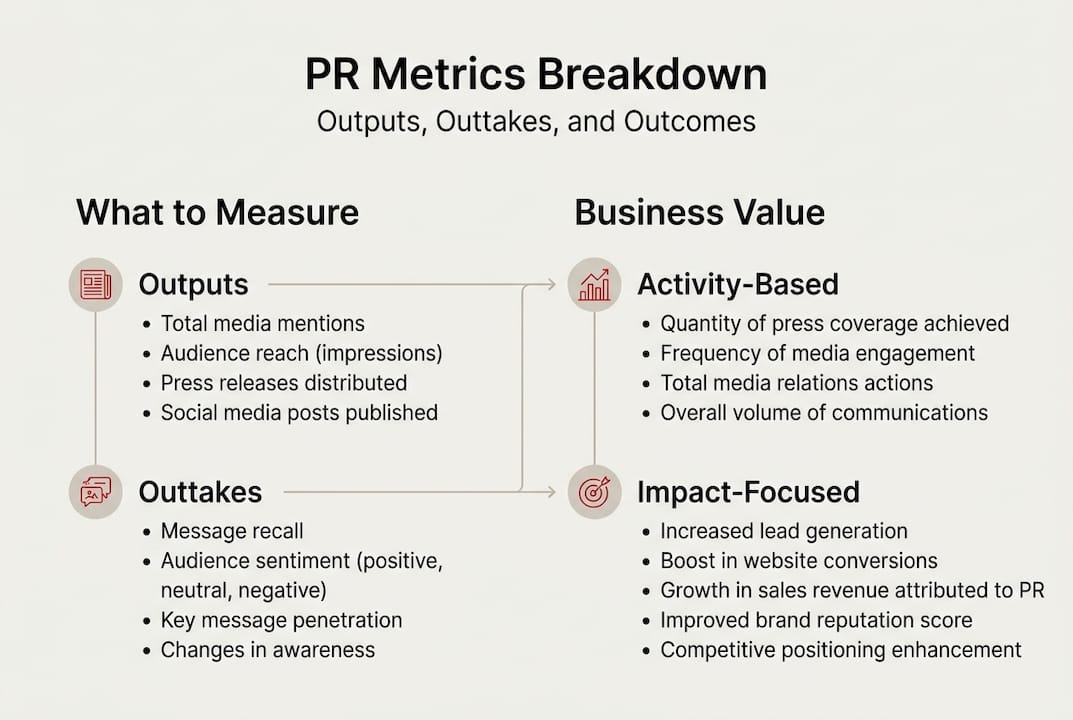
Outputs are the direct results of your PR activity. Think media coverage, press release pickups, event attendance, or social shares. These are easy to count and tempting to lead with, but they only tell you what happened, not whether it mattered.
Outtakes measure how audiences responded. Did they read the article? Did sentiment shift? Did website traffic spike after a campaign? Outtakes connect your outputs to real human behavior.
Outcomes are where the business case lives. Did sales increase? Did brand perception improve? Did your target audience take a desired action? PR professionals track outputs like media coverage, outtakes such as sentiment and engagement, and outcomes including ROI using frameworks like Barcelona Principles 4.0.
| Metric type | Examples | Business value |
|---|---|---|
| Outputs | Press mentions, social shares | Low, activity-based |
| Outtakes | Sentiment, engagement rate | Medium, behavior-based |
| Outcomes | Brand lift, leads, ROI | High, business-aligned |
Pro Tip: If your monthly PR report leads with impressions, flip the order. Start with outcomes, then support them with outtakes, and use outputs as context. That reframe alone changes how leadership perceives your team’s value.
Campaigns that move beyond vanity metrics consistently show stronger results. A B2B tech company that shifted from tracking press placements to measuring demo requests driven by earned media coverage found a direct link between specific story angles and pipeline growth. That kind of insight is only possible when you measure PR business impact at the outcome level, not just the output level.
Tools and techniques: Building the modern PR analytics stack
Measuring the right things requires the right tools. The good news is that the PR analytics landscape has matured significantly, and there are strong options at every budget level.
Common tools include Google Analytics, Meltwater and Cision for media monitoring, Brandwatch for sentiment analysis, and AI-powered tools for predictive insights and personalization. Each serves a different purpose, and the best stacks combine them intentionally.
| Tool category | Examples | Primary use |
|---|---|---|
| Web analytics | Google Analytics | Traffic, conversions, referrals |
| Media monitoring | Meltwater, Cision | Coverage tracking, reach |
| Sentiment analysis | Brandwatch | Audience tone, brand perception |
| AI-powered tools | Various platforms | Predictive insights, personalization |
Here is a practical approach to building your stack without creating data silos:
- Start with your campaign goal. Are you driving awareness, shifting perception, or generating leads? Your goal determines which tools matter most.
- Map your metrics to that goal before selecting any platform. Tool-first thinking leads to irrelevant data.
- Choose one primary platform per function. Overlap creates confusion and inflates your budget.
- Connect your tools wherever possible. Google Analytics and your media monitoring platform should talk to each other.
- Review your stack every quarter. Tools evolve fast, and what worked six months ago may have a better alternative now.
AI sentiment analysis has become a genuine game-changer for PR teams managing large volumes of coverage. Instead of manually reading hundreds of articles, AI can flag tone shifts, identify emerging narratives, and surface risks before they escalate. Pair that with smarter media planning grounded in audience data, and you have a stack that works proactively, not just reactively.

Pitfalls, critiques, and creative balance: What most PR teams miss
Even with the right tools and frameworks in place, PR teams can still stumble. The pitfalls are real, and some of them are hiding in plain sight.
Here are the most common traps:
- Chasing impressions. High reach numbers feel good, but if the wrong audience is seeing your message, volume is meaningless.
- AI fatigue. Over-automating outreach with AI tools contributes to journalist fatigue and weakens media relationships.
- Data overload. Too many dashboards, too many metrics, and not enough time to interpret any of them.
- Losing the creative thread. When data becomes the only decision-maker, campaigns get safe, predictable, and forgettable.
While analytics drives precision, criticisms include over-reliance on vanity metrics, only 45% of PR professionals confident in ROI measurement, AI worsening journalist fatigue, and data drowning creativity.
The fix is not less data. It is smarter integration of qualitative and quantitative insight. Quantitative data tells you what is happening. Qualitative research, whether through focus groups, interviews, or open-ended survey responses, tells you why. Both are essential.
We have seen this play out across campaigns where the numbers looked great but the brand narrative felt flat. The data said reach was up. The qualitative feedback said audiences felt the messaging was generic. That kind of nuance only surfaces when you look beyond the spreadsheet.
Exploring creativity in PR analytics is worth your time if you are navigating this tension. And when it comes to making analytics work across departments, cross-team alignment between research and communications is not optional. It is the difference between data that sits in a report and data that drives action.
A smarter path: Why outcomes-focused analytics beats vanity metrics
Here is our honest take: chasing impressions is a comfort habit, not a strategy. It feels productive. It generates slides that look impressive. But it rarely drives the business results that justify PR investment.
We have worked with enough teams to know that the shift to outcomes-focused measurement is not just a technical upgrade. It is a mindset change. It requires asking harder questions, building tighter alignment with sales and marketing, and being willing to report numbers that are smaller but more meaningful.
AI belongs in your analytics stack, but it should complement human judgment, not replace it. The best PR teams we see use AI to process volume and surface patterns, then apply human insight to decide what those patterns mean and what to do next.
Prioritizing outcomes over outputs, using AI as a complement rather than a replacement, and closing gaps in ROI attribution are the markers of mature PR analytics. Getting there takes investment in the right research infrastructure. That is where ROI-focused research support makes a real difference, especially for teams that need rigorous methodology without the overhead of building it in-house.
Ready to level up your PR analytics?
If this guide has clarified where your measurement gaps are, the next step is building a research approach that fills them. We specialize in exactly that. Whether you need quantitative survey data to track brand perception shifts, qualitative research to understand audience sentiment, or a full analytics framework aligned to your campaign goals, we can help. Our team works with PR professionals and agency managers 7 days a week, with no project minimums and full flexibility on scope. Reach out to our team and let us design a research solution that turns your PR data into genuine business insight.
Frequently asked questions
What are the Barcelona Principles in PR analytics?
The Barcelona Principles 4.0 are a globally recognized standard for PR measurement that rejects AVEs and promotes outcome-focused metrics aligned to real business goals. They provide a shared framework for ethical, meaningful evaluation of communications work.
Which tools are best for PR campaign analytics?
Popular choices include Google Analytics, Meltwater, Cision, Brandwatch, and modern AI solutions for monitoring, sentiment analysis, and predictive insights. The right mix depends on your campaign goals and the outcomes you are trying to measure.
How do I avoid vanity metrics in PR analytics?
Focus on measuring actual outcomes like business impact, sentiment shifts, and ROI rather than surface-level counts. Outcome-focused frameworks and tools that align with business goals will keep your reporting grounded in what actually matters.
Does using AI in PR analytics threaten creativity?
AI risks drowning creativity when teams rely on it too heavily without human oversight. The solution is using AI to handle volume and pattern recognition while keeping human insight at the center of creative and strategic decisions.