

TL;DR:
- Effective advertising depends on targeting the right audience, not just creative quality.
- Precise audience profiles and the right recruitment methods ensure data accuracy and campaign success.
- Continuous verification and benchmarking prevent costly sampling errors and improve insight reliability.
Most advertising campaigns don’t fail because of bad creative. They fail because the wrong people saw them. When your audience is off, every dollar you spend is working against you. Wasted impressions, low engagement, and confusing results pile up fast. The good news? Audience recruitment is a process you can master. This guide walks you through everything: preparation, execution, verification, and what to do when things go sideways. Whether you’re running a brand study or testing new messaging, getting the right people in front of your research is the foundation of every insight that actually moves the needle.
Table of Contents
- Understanding the essentials: What you need before recruitment
- Choosing your recruitment methods: Active versus passive approaches
- Executing recruitment: Step-by-step for quality and speed
- Verifying and benchmarking your recruited audience
- What most miss about true audience recruitment success
- Ready for expert audience recruitment? Let us help
- Frequently asked questions
Key Takeaways
| Point | Details |
|---|---|
| Preparation is vital | Clearly define your campaign’s goals and choose the right tools before recruiting audiences. |
| Active methods work best | Direct outreach consistently yields higher quality advertising audiences than passive approaches. |
| AI accelerates recruitment | Leveraging AI panels like Qualtrics Edge blends speed and accuracy for superior results. |
| Benchmark for quality | Always compare your results against industry standards to ensure reliable campaign outcomes. |
Understanding the essentials: What you need before recruitment
Before you recruit a single person, you need a clear picture of who you’re looking for and why. Skipping this step is the fastest way to end up with data that looks fine but tells you nothing useful.
Start with your campaign objectives. Are you testing creative concepts? Measuring brand lift? Validating messaging with a niche segment? Each goal demands a different audience profile. A vague objective produces a vague audience, and vague audiences produce vague insights. Be specific.
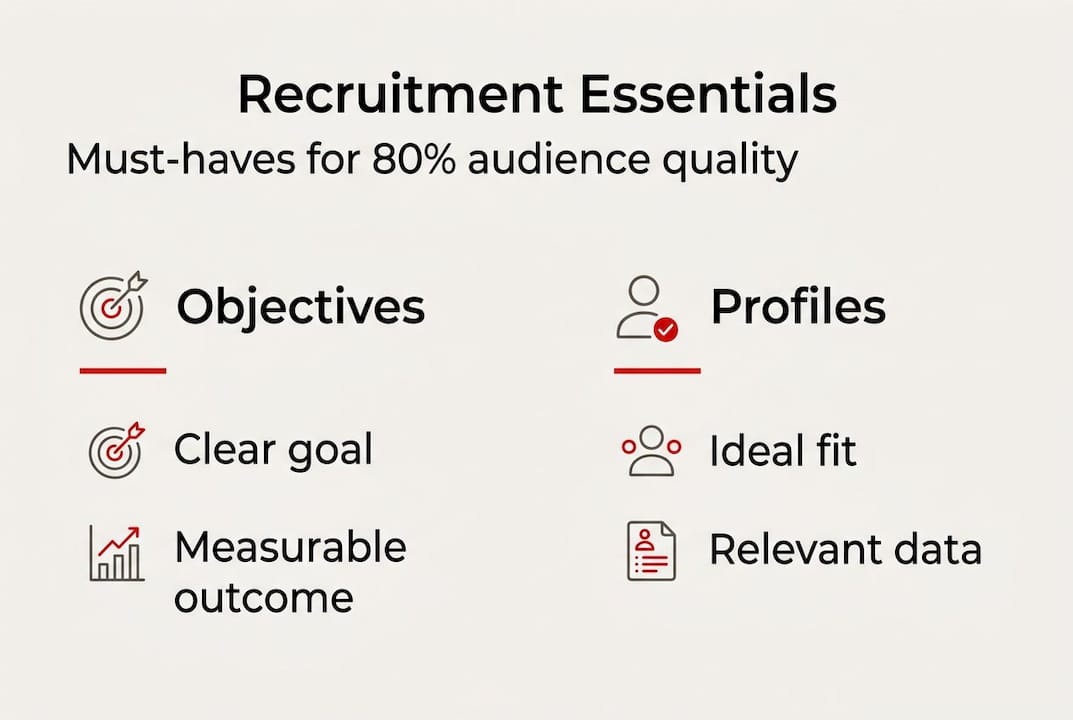
Next, build your ideal audience profile. Think beyond basic demographics. Consider psychographics, purchase behavior, category involvement, and media consumption habits. The more precise your profile, the easier it is to screen for the right participants and filter out the wrong ones.
You also need the right tools. AI-powered panels like Qualtrics Edge have changed the speed and accuracy of recruitment significantly. These platforms blend synthetic and human data to help you reach the right respondents faster without sacrificing quality. Pairing them with best market research agencies that specialize in participant recruitment gives you even stronger results.
Here’s a quick checklist to run through before you launch:
- Campaign objective defined (specific, measurable)
- Audience profile documented (demographics, psychographics, behavior)
- Recruitment platform selected (panel, AI tool, or hybrid)
- Screening criteria finalized (inclusion and exclusion criteria)
- Compliance requirements reviewed (GDPR, CCPA, or relevant data privacy laws)
- Baseline benchmarks established for quality comparison
That last point matters more than most teams realize. Benchmark against industry norms before launching campaigns, using 80% confidence as a directional standard. Without a benchmark, you have no way to know if your recruited sample is strong or just passable.
For teams newer to this, market benchmarking is a discipline worth investing in early. It shapes every downstream decision.
| Requirement | Why it matters |
|---|---|
| Clear objective | Guides screening criteria |
| Audience profile | Prevents mismatched respondents |
| Platform selection | Impacts speed and data quality |
| Compliance review | Protects your brand and participants |
| Baseline benchmarks | Enables quality comparison |
Pro Tip: Write your screening questionnaire before you choose your platform. The questions you need to ask will often tell you which tool is best suited for the job.
Choosing your recruitment methods: Active versus passive approaches
Once your prerequisites are in place, the next step is picking the right recruitment approach. This decision shapes your timeline, budget, and data quality more than almost anything else.
Active recruitment means you go out and find participants. You’re directly reaching out through targeted outreach, screener-based invitations, or panel recruitment. Passive recruitment means participants come to you, typically through ads, social posts, or website sign-up forms.

Both have their place. But active outreach consistently outperforms passive recruitment for audience quality, especially when you’re targeting niche or hard-to-reach segments. Passive methods can work well for broad consumer audiences where volume matters more than precision.
| Method | Strengths | Weaknesses | Best for |
|---|---|---|---|
| Active outreach | High precision, better quality | More time and cost | Niche, B2B, healthcare |
| Passive recruitment | Scalable, lower cost | Lower quality control | Broad consumer studies |
| Hybrid approach | Balances quality and volume | Requires more coordination | Complex campaigns |
Here’s how to choose your approach in order of priority:
- Define your audience difficulty. Is this a general consumer or a niche professional? Harder audiences need active methods.
- Set your quality threshold. If data quality is non-negotiable, lean active.
- Assess your timeline. Passive methods take longer to fill niche quotas.
- Review your budget. Active outreach costs more upfront but saves money on bad data.
- Decide on a hybrid if needed. Many campaigns benefit from mixing both approaches.
For audiences that are genuinely difficult to find, learning how to recruit hard-to-reach audiences is a skill that pays off every time. And reviewing examples of research audiences from past campaigns can help you calibrate your expectations before you start.
Pro Tip: For niche segments where human panel data is thin, consider supplementing with synthetic data to fill gaps. AI tools can model responses for underrepresented groups, giving you directional insights while you continue recruiting real respondents.
Executing recruitment: Step-by-step for quality and speed
Having chosen your method, here’s how to execute recruitment for both quality and efficiency. This is where strategy meets action, and where most teams either gain an edge or lose time.
- Finalize your screener. Keep it short, specific, and free of leading questions. A bloated screener kills completion rates.
- Launch in phases. Don’t release your full sample at once. Start with 20 to 30% to catch screener issues early.
- Monitor in real time. Track completion rates, drop-off points, and demographic distribution as data comes in.
- Apply quality checkpoints. Flag and review responses that show speeding, straight-lining, or inconsistent answers.
- Leverage AI tools. AI panels blend synthetic and human data for faster, reliable recruitment without compromising accuracy.
- Adjust quotas as needed. If a demographic segment is filling slowly, activate backup sources or adjust incentives.
- Close recruitment cleanly. Once quotas are met, close the survey immediately to prevent over-collection.
The role of AI in this process is real and growing. Understanding AI and analytics in market research helps you use these tools strategically rather than just as shortcuts. The firms that use AI well are the ones that still apply human judgment at every checkpoint.
“The brands that win at audience recruitment are the ones that treat it as a living process, not a one-time task. They check in, adjust, and verify at every stage.”
For a broader view of how AI in market research is reshaping the industry, the conversation is moving fast. Staying current matters.
Pro Tip: Schedule a mid-recruitment assessment at the 50% completion mark. This gives you enough data to spot problems early and enough time to fix them before you’ve locked in a flawed sample.
Verifying and benchmarking your recruited audience
After executing recruitment, it’s time to test if you’ve hit your mark and what to do if you haven’t. Verification is not optional. It’s the step that separates good data from expensive guesswork.
Start with this validity checklist:
- Demographic match: Does your sample reflect the target profile you defined?
- Screening integrity: Did participants pass screener logic checks?
- Response quality: Are there signs of speeding, straight-lining, or gibberish open-ends?
- Quota balance: Are all required segments represented at the right proportions?
- Engagement signals: Are completion rates and time-on-task within expected ranges?
Once you’ve run through the checklist, benchmark your findings. Benchmark recruited audiences against robust external norms to determine if your sample meets campaign quality standards. Using 80% confidence as a directional benchmark is a widely accepted starting point in the industry.
| Quality signal | Acceptable range | Action if outside range |
|---|---|---|
| Screener pass rate | 20 to 40% | Revisit screener criteria |
| Survey completion rate | 75% or higher | Check survey length and flow |
| Speeding rate | Under 10% | Remove flagged responses |
| Demographic alignment | Within 5% of target | Supplement or re-recruit |
For teams running cross-channel campaigns, audience measurement across platforms adds another layer of verification that’s worth building into your process.
If your audience fails quality checks, here’s what to do:
- Remove low-quality responses and recalculate your effective sample size
- Identify which segment failed and target it specifically in a second recruitment wave
- Tighten your screener to prevent the same issue from recurring
- Consult your industry benchmarking data to reset quality expectations
- Consider switching recruitment methods if passive approaches are underdelivering
Verification is not a failure checkpoint. It’s a quality checkpoint. The goal is to catch issues before they cost you a campaign.
What most miss about true audience recruitment success
Here’s the uncomfortable truth most guides skip: following the steps perfectly still isn’t enough if you’re measuring the wrong things at the end.
We see it often. Marketers invest in solid recruitment, hit their quotas, pass their quality checks, and then make campaign decisions based on surface-level metrics like completion rate and demographic match. Those are inputs, not outcomes. The real question is whether your recruited audience actually reflects the people who will respond to your advertising in the real world.
Fast recruitment without robust verification is a false economy. AI tools accelerate the process, but speed without judgment creates confident wrong answers. The best brands we work with treat recruitment as iterative. They benchmark, adjust, and benchmark again. They treat a research recruitment case study as a learning asset, not just a deliverable.
Risk management is part of recruitment strategy. Build it in from the start, not as an afterthought.
Ready for expert audience recruitment? Let us help
If your team is ready to raise the bar or needs more specialized help, we’re here for it. At Veridata Insights, we specialize in active, AI-powered, and benchmark-driven recruitment for B2B, B2C, healthcare, and hard-to-reach audiences. No project minimums. Seven days a week. We bring the precision and the process so you can focus on the insights.
Whether you need end-to-end support or just a sharper screener, we can do as much or as little as you need. Reach out to our team and let’s talk about what your next campaign actually requires. Quality audiences are not a luxury. They’re the foundation.
Frequently asked questions
How long does the advertising audience recruitment process take?
The process can take anywhere from a few days to two weeks depending on audience difficulty and recruitment method. AI panels speed up recruitment significantly compared to traditional manual outreach.
What’s the difference between active and passive recruitment?
Active recruitment involves directly reaching out to specific participants, while passive recruitment relies on them finding you through ads or sign-ups. Active outreach yields better quality for niche or specialized audiences.
How can I verify the quality of a recruited audience?
Benchmark your audience’s demographics and engagement against industry norms and use at least 80% confidence as a directional standard. Benchmark recruited audiences against external norms to confirm your sample meets campaign quality standards.
Are AI panels accurate and compliant for audience recruitment?
Qualtrics Edge panels blend synthetic and human data for speed and are trusted for compliance by many leading firms. They work best when paired with human quality oversight at key checkpoints.
Recommended
- How to Recruit Hard-to-Reach Audiences for Market Research – Veridata Insights
- The Best Market Research Agencies for Participant Recruitment – Veridata Insights
- In-Depth Interview Recruiting: Why Veridata Insights Leads the Way in Quality Respondent Engagement – Veridata Insights
- Video: Veridata Insights are Research Recruitment Experts – Veridata Insights
- Verbeter je leadgeneratie met een data-driven outreach strategie
- 7 Essential Digital Advertising Tips for Business Owners – Jarrod Harman