



TL;DR:
- Qualitative research uncovers motives, context, and patterns vital for legal case strategy.
- It is essential for complex, novel, or intent-driven disputes where quantitative data fall short.
- Effective use requires rigorous methodology and early integration into case development.
Numbers tell part of the story. But in a courtroom, the part that matters most is often the part you can’t measure. Motives, context, behavioral patterns, and the human story behind the facts, these are the elements that shift verdicts. Qualitative research gives litigators a way to surface exactly that kind of insight. Yet many legal professionals still treat it as a secondary tool, something to pull out when the data runs thin. This guide makes the case for flipping that assumption entirely and shows you how to put qualitative methods to work at every stage of case strategy.
Table of Contents
- What is qualitative research in legal contexts?
- Why qualitative research is essential for legal strategy
- When qualitative methods outperform quantitative approaches
- How to effectively implement qualitative research in your legal case
- What most litigators overlook about qualitative legal research
- Get expert support for your next case
- Frequently asked questions
Key Takeaways
| Point | Details |
|---|---|
| Qualitative reveals context | It uncovers the motivations and nuances behind legal evidence that statistics often miss. |
| Essential for complex cases | Qualitative research shines when data is scarce or when cases involve novel or ambiguous issues. |
| Strengthens legal strategy | Combining qualitative methods with quantitative analysis leads to more robust and persuasive arguments in court. |
| Adaptability is key | Qualitative approaches flexibly address emerging themes and complex disputes unlike rigid surveys. |
What is qualitative research in legal contexts?
At its core, qualitative vs quantitative research comes down to one key distinction: quantitative research measures how many or how much, while qualitative research explores why and how. For legal professionals, that distinction is enormous.
Qualitative research in law involves gathering and interpreting non-numerical data. Think in-depth interviews with witnesses or subject matter experts, thematic analysis of documents and communications, and case studies that map complex behaviors or organizational patterns. These methods don’t produce a percentage or a p-value. They produce meaning.
Common qualitative methods relevant to litigation include:
- In-depth interviews: One-on-one conversations that reveal motivations, contradictions, and context behind actions
- Focus groups: Group discussions useful for understanding shared perceptions, such as how a jury pool might react to a narrative
- Thematic analysis: Systematic review of documents, transcripts, or communications to identify recurring patterns
- Case studies: Detailed examination of a single event, individual, or organization to understand complex dynamics
As researchers note, qualitative case study methods “provide in-depth understanding of complex legal phenomena, behaviors, and norms that quantitative methods cannot fully capture.”
Qualitative research doesn’t replace hard evidence. It gives that evidence a spine. It tells the court why something happened, not just that it happened.
This adaptability is what makes qualitative research so valuable in novel or complex cases. When you’re dealing with emerging technology disputes, unusual contractual relationships, or cases with limited precedent, rigid quantitative frameworks simply don’t fit. Qualitative methods flex to meet the evidence where it is.
Why qualitative research is essential for legal strategy
Knowing what qualitative research is and knowing how to use it strategically are two different things. Let’s get practical.
Qualitative research uncovers the why behind the facts. A document may show that a decision was made. An interview reveals the reasoning, the pressure, and the intent behind that decision. That distinction can be the difference between a weak argument and a compelling one.
Systematic qualitative analysis of case law “allows for in-depth examination of judicial rhetoric, context, and nuances, complementing quantitative methods for comprehensive legal empirical research.” In other words, it doesn’t just add color. It adds depth that changes how evidence is interpreted.
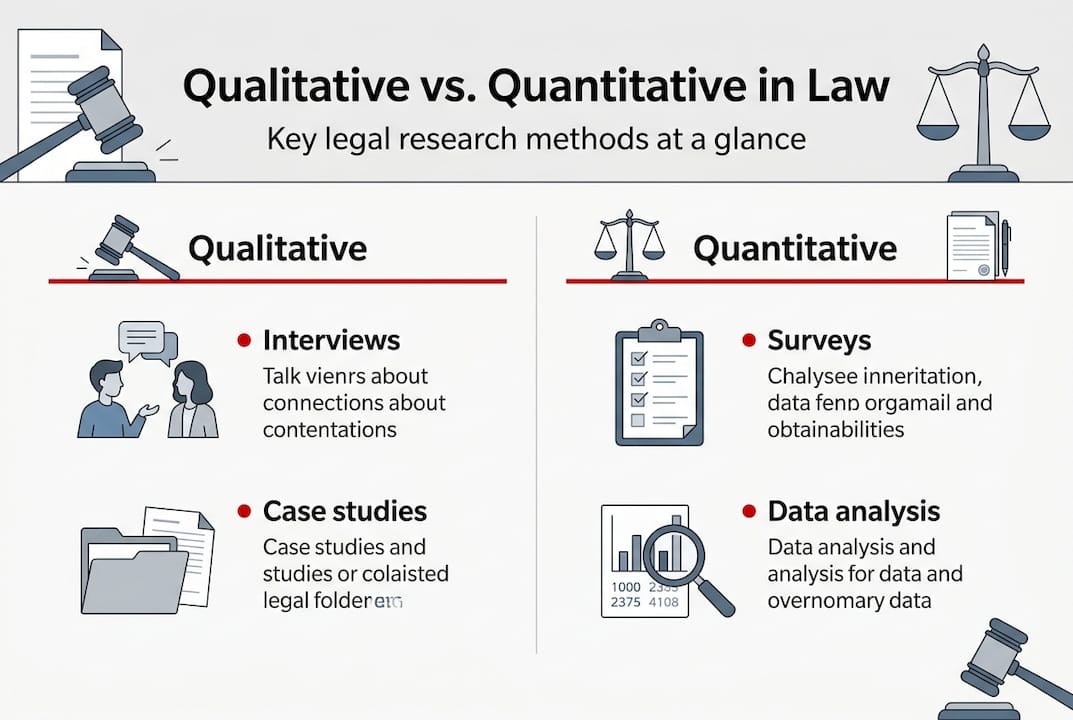
Here’s a quick comparison of how the two approaches serve different strategic needs:
| Strategic need | Quantitative approach | Qualitative approach |
|---|---|---|
| Establishing frequency or scale | Strong fit | Limited fit |
| Understanding motive or intent | Weak fit | Strong fit |
| Analyzing judicial language and tone | Weak fit | Strong fit |
| Jury perception research | Moderate fit | Strong fit |
| Emerging tech or novel disputes | Weak fit | Strong fit |
| Pattern recognition across large datasets | Strong fit | Moderate fit |
For jury analysis, qualitative methods are especially powerful. Focus groups and mock jury interviews help you understand how ordinary people interpret your narrative before you ever step into the courtroom. That’s not anecdote. That’s strategy.

Learning why you need both methods is important, and combining qualitative and quantitative research often produces the most persuasive and complete evidentiary picture.
Pro Tip: Prioritize qualitative methods early in case development, not just at trial prep. The insights you gather during investigation shape your entire theory of the case.
When qualitative methods outperform quantitative approaches
Some situations demand qualitative research. Here are the moments where it isn’t just useful. It’s necessary.
- Novel legal disputes: When there’s little precedent, such as in emerging technology or data privacy cases, quantitative benchmarks often don’t exist. Qualitative research maps the terrain.
- Intent-driven cases: Employment discrimination, fraud, and breach of fiduciary duty cases often hinge on what someone meant to do. Qualitative methods surface that.
- Complex organizational behavior: Cases involving corporate culture, internal communications, or institutional decision-making benefit from thematic and narrative analysis.
- Jurisdictional nuance: When local norms, customs, or community standards are at issue, qualitative research captures what surveys miss.
- Witness credibility assessment: Qualitative interview techniques help identify inconsistencies, emotional cues, and narrative gaps.
As research on complex disputes confirms, qualitative methods excel in novel cases “where quantitative data is scarce,” particularly around emerging tech adoption or jurisdictional nuances, because they adapt to emergent themes unlike rigid quantitative surveys.
| Case scenario | Recommended method | Why |
|---|---|---|
| Large-scale fraud with financial records | Quantitative primary | Volume and pattern analysis |
| Workplace harassment with disputed intent | Qualitative primary | Motive and context critical |
| Tech IP dispute with limited precedent | Qualitative primary | Novel territory, emergent themes |
| Personal injury with medical data | Mixed methods | Both scale and context matter |
| Contract dispute with communications trail | Qualitative primary | Meaning and tone of language |
We’ve seen this play out directly in our work on a multi-national technology case study, where qualitative methods revealed the organizational context that numbers alone couldn’t explain. For more inspiration, explore qualitative research study examples across industries.
For highly technical disputes, pairing qualitative research with expert legal advice for complex cases creates a formidable combination.
Pro Tip: If your quantitative data raises more questions than it answers, that’s your signal to bring in qualitative methods. The confusion is the clue.
How to effectively implement qualitative research in your legal case
Recognizing when to use qualitative research is one thing. Executing it well is another. Here’s a practical process.
- Define the core question: What specifically do you need to understand? Motive? Perception? Behavioral pattern? A sharp research question drives everything else.
- Select the right method: Interviews for individual insight, focus groups for shared perception, thematic analysis for document-heavy cases, case studies for complex organizational behavior.
- Collect data rigorously: Use trained interviewers, structured protocols, and clear documentation. Sloppy collection undermines admissibility and credibility.
- Analyze systematically: Code themes, identify patterns, and document your analytical process. Systematic qualitative analysis requires the same rigor as any empirical method.
- Present findings clearly: Translate qualitative insights into plain, persuasive language. Judges and juries respond to story and clarity, not academic jargon.
For employment law cases where context and motive are central, this process has proven especially effective.
Some common pitfalls to avoid:
- Don’t over-interpret: Qualitative data reveals patterns, not certainties. Present it as context, not proof.
- Don’t skip documentation: Every methodological decision should be recorded to withstand scrutiny.
- Don’t use unqualified researchers: The credibility of qualitative findings depends heavily on the expertise of those conducting the research.
- Do involve your research partner early: The earlier you bring in expertise, the better the research design.
Partnering with a research firm that understands legal contexts means you get methodology that holds up under cross-examination, not just findings that sound good in a brief.
What most litigators overlook about qualitative legal research
Here’s the uncomfortable truth: most legal professionals treat qualitative research like a footnote. They bring it in late, use it narrowly, and present it apologetically. That’s a mistake.
While quantitative analytics dominate legal research usage, with surveys showing roughly 70% adoption for pattern recognition, the why behind data is where cases are actually won. Context, motivation, and narrative are qualitative territory. And they matter more in the courtroom than most attorneys admit.
The assumption that only large-sample studies carry legal weight is simply wrong. A single well-executed case study or a series of rigorous interviews can reframe an entire case theory. We’ve seen it happen.
The real risk isn’t using qualitative research. It’s misusing it. Over-interpretation, weak methodology, and cherry-picked themes are the traps. Avoid them by treating qualitative analysis with the same discipline you’d apply to any expert testimony.
Effective litigators, in our experience, make qualitative research central to strategy, not supplemental. They use it to build the narrative that gives their quantitative evidence meaning. Explore Veridata’s perspective on qualitative research to see how that approach plays out in practice.
Get expert support for your next case
Qualitative research is a powerful tool, but only when it’s designed and executed with precision. At Veridata Insights, we work with legal professionals to build research that holds up, from methodology design through data collection, analysis, and reporting. No project minimums. Seven days a week. Whether you need a focused interview series or a full thematic analysis, we meet you where your case is.
Ready to put qualitative insight to work? Choose the right research partner for your case, or contact Veridata Insights directly to talk through your research needs. We’d love to help you build a stronger case.
Frequently asked questions
What are examples of qualitative research in legal cases?
Qualitative research in law often involves interviews, focus groups, and case studies that reveal motives, interpret testimony, or analyze complex precedents. As noted in research on case study methodology, these approaches provide in-depth understanding of complex legal phenomena that quantitative methods cannot fully capture.
When should qualitative research be used in litigation?
Use qualitative research for novel, complex, or context-sensitive cases where numbers alone don’t capture the full picture or where motives and context drive outcomes. Qualitative methods excel in disputes where quantitative data is scarce or where emergent themes need to be tracked.
How does qualitative research complement quantitative analysis in court?
It provides the context, nuance, and motivations that explain quantitative findings, making evidence more persuasive and robust. Systematic qualitative analysis examines judicial rhetoric and case nuances in ways that numbers simply cannot replicate.
Can qualitative research be used as court-admissible evidence?
Yes, courts may admit qualitative research findings if they meet evidentiary relevance and reliability standards. The key is rigorous methodology and clear documentation of the analytical process.
Recommended
- The Benefits of Combining Qualitative and Quantitative Research for Client Success – Veridata Insights
- Qualitative vs Quantitative Research: Which Approach Is Right for You? – Veridata Insights
- Case Study: Qualitative Research for a Multi-National Technology Company – Veridata Insights
- Partnering with a Qualitative Research Firm – Veridata Insights
- Law Firm – Mino Di Vita