



Many analysts dismiss qualitative research as subjective storytelling, yet rigorous qualitative methods reveal consumer motivations that numbers alone miss. This guide explains how systematic frameworks transform exploratory data into reliable business insights. You’ll learn core methods, analytical frameworks, and practical steps to conduct qualitative market research that complements your quantitative data and drives strategic decisions.
Table of Contents
- Understanding Qualitative Research: Definition And Principles
- Core Qualitative Methods In Market And Business Research
- How Qualitative Research Differs From Quantitative Research
- What Most People Get Wrong: Common Misconceptions About Qualitative Research
- Frameworks For Qualitative Data Analysis And Interpretation
- Translating Qualitative Findings Into Business Insights
- Practical Steps For Conducting Qualitative Research In Market Analysis
- Explore Expert Qualitative Research Services At Veridata Insights
- FAQ
Key takeaways
- Qualitative research explores why consumers behave as they do through non-numerical data like interviews and observations.
- Core methods include focus groups, in-depth interviews, ethnography, and content analysis, each revealing different insight types.
- Qualitative complements quantitative research by adding context and motivation to numerical patterns.
- Systematic frameworks like the Framework Method ensure rigorous analysis and actionable findings.
- Following structured steps from objective-setting through validation produces reliable business insights.
Understanding qualitative research: definition and principles
Qualitative research is exploratory, non-numerical investigation focused on understanding consumer behaviors, motivations, and perceptions. In market research, it adds depth and context to quantitative findings by answering why customers choose certain products or how they experience your brand.
This approach uses common qualitative research methods including focus groups, in-depth interviews, ethnographic research, and content analysis. Each method uncovers different types of insights:
- Focus groups reveal how people discuss topics collectively, exposing group dynamics and consensus points
- In-depth interviews capture individual perspectives on sensitive or complex issues without peer influence
- Ethnography observes natural behaviors in real contexts like homes or workplaces
- Content analysis systematically reviews textual and media data to identify patterns in messaging or sentiment
Choosing the right method depends on your research objective. Focus groups work well when exploring diverse opinions, while ethnography excels at uncovering unconscious habits. Understanding these distinctions helps you design studies that generate actionable intelligence rather than anecdotal observations.
Core qualitative methods in market and business research
Each qualitative method serves specific research needs and produces distinct insight types. Core qualitative research methods provide structured approaches to capture rich data that numerical surveys cannot reach.
Focus groups bring 6 to 10 participants together for moderated discussions. They excel at exploring group consensus, revealing disagreements, and watching how opinions shift through conversation. Use them when testing messaging concepts or understanding shared cultural perceptions.
In-depth interviews involve one-on-one conversations lasting 30 to 90 minutes. They capture deep individual perspectives on complex topics like financial decisions or healthcare choices. This method works best for sensitive subjects where participants might withhold information in group settings.
Ethnography places researchers in natural environments to observe behavior firsthand. Watching how customers shop in stores or use products at home reveals unconscious habits and contextual factors that participants cannot articulate in interviews. This method requires more time but delivers unmatched behavioral insight.

Content analysis systematically reviews text and media to identify themes, sentiment patterns, and messaging trends. It works well for analyzing customer reviews, social media conversations, or competitor communications at scale.
Pro Tip: Match your method to participant accessibility and research depth needs. If your audience is geographically dispersed, remote interviews may work better than in-person focus groups. For more guidance, explore our qualitative market research FAQs.
How qualitative research differs from quantitative research
Qualitative research explores why and how behaviors occur using rich, unstructured data. Quantitative research measures what and how many using numerical data and statistical analysis. Both approaches complement each other in comprehensive market studies.
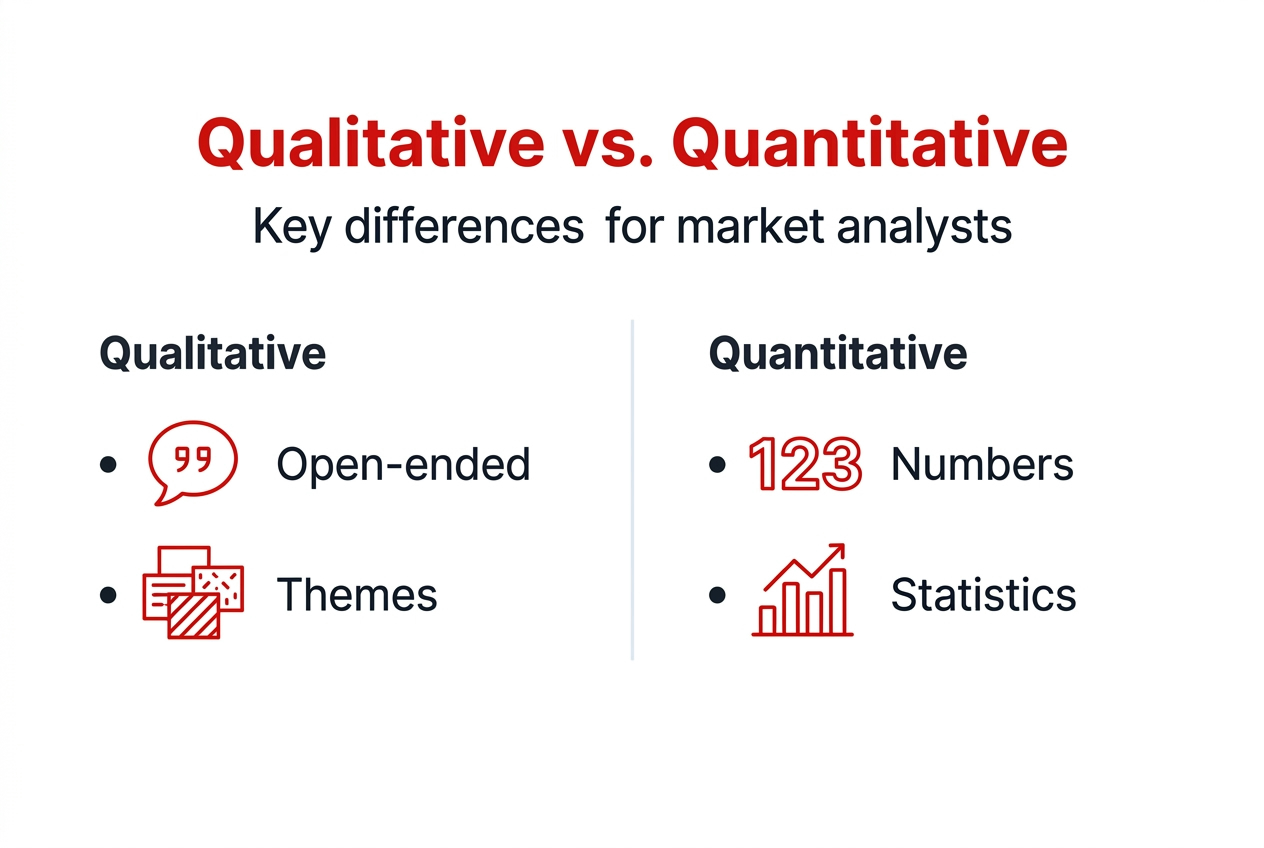
Research shows that 72% of market researchers use qualitative methods to develop hypotheses before testing them quantitatively. For example, interviews might reveal that customers abandon shopping carts due to unexpected shipping costs. A quantitative survey then measures how many customers cite this reason and tests pricing solutions.
In product development, qualitative research uncovers user pain points through observation and conversation. Quantitative methods then validate which pain points affect the most users and prioritize feature development accordingly. Customer experience improvements often follow this pattern, where qualitative insights identify friction points and quantitative data confirms their business impact.
| Attribute | Qualitative Research | Quantitative Research |
|---|---|---|
| Primary Goal | Explore motivations and contexts | Measure frequency and relationships |
| Data Type | Words, images, observations | Numbers, statistics |
| Sample Size | Smaller, purposive samples | Larger, representative samples |
| Analysis | Thematic coding, pattern recognition | Statistical testing, correlation |
| Typical Use | Hypothesis generation, deep understanding | Hypothesis testing, generalization |
Pro Tip: Integrate both methods through full-service research solutions combining qualitative and quantitative methods to gain both depth and scale in your market intelligence.
What most people get wrong: common misconceptions about qualitative research
Many business leaders hesitate to use qualitative research because they believe it lacks scientific rigor. This misconception stems from confusing casual observation with systematic qualitative methods.
Myth 1: Qualitative research is anecdotal and unscientific. In reality, rigorous qualitative studies use systematic coding frameworks, triangulation across data sources, and validation techniques like member checking. The Framework Method structures data analysis through transparent, reproducible steps that multiple researchers can verify.
Myth 2: Findings cannot reliably inform business decisions. Multiple case studies demonstrate direct business impact from qualitative insights. One retail ethnography study identified in-store social interaction patterns that led to layout changes increasing sales by 15%. Software companies routinely use usability testing, a qualitative method, to guide interface design decisions worth millions in development costs.
The confusion often arises from poor execution rather than methodological weakness. Studies without clear sampling strategies, inconsistent interview protocols, or subjective interpretation lack validity. However, properly designed qualitative research follows rigorous standards:
- Clear research questions and sampling rationale
- Consistent data collection protocols across participants
- Systematic coding with inter-rater reliability checks
- Triangulation across methods or data sources
- Transparent reporting of analytical steps
“Qualitative research delivers rich contextual understanding that quantitative data alone cannot provide, revealing the human experiences behind statistical patterns.”
When you apply these standards, qualitative insights become as defensible as quantitative findings. Explore our qualitative market research Q&A for more details on ensuring research quality.
Frameworks for qualitative data analysis and interpretation
Systematic frameworks transform raw qualitative data into structured insights. The Framework Method provides a widely used approach that organizes coding and theme development through transparent steps.
This method involves six iterative stages:
- Familiarization: Read transcripts thoroughly to identify initial patterns and impressions
- Coding: Label data segments with descriptive codes capturing key concepts
- Developing working analytical framework: Group related codes into broader categories and themes
- Applying the framework: Systematically code all data using the refined framework
- Charting data: Organize coded segments into a matrix showing patterns across participants
- Interpreting the data: Identify relationships between themes and draw conclusions addressing research questions
Memoing throughout this process captures analytical thoughts and hypothesis development. Writing reflective notes as you code helps track pattern evolution and supports transparent reasoning.
Triangulation improves validity by comparing findings across multiple data sources, methods, or researchers. If interview insights align with observational data and survey comments, confidence in the interpretation increases. When discrepancies appear, they highlight areas needing deeper investigation.
These systematic approaches make qualitative analysis reproducible. Another researcher following your framework and accessing your data should reach similar conclusions. This transparency addresses concerns about subjectivity and strengthens the credibility of qualitative insights in business contexts.
Translating qualitative findings into business insights
Qualitative research reveals emotional and behavioral drivers that numerical data often misses. Converting these findings into actionable business insights requires connecting thematic patterns to strategic opportunities.
Start by identifying recurring themes across participant responses. If interviews repeatedly mention frustration with customer service wait times, this pattern signals an operational priority. Next, examine why this frustration matters by exploring its emotional impact and behavioral consequences. Do customers switch to competitors or reduce purchase frequency?
Qualitative insights inform multiple business functions:
- Product design: User testing uncovers usability barriers and unmet needs that shape feature development
- Customer experience: Journey mapping identifies friction points and emotional peaks that guide service improvements
- Marketing messaging: Understanding customer language and values helps craft resonant brand communications
- Operational decisions: Observing employee workflows reveals inefficiencies and training opportunities
One retail brand used ethnography to study customer in-store behavior patterns, discovering that shoppers valued social interactions more than expected. Redesigning store layouts to facilitate conversation increased sales by 15% within six months. This demonstrates how behavioral observation translates into measurable business outcomes.
“Research indicates that 65% of B2B analysts report improved market understanding when combining qualitative insights with quantitative metrics, leading to more informed strategic decisions.”
For practical applications across industries, review examples of qualitative research studies showing how thematic insights drive competitive advantage.
Practical steps for conducting qualitative research in market analysis
Successful qualitative research follows a structured process from planning through reporting. These seven steps ensure your study generates reliable, actionable findings:
- Define clear objectives: Specify what you need to understand and why it matters to business strategy
- Select appropriate methods: Match techniques to your objectives, participant accessibility, and required insight depth
- Recruit participants ethically: Use purposive sampling to find information-rich cases while ensuring informed consent and privacy
- Collect rich, detailed data: Use open-ended questions, follow-up probes, and observation protocols that capture context
- Analyze using coding frameworks: Apply systematic qualitative data analysis techniques including iterative coding cycles and thematic synthesis
- Validate through triangulation: Compare findings across data sources, methods, or researchers to strengthen credibility
- Report actionable findings: Translate themes into business recommendations with supporting evidence and implementation suggestions
Ethical considerations matter throughout this process. Protect participant privacy through anonymization and secure data storage. Obtain informed consent explaining how you will use their information. Be transparent about research sponsors and potential conflicts of interest.
Recruiting the right participants determines insight quality. B2B research often requires specialized recruitment to reach decision-makers. Healthcare studies need participants meeting specific clinical criteria. Hard-to-reach audiences demand creative sourcing strategies.
Pro Tip: Invest time defining precise objectives before selecting methods. Vague goals like “understand customer satisfaction” produce scattered insights. Specific objectives like “identify why customers abandon cart checkout” guide focused method selection and sharper analysis.
When communicating findings to stakeholders, use participant quotes to illustrate themes and connect insights to business metrics. Visual frameworks like journey maps or thematic matrices help non-researchers grasp patterns quickly. For guidance on partner selection, see how to choose a qualitative research company and explore our qualitative market research FAQs. If you need structured project guidance, review steps for conducting market research in consulting.
Explore expert qualitative research services at Veridata Insights
Designing and executing rigorous qualitative research requires specialized expertise and resources. Veridata Insights offers comprehensive qualitative market research services including study design, participant recruitment across B2B, B2C, and healthcare audiences, data collection, systematic analysis, and actionable reporting.
Our full-service approach handles as much or as little as you need, with no project minimums and year-round availability. Whether you need focus group moderation, in-depth interview expertise, ethnographic observation, or analytical support, we deliver data you trust with service you need. Contact Veridata Insights to discuss how our qualitative research capabilities can strengthen your market intelligence and drive strategic decisions.
FAQ
What is the difference between qualitative and quantitative research?
Qualitative research explores reasons and motivations using non-numerical data like interviews and observations. Quantitative research counts and measures phenomena using numerical data and statistical analysis. Both methods provide complementary insights, with qualitative revealing why behaviors occur and quantitative measuring how frequently they happen across populations.
How do I choose the right qualitative method for my market research?
Consider your research objectives, participant accessibility, and required insight depth when selecting methods. In-depth interviews suit sensitive topics or complex individual perspectives. Focus groups work well for exploring diverse opinions and group dynamics. Ethnography excels at observing natural behaviors in context. For detailed guidance, review choosing a qualitative research method.
Can qualitative research data be trusted for business decisions?
Yes, when you apply rigorous frameworks, triangulation, and coding consistency, qualitative data reliably informs business decisions. Multiple case studies demonstrate direct positive business impacts from qualitative insights, including product improvements and operational changes that increased revenue. Systematic analysis methods ensure findings are valid, transparent, and reproducible. Learn more about qualitative research reliability.
What sample size do I need for qualitative research?
Qualitative research uses purposive sampling focused on information richness rather than statistical representation. Sample sizes typically range from 5 to 30 participants depending on method and research complexity. Saturation occurs when new participants provide no additional insights. In-depth interviews might require 10 to 15 participants, while focus groups often involve 3 to 5 groups of 6 to 10 people each.
How long does a qualitative research project typically take?
Timelines vary based on method, sample size, and complexity. Focus group projects often take 4 to 8 weeks from design through reporting. In-depth interview studies require 6 to 12 weeks. Ethnographic research can extend to several months for deep contextual understanding. Rapid qualitative methods condensing timelines exist for urgent business needs, though they may sacrifice some depth for speed.