


TL;DR:
- Technology market research is essential for guiding strategic product, investment, and market decisions in the tech industry. The demand for reliable tech intelligence is rapidly growing, with the market valued at over $340 billion in 2026 and projected to reach $540 billion by 2033. Effective research combines AI tools with human expertise to provide actionable insights aligned with clear business objectives.
Technology market research is defined as the systematic collection and analysis of data on technology products, customer behavior, competitive positioning, and sector trends to guide business decisions. In 2026, this discipline sits at the center of every serious product, investment, and go-to-market decision in the tech sector. Firms like Gartner and IDC have built entire business models around it. The global technology research services market was valued at approximately $340 billion in Q2 2026 and is projected to reach $540 billion by 2033. That growth rate tells you one thing clearly: the demand for reliable tech intelligence is accelerating, not leveling off.
What are the main types of technology market research?
Tech industry analysis is not one-size-fits-all. The type of research you commission depends entirely on the decision you need to make and how fast you need to make it.
Qualitative research uncovers the “why” behind behavior. Focus groups, in-depth interviews, and ethnographic studies reveal how customers think about technology products, what frustrates them, and what they actually want. Quantitative research delivers the “how many” and “how much.” Surveys, usage analytics, and structured data collection give you statistically reliable numbers to act on.
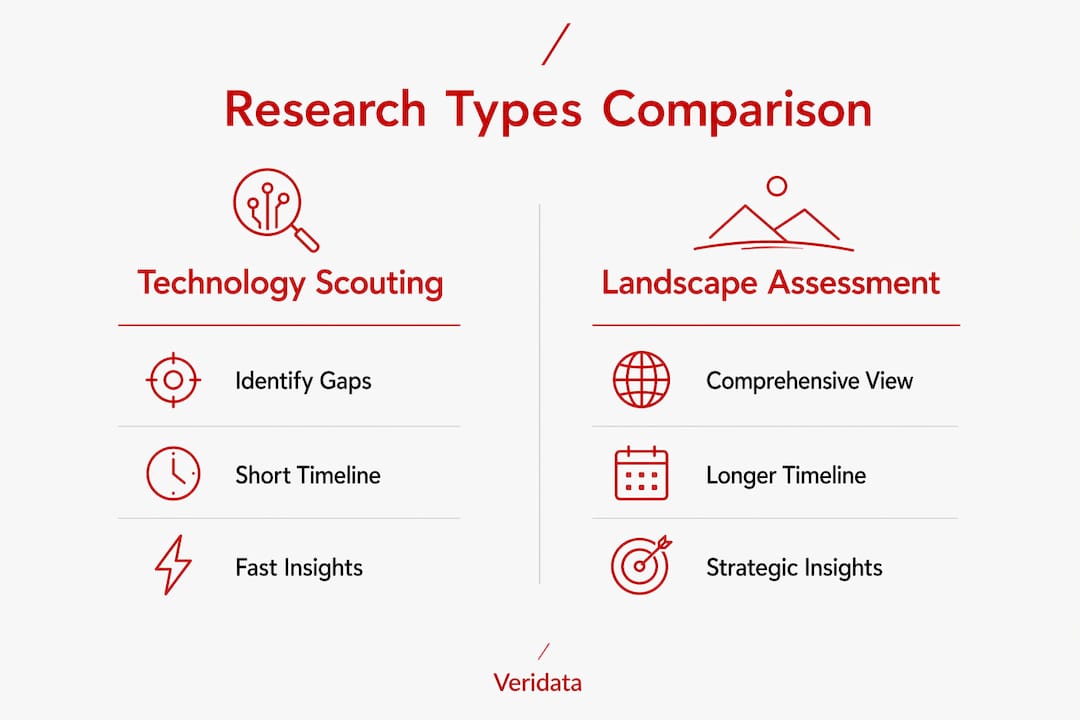
Beyond that core split, tech-specific research breaks into two distinct formats:
- Technology scouting reports are tactical, narrow-scope studies delivering findings within 3–4 weeks. Use these when you need to fill a specific innovation gap fast or evaluate a single vendor category.
- Technology landscape reports are strategic, bigger-picture assessments that take 6–8 weeks. They map an entire ecosystem, identify investment flows, and inform multi-year roadmaps.
- Competitive analysis tracks rival product features, pricing, and positioning. This feeds directly into product development and sales strategy.
- Customer insights research examines technology consumer trends, including adoption rates, satisfaction drivers, and unmet needs across segments.
| Research Type | Primary Purpose | Typical Timeline |
|---|---|---|
| Technology Scouting | Identify specific innovation opportunities | 3–4 weeks |
| Landscape Report | Map full ecosystem and investment flows | 6–8 weeks |
| Competitive Analysis | Benchmark against rivals | 2–4 weeks |
| Customer Insights | Understand adoption and satisfaction | 3–6 weeks |
Pro Tip: If your leadership team is debating whether to build, buy, or partner on a capability, commission a scouting report first. It costs less and answers the immediate question without the full landscape investment.
How is technology market research conducted effectively in 2026?
The methodology behind digital technology research has shifted significantly. AI-powered tools now handle data aggregation and pattern recognition at a scale no human team can match manually. But the judgment calls, the framing of the right questions, and the interpretation of findings still require experienced researchers. AI aids market research but does not replace it.
Here is a proven step-by-step process for executing tech market research that delivers reliable results:
- Define the research objective. A vague brief produces vague findings. Specify the decision the research must support, whether that is a product launch, a market entry, or a capital allocation choice.
- Select the methodology. Match qualitative or quantitative approaches to the objective. Innovation market research often requires both in sequence.
- Identify data sources. Primary sources include surveys, executive interviews, and focus groups. Secondary sources include Gartner reports, IDC forecasts, government open data, and AI-powered analytics platforms.
- Design the instrument. For surveys, every question must map back to the research objective. Questionnaire design is where most research goes wrong. Poor question construction produces data that cannot be acted on.
- Collect and process data. AI tools like natural language processing platforms accelerate coding of open-ended responses. Structured data gets cleaned and weighted before analysis.
- Analyze and interpret. This is where human expertise earns its value. Patterns in data only become insights when someone with domain knowledge interprets what they mean for your specific business context.
- Report and visualize. Dashboards, infographics, and executive summaries translate findings into decisions. Raw data tables do not move organizations forward.
A 2026 survey of 2,500 technology executives shows increased AI adoption alongside a sharp shift toward metrics tied to ROI and disciplined capital allocation. That shift means your research program must produce findings that connect directly to financial outcomes, not just market awareness.
Pro Tip: Build your research brief around a specific business decision, not a general topic. “Should we enter the SMB cybersecurity segment in Q3?” produces far more useful research than “Tell us about the cybersecurity market.”

What market trends and investment dynamics shape tech in 2026?
The 2026 tech sector is defined by massive capital concentration at the top and brutal pressure on everyone else. Understanding this context is not optional for anyone doing technology business research. It changes what questions you ask and how you interpret the answers.
Hyperscalers will spend between $650 billion and $725 billion on AI data centers and chips in 2026. That level of infrastructure investment creates enormous downstream pressure on software vendors to justify the spend with real revenue. To justify multibillion-dollar AI hardware investments, downstream software revenue must scale massively, or valuation corrections will occur rapidly.
OpenAI and Anthropic combined surpassed $55 billion in annualized run-rate revenue by mid-2026. That scale demonstrates that AI foundation models have crossed from experimental to commercial. It also raises the competitive bar for every enterprise software vendor trying to build AI features into their products.
The market rewards what analysts at Coatue call “sellers of scarcity”: providers of essential AI infrastructure and components. Firms without clear ROI stories face valuation pressure regardless of revenue growth. This winner/loser split is the defining feature of the current tech market.
| Market Indicator | 2026 Data Point | Implication |
|---|---|---|
| Tech Research Services Market | $340 billion (Q2 2026) | Strong demand for intelligence services |
| Hyperscaler AI Capex | $650B–$725 billion | Infrastructure investment dominates spending |
| OpenAI + Anthropic Revenue | $55 billion annualized | AI foundation models are commercially proven |
| Tech Sector Earnings Trend | Upward revisions | Underlying sector strength despite volatility |
“AI infrastructure costs are rising again in 2026 after previous declines, adding near-term volatility to expenditure forecasts.” — Aprio, 6 Key Tech Industry Insights 2026
Emerging tech market trends also include stabilizing software developer hiring after prior declines. Developer hiring stabilization signals that organizations are recalibrating their innovation velocity expectations. For project managers and executives, this means talent availability is no longer the primary constraint on technology delivery. Capital allocation and research quality are.
How can research insights improve your business strategy?
Market insights in technology only create value when they connect to specific decisions. Research that sits in a PDF and never changes a product roadmap or a budget line is wasted investment. Here is how high-performing organizations put tech research to work.
Product prioritization and innovation pipeline
Customer insights research identifies which features drive adoption and which ones users ignore. When a B2B software company surveys 500 enterprise buyers and discovers that 70% cite integration complexity as their top barrier, that single finding reshapes the entire product roadmap. The research does not just confirm a hypothesis. It forces a reallocation of engineering resources.
Technology scouting feeds the innovation pipeline by identifying emerging capabilities before competitors do. Predicting market dynamics with the right tools lets you move from reactive to proactive product development.
Competitive positioning and market entry
Landscape reports give executives the full picture of who is winning, who is losing, and why. That context is essential before entering a new segment or launching a competing product. Knowing that a market rewards scarcity providers, as the current AI infrastructure market does, tells you whether to compete on differentiation or walk away.
Investment decision-making
Technology adoption studies quantify how quickly a market is moving toward a new standard. That data directly informs capital allocation decisions. If adoption of a particular AI capability is at 12% today but projected to reach 60% within 18 months, the investment case is clear. If adoption is stalling at 15% with no acceleration, the case collapses.
High-value strategic actions derived from strong tech research include:
- Mapping your product roadmap against verified customer adoption curves, not internal assumptions
- Using competitive analysis to identify pricing white space before launching new tiers
- Commissioning scouting reports before any build-vs-buy decision to avoid duplicating existing market solutions
- Tracking ROI metrics from research investments to justify ongoing budget allocation to leadership
Key takeaways
Effective technology market research combines tactical scouting for immediate decisions with strategic landscape analysis for long-term positioning, grounded in disciplined ROI measurement.
| Point | Details |
|---|---|
| Match research type to decision | Use scouting for fast, specific gaps; use landscape reports for ecosystem-level strategy. |
| AI assists, humans decide | AI tools accelerate data collection and coding, but expert interpretation drives real insight. |
| 2026 market rewards ROI clarity | Firms without measurable returns on AI investment face valuation pressure regardless of revenue. |
| Research must connect to decisions | Findings only create value when they directly inform a product, budget, or market entry choice. |
| Qualitative and quantitative work together | Combining both methods produces a fuller picture of customer behavior and market dynamics. |
The research mistake i see executives make most often
After working across dozens of technology research engagements, the pattern I see most often is this: executives commission research to confirm a decision they have already made. They want validation, not intelligence. The research brief is written backward from the desired conclusion, and the findings get cherry-picked to support a slide deck that was already half-built.
That approach is expensive and dangerous. The 2026 tech market does not forgive strategic errors the way a bull market does. With hyperscalers spending up to $725 billion on AI infrastructure and the market brutally separating winners from losers, a bad market entry decision or a misallocated product investment can set a company back years.
The organizations that use tech research well treat it as a decision-forcing function. They go in with genuine uncertainty, ask hard questions, and let the data change their minds. I have seen a well-designed customer insights study kill a product launch that had 18 months of internal momentum behind it. That was the right call. The research saved the company from a costly mistake.
The other thing I would push back on is the assumption that bigger research firms automatically produce better intelligence. Size does not guarantee quality. Scrappy-Doo proved that to us. What matters is methodology rigor, the quality of the recruitment for qualitative work, and whether the analysts interpreting the data actually understand your market. A focused, expert-driven research partner will outperform a generic report from a large firm every time.
Staying ahead of trends in 2026 requires ongoing research investment, not a single annual report. The pace of change in AI and enterprise software means your competitive intelligence has a shorter shelf life than it did three years ago.
— Daniel
How veridata insights supports your tech research goals
Veridata Insights delivers technology market research built around your specific business decisions, not generic sector reports. Whether you need fast tactical scouting to evaluate a vendor category or a full strategic landscape assessment to guide a multi-year roadmap, Veridata Insights handles the full process: consultation and design, methodology selection, questionnaire review, data collection, coding, and reporting with data visualization. There are no project minimums and no rigid service tiers. You get exactly what your decision requires. Veridata Insights specializes in B2B, B2C, healthcare, and hard-to-reach audiences, making it the right partner when your research targets are difficult to access. Learn more about Veridata Insights’ research expertise or reach out directly to discuss your next project.
FAQ
What is technology market research?
Technology market research is the structured process of collecting and analyzing data on tech products, customer behavior, competitive positioning, and sector trends. Organizations use it to guide product development, investment decisions, and go-to-market strategy.
How long does a tech market research project take?
Timeline depends on scope. Technology scouting reports deliver findings in 3–4 weeks, while full landscape assessments take 6–8 weeks. Customer insights studies typically run 3–6 weeks depending on audience complexity.
What is the difference between qualitative and quantitative tech research?
Qualitative research uncovers motivations and attitudes through interviews and focus groups. Quantitative research measures behavior and preferences at scale through surveys and analytics. Most strong tech research programs use both.
How do AI tools affect technology market research?
AI tools accelerate data collection, pattern recognition, and open-ended response coding. However, human expertise remains essential for framing the right questions, interpreting findings, and connecting insights to business decisions.
Why does ROI measurement matter in tech research?
A 2026 survey of 2,500 technology executives shows a clear shift toward ROI-focused metrics in technology investment decisions. Research that cannot demonstrate a return on the decision it informed is difficult to justify in a capital-disciplined environment.