


Most business decisions still start with a gut feeling. Someone in the room sounds confident, the idea feels right, and the team moves forward. But confidence without evidence is just expensive guessing. Research consultation changes that equation entirely. It transforms uncertainty into structured, validated strategy by combining rigorous methodology with expert interpretation. In this article, we cover what research consultation actually means, how consultants validate insights, which frameworks drive the best outcomes, and what you can do right now to get more value from every research engagement.
Table of Contents
- What is research consultation and why does it matter?
- Consultants’ approaches to validating insights
- Frameworks for structured analysis in research consultation
- Edge cases and outliers: strategic assets in research consultation
- Practical steps to maximize value from research consultation
- Unlock expert research consultation for your business
- Frequently asked questions
Key Takeaways
| Point | Details |
|---|---|
| Research consultation defined | It’s more than data collection—consultants validate, interpret, and apply information for strategic impact. |
| Structured frameworks matter | Use frameworks like McKinsey’s Market Analysis and MECE for comprehensive, actionable insights. |
| Edge cases unlock potential | Investigating outliers can help reduce risk and reveal new opportunities. |
| Consultant validation methods | Triangulation, cross-verification, and data integration ensure findings are trustworthy and useful. |
| Maximize value with preparation | Clarify your goals, select skilled experts, and demand evidence for recommendations before acting. |
What is research consultation and why does it matter?
Research consultation is not simply collecting data and handing over a report. It is a collaborative process where experts help you define the right questions, choose the right methods, and interpret findings in a way that connects directly to your business objectives. Think of it as the difference between getting a stack of numbers and getting a clear answer.
At its core, research consultation adds a layer of strategic rigor that basic market research often lacks. Consultants bring structure to ambiguous problems. They help brands and consulting firms avoid the trap of confirmation bias, where teams only look for data that supports what they already believe.
Here is what strong research consultation delivers:
- Insight validation: Findings are tested against multiple sources before any recommendation is made
- Strategic alignment: Research objectives are tied directly to business goals, not just general curiosity
- Risk reduction: Gaps and blind spots are identified early, before costly decisions are made
- Stronger client relationships: Consulting relationships through research become more credible when backed by solid evidence
- Smoother collaboration: Collaboration in research consulting improves when both sides share a clear methodology
“The best research consultation does not just answer your question. It tells you whether you were asking the right question in the first place.”
Building trust in consulting partnerships also depends on transparency in how data is gathered and interpreted. Clients who understand the process trust the output far more.
Consultants’ approaches to validating insights
Now that we know what research consultation is, let’s look at how consultants actually assess and validate the information they gather.

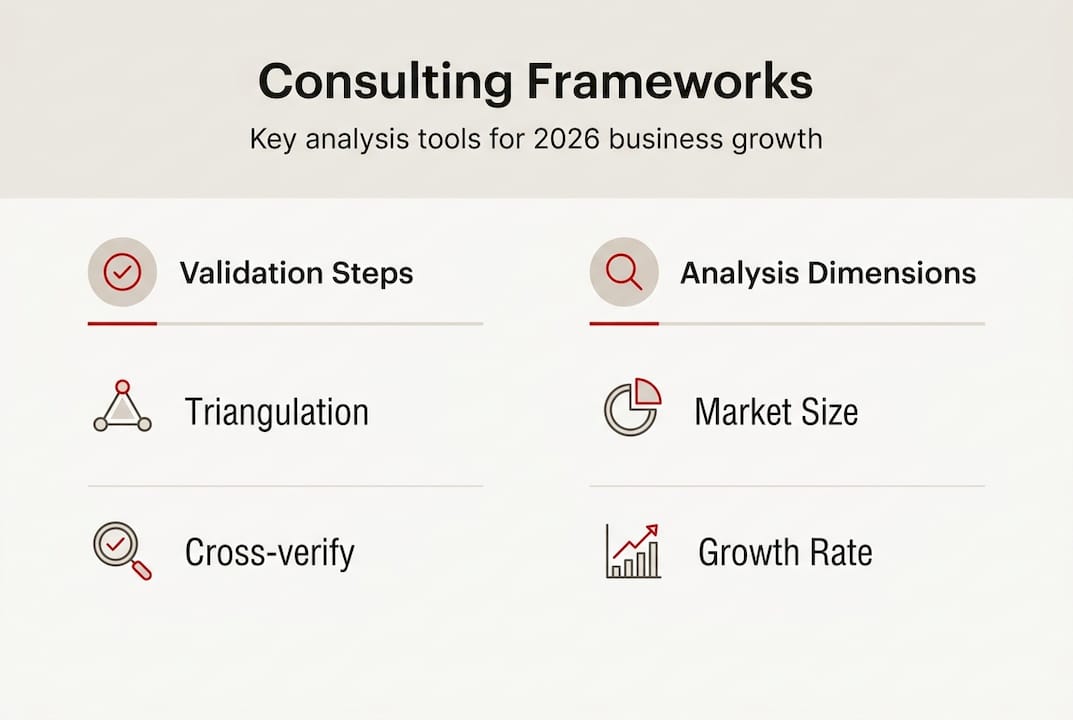
Validation is where good research separates itself from great research. Consultants validate insights via data triangulation, cross-verification, balancing quantitative and qualitative data, and advanced techniques. Each of these steps reduces the chance that a single flawed data point drives a major strategic decision.
Triangulation means comparing findings across multiple methods and sources. If a survey, a set of interviews, and a competitive analysis all point to the same conclusion, you can trust that conclusion. If they conflict, that tension itself becomes valuable information.
Cross-verification ensures that findings hold up across different datasets and time periods. A spike in one month’s data might be noise. A pattern across six months is a signal.
Here is a quick comparison of the two primary research types consultants balance:
| Research type | Strengths | Best used for |
|---|---|---|
| Quantitative | Measurable, scalable, statistically significant | Sizing markets, tracking trends, benchmarking |
| Qualitative | Contextual, nuanced, exploratory | Understanding motivations, testing concepts, uncovering needs |
Using only one type leaves gaps. Combining research methods gives you both the “what” and the “why,” which is where real strategy lives.
Consultants who deliver transformative consulting insights know that the goal is not just accuracy. It is actionability. Data that cannot be acted on is just noise. The best consultants translate validated findings into clear recommendations that drive impactful strategies and support client excellence through research.
Pro Tip: When reviewing research findings, always ask your consultant to flag outlier data points separately. Outliers are often dismissed as errors, but they can signal emerging trends or underserved segments worth exploring.
Frameworks for structured analysis in research consultation
After reviewing methods for validation, let’s look at the frameworks that guide structured research consultation.
Frameworks give consultants a repeatable, defensible structure for analysis. Without them, even good data can lead to scattered conclusions. McKinsey frameworks like Market Analysis and the MECE principle structure research for comprehensive, non-overlapping analysis. MECE stands for Mutually Exclusive, Collectively Exhaustive, meaning every insight fits into one clear category and no important area is left out.
Here is how a structured Market Analysis framework breaks down:
| Analysis dimension | Key questions answered |
|---|---|
| Market size | How large is the opportunity? |
| Growth rate | Is the market expanding or contracting? |
| Segmentation | Which customer groups matter most? |
| Competitive landscape | Who are the key players and what are their positions? |
| Customer needs | What problems are buyers trying to solve? |
A structured approach to market sizing research ensures you are not building strategy on assumptions. You are building it on evidence.
Here is a practical sequence for applying these frameworks:
- Define the market boundaries clearly before collecting any data
- Segment the audience using behavioral, demographic, or needs-based criteria
- Map the competitive landscape to identify white spaces and threats
- Analyze customer needs through both qualitative and quantitative lenses
- Apply the MECE principle to organize findings so recommendations are clear and non-redundant
“Structured frameworks do not limit creative thinking. They focus it. The best insights come from disciplined analysis, not open-ended brainstorming.”
The value chain of market research runs from objective-setting all the way through to strategic application. Frameworks are the backbone of that chain. And understanding qualitative vs quantitative research helps you choose the right tools at each stage.
Edge cases and outliers: strategic assets in research consultation
With frameworks established, it is critical to address how edge cases, often ignored, play a major role in strategic consultation.
Most analysts focus on the middle of the data. The average customer. The typical response. But the edges of your dataset often hold the most valuable intelligence. Investigating outliers de-risks products, uncovers white spaces, and prevents failures from amplifying in scaled systems.
Consider a brand launching a new product. The majority of survey respondents love the concept. But a small cluster of respondents flags a specific safety concern. Ignore that cluster and you might face a recall. Investigate it and you might catch a critical flaw before it becomes a crisis.
Edge cases matter for several reasons:
- They reveal overlooked risks that mainstream analysis misses
- They point to underserved segments that competitors have not yet targeted
- They expose systemic vulnerabilities that only appear under unusual conditions
- They often represent early adopters or extreme users whose behavior predicts broader trends
“The customer who uses your product in an unexpected way is not an anomaly. They are a signal.”
Pro Tip: When planning a new product launch or market entry, build a dedicated edge case review into your research process. Ask your consultant to specifically analyze the bottom and top 5% of responses. That is where the surprises live.
Treating outliers as strategic assets rather than statistical noise is one of the clearest signs of a mature research consultation practice.
Practical steps to maximize value from research consultation
Finally, let’s translate all these concepts into practical advice for building effective research consultation partnerships.
Getting value from research consultation does not happen automatically. It requires preparation, clear communication, and active engagement throughout the process. Here is a proven sequence to follow:
- Clarify your objectives before the first meeting. Know what decision you are trying to make. Vague briefs produce vague insights.
- Define scope and timeline upfront. Research without boundaries tends to expand. Set clear parameters so the work stays focused and on schedule.
- Select consultants with relevant industry expertise. A consultant who understands your sector will ask better questions and interpret findings more accurately.
- Stay engaged during fieldwork. Do not disappear after the kickoff call. Regular check-ins help catch issues early and keep the research aligned with evolving business needs.
- Demand actionable outputs. Consultants validate insights through rigorous methods, but the final deliverable should connect directly to decisions, not just describe findings.
- Build a feedback loop. After acting on research recommendations, track outcomes and share results with your consultant. This improves future engagements significantly.
Pro Tip: Always request the underlying evidence for key recommendations, not just the executive summary. A one-page summary is convenient, but the supporting data is where you will find the nuance that makes strategy truly effective.
The most productive research consultation partnerships are built on mutual clarity. You bring the business context. Your consultant brings the methodology and analytical rigor. Together, you produce insights that actually move the needle.
Unlock expert research consultation for your business
Understanding the frameworks, validation methods, and strategic value of research consultation is a strong start. But applying all of this to your specific business context is where the real work begins. At Veridata Insights, we specialize in exactly that. Whether you need full-service support from design through reporting, or just a focused consultation on methodology, we are here 7 days a week with no project minimums. Our team works across B2B, B2C, healthcare, and hard-to-reach audiences, so your research is always in expert hands. Ready to turn your research questions into clear, actionable strategy? Connect with research experts at Veridata Insights and let’s get started.
Frequently asked questions
How do consultants validate research findings?
Consultants use triangulation and cross-verification alongside a balance of qualitative and quantitative data to ensure accuracy and reduce bias. This multi-layered approach makes findings far more reliable than any single method alone.
What is data triangulation in research consultation?
Data triangulation means leveraging multiple sources and methodologies to cross-check findings and make results more reliable. When different methods point to the same conclusion, confidence in that conclusion increases significantly.
Why do edge cases matter in research consultation?
Edge cases reveal hidden risks and opportunities that mainstream analysis overlooks, helping prevent failures and uncover innovative paths for business growth. Ignoring them is one of the most common and costly mistakes in strategic research.
How can businesses get more value from research consultation?
Set clear objectives before engaging, choose consultants with relevant expertise, and always ask for evidence-backed recommendations rather than summary-only deliverables. Active engagement throughout the process consistently produces stronger outcomes.
Recommended
- How Market Research Drives Strategic Decision-Making in Consulting – Veridata Insights
- What Consulting Clients Expect from Market Research-Driven Strategies – Veridata Insights
- Leveraging Market Research for Strategic Consulting – Veridata Insights
- B2B Market Trends: What Businesses Expect from Consulting Strategies – Veridata Insights
- 7 Key 2025 Business Trends in Switzerland for Growth
- Business management best practices for fast-track degrees 2026