


TL;DR:
- Legal analytics significantly reduces legal research time and increases consistency.
- It involves collecting and analyzing legal data using statistical, machine learning, and visualization tools.
- Human oversight remains essential to address ethical concerns and interpret complex analytical results.
Legal research has long carried a reputation for being slow, subjective, and labor intensive. That reputation is losing ground fast. Empirical benchmarks now show 23.5 days faster resolutions in courts using AI-enabled analytics tools, which challenges the assumption that thorough legal research must take weeks of manual effort. For legal professionals and research analysts, this is not just a headline. It is a signal that the methods, tools, and workflows underpinning legal research are shifting in ways that reward those who adapt early. This article breaks down what legal analytics actually is, how it works in practice, what it measurably delivers, and where you still need to watch your step.
Table of Contents
- What is legal analytics and why does it matter?
- Methodologies and workflows: From data to actionable legal insights
- The measurable impact: Time savings, improved consistency, and better predictions
- Edge cases, limitations, and ethical considerations in legal analytics
- Rethinking analytics: Practical wisdom for legal professionals
- Connect with analytics experts to build your legal research advantage
- Frequently asked questions
Key Takeaways
| Point | Details |
|---|---|
| Boost efficiency | Analytics can significantly reduce legal case preparation and analysis time, freeing resources for strategic tasks. |
| Objective insights | Data-driven methods bring more consistent, evidence-based outcomes than reputation or intuition alone. |
| Avoid pitfalls | Ethical considerations, data biases, and proper human oversight remain critical when applying analytics in legal research. |
| Nuanced application | Results improve most with hybrid human-AI workflows and rigorous methodologies tailored to legal contexts. |
What is legal analytics and why does it matter?
Legal analytics is not a single tool or software platform. It is a discipline. Legal analytics involves collecting, analyzing, and interpreting legal data using statistical methods, machine learning, natural language processing (NLP), and data visualization techniques. The goal is to transform raw legal data, such as case records, court decisions, contract terms, and litigation histories, into objective, actionable insights.
There are four core types of analytics that legal professionals work with:
- Descriptive analytics: Summarizes historical legal data. What happened in past cases? What were the outcomes?
- Diagnostic analytics: Explains why outcomes occurred. Which factors drove a particular verdict or settlement?
- Predictive analytics: Forecasts likely future outcomes based on patterns in historical data.
- Prescriptive analytics: Recommends specific actions based on predicted outcomes and defined objectives.
Each type builds on the previous one. Descriptive analytics gives you the map. Predictive analytics tells you where the road is likely to lead. Prescriptive analytics hands you the wheel.
The tools making this possible include NLP engines that can read and categorize thousands of court opinions in minutes, machine learning models that identify outcome patterns across jurisdictions, and visualization platforms that turn complex legal datasets into readable charts and dashboards. These are not futuristic concepts. They are in active use across law firms, corporate legal departments, and research institutions right now.
Why does this matter for data-driven legal research? Because traditional legal research relies heavily on individual expertise, memory, and manual document review. That approach introduces variability. Two attorneys reviewing the same case history may reach different conclusions. Analytics reduces that variability by grounding analysis in patterns drawn from large datasets rather than individual judgment alone.
“The shift from intuition-based to data-driven legal research is not about replacing lawyers. It is about giving them better information faster.”
The practical payoff is real. Legal teams using analytics tools report sharper case strategies, more consistent research outputs, and stronger negotiating positions backed by empirical data rather than gut instinct.
Methodologies and workflows: From data to actionable legal insights
Understanding that analytics matters is one thing. Knowing how it actually works in a legal research context is another. Let us walk through the core methodologies and the workflows that connect raw data to usable insight.
The three-phase visual analytics workflow used in legal research moves through Discovery and Scoping, Analysis and Interpretation, and Reasoning and Documentation. Each phase has a specific purpose and set of activities.
- Discovery and scoping: Define the research question, identify relevant data sources, and set the scope. This phase prevents analysts from drowning in irrelevant case law.
- Analysis and interpretation: Apply statistical models, NLP tools, and visual analytics in law to extract patterns. Topic modeling, network analysis, and clustering techniques are commonly used here.
- Reasoning and documentation: Translate findings into legal arguments or strategic recommendations. This phase requires human judgment to contextualize what the data shows.
Here is a quick look at the most commonly used analytics methods and what they do:
| Method | What it does | Legal application |
|---|---|---|
| Topic modeling | Groups documents by theme | Organizing large case law libraries |
| Network analysis | Maps relationships between entities | Tracing citation patterns or co-counsel networks |
| Predictive modeling | Forecasts outcomes | Estimating settlement probability |
| NLP classification | Categorizes text automatically | Tagging contract clauses or legal issues |
Litigation analytics, a specialized branch, focuses on benchmarking attorney and judge performance. You can analyze how a specific judge has ruled on motions to dismiss over the past decade, or how a particular opposing counsel tends to structure arguments. That kind of intelligence used to require months of manual review. With machine learning in legal practice, it takes hours.
Pro Tip: Do not skip the scoping phase. Legal datasets are enormous and often messy. Defining your research question tightly before you start analysis saves time and prevents you from chasing patterns that are statistically interesting but legally irrelevant.
The measurable impact: Time savings, improved consistency, and better predictions
Numbers tell a compelling story here. AI tools reduce case prep time by 40% and case analysis time by as much as 75%, according to recent benchmarks from a 29-year litigation attorney who evaluated leading platforms. Those are not marginal gains. They represent days or weeks returned to legal teams every month.
Consistency is another major win. Traditional legal research produces variable outputs depending on who is doing the research and when. Analytics-driven workflows improve inter-rater reliability, pushing Cohen’s kappa scores (a measure of agreement between reviewers) from around 0.65 to 0.80. That jump means legal teams are reaching the same conclusions more reliably, which matters enormously in high-stakes litigation.

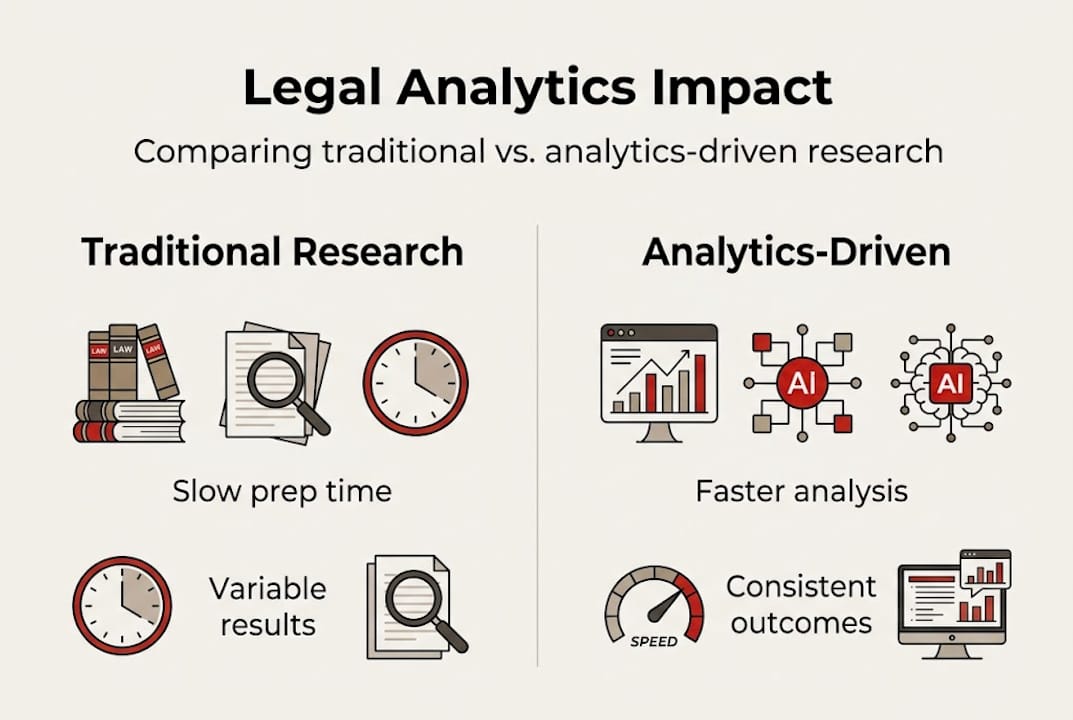
Here is a direct comparison of traditional versus analytics-driven legal research:
| Factor | Traditional research | Analytics-driven research |
|---|---|---|
| Case prep time | Baseline | Up to 40% faster |
| Case analysis time | Baseline | Up to 75% faster |
| Resolution speed | Baseline | 23.5 days faster |
| Consistency (kappa) | ~0.65 | ~0.80 |
| Firm ranking accuracy | Near-zero predictive value | ~60% prediction accuracy |
That last row deserves attention. Prediction accuracy of data-driven firm rankings sits at approximately 60%, compared to near-zero for prestige-based rankings. In other words, choosing litigation counsel based on outcome data is dramatically more reliable than choosing based on reputation alone. That finding, from Stanford Law, reshapes how corporate legal departments should be evaluating outside counsel.
The benefits of advanced analytics for legal efficiency extend beyond speed. Legal teams using analytics report stronger confidence in their case assessments and better alignment between research findings and strategic decisions. And as AI adoption in legal research continues to grow, the gap between analytics-enabled teams and those still relying on purely manual methods will only widen.
- Faster case preparation frees senior attorneys for higher-value strategic work
- Consistent outputs reduce the risk of conflicting internal research conclusions
- Predictive models help prioritize which cases to settle versus litigate
- Outcome-based benchmarks give clients better visibility into likely results
Edge cases, limitations, and ethical considerations in legal analytics
Analytics is powerful. It is not perfect. And in legal contexts, imperfection carries real consequences. Let us be direct about the challenges.
Visual analytics struggles with legal structure, particularly with the ambiguity and tacit knowledge embedded in legal reasoning. A machine can identify that a judge ruled against plaintiffs in 70% of summary judgment motions. It cannot always explain the nuanced reasoning behind each decision, or account for the specific facts that made a case exceptional. Provenance tracking and methodological rigor are essential to ensure findings are replicable and defensible.
The ethical dimension is equally important. Ethical big data use and AI-induced risks such as hallucinations, where AI systems generate plausible but false legal citations, and systemic bias in training data, are real concerns that legal professionals must actively manage.
Key limitations to keep in mind:
- AI hallucinations: Language models can fabricate case citations that look legitimate but do not exist. Always verify AI-generated references independently.
- Censored data bias: Court records are not complete. Settled cases, sealed records, and unreported decisions create gaps that skew analytical models.
- Jurisdiction specificity: A model trained on federal circuit court data may perform poorly when applied to state court patterns.
- Over-reliance on prestige signals: Analytics models that incorporate firm reputation as a variable can perpetuate historical biases rather than correct them.
- Interpretability gaps: Complex machine learning models can produce accurate predictions without explaining why, which creates accountability problems in legal contexts.
Pro Tip: Build verification checkpoints into every analytics workflow. Treat AI outputs as a starting point for human analysis, not a final answer. This hybrid approach, combining machine efficiency with human judgment, is where ethical analytics in consulting and human-AI hybrid workflows deliver the most reliable results.
“The goal is not to automate legal judgment. The goal is to inform it with better data.”
Methodological accountability is non-negotiable. Every analytical model used in legal research should be documented, tested for bias, and reviewed for methodological accountability in legal research. If you cannot explain how your model works to a skeptical judge or client, it is not ready for professional use.
Rethinking analytics: Practical wisdom for legal professionals
Here is something the technology vendors rarely tell you: the most sophisticated analytics tool is not always the right one. We have seen legal teams invest heavily in complex predictive platforms, only to find that a well-designed, simpler model built on clean, jurisdiction-specific data outperformed the expensive solution. Simpler models are easier to explain, easier to audit, and often more defensible in practice.
The deeper lesson is that analytics success in legal research depends less on the tool and more on the people using it. Interdisciplinary training is crucial for legal professionals to leverage analytics effectively, balancing innovation with methodical rigor. A legal analyst who understands both statistical methodology and substantive law will consistently outperform a data scientist who does not understand how courts actually work.
We also know from experience that ethical checks are not a box-ticking exercise. They are the foundation of trustworthy research. And some of the most AI surprises in legal research come not from cutting-edge models but from applying basic analytics rigorously to data that has never been systematically examined before. Start with the fundamentals. Build from there.
Connect with analytics experts to build your legal research advantage
Legal analytics is not a set-it-and-forget-it solution. It requires the right methodology, clean data, and expert interpretation to deliver results you can actually use in practice. That is exactly where we come in. At Veridata Insights, we work with legal professionals and research analysts to design and execute analytics projects at whatever scale you need, with no project minimums and support available seven days a week. Whether you need help scoping a litigation analytics project, building a predictive model, or interpreting complex datasets, our team is ready. Reach out to our legal analytics consulting team and let us help you turn data into your competitive edge.
Frequently asked questions
What types of analytics are used in legal research?
Legal research uses descriptive, diagnostic, predictive, and prescriptive analytics, all supported by comprehensive data techniques including statistical modeling, machine learning, and visualization methods.
How much faster does analytics make legal case preparation?
AI research tools generate major time savings, cutting case preparation time by up to 40% and case analysis time by 75% based on recent benchmarks from practicing attorneys.
What are the main risks when using analytics in legal research?
Potential risks include AI hallucinations, data bias, limited interpretability, and ethical big data concerns that require active human oversight and methodological accountability.
Is human expertise still needed with legal analytics?
Absolutely. Hybrid human-AI workflows remain essential for interpreting analytics outputs, resolving legal structure nuances, and ensuring findings are defensible in professional and courtroom contexts.
Recommended
- Qualitative Research in Legal Cases: Strategy That Wins – Veridata Insights
- Harnessing AI and Advanced Analytics in Market Research for Consulting Firms – Veridata Insights
- How Data and Analytics Are Transforming Strategic Consulting – Veridata Insights
- How Veridata Insights Helps Consulting Firms Deliver Transformative Insights – Veridata Insights