



Businesses that skip market research don’t just miss opportunities. They make expensive mistakes that are entirely avoidable. Launching a product without validated demand, entering a market without understanding the competition, or crafting messaging that misses your audience entirely — these are real, costly outcomes. Market research is the foundation that separates confident, data-driven decisions from expensive guesswork. This guide walks you through everything you need: the types of research that matter, the tools that make it easier, a step-by-step process, and how to turn findings into real strategic action.
Table of Contents
- Defining market research: What, why, and types
- Essential tools and preparation steps
- Step-by-step process: Planning, execution, and analysis
- Edge cases, common pitfalls, and how to avoid them
- Turning research into actionable strategy
- What most market research guides get wrong
- Ready to elevate your decisions with research?
- Frequently asked questions
Key Takeaways
| Point | Details |
|---|---|
| Mix methods for results | Combining qualitative and quantitative research creates more reliable and actionable insights. |
| Preparation is critical | Successful market research starts with clear objectives, the right tools, and a defined process. |
| Avoid common pitfalls | Recognize and address sampling bias, outdated data, and inaction on insights for better outcomes. |
| Make findings actionable | Translate research insights into strategy to fuel measurable business growth. |
| Continuous improvement | Adopt an iterative, ongoing approach for research that keeps pace with market changes. |
Defining market research: What, why, and types
Market research is the systematic process of gathering, analyzing, and interpreting information about your market, customers, competitors, and industry. It’s not just about collecting data. It’s about understanding context so you can make smarter decisions.
The strategic value is clear. 91% of companies report that market research increased their sales. That’s not a coincidence. Research reduces risk, uncovers unmet needs, and gives you the confidence to act.
There are two core research types you need to know:
- Primary research collects new, original data directly from your target audience through surveys, interviews, focus groups, or observation.
- Secondary research uses existing data, such as industry reports, government statistics, and published studies.
Within those, qualitative explores why people behave as they do (think interviews and focus groups), while quantitative measures what and how many (think surveys and analytics). Understanding market research fundamentals helps you choose the right approach from the start.
| Research type | Method examples | Best for |
|---|---|---|
| Primary qualitative | Interviews, focus groups | Exploring motivations, attitudes |
| Primary quantitative | Surveys, polls | Measuring trends, validating hypotheses |
| Secondary qualitative | Case studies, reports | Context, industry landscape |
| Secondary quantitative | Industry data, analytics | Benchmarking, sizing markets |
“The best research doesn’t just answer your question. It tells you what question you should have been asking all along.”
When you combine both primary and secondary research, and both qualitative and quantitative methods, you get a fuller, more reliable picture of your market.
Essential tools and preparation steps
Knowing the purpose and types of market research, the next step is effective preparation with the right groundwork and resources.

The tools you use directly affect the quality of your data. Fortunately, the options available today are better than ever. AI tools for market research are accelerating analysis, reducing manual work, and helping teams spot patterns faster. But technology is only as good as the process behind it.
| Tool type | Examples | Primary use |
|---|---|---|
| Survey platforms | SurveyMonkey, Qualtrics | Quantitative data collection |
| Analytics platforms | Google Analytics, Tableau | Behavioral and trend analysis |
| AI research tools | ChatGPT, Perplexity | Secondary research, synthesis |
| Recruitment panels | Research firm panels | Reaching target audiences |
| Interview tools | Zoom, Otter.ai | Qualitative data capture |
Before you pick up a single tool, preparation is everything. Here’s a checklist to set your research up for success:
- Define your objective. What specific decision will this research inform? Be precise.
- Choose your methods. Will you go qualitative, quantitative, or both?
- Identify your target audience. Who exactly needs to participate for the data to be valid?
- Set your timeline. Rushed research produces unreliable results. Build in buffer time.
- Establish your budget. Know your limits before you start scoping tools and recruitment.
The mixed qual and quant approach combined with iterative cycles and AI-assisted tools delivers the fastest, most reliable outcomes.
Pro Tip: Start with qualitative research to surface your hypotheses, then use quantitative methods to validate them at scale. This sequence saves time and prevents you from measuring the wrong things.
Step-by-step process: Planning, execution, and analysis
With your tools ready, it’s time to move through the process in a series of actionable steps tailored to today’s business landscape.
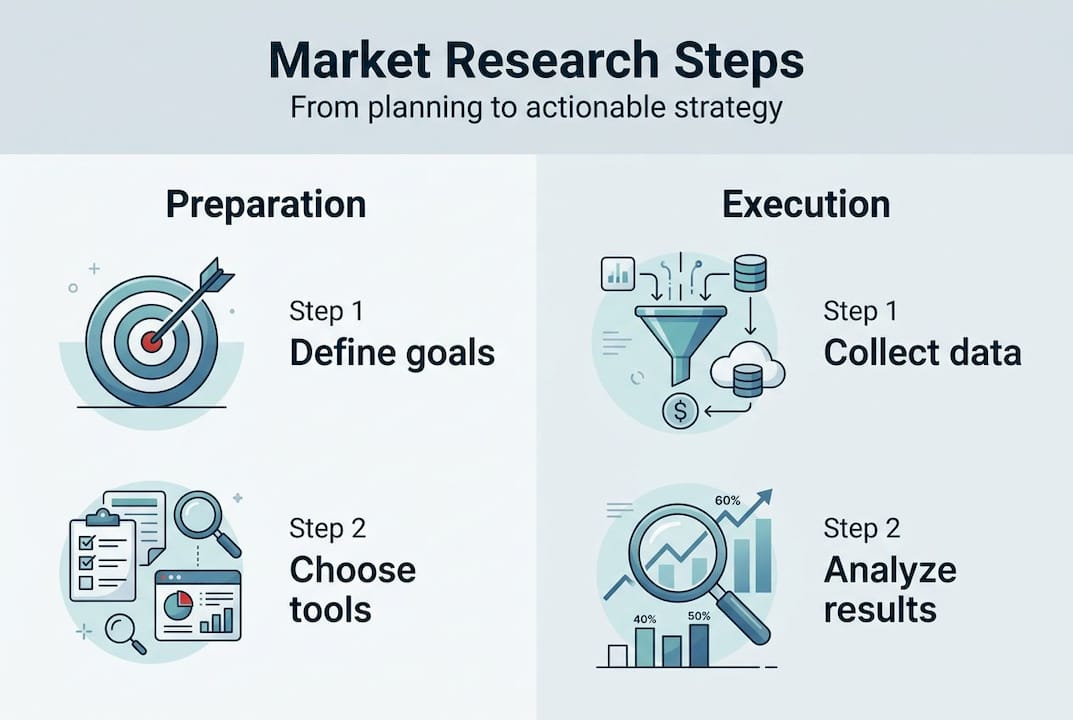
A well-structured process keeps your research focused and your findings usable. Here’s how to move from question to insight:
- Define your research questions. Start with the business problem. What do you need to know to move forward?
- Select your methodology. Match your method to your question. Use the simplified process as a reference.
- Design your instruments. Write your survey questions, interview guides, or discussion outlines.
- Recruit your participants. This step is often underestimated. The right respondents make or break your data.
- Field the research. Collect data according to your plan. Monitor quality as you go.
- Analyze the findings. Look for patterns, outliers, and connections. Don’t just confirm what you already believe.
- Report and present. Translate findings into clear, actionable recommendations for stakeholders.
The process looks different depending on your context. B2B research emphasizes in-depth interviews with decision-makers, while B2C typically relies on large-scale surveys to capture broader trends and emotional drivers. Knowing which approach fits your situation matters.
Marketing budgets average around 10% of revenue, with digital spending rising 7%. That’s a significant investment. Research ensures those dollars are pointed in the right direction.
Pro Tip: Document every decision you make during the process, including why you chose a particular method or sample size. This creates an audit trail that makes future research faster and more consistent.
For teams looking to combine qualitative and quantitative methods effectively, the key is sequencing and clear handoffs between phases.
Edge cases, common pitfalls, and how to avoid them
Even the best plans can run into trouble. Knowing the biggest risks ahead of time is crucial.
Most research failures aren’t dramatic. They’re quiet. A biased sample here, a leading question there, and suddenly your data is pointing you in the wrong direction without you realizing it. These common pitfalls are well-documented, which means they’re also avoidable.
Here are the most frequent mistakes and how to sidestep them:
- Sampling bias: Your sample doesn’t represent your actual audience. Fix it by defining your target population clearly before recruitment begins.
- Leading questions: Questions that hint at a desired answer corrupt your data. Use neutral language and test your survey with a small group first. Good B2B survey design starts with question neutrality.
- Confirmation bias: Researchers unconsciously favor data that supports existing beliefs. Build in a review step where someone challenges your interpretations.
- Ignoring insights: Collecting data and not acting on it is one of the most common research mistakes. Assign ownership of each key finding to a decision-maker.
- Outdated data: Markets change fast. Using research that’s two or three years old can lead you to decisions that no longer fit reality.
“Data quality isn’t just a technical issue. It’s a strategic one. Bad data leads to confident wrong decisions, which are the most dangerous kind.”
The market research challenges that trip up most organizations aren’t exotic. They’re the basics, done poorly. Staying disciplined about process and quality control is what separates useful research from expensive noise.
Turning research into actionable strategy
Once research is complete, it’s essential to ensure the insights inform real business decisions and strategy.
Data sitting in a report nobody reads isn’t research. It’s a sunk cost. The goal is always to connect findings to decisions. Here’s how to make that happen effectively:
- Summarize findings visually. Charts, graphs, and dashboards make patterns immediately clear for stakeholders who don’t want to read 40 pages.
- Tie every insight to a business question. If a finding doesn’t connect to a decision, it’s background noise.
- Present with recommendations, not just data. Stakeholders need to know what to do next, not just what you found.
- Assign owners to each action item. Insights without accountability disappear.
Knowing what makes a good market research report is half the battle. The other half is making sure the right people see it and act on it.
| Research finding | Strategic action |
|---|---|
| Customers cite price as top barrier | Test tiered pricing or entry-level offer |
| Brand awareness is low in key segment | Invest in targeted awareness campaigns |
| Competitors are weak on service | Differentiate through customer experience |
| New use case discovered in interviews | Develop targeted messaging or product feature |
Effective market research drives growth by reducing risk and informing strategy, and it works best as a mixed-method, iterative practice. One round of research is a snapshot. Ongoing research is a strategic advantage.
Research also informs how you drive decisions with research across departments, from product to marketing to sales. The more embedded research becomes in your decision-making culture, the faster your organization learns and adapts.
What most market research guides get wrong
Here’s something most guides won’t tell you: following the steps correctly isn’t enough. The real differentiator is iteration.
Most frameworks present research as a linear process with a clear endpoint. In practice, the best research is circular. You learn something, you act, and then you research again to see if your action worked. Single-method research risks blind spots, and even mixed-method research can mislead if you treat it as a one-time exercise.
We also see a pattern that rarely gets discussed: internal bias after an initial win. A team runs research, gets a clear result, acts on it successfully, and then assumes the insight is permanent. Markets shift. Customers evolve. What was true 18 months ago may not be true today.
The other trap is misreading stakeholder needs. Research is often designed to answer the question leadership thinks they’re asking, not the question that would actually move the business forward. Push back early. Clarify the real decision before you design a single question.
Pro Tip: Challenge your initial assumptions even after early wins. The most dangerous moment in research is when you think you already know the answer.
Partnering for research with an experienced team helps you avoid these blind spots and keeps your process honest.
Ready to elevate your decisions with research?
You now have the framework. The question is execution. Market research done well takes expertise, the right methodology, and a partner who understands both your audience and your objectives. That’s exactly what we do at Veridata Insights. We offer full flexible-service research with no project minimums, 7 days a week, 365 days a year. Whether you need qualitative depth, quantitative scale, or a mixed-method approach, we handle everything from design to reporting. If you’re ready to make smarter, faster decisions backed by data you can trust, speak to a research expert today and let’s build something great together.
Frequently asked questions
What is the difference between qualitative and quantitative market research?
Qualitative research explores why people behave as they do through interviews and focus groups, while quantitative research measures trends and frequencies using surveys and statistical data. Both methods serve different purposes and work best when used together.
How does market research differ for B2B and B2C companies?
B2B research emphasizes in-depth interviews with key decision-makers to understand complex buying processes, while B2C research uses large-scale surveys to capture broader consumer trends and emotional motivations.
What are common mistakes to avoid in market research?
The most frequent errors include sampling bias, leading questions, confirmation bias, relying on outdated data, and collecting insights without assigning anyone to act on them.
How often should market research be conducted?
Market research should be iterative and ongoing, reviewed regularly to keep pace with shifting markets, evolving customer needs, and new business objectives rather than treated as a one-time project.
Recommended
- How Do I Conduct Effective Market Analysis to Support a New Product Launch Strategy? – Veridata Insights
- Leveraging Market Research for Strategic Consulting – Veridata Insights
- How Market Research Drives Strategic Decision-Making in Consulting – Veridata Insights
- The Steps For Conducting Market Research For Your Management Consulting Projects – Veridata Insights
- Shipping Strategy Workflow for Scalable E-commerce Success | ParcelPlanet